Book contents
- Frontmatter
- Contents
- List of Tables
- List of Figuress
- Acknowledgements
- Contributors and Editors
- Part IIntroduction
- Part IIPeople
- 2Documenting Social and Economic Transformation in Myanmar's Rural Communities
- 3Social Protection in Myanmar: A Key Mechanism for Political Legitimacy?
- 4Health Service Delivery and Peacebuilding in Southeast Myanmar
- Part IIIPlaces
- Part IVPolitics
- Part VEpilogue
- Abbreviations and Key Terms
- Index
2 - Documenting Social and Economic Transformation in Myanmar's Rural Communities
from Part II - People
Published online by Cambridge University Press: 12 February 2019

Book contents
- Frontmatter
- Contents
- List of Tables
- List of Figuress
- Acknowledgements
- Contributors and Editors
- Part IIntroduction
- Part IIPeople
- 2Documenting Social and Economic Transformation in Myanmar's Rural Communities
- 3Social Protection in Myanmar: A Key Mechanism for Political Legitimacy?
- 4Health Service Delivery and Peacebuilding in Southeast Myanmar
- Part IIIPlaces
- Part IVPolitics
- Part VEpilogue
- Abbreviations and Key Terms
- Index
Summary
INTRODUCTION
Myanmar has undergone significant reforms in recent years. A commonly accepted view is that, unlike many of the political shifts experienced elsewhere in the world in the twenty-first century, their impetus came not “from below” but from national elites, prompted by military decisions to open the country to the world and begin to democratize (Pederson 2012, Fink 2014). Much of the literature on Myanmar's transition thus focuses on national dynamics, seeking insights on what has changed, why, and how, by examining shifts among political elites, the business community, and the upper echelons of the Tatmadaw (see Pederson 2012; ICG 2012; Jones 2014). These changes emerged from a variety of elite-led processes, including the drafting of a new constitution in 2008, and accelerated under the Thein Sein-led government starting in 2011. Yet while analysing the motives and strategies of elites is vital for understanding the national impetus behind Myanmar's reforms, it leaves little space for assessing how the transition has played out among the broader populace, particularly in the rural villages where seventy per cent of Myanmar's people live. It also overlooks how the prevailing social institutions at the local level have responded to the various forms and sources of contention (actual and/or potential) inherently accompanying such major changes, and the associated implications for policy and practice in Myanmar.
This paper seeks to contribute to research on Myanmar's social transformation by analysing how governance reforms and changes in the life experiences of people in rural communities are altering the social contract at the village level. The paper argues that the nature and extent of the “social contract”—i.e., the terms on which citizens interact with one another, and the basis on which contending views of citizens’ core rights and responsibilities are negotiated with and legitimately upheld by the state—is being re-written in Myanmar. Three areas of change, especially since 2011, have affected how citizens in rural areas interact with the state: village governance, citizens’ expectations of the state, and connectivity. Responding to these challenges will require strategies informed by the best available evidence.
Information
- Type
- Chapter
- Information
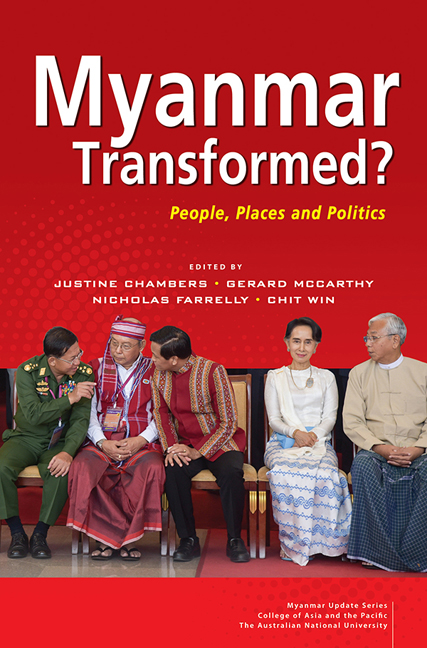
- Myanmar Transformed?People, Places and Politics, pp. 23 - 52Publisher: ISEAS–Yusof Ishak InstitutePrint publication year: 2018
Accessibility standard: Unknown
Why this information is here
This section outlines the accessibility features of this content - including support for screen readers, full keyboard navigation and high-contrast display options. This may not be relevant for you.Accessibility Information
Accessibility compliance for the PDF of this chapter is currently unknown and may be updated in the future.