Book contents
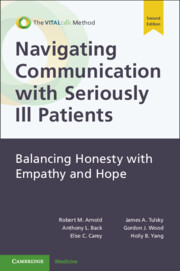
- Navigating Communication with Seriously Ill Patients
- Navigating Communication with Seriously Ill Patients
- Copyright page
- Dedication
- Reviews
- Contents
- Preface
- Acknowledgments
- 1Taking Your Skills to the Next Level
- 2Foundational Communication Skills
- 3Talking about Serious News
- 4Discussing Prognosis
- 5Planning for the Future: Discussing What’s Important, Well Before a Crisis
- 6Discussing Treatment Decisions
- 7Between the Big Events
- 8Goals of Care in Late-Stage Disease
- 9Conducting a Family Conference
- 10Dealing with Conflicts between Clinicians and Patients
- 11Working Through Conflicts with Colleagues
- 12When You’re Really Stuck
- 13Talking about Dying
- 14Cultivating Your Skills
- Index
- References
2 - Foundational Communication Skills
Published online by Cambridge University Press: 05 April 2024

Book contents
- Navigating Communication with Seriously Ill Patients
- Navigating Communication with Seriously Ill Patients
- Copyright page
- Dedication
- Reviews
- Contents
- Preface
- Acknowledgments
- 1Taking Your Skills to the Next Level
- 2Foundational Communication Skills
- 3Talking about Serious News
- 4Discussing Prognosis
- 5Planning for the Future: Discussing What’s Important, Well Before a Crisis
- 6Discussing Treatment Decisions
- 7Between the Big Events
- 8Goals of Care in Late-Stage Disease
- 9Conducting a Family Conference
- 10Dealing with Conflicts between Clinicians and Patients
- 11Working Through Conflicts with Colleagues
- 12When You’re Really Stuck
- 13Talking about Dying
- 14Cultivating Your Skills
- Index
- References
Summary
Four core communication skills are “Ask-tell-ask”, recognize and respond to emotion, ask permission to move forward, and “Tell me more…” “Ask-tell-ask” is asking what the patient or surrogate knows about the medical situation, telling them the headline (information and meaning), and asking what they are taking away from your conversation. Recognizing and responding to emotion, both verbal and nonverbal, can allow patients to discuss additional medical information, builds connection between clinician and patient, and can clarify what is important to the patient. Responding to emotion may be nonverbal or verbal (e.g., NURSE statements), and may include simple or complex reflections or “wish statements”. Asking permission to move the conversation forward signposts that there is a transition, allows patients control, and helps you judge if they are ready. Finally, “Tell me more…” helps clarify informational needs or allow a deeper view into a patient’s reasoning or emotional space, giving the clinician guidance on where to direct the conversation. In telemedicine, communication skills need to be adapted as some of the in-person nonverbal skills are less effective or impossible.
Information
- Type
- Chapter
- Information
- Navigating Communication with Seriously Ill PatientsBalancing Honesty with Empathy and Hope, pp. 15 - 35Publisher: Cambridge University PressPrint publication year: 2024
References
Further Reading
Back, A. L. and Arnold, R. M., “Yes it’s sad, but what should I do?” Moving from empathy to action in discussing goals of care. J Pall Med, 2014, 17(2):141–4.CrossRefGoogle Scholar
Chua, I. S., Jackson, V., and Kamdar, M., Webside manner during the COVID-19 pandemic: Maintaining human connection during virtual visits. J Pall Med, 2020, 23(11):1507–9.CrossRefGoogle ScholarPubMed
Coulehan, J. L., Platt, F. W., Egener, B., et al., “Let me see if I have this right … ”: Words that help build empathy. Ann Intern Med, 2001, 135(3): 221–7.CrossRefGoogle ScholarPubMed
Graugaard, P. K., Holgersen, K., Eide, H., et al., Changes in physician–patient communication from initial to return visits: A prospective study in a haematology outpatient clinic. Patient Educ Couns, 2005, 57(1): 22–9.CrossRefGoogle Scholar
Jacobsen, J., Jackson, V., Greer, J., and Temel, J., What’s in the Syringe? Principles of Early Integrated Palliative Care. Oxford University Press, 2021.CrossRefGoogle Scholar
Kripalani, S. and Weiss, B. D., Teaching about health literacy and clear communication. J Gen Intern Med, 2006, 21(8): 888–90.CrossRefGoogle ScholarPubMed
Kruser, J. M., Pecanac, K. E., Brasel, K. J., et al., “And I think that we can fix it”: Mental models used in high-risk surgical decision-making. Ann Surg, 2015, 261(4): 678–84.CrossRefGoogle ScholarPubMed
Levinson, W., Gorawara-Bhat, R., and Lamb, J., A study of patient clues and physician responses in primary care and surgical settings. JAMA, 2000, 284(8): 1021–27.CrossRefGoogle ScholarPubMed
Miller, W. R. and Rollnick, S., Motivational Interviewing: Helping People Change (3rd ed.). Guilford Press, New York, 2013.Google Scholar
Quill, T. E., Arnold, R. M., and Platt, F., “I wish things were different”: Expressing wishes in response to loss, futility, and unrealistic hopes.” Ann Intern Med, 2001, 135(7): 551–5.CrossRefGoogle ScholarPubMed
Silverman, J., Kurtz, S. M., and Draper, J., Skills for Communicating with Patients. Radcliffe Medical Press, Oxford, 2005.Google Scholar
Stone, D., Patton, B., and Heen, S., Difficult Conversations: How to Discuss What Matters Most. Penguin Books, New York, 2010.Google Scholar
Suchman, A. L., Markasis, K., Beckman, H. B., et al., A model of empathic communication in the medical interview. JAMA, 1997, 277(8): 678–82.CrossRefGoogle Scholar
Accessibility standard: Unknown
Why this information is here
This section outlines the accessibility features of this content - including support for screen readers, full keyboard navigation and high-contrast display options. This may not be relevant for you.Accessibility Information
Accessibility compliance for the HTML of this chapter is currently unknown and may be updated in the future.