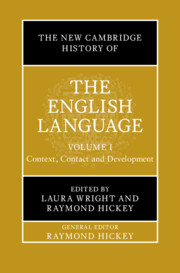
Book contents
- The New Cambridge History of the English Language
- The New Cambridge History of the English Language
- The New Cambridge History of the English Language
- Copyright page
- Contents
- Figures
- Tables
- Maps
- Contributors to Volume I
- General Preface
- Abbreviations
- General Editor’s Introduction
- Introduction to Volume I
- Part I The Context of English
- 1 The Indo-European Framework
- 2 English in Its Germanic Surrounding
- 3 Language Development in the Old English Period
- 4 The Geography of English in England
- 5 Philology and the History of English
- Part II Contact and External Influences
- Part III The Long View by Levels and Areas
- Appendix: Recommended Reading
- Index
- References
1 - The Indo-European Framework
from Part I - The Context of English
Published online by Cambridge University Press: 30 October 2025
By

Book contents
- The New Cambridge History of the English Language
- The New Cambridge History of the English Language
- The New Cambridge History of the English Language
- Copyright page
- Contents
- Figures
- Tables
- Maps
- Contributors to Volume I
- General Preface
- Abbreviations
- General Editor’s Introduction
- Introduction to Volume I
- Part I The Context of English
- 1 The Indo-European Framework
- 2 English in Its Germanic Surrounding
- 3 Language Development in the Old English Period
- 4 The Geography of English in England
- 5 Philology and the History of English
- Part II Contact and External Influences
- Part III The Long View by Levels and Areas
- Appendix: Recommended Reading
- Index
- References
Summary
After an outline of the basis of scientific historical linguistics, this chapter discusses what can be learned about Proto-Indo-European (PIE), the earliest recoverable ancestor of English, from archaeology and the study of ancient DNA. It then discusses some characteristics of PIE, outlines how its daughter languages diversified and sketches how Proto-Germanic developed. The chapter closes with a survey of words of PIE and its immediate daughter languages that survive in Modern English (ModE). A special theme is the first- and second-person pronouns, whose development is sketched very briefly from PIE to ModE.
Keywords
Information
- Type
- Chapter
- Information
- The New Cambridge History of the English LanguageContext, Contact and Development, pp. 27 - 51Publisher: Cambridge University PressPrint publication year: 2025
References
Anthony, David W. 2007. The Horse, the Wheel, and Language: How Bronze-Age Riders from the Eurasian Steppes Shaped the Modern World. Princeton, NJ: Princeton University Press.Google Scholar
Chang, Will, Cathcart, Chundra, Hall, David and Garrett, Andrew. 2015. Ancestry-constrained phylogenetic analysis supports the Indo-European steppe hypothesis. Language 91: 194–244.10.1353/lan.2015.0005CrossRefGoogle Scholar
Clackson, James. 2007. Indo-European Linguistics: An Introduction. Cambridge: Cambridge University Press.CrossRefGoogle Scholar
Crowley, Terry. 2010. An Introduction to Historical Linguistics. Fourth edition. Oxford: Oxford University Press.Google Scholar
Evans, Steven N., Ringe, Don and Warnow, Tandy. 2006. Inference of divergence times as a statistical inverse problem. In Forster, Peter and Renfrew, Colin (eds.), Phylogenetic Methods and the Prehistory of Languages. Cambridge: McDonald Institute, pp. 119–129.Google Scholar
Fortson, Benjamin W. IV. 2010. Indo-European Language and Culture: An Introduction. Second edition. Chichester: Wiley-Blackwell.Google Scholar
Fox, Anthony. 1995. Linguistic Reconstruction: An Introduction to Theory and Method. Oxford: Oxford University Press.CrossRefGoogle Scholar
Fruehwald, Josef. 2016. The early influence of phonology on a phonetic change. Language 92: 376–410.CrossRefGoogle Scholar
Gray, Russell D. and Atkinson, Quentin D.. 2003. Language-tree divergence times support the Anatolian theory of Indo-European origin. Nature 426: 435–439.10.1038/nature02029CrossRefGoogle ScholarPubMed
Haak, Wolfgang Iosif Lazaridis, Patterson, Nick, Rohland, Nadin, Mallick, Swapan, Llamas, Bastien, Brandt, Guido, Nordenfel, Susanne et al. 2015. Massive migration from the steppe was a source for Indo-European languages in Europe. Nature 522: 207–211.10.1038/nature14317CrossRefGoogle ScholarPubMed
Hill, Eugen. 2004. Das germanische Verb für ‘tun’ und die Ausgänge des germanischen schwachen Präteritums. Sprachwissenschaft 29: 257–303.Google Scholar
Hill, Eugen. 2010. A case study in grammaticalized inflectional morphology: origin and development of the Germanic weak preterite. Diachronica 27: 411–458.CrossRefGoogle Scholar
Hoenigswald, Henry M. 1960. Language Change and Linguistic Reconstruction. Chicago, IL: University of Chicago Press.Google Scholar
Jasanoff, Jay H. 2003. Hittite and the Indo-European Verb. Oxford: Oxford University Press.10.1093/acprof:oso/9780199249053.001.0001CrossRefGoogle Scholar
Katz, Joshua T. 1998. Topics in Indo-European personal pronouns. PhD dissertation, Harvard University.Google Scholar
Kessler, Brett. 2001. The Significance of Word Lists. Stanford, CA: CSLI Publications.Google Scholar
Kessler, Brett and Lehtonen, Annukka. 2006. Multilateral comparison and significance testing of the Indo-Uralic question. In Forster, Peter and Renfrew, Colin (eds.), Phylogenetic Methods and the Prehistory of Languages. Cambridge: McDonald Institute, pp. 33–42.Google Scholar
Kroonen, Guus. 2012. Non-Indo-European root nouns in Germanic: evidence in support of the Agricultural Substrate Hypothesis. In Grünthal, Riho and Kallio, Petri (eds.), A Linguistic Map of Prehistoric Northern Europe. Helsinki: Société Finno-Ougrienne, pp. 239–260.Google Scholar
Kümmel, Martin. 2020. The development of the perfect within IE verbal systems: an overview. In Crellin, Robert and Jügel, Thomas (eds.), Perfects in Indo-European Languages and Beyond. Amsterdam: John Benjamins, pp. 15–47.10.1075/cilt.352.02kumCrossRefGoogle Scholar
Labov, William. 2020. The regularity of regular sound change. Language 96.1: 42–59.10.1353/lan.2020.0001CrossRefGoogle Scholar
Lühr, Rosemarie. 1984. Reste der athematischen Konjugation in den germanischen Sprachen. In Untermann, Jürgen and Brogyanyi, Béla (eds.), Das Germanische und die Rekonstruktion der indogermanischen Grundsprache. Amsterdam: John Benjamins, pp. 25–90.10.1075/cilt.22.04luhCrossRefGoogle Scholar
Mallory, J. P. 1989. In Search of the Indo-Europeans: Language, Archaeology, and Myth. London: Thames and Hudson.Google Scholar
Mottausch, Karl-Heinz. 2013. Untersuchungen zur Vorgeschichte des germanischen starken Verbs: die Rolle des Aorists. Hamburg: Verlag Dr. Kovač.Google Scholar
Nakhleh, Luay, Ringe, Don and Warnow, Tandy. 2005. Perfect phylogenetic networks: a new methodology for reconstructing the evolutionary history of natural languages. Language 81: 382–420.10.1353/lan.2005.0078CrossRefGoogle Scholar
Paul, Hermann. 1920 [1880]. Prinzipien der Sprachgeschichte. Fifth edition. Halle: Niemeyer.Google Scholar
Rasmussen, Jens Elmegård. 1996. On the origin of the Germanic weak preterite. Copenhagen Working Papers in Linguistics 4: 161–168.Google Scholar
Reich, David. 2019. Who We Are and How We Got Here: Ancient DNA and the New Science of the Human Past. New York: Vintage Books.Google Scholar
Ringe, Don. 2017. From Proto-Indo-European to Proto-Germanic. Second edition. Oxford: Oxford University Press.10.1093/oso/9780198792581.001.0001CrossRefGoogle Scholar
Ringe, Don. 2022. Stative perfects. In Peter, M. Scharf (ed.), Indian Linguistic Studies in Honor of George Cardona, Vol. II: Historical Linguistics, Vedic, etc. Providence, RI: The Sanskrit Library, pp. 85–98.Google Scholar
Ringe, Don and Eska, Joseph F.. 2013. Historical Linguistics: Toward a Twenty-First Century Reintegration. Cambridge: Cambridge University Press.10.1017/CBO9780511980183CrossRefGoogle Scholar
Ringe, Don and Taylor, Ann. 2014. The Development of Old English. Oxford: Oxford University Press.10.1093/acprof:oso/9780199207848.001.0001CrossRefGoogle Scholar
Ringe, Don, Warnow, Tandy and Taylor, Ann. 2002. Indo-European and computational cladistics. Transactions of the Philological Society 100: 59–129.10.1111/1467-968X.00091CrossRefGoogle Scholar
Rix, Helmut, Kümmel, Martin, Zehnder, Thomas, Lipp, Reiner and Schirmer, Brigitte. 2001. LIV, Lexikon der indogermanischen Verben: die Wurzeln und ihre Primärstammbildungen. Second edition. Wiesbaden: Reichert.Google Scholar
Stiles, Patrick V. 1985–1986. The fate of the numeral ‘4’ in Germanic. North-Western European Language Evolution 6: 81–104, 7: 3–27, 8: 3–25.10.1075/nowele.6.06stiCrossRefGoogle Scholar
Stiles, Patrick V. 2010. The Gothic extended forms of the dental preterite endings. North-Western European Language Evolution 58–59: 343–366.10.1075/nowele.58-59.12stiCrossRefGoogle Scholar
Warner, Anthony R. 1993. English Auxiliaries: Structure and History. Cambridge: Cambridge University Press.CrossRefGoogle Scholar
Accessibility standard: WCAG 2.0 A
Why this information is here
This section outlines the accessibility features of this content - including support for screen readers, full keyboard navigation and high-contrast display options. This may not be relevant for you.Accessibility Information
The HTML of this chapter
conforms to version 2.0 of the
Web Content Accessibility Guidelines
(WCAG), ensuring core accessibility principles are addressed and meets the basic
(A)
level of WCAG compliance, addressing essential accessibility barriers.
Content Navigation
Table of contents navigation
Allows you to navigate directly to chapters, sections, or non‐text items through a linked table of contents, reducing the need for extensive scrolling.
Allows you to navigate directly to chapters, sections, or non‐text items through a linked table of contents, reducing the need for extensive scrolling.
Index navigation
Provides an interactive index, letting you go straight to where a term or subject appears in the text without manual searching.
Provides an interactive index, letting you go straight to where a term or subject appears in the text without manual searching.
Reading Order & Textual Equivalents
Single logical reading order
You will encounter all content (including footnotes, captions, etc.) in a clear, sequential flow, making it easier to follow with assistive tools like screen readers.
You will encounter all content (including footnotes, captions, etc.) in a clear, sequential flow, making it easier to follow with assistive tools like screen readers.
Short alternative textual descriptions
You get concise descriptions (for images, charts, or media clips), ensuring you do not miss crucial information when visual or audio elements are not accessible.
You get concise descriptions (for images, charts, or media clips), ensuring you do not miss crucial information when visual or audio elements are not accessible.
Visual Accessibility
Use of colour is not sole means of conveying information
You will still understand key ideas or prompts without relying solely on colour, which is especially helpful if you have colour vision deficiencies.
You will still understand key ideas or prompts without relying solely on colour, which is especially helpful if you have colour vision deficiencies.
Structural and Technical Features
ARIA roles provided
You gain clarity from ARIA (Accessible Rich Internet Applications) roles and attributes, as they help assistive technologies interpret how each part of the content functions.
You gain clarity from ARIA (Accessible Rich Internet Applications) roles and attributes, as they help assistive technologies interpret how each part of the content functions.