Book contents
- Onomatopoeia
- Onomatopoeia
- Copyright page
- Dedication
- Contents
- Figures
- Tables
- Acknowledgments
- Abbreviations
- 1Introduction
- 2Defining Onomatopoeia
- 3Onomatopoeias as Linguistic Signs
- 4Prototypical Features of Onomatopoeia
- 5Onomatopoeia and Sound Symbolism
- 6Cross-Linguistic Onomatopoeic Patterns
- 7Richness of Languages in Onomatopoeias by Sound Type and Source
- 8Onomatopoeias versus Ideophones
- 9Conclusion
- Book part
- References
- Author Index
- Language Index
- Subject Index
4 - Prototypical Features of Onomatopoeia
Published online by Cambridge University Press: 18 December 2025

Book contents
- Onomatopoeia
- Onomatopoeia
- Copyright page
- Dedication
- Contents
- Figures
- Tables
- Acknowledgments
- Abbreviations
- 1Introduction
- 2Defining Onomatopoeia
- 3Onomatopoeias as Linguistic Signs
- 4Prototypical Features of Onomatopoeia
- 5Onomatopoeia and Sound Symbolism
- 6Cross-Linguistic Onomatopoeic Patterns
- 7Richness of Languages in Onomatopoeias by Sound Type and Source
- 8Onomatopoeias versus Ideophones
- 9Conclusion
- Book part
- References
- Author Index
- Language Index
- Subject Index
Summary
Chapter 4 maps prototypical features of onomatopoeia by means of extensive empirical data on 124 sample languages and bear on the phonological, morphological, syntactic, word-formation, semantic, and sociopragmatic characteristics. The prototypical features are identified primarily, but not exclusively, on the basis of the markedness theory. It is postulated that the defining properties of onomatopoeias are marked relative to the properties of the general non-onomatopoeic word-stock in the sense of aberration from the latter’s properties. This claim does not mean that all onomatopoeias in natural languages or all onomatopoeias in a given language are marked in all the defining characteristics. Their prototypical characteristics should be viewed in the sense that onomatopoeia as a class of words has the capacity to deviate from the characteristics common to the non-onomatopoeic word-stock. It is postulated that these prototypical, defining features of onomatopoeia are marked features in the majority of languages, even if the languages differ in the degree of manifestation of these features at individual levels of language description. The discussion is supported by numerous examples.
Information
- Type
- Chapter
- Information
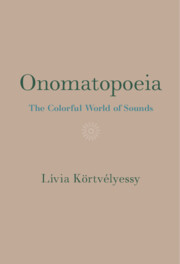
- OnomatopoeiaThe Colorful World of Sounds, pp. 86 - 201Publisher: Cambridge University PressPrint publication year: 2025
Accessibility standard: Unknown
Why this information is here
This section outlines the accessibility features of this content - including support for screen readers, full keyboard navigation and high-contrast display options. This may not be relevant for you.Accessibility Information
Accessibility compliance for the HTML of this chapter is currently unknown and may be updated in the future.