The English-language archive from medieval Ireland is a relatively unexploited resource. Many literary scholars pay scant attention to this scattered collection as an entity, and those concerned with the history of medieval Ireland rarely venture into this realm for long. This book seeks to serve as a guide to help navigate the under-explored landscape of Ireland’s earliest English literature, primarily in the fourteenth and fifteenth centuries. The study aims not only to broaden horizons and bridge interdisciplinary boundaries by demonstrating the value of examining this corpus as material emanating from a medieval colonial outpost producing and consuming vernacular English literature but also to serve as a guide in order to refocus and direct attention to some of the material and questions this examination reveals.
Perhaps the most enduring legacy of the English military campaign in Ireland in the 1160s is that it established the foundations for the use of the English language in Ireland. The term used in the Rawlinson poem, quoted in the chapter’s epigraph, to describe the island, ‘the land of Ireland’, was the official description used in the medieval chancery (notably, without the ‘holy’, which may have been added here for religious or metrical purposes).2 In the polyglot community of medieval Ireland, however, English was just one of the languages spoken and written. Irish, Latin, English, and French (the latter to a lesser extent in Ireland from the fourteenth century) were all spoken and written to varying degrees for diverse individual and community purposes within the English lordship of Ireland.3 Although much literature in Irish, the main vernacular of the island, remains under-examined, many gems are well known, and further material has been subject to recent interrogation.4 Latin literature has been the subject of multiple studies in modern scholarship, and French in medieval Ireland has recently been afforded generous attention.5 The focus in this book on the English-language material of Ireland is the first extensive modern examination of this literary corpus in the second substantial medieval vernacular of the island. Much of the material at the heart of this book is linked to Ireland through its dialect, Middle Hiberno English (MHE), a form connected to England’s West Midlands, where many of the post-1160s settlers originated and where many in Ireland continued to hold land as part of a network of transnational lordships crossing the Irish Sea. There are, of course, plenty of examples of literature and books produced in Britain circulating in medieval Ireland. This book seeks to explore connections linking Ireland and Britain in this period, shedding new light on our understanding of medieval Ireland and the Anglophone world.
The focus of this study remains on what we would recognise as literature today, primarily discursive prose and poetry, rather than administrative, legal, or personal documents.6 Frequently, we find scribes producing administrative texts as well as more creative ‘literature’ in various languages, and the discussion will allude to material in all languages of medieval Ireland when pertinent. Tracing the manuscripts which contain English in the dialect of Ireland circulating in Ireland and their likely scribes, owners, and readers is the first crucial step in attempting to form a more coherent picture of the literature of medieval Ireland and to sketch the social and community history of this period. Texts which are not written either in Ireland or in the dialect of MHE but which either circulate in Ireland as imported books or survive as texts copied in England based on works originally written in Ireland play important roles. Suggestive of wider intellectual and reader networks and trade routes, these books are a crucial part of the picture. The Gaelic context also is surprisingly useful, not only as a foil to the medieval literary culture in English Ireland but also to demonstrate interactions, cultural assimilation, and evidence of lost English-language works.
The list of named English-language writers of medieval Ireland is relatively small, partly on account of this period’s reflex towards anonymity and general expectations that scribes or translators serve as transmitters of older material. Nonetheless, the corpus of medieval English vernacular literature in Ireland is substantial. Reflecting trends in England, it attests to the practical value of the written word, transmitting experience and advice which could illuminate the realities of life during the challenges and conflicts that beset the late medieval colonial community or reflect social, religious, and political concerns in a drafty tower-house at the edge of an embattled frontier territory at the edge of the English empire. Reading many of these works makes it possible to connect with the audience, authors, and annotators, and to understand a little more about the value and importance of literature in their world and how the rhetoric of that literature could affect perceptions about the past, the present, and the future.
This study refers to people in Ireland who write and consume texts in English mostly by the term ‘English’ or ‘the English community in Ireland’, and occasionally by ‘the English in Ireland’.7 Widespread medieval use of the term ‘English’ to describe the historic military campaigners and the later inhabitants of English settlements in Ireland seems reason enough to avoid modern complicated arguments regarding which composite label best describes the genetic and cultural make-up of the community and instead use the term they adopted themselves. Indeed, in his account of the campaign in the Expugnatio Hibernica (c.1189), Giraldus Cambrensis/Gerald of Wales/Gerald de Barri (c.1146–1223) refers to the military men as ‘Anglici’, rarely acknowledging the complexities of the garrison for his own dynastic and political propagandistic purposes.8 His characterisation of the group in his second work on Ireland, which charts the coming of the (Angles) English (‘adventus Anglorum’), has a faint echo of his predecessor, another churchman and historian, Bede (c.673–735), in his Historia Ecclesiastica Gentis Anglorum (731), with Giraldus conflating – as Bede had done for a different group of armed men – the reality of their origins in order to project an image of social and political coherence and dominance not reflected on the ground. The other main source from the perspective of the arrivals recalling the military expedition from the 1160s is the anonymous vernacular French Geste des Engleis en Yrlande (Song of Dermot and the Earl), which survives incompletely in one late thirteenth-/fourteenth-century copy, Lambeth Palace Carew MS 596, and refers to the arrivals as the English (‘des engleis’).9
In 1496, Gerald FitzGerald (Gearóid Mór) (1456/7–1513), eighth earl of Kildare, referred to ‘Englishe Irysshe’ when addressing the king’s council.10 Dublin scholar Richard Stanihurst (1547–1618) referred to the ‘Anglo-Hiberni’ in his Latin history De Rebus in Hibernia Gestis (Great Deeds in Ireland), printed in 1584 in Leiden, where he was studying.11 This rare term, the precursor of ‘Anglo-Irish’, in some ways links the literature of this early period and the celebrated later period of Anglo-Irish literature. The emergence of English as a literary language in the fourteenth century evolved against a backdrop of the growing power of vernaculars in Europe. Geoffrey Chaucer (c.1342–1400), whose writings in English were perceived to have impacted the respectability of English as a literary language, made use of emergent English vocabulary but was also inspired by international literature.12 Language in this period did not, of course, primarily indicate identity. Christopher Cannon points to the ‘poor beginning’ of English and reminds us that the emergence of what became the foundational literary genre of English (‘the spirit of English romance became the spirt of English’) sprang from French prior to its flourishing in English.13 In Ireland, this interaction with French – and the monastic communities which were established in Ireland and used French as their lingua franca – was augmented by an interaction with the Irish language. We may not be able to draw a direct line of influence from the (equally sparce) earliest evidence for English and our modern incarnation of that language (although, as the Epilogue suggests, it certainly influenced some of the modern literary giants of the island), but it cannot be denied that this early stage of linguistic interaction is part of the longer tradition of the English language on the island of Ireland. Occasionally we can see in much of the medieval literature echoes of concern with identity, which manifests in different but interesting ways across the ages. This study seeks to identify works which have been forgotten but remain an important part of Ireland’s medieval and literary heritage to allow us to better understand the early days of English literary culture and English vernacular book production and consumption in the medieval Anglophone world.
The Structure of this Book
This chapter seeks to put the literature of medieval Ireland in its historical and cultural context. Subsequent chapters will explore how the surviving vernacular literary culture can help reveal the complexities of medieval Ireland and its literary heritage. Chapter 2 reassesses evidence for books and book culture relating to medieval English Ireland and teases out connections between that community and Gaelic Ireland. In Part II of this book, Chapter 3 examines the vernacular literature relating to the church, focusing on the earliest English-language satire, The Land of Cokaygne, and the richness of the vernacular preaching material extant from medieval Ireland. Chapter 4 examines the evidence for books, book-production, and reading in medieval Dublin, the administrative heart of the English lordship of Ireland. It has a particular focus on the scribes who can be identified as contributing to the literary culture, James Yonge (c.1375–c.1439) and his network, and also to important didactic works produced or circulating in Dublin, including the only medieval illustrated copy of Piers Plowman. Part III opens with an examination in Chapter 5 of vernacular ‘how-to-save-your-soul’ literature, paying attention both to satirical and critical literature as well as more didactic religious books circulating among the laity in medieval Ireland, some of which offer important readership information. Chapter 6 offers a focused study of an elite patron of the arts in mid fifteenth-century Ireland, James Butler, fourth earl of Ormond (c.1390–1452). Exploring Ormond’s use of the vernacular, the chapter explores literature as a prism to trace his shifting identity across the English and Gaelic spheres. The Epilogue draws these strands together to explore how some of Ireland’s great modern writers viewed the medieval past in order to offer a sense of how they envisioned such material as part of the long tradition of writing English in Ireland.
The Coming of the English to Ireland
The backstory to the arrival of armed vassals of the king of England, Henry II (1133–89), in Ireland is well known.14 In an effort to recover lost territory in the province of Leinster, Diarmait Mac Murchada (1110–71), king of Leinster, approached Henry II to secure military support. Mac Murchada, whose lands lay in what are today the modern counties of Wexford and part of Carlow, had previously supported Henry on various expeditions, and Henry’s granting of his request allowed ambitious vassals to embark on an armed expedition to Ireland which was to have long-lasting repercussions.15 Ostensibly, Diarmait’s lands were lost because of an illicit relationship with Derbfhorgaill (c.1108–93), the wife of Tigernán Úa Rúairc (d.1172), king of Bréifne, whose land was situated alongside that of his wife’s family, who ruled the territory of Mide, mainly consisting of the counties of Meath and Westmeath. The medieval sources, both Gaelic and Anglo-Norman, oscillate between describing this as a love match and characterising it as an abduction motivated by lust or politics. Whatever the motives for this event, which occurred in 1152, it is unlikely that this alone contributed to Diarmait’s expulsion from Leinster in 1166 fourteen years later and his subsequent appeal to Henry II for a military force. Nonetheless, it seems that ‘Derbfhorgaill’ is the woman history has nominated to take the brunt of the blame for the calculated political actions of others.
Even if one accepts Diarmait’s right to reclaim his land in Leinster, the straying of the military force from his former territory in Leinster, which Diarmait might reasonably have offered as recompense for support, is of dubious legality, a circumstance which is generally conveniently overlooked. Remarkably, the bombastic self-appointed chronicler of the conquest of Ireland, Giraldus, acknowledges that, if the military campaigners were simply supporting a justified reclamation rather than launching an invasion of foreign territory, the campaigning army had less right to land outside Leinster.16 This admission is a rare contemporary concession by the propagandist acknowledging the potential illegality of at least part of the military enterprise in Ireland. Giraldus’ two works on Ireland, written in Latin, are readily recognised as key sources for the expedition of the 1160s, and his perspective has long been credited with influencing the understanding of this period and subsequent claims of the English crown to the island well into the early modern period. An examination of the late medieval translation of his Expugnatio Hibernica into MHE demonstrates not only the continued impact of his words in the Middle Ages but also the under-appreciated value of the vernacular corpus, in particular, as a vehicle for the transmission of an English colonial perspective on the English invasion and subsequent settlement in Ireland.17
In spite of disparate ethnic strands among the invaders (and the significance of Welsh settlement in Ireland prior to and following the invasion), the enterprise remained primarily an English affair under the auspices of the king of England, Henry II. As well as the English contingent, there were Welsh and Flemish invaders involved in the enterprise. As a convenient modern shorthand, the invaders as a group have been termed Norman, Anglo-Norman, Anglo-French, Cambro-Norman, English, and even Welsh. These terms – none of which are accurate without qualification – signal a recognition of differences of culture and language among the military force and show some appreciation of the heritage and origins of these various groups. These disparate origins also contribute to making twelfth-century Ireland a linguistic and cultural melting pot.
Previous arrivals in the form of ‘Viking’ settlers from Scandinavia (mostly Norway) in the tenth century had infused the Irish language with Norse loan-words, borrowings, and word structure. Now another language was encountering Irish, the oldest written vernacular language. After the settlement of many of the garrisons from the 1160s, medieval Ireland was thus a multi-lingual as well as multi-cultural sphere. The prominent significance of English in modern Ireland does not mirror the early days of the language in Ireland. Moreover, our preoccupation with written forms of language evidence often both obscures the first cries of a language and tends to date the arrival of that language in the world in the period when it first appears in written form. In Ireland, our first evidence for substantial written English prose can be dated to the fourteenth century, although there are traces of English in earlier administrative records.
The English Community in Ireland
Medieval Ireland was, by its very nature, similar to and divergent from culture in England. Those who wrote in English in Ireland could often draw on their knowledge of English literature, Latin, French, and occasionally the Irish language. This linguistic range allowed the writer – and the learned reader – to recognise the web of cumulative meanings and purposes which infuse language and the cultural reach of literature. Late medieval English Ireland consisted of the so-called four obedient shires, those counties along the eastern seaboard facing Britain: Dublin, Meath, Louth, and Kildare; more inland territories such as Kilkenny; and southern port towns like Waterford and Wexford. These territories, however, were cut off from neither England nor their Gaelic neighbours. Literature can imbue tensions and hidden connections that allow us to build up a picture of medieval Ireland and the English colony as a shared cultural zone, mediating outside influences and developing and reflecting on their own self-knowledge and identity. Of course, much of the early English writing in Ireland was spoken and never committed to writing. There was little need to write down material which functioned perfectly adequately as a spoken vernacular. Official records of the church or secular authorities were recorded in Latin or French; even when the latter fell out of use as a vernacular in Ireland, its status in written form was assured, given its position as the language of law and the court in England and its continued use in certain church contexts.
French in Medieval Ireland
French in Ireland (often termed ‘Hiberno-French’ by scholars) survived in Ireland until the mid fourteenth century. As Keith Busby has demonstrated in his recent encyclopaedic study of French in Ireland, ‘despite the lack of documentary evidence … there can be little doubt that French had been spoken on the island in various contexts in the preceding decades’, and, moreover, ‘the newcomers from the east exploited and expanded, rather than opened channels of communication with the native Irish population’.18 Hiberno-French did not produce extensive literature, nor is there evidence of significant circulation of works in French (in spite of Busby’s identification of additional material in French), suggesting that its audience in Ireland was limited. Most of our extant literary works in Hiberno-French date to the thirteenth century. Most notable is the historical poem The Song of Dermot and the Earl, a foil to Giraldus’ account of the twelfth-century military expedition. Surviving in a unique witness, it shows little sign of medieval engagement. It may have originally circulated orally and was possibly written to preserve the meter.19 This reminds us that there was a vast oral culture to which we have no access; the remaining narratives are glimpses of an incomplete and changing picture. Another thirteenth-century poem, the 220-line Walling of New Ross (Rithmus Facture Ville de Rosse), is dated to 1265, one of three Hiberno-French texts in fourteenth-century BL Harley MS 913. Alan Bliss and Joseph Long in their important study suggest that the Walling of New Ross may have held community-wide interest, while The Song appears to have had a more limited appeal and circulation.20
The initial settlers following the twelfth-century expedition did not land in Ireland and immediately converse in English. It seems possible that immediately post-expedition French ‘enjoyed a superior standing in Ireland compared to English’.21 Raymond Hickey points out that French loan-words were absorbed into the Irish language and adapted to the Irish sound system, in contrast to English, where such loans are generally adapted to the donor language’s phonology.22 Against this, French appears to have made a ‘comparatively slight impact’ on Irish toponomy, with many place-names only surviving in a heavily anglicised form, although this may be the result of a later dominance of English.23 In any case, the evidence regarding the use of French as a vernacular in fourteenth-century Ireland is not clear-cut, but it maintained a prominence in ecclesiastical and legal contexts.24
Middle Hiberno English
Many of the prominent military men who arrived in Ireland in the early phases of the expeditions had an extensive network of territory across England, Wales, Normandy, and now Ireland; this was certainly true for the two main leaders, Richard de Clare ‘Strongbow’ (d.1176), who led the 1170 expedition, and Hugh de Lacy, who accompanied King Henry II during his Irish campaign of 1171–2, and this connection between lands on both sides of the Irish Sea was to become a common pattern in the history of the colony.25 Given that many of these settlers were drawn from various locations in England, and indeed Wales, the dialects which they encountered in Ireland naturally threw a selection of forms into the melting pot of what would become colonial English. As Alan Bliss points out in his important survey of languages in medieval Ireland, the colonial enterprise resulted in a situation where ‘speakers from a number of different dialects [of English] found themselves living in close juxtaposition’.26 Standardisation of dialect occurred to some degree, but the basis of the language was dependent on compromise standardisation across a number of dialects, which created MHE’s unique morphology and phonology.27 Thus the composition of the dialectal lexis is different, so even though it shares various forms with a number of separate dialects, its development was unique and not as uniform as elsewhere.
The dialect of MHE is determined by the combined presence of a number of features which occur separately in various Middle English dialects but not en masse in any other dialect. Examining the forms of Middle English which are present and absent in a particular text has made it possible to localise texts based on their dialect, and in this way it is possible to construct a literary map of England divided into five dialectal areas: South Eastern (Kentish), South Western (Surrey and Hampshire), East Midlands (southeast midlands, northeast midlands), West Midlands (southwest midlands, northwest midlands), and Northern.28 These divisions ignore Ireland completely; as John Thompson laments: ‘English dialects west of the West Midlands simply have not been mapped yet.’29
Early studies on the dialect were begun by Wilhelm Heuser and Jeremiah Hogan, with the most important work undertaken by Angus McIntosh and Michael Samuels, whose seminal study identified various elements present in the medieval English dialect in Ireland.30 The linguists found that the dialects of the southwest and west midlands were hugely influential in the formation of the English dialect in Ireland. (The southwest and west midlands are defined as the area which includes, in the southwest, Somerset, Bristol, Gloucestershire, Oxfordshire, Wiltshire, Dorset, Devon, and Cornwall, and, in the west midlands, Herefordshire, Shropshire, Staffordshire, Warwickshire, and Worcestershire.) These west midland dialects were conservative, retaining many of the patterns, pronunciation, and inflections found in Old English. The dialect in Ireland, however, also made its own changes, such as simplifying inflections and dropping the final unstressed -e. As Bliss notes, the ensuing ‘combination of conservative pronunciation and inflectional innovation is not paralleled in any other variety of medieval English, so that written Hiberno-English is wholly distinctive: each of its distinctive features can be paralleled elsewhere, but the total pattern is unique’.31 Indeed, McIntosh and Samuels, on account of ‘an amalgam of various southwestern and (to some extent western) features’, list a number of elements drawn from the west midland area which appeared possible to trace within the MHE dialect identified as Herefordshire, Gloucestershire, Somerset, Devon, Shropshire, south Lancashire, and Cheshire, as well as Wales.32 Most of the areas name-checked correspond to the origins of some of the military men or settler families who feature prominently in the aforementioned early military expedition in Ireland.33 Some of the individuals involved in this initial expedition are referenced by Giraldus, and we can expect that many of those lower on the social scale (the ones most likely speaking English in that period) were drawn from the areas in which these magnates operated, reinforcing connections to a particular area across the sea. This reinforces the likelihood that the locales which MacIntosh and Samuels identify as plausible sources from which elements of the MHE are drawn is indeed correct.
English and Irish
The MHE dialect was not simply influenced by other Middle English dialects, and, although the influence of the Irish language on the English dialect in Ireland is debated, many scholars believe that by the late Middle Ages most speakers would have been bilingual: Bliss suggests that ‘it seems certain that from the fourteenth century onwards most of the Englishmen in Ireland also spoke Irish, and … some of them may have known no other language …’.34 Raymond Hickey has also posited a high level of bilingualism in Ireland, and he and Michael Benskin have argued for the influence of Irish on the English language in medieval Ireland.35 Irish was most likely spoken and understood to some degree by at least some members of the English community, particularly in large English towns in late medieval Ireland.36 Intermarriage between the English and Irish often served a valid political purpose, but it might also have introduced another language into the home.37 The rhetoric of degeneracy emerging from the English community in Ireland, however, may have distorted early modern (and modern) commentators’ discussions of the ubiquity of the Irish vernacular in English Ireland.
Readers frequently encountered bilingual and even trilingual medieval manuscripts of varying degrees. Within the corpus of English-language literature of Ireland, however, Irish words are rarely found. In James Yonge’s Latin work of 1411, composed in Dublin for Laurence Rathold de Pasztho, a visiting Hungarian nobleman, Yonge outlines the journey which his patron has undertaken to Ireland’s most famous pilgrimage site, St Patrick’s Purgatory in county Donegal. In this work, Memoriale super visitatione domini Laurencii Ratholdi militis & baronis Vngariæ factum de Purgatorio Sancti Patricii in insula Hibernie (Memoriale), a copy of which is found in BL Royal MS 10 B IX, Yonge says that the pilgrimage site is situated at a place which in Irish (‘Hibernice’) is called ‘Lotherge’ (Lough Derg). This, he explains, means ‘Stagnum Rubeum’ (Red Lake).38 The larger part is called ‘kernagh’, which he translates into Latin as ‘Clamoris Insula’ (Island of Wailing), while the smaller part is called ‘regles’ in Irish and ‘regula’ in Latin.39 The presence of these few Irish words does not suggest that Yonge, a scribe in Dublin who could write in English and Latin as well as translate from French, had any skill in Irish. The explanations of the place names likely reflect knowledge gleaned from books, documents, or oral sources. Indeed, when Yonge explains that one of the demons found in the purgatory is called ‘Cornu’ in Irish, he notes that it was also seen by a previous pilgrim to the purgatory, Antonio.40 This is probably a reference to Antonio Mannini, a Florentine whose pilgrimage in 1411 to the purgatory was memoralised by his brother Salvestro di Giovanni Mannini on his return from Ireland in 1413. Salvestro records that Antonio journeyed to and from the purgatory in the company of Laurence (the patron of Yonge’s work). In the account of Antonio’s boat journey to the purgatory island, a significant portion of the description is dedicated to his sighting of a creature shaped like a heron, which the canon of the purgatory explains is the demon ‘Cornu’, whom God, on account of the prayers of St Patrick, rendered in this form until Judgement Day.41 This creature only appears in the written accounts of Antonio and Laurence, with both crediting the vision to Antonio, suggesting Laurence’s text relies on Antonio’s encounter (or written account) as its source. The account of Antonio’s journey – complete with references to the fourteenth-century il Paradiso, the third section of La Commedia of his Florentine compatriot Dante Alighieri (1265–1321) – is partly based on the letters written by Antonio in Dublin on 15 February 1412 to his brother via an intermediary in London, Corso di Giovanni Rustichi, possibly while or just after Yonge and Laurence were discussing his recent experiences, interviews which were to form the bedrock of the written account of his pilgrimage. In the written account Yonge produces, he describes the demon Cornu, which Antonio sees as resembling a plucked heron without wings (the bird is identified in Latin as ‘ardee’), resplendent with a voice like a trumpet which foretells the death of pilgrims. He fails to make an explicit link between the demon’s name and the Irish word for heron (‘corr’), and although it may be implied, the connection would no doubt be lost in a text intended for an audience with no knowledge of Irish. It seems that, despite his long-established links with Dublin, his knowledge of Irish may not be strong, and he is indebted to his patron’s fellow traveller for information about the creature.
This lack of knowledge of the Irish language among scribes working in the English colony is unsurprising. Although, in order to forge alliances, many English lords sent their children to be fostered among Gaelic families where they presumably learnt Irish, many inhabitants of English Ireland would have had no such opportunity to immerse themselves in the language of their neighbours.42 Many clerics, however, may have been bilingual for practical reasons.43 In 1485, a parliamentary dispensation to the archbishop of Dublin pointed to the necessity to appoint Irish clerks to benefices to serve an Irish community because many English clerks were inexpert in the Irish language, and – significantly – among ‘those who are practiced in the same’ (the Irish language), many did not wish to or feared to live among the Irish.44 By the fifteenth century, the number of Irish clerics, presumably conversant in Irish, Latin, English, and possibly French, holding benefices within the colony had increased, potentially bringing more people into contact with the Irish language.45 This did not, however, necessitate language acquisition among the non-Irish in the colony, and the use of English was deemed a requirement by those holding benefices among the English.46 Among Irish clerics, who presumably had to speak English, many (but not all) anglicised their names and may have altered their hairstyles and acquired English law to fit into the English community and to protect themselves from potential challenges to their holding benefices.47
Latin and English
That Latin dominated medieval manuscript culture does not mean it was the dominant language spoken throughout society, although in certain ecclesiastical contexts it could serve as a useful lingua franca. Latin formed the bedrock around which other languages interacted. In Ireland these were predominantly French, English, and Irish. If the choice of a language or languages for a text was not determined solely by its position in the linguistic hierarchy, other factors must account for its use. Legal and ecclesiastical material continued to be written in Latin and/or French in medieval Ireland (as in England) on account of tradition and of the authority suggested by such languages. The use of vernacular English in Ireland cannot be assumed to primarily articulate an English identity or assure us of the primacy of the English language, but its value as an accessible vehicle to impart knowledge was crucial for a certain portion of the inhabitants of medieval Ireland.
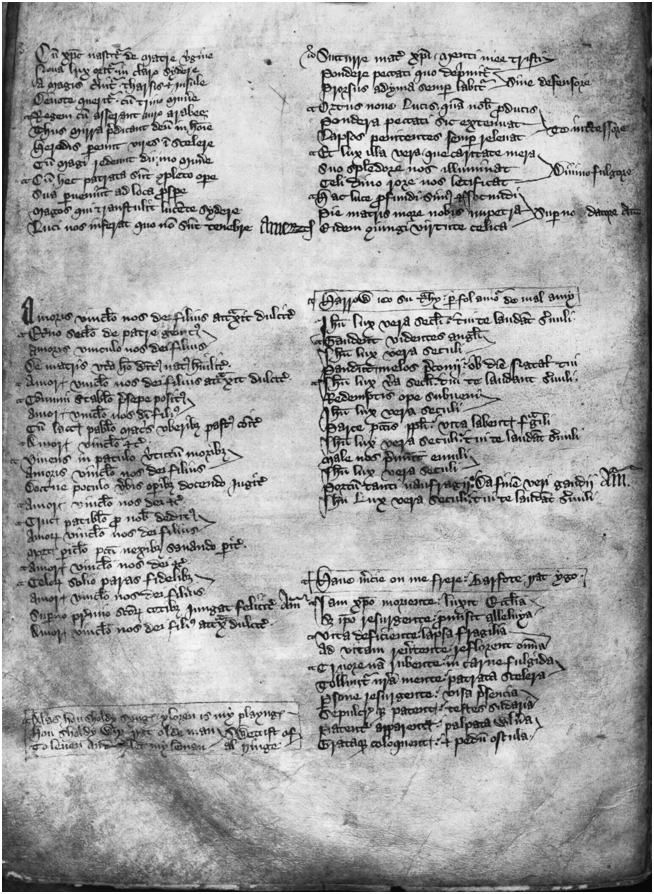
One of the most striking examples of early written English is found in the early fourteenth-century portion of the Red Book of Ossory, Representative Church Body Library D11/1/2 (Figure 1), so-called on account of its red binding and its connection with the infamous Richard de Ledrede (d.1360/1) from 1317 to 1360.48 Perhaps the most well-known entries in this manuscript are the sixty Latin lyrics presented here as part of the bishop’s efforts to save the souls of those under his charge ‘… in order that their throats and mouths, consecrated by God, may not be polluted by songs which are lewd, secular, and associated with revelry’.49 Many of these lewd, secular songs were likely in English, as evidenced by the fragmentary phrases written into the manuscript, and their inclusion here was intended to serve as an aide-mémoire for the tune to which these Latin hymns were to be sung. Although some scholars ascribed these lyrics to the bishop, he is not, in many cases, their author.50 These more appropriate Latin hymns were probably intended to be sung by the clergy – the note at the foot of the first page of these entries refers to trained singers.51 The fame of these vernacular pieces in this manuscript – six in English and two in French – overshadows the more significant Latin entries in the volume. What is most striking and little remarked upon is the extent to which the English-language material is secondary, squeezed onto the page, like other Middle English verses often ‘copied into inviting blank spaces’.52 The vernacular entries reflect secular material which the bishop may have hoped to obliterate entirely. One longer entry is prefaced to the seventeenth Latin lyric and clearly illustrates the often-secular subject-matter of these lyrics, with this one (Figure 1) hinting of a love triangle and the potential cuckolding by a young wife of an ignorant old husband:
De Ledrede may be most well known for his vigorous pursual of witches in his territory; his efforts led to the first witch-burning in Ireland on account of his prosecution of Dame Alice Kyteler of Kilkenny and Petronilla de Meath.54 But his apparent obsession with cleansing the sins of his flock – including heresy – and those in his church preserved these English-language fragments, offering a rare glimpse of local English vernacular culture in Ireland.55 It is somewhat ironic that an effort to obliterate these vernacular songs managed to preserve the shadow of an oral culture for which we would otherwise have little evidence. This fear of vernacular song is not unique. In the Gemma Ecclesiastica, Giraldus Cambrensis recalls a parish priest in Worcester who, reputedly having been kept awake by boisterous singing and dancing, accidentally sang ‘Swete lamman dhin are’ (Sweetheart have mercy) at mass the next morning instead of ‘Dominus vobiscum’ (Peace be with you), and whose bishop subsequently moved to denounce the secular vernacular song.56
The Red Book of Ossory, Dublin, RCB Library D11/1/2 f.71v.
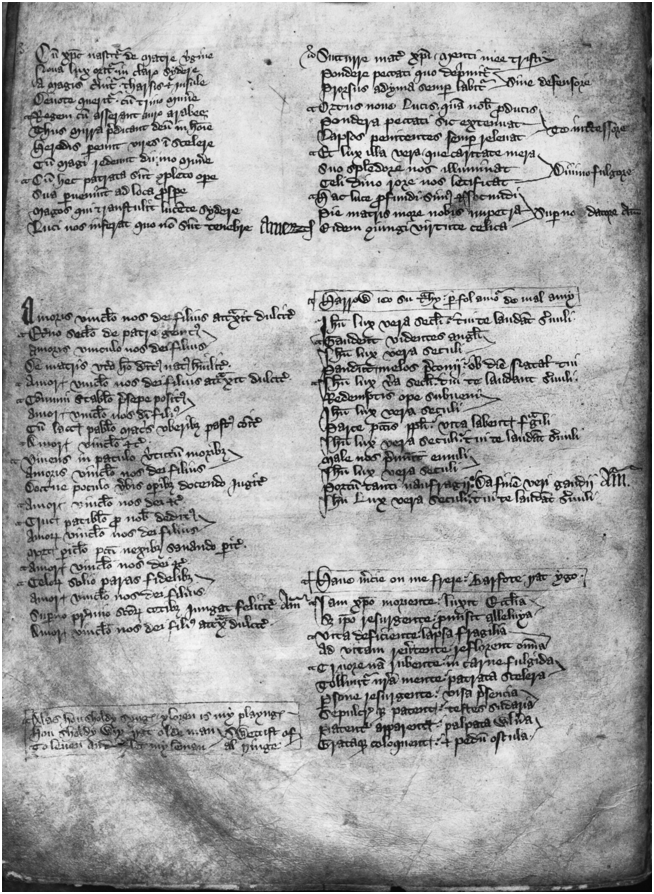
Figure 1 Long description
The folio is one of a number of folios in the Red Book of Ossory which presents Latin lyrics. A few lines of English language songs are written in a box above some of the Latin lyrics to demonstrate the tune they are to follow. The English text of the longest lyric, which is included in full in the text of this chapter and begins with, Alas how sholdy synge, appears in a box at the end of the left hand column.
Scholarship on Medieval English In Ireland
Two volumes produced in the 1980s offer contrasting approaches to the position of writing produced in the Middle Ages when charting the history of the literature of Ireland. A. Norman Jeffers’ Macmillan History of Literature: Anglo-Irish Literature (1982) addresses the issue head-on: ‘Can we then simply begin with Swift as the first major Anglo-Irish writer?’57 The chapter which deals with the medieval period is seventeen pages – almost a third the length of the other chapters – mostly summarising the political situation with a brief overview of literature in all languages on the island. Understandably, for the renowned Yeats scholar, the focus is on the modern period to which more than half the book is dedicated. Other volumes more blatantly ignore the earlier period. Seamus Deane’s A Short History of Irish Literature (1986) firmly locates the formation of the Anglo-Irish literary tradition in the seventeenth century and confines references to earlier material to the opening chapter on the Gaelic background.58 By his own admission, Gaelic literature receives short shift given the author’s linguistic skills, but medieval English-language literature is roundly dismissed – ‘The only literature of enduring quality was produced in Irish’, a statement somewhat contradicted by the acknowledgement that ‘there are historically interesting poems in Middle English like The Land of Cokaygne, a satire in rhymed couplets’, which is not examined.59 The Penguin Book of Irish Poetry (2010) makes a useful and conscious effort to include poetry from all periods, but its anthology format and insistence on offering only translations hampers real engagement with early material.60
The Middle Ages are dealt with in the three chapters in part one of Wiley Blackwell’s 2010 two-volume A Companion to Irish Literature. The first two chapters deal exclusively with Irish literature (parts of the Ulster and Finn cycle, respectively), with the third adopting a broader approach, addressing post-twelfth-century English (‘Anglo-Norman’) engagement with Irish-language literature.61 The inclusion of studies devoted to the latter is necessary and praiseworthy, but the exclusion of English-language material is unfortunate. It is unfair to expect general histories to adequately address the complexities of medieval literature, but the frequent summary dismissal of the entire period is disappointing.
In terms of overviews, exceptions to the general trend include Jeremiah Hogan’s slim but useful 1927 volume based on his doctoral thesis, The English Language in Ireland, and St John D. Seymour’s 1929 pioneering survey of relatively neglected literature in Anglo-Irish Literature 1200–1582.62 More recently, scholars have dealt with specific details of the corpus: Angus MacIntosh and Samuels’ study of the dialect of Ireland has been augmented by Michael Benskin, and their contribution to the original Linguistic Atlas of Late Mediaeval English (LALME) and its revised digital version eLALME remains an essential bibliographical tool to which scholars continue to be indebted for understanding the late medieval linguistic landscape.63 The atlas deploys linguistic analyses of phono-graphological features for dialectological identification (in dot maps) for England, Scotland, and Wales, but it lacks a map for Ireland. It does, however, present an index of localisable written sources across both Britain and Ireland. McIntosh and Samuels’ article ‘Prolegomena to the Study of Mediaeval Anglo-Irish’ presents a key preliminary survey of extant manuscripts and texts now augmented by Benskin’s work, which offers further detail on specific examples.64 Another recent important contribution is John Thompson’s survey study in ‘Books beyond England’, which analyses the literature in a wider context.65
General overviews of the material – for instance, Hogan’s 1927 The English Language in Ireland – require updating. In terms of specific manuscripts, Kathryn Kerby-Fulton has written on fifteenth-century literary culture and focused on the Piers Plowman produced in Ireland66 as well as the scribal culture of English Ireland,67 while Deborah Moore has examined material in the important BL Harley MS 913.68 No adequate overview yet exists exploring the place of this literature in the wider literary context of medieval Ireland or indeed within the wider ‘English Empire’. In spite of this, in the frame of Irish literature, the medieval predecessors form the earliest stage in Anglo-Irish literature, suggesting a link which connects them into the wider literary heritage on the island and these islands. The complexities of political traditions in Ireland, whereby the spring of the English language lies within the context of an ‘English’ colonial settlement, present obvious problems. This study does not pretend to incorporate the breadth of medieval Irish literature – that is a task for another day – but it is essential to acknowledge links between the medieval English-language tradition and the Gaelic world. The book aims to reclaim from obscurity medieval English literature from Ireland and demonstrate its interconnectedness with both the English, mostly bilingual, community in Ireland and the Gaelic sphere: the first step on the reintegration of this lost literary heritage into the academic and public consciousness of the English literary tradition in Ireland.
Assessing the Literary Landscape
What remains of our written medieval heritage in the language that would over the next few centuries become widespread in Ireland offers us a glimpse of the Anglophone world of late medieval Ireland. The English lordship of Ireland was a place where English law was established with a community based primarily along the coastal areas of the island, particularly in the east and southeast. This was a community made up of men and women recently arrived or born in Ireland who were considered legally English. Irish men and women in that same community bought and used English law rather than the Brehon law, which abounded in Gaelic-controlled parts of Ireland and was permitted, for practical reasons, in some parts of English Ireland.69 The community of English Ireland – ostensibly comprised of groups known as the English and loyal Irish – were situated in a ‘march’, a frontier zone, demarcating English and Gaelic territories.70 The inhabitants of the so-called loyal counties or obedient shires owed allegiance to the English king, and their territory alternated between being a land of war and a land of peace for much of this period.71 From the early days, the English community in Ireland had been obliged to arm themselves to defend their land, with the military fraternity the Order of St George being established in Ireland for that reason.72 By the fourteenth century, after the ravages of plague and continued hostile incursions into English land by Irish and English rebel forces, some long-established settlers in Ireland sold their land and departed. The late Middle Ages was not an easy time for the English community in Ireland. The fourteenth century – a period known to scholars as the Gaelic resurgence – saw growth in the strength of Gaelic communities.73 An effort to extract Ireland from the control of the English crown found support in this period in Gaelic Ireland for a Gaelic alliance drawing on the age-old political and cultural links between Ireland and Scotland.74 Edward Bruce, brother of Robert Bruce, King of Scotland, was crowned king of Ireland in 1316 during the ‘Bruce invasion’ of 1315–18.75 Edward’s death in 1318 at Faughart at the hands of John de Bermingham (later earl of Louth) closed that alternative history of Ireland, and the English presence endured.76 Gaelic culture remained strong as English control ebbed and flowed, and, by the later Middle Ages, English was the primary vernacular spoken in territories held by the English community in Ireland, with Irish the dominant vernacular in Ireland outside of small English spheres of influence.77 Given the myriad challenges besetting the English community in Ireland, it is unsurprising some feared their presence in Ireland was under threat.
Of course, the reality of late medieval Ireland did not pit all English against all Irish, nor indeed should we take all lamenting calls to England for aid from a flailing community at face value. Perhaps, however, partly because of rather lacklustre support from the English crown to the English community in Ireland, there was a considerable level of interaction between the English and Irish communities on the island. The most significant military intervention in Ireland by the crown was in the campaigns of King Richard II in 1394 and 1399.78 As well as purchasing English law, the Irish within and beyond the loyal counties married the English – creating alliances which sought to foster lasting bonds of kinship. As Kenneth Nicholls pointed out, ‘intermarriage between the two races [English and Irish] was common from the beginning’, and the children of such unions were entitled to privileges of English status at law.79 The initial diplomatic marriage between the earl of Pembroke, Richard de Clare ‘Strongbow’, and Diarmait Mac Murchada’s daughter, Aífe, in 1170 was strategic and paved the way for such cultural meshing as would later characterise much of the English community in Ireland. Fosterage of children, a practice common in the Gaelic world, was another crucial way to bridge gaps.
A poem in English, preserved in Sir John Davies’ seventeenth-century tract, A discouerie of the true causes why Ireland was neuer entirely subdued (1612), was reportedly enrolled by a scribe on the White Book (of the Exchequer) in the fourteenth century (Davies suggests ‘in a hand as auncient as the time of King Edward the third’) and neatly encapsulates the concerns of degeneration and Gaelicisation in the English community:
Engagement with the Gaelic community is also evident in the actions of some canny political figures who had to adapt to their circumstances, finding ways to maintain control in unstable or hostile territories. Such engagement was not welcomed by the English administration in England, who feared the English community in Ireland could degenerate and create lasting and dangerous bonds with the Irish community.81 If the scribe who penned this verse in the White Book is concerned with the adoption of English law by Irish (‘false English’), his concern about the effect on the English language and English rule would surely have been exacerbated by the writing of poetry in Irish by English magnates such as the Fitzgerald earls of Desmond. The Desmond earls initially held land in the twelfth century in county Limerick, but, by the sixteenth century, their holdings stretched across counties Limerick, Kerry, Cork, Tipperary, and Waterford. Their position, surrounded by Gaelic polities, meant that they became considerably Gaelicised, although their archive has not survived, and thus extensive administrative detail for the lordship is lacking.82
Paths to fostering more harmonious relations with neighbours in Ireland frequently took the English into closer contact with the Gaelic world than with the English crown and, as the aforementioned verse suggests, many of the English in Ireland felt such contact was inappropriate. Recurring royal pronouncements against the use of Irish culture, with particular attention paid to law, language, and dress indicate that this blurring of identities concerned the English crown.83 In the Gaelic sphere, meshing of communities and identities was perhaps tolerated rather than encouraged. The foremost Gaelic poet of his generation, Gofraidh Fionn Ó Dálaigh’s (d.1387) of Cork – an oft-quoted reference in a fourteenth-century poem for Gerald Fitzgerald, son and heir of the second earl of Desmond, a descendent of one of the English military leaders of the 1160s – outlines the ability of the Gaelic poets to adapt to their patron’s requirements, suggesting a calculated approach to serving any patrons willing to commission Gaelic poetry:
The presence of this humorous but rather surprising admission appears in a long poem dedicated to Gerald ‘a mheic an Iarla’ (son of the earl) asking him to mediate on the poet’s behalf with his father, Maurice, second earl of Desmond, who it appears has misunderstood the conventions (and often pseudo-sincerity) of bardic praise poetry and has taken issue with Ó Dálaigh’s contradictory material for other patrons (the Irish MacCarthys of Desmond and the O’Briens of Thomond were among his important patrons).86 If we believe this explanation of the cause of friction between the Irish poet and the English earl, it also suggests that participation of a Gaelicised English community in Gaelic culture might generally be assumed to indicate familiarity and participation with poetic conventions regardless of the potential insincerity of the rhetoric. Indeed, the recognition of such conventions by the English community in Ireland might explain why English statutes in Ireland (often written by men ordinarily based in England) argued vehemently against trusting Irish rhymers who might mislead English audiences, especially since the Irish in general were frequently characterised as untrustworthy. The expectation that poets would provide patrons with what they wished to hear was not confined to Gaelic bardic poetry, but, arguably, tensions might have run higher in Ireland, where the communities were more militarised and the political and social context (‘Goill’ versus ‘Gaoidhil’) was potentially more divisive.
‘Gearóid Iarla’ (Earl Gerald), the third earl of Desmond, perhaps understood this patron/poet transaction better than his father; he cut out the middleman and was known for his own literary output in Irish.87 We must be careful, however, not to link language to identity in this period: Gerald may have written in Irish, but even he had to acknowledge that, sometimes, the words and actions of the ‘Goill’ in Ireland were not compatible with the desires of Gaelic Ireland. One celebrated poem presents him as an agent of the crown defending his actions against the Irish:
Such sentiments, of course, may be little more than rhetoric. However, Joseph Leerson suggests that the use of the word ‘Éireannach’ here to describe the people of Ireland without reference to ethnic distinction suggests that Gerald felt an affinity to his Gaelic neighbours.89 Much like Ó Dálaigh before him, these comments may seek less to assuage his own guilt than to justify himself to those who are unhappy with his actions. In this context, ‘Éireannach’ may be a convenient rather than strongly felt association. Moreover, patronage of literature in Irish, either self-penned or commissioned, was not necessarily a sign of affinity with the ‘Gaoidhil’ but evidence of engagement with Gaelic culture. In addition to Desmond poets composing in Irish, a rubric by the main scribe in BL Harley MS 913 attributes a short proverb, ‘Soule su, simple, e saunz solas’ (I am alone, solitary, and without solace), to ‘Count Desmond’.90 Whether the poet in question is Gerald, third earl, or Maurice fitzThomas, first earl (both have been suggested), the proverb is a reminder that the earls were engaging in French not only with Gaelic culture but also with that of the English community. They were engaging with culture rather than becoming Gaelic. Language is not an exclusive marker of identity, and individuals and dynasties were likely comfortable with a more hybrid and fluid identity than our current inclination towards binaries demands.91
Engagement with Gaelic culture did not mean that the English and Irish in Ireland were not suspicious of each other’s motives. The issuing of the Statute of Kilkenny in 1366 in an attempt to curb what were seen as dangerous interactions between the English and the Irish is well known.92 The Desmond lordship has been described as ‘bi-cultural’, but they were not the only magnates alert to the value of engaging with the Gaelic world.93 Writing on the importance of prudence, the Dublin-based writer Yonge, in his Gouernaunce of Prynces (1422) for James Butler, fourth earl of Ormond (the subject of Chapter 6), warns against trusting Irish entertainers who may use their privileged position to gain access to English households and spy on the English: ‘he is an onwyse man that audyence or Yeftis yewyth to Rymoris othyr any Suche losyngeris, for thay Praysith hare yeueris be thay neuer So vicious’.94 It is often said that the passages relating to cultural control in the Statute of Kilkenny are overemphasised today. However, these cultural and linguistic concerns are reflected by Yonge, who reminds the earl of the penalty of excommunication to be issued to those who contravene the order: ‘Who-so ham any good yewyth brekyth the statutis of kylkeny, and he is acursid by a xj bisschopis, as the same Statutes makyth mencion. Sodaynly no thynge be-hete, for whan thou haste be-hote, more shalte thou yeue.’95 Ormond, a frequent patron of Gaelic as well as English literature, was unlikely to pay the warning much heed. Indeed, at the 1495 parliament called by Lord Deputy of Ireland Sir Edward Poyning (1494–5), the Statute of Drogheda (known as Poyning’s Law) repealed the Statute of Kilkenny.96
A potentially more important use of the English language as a symbol of English identity (and one potentially equally elusive in terms of impact) is in the declaration by Thomas Poltan on behalf of the English delegation at the Council of Constance in 1417. While arguing that England should be considered one of the main nations of Western Christendom along with Italy, Germany, France, and Spain, one of Poltan’s arguments (presented via written submission to be inserted subsequently, as the material was deemed too lengthy to be read at the council) points to language as a useful identifying and defining feature of a nation (‘natio’). He acknowledges that, unlike the French nation (‘natio Gallica’) – which has one language, French – ‘within the famous English or British nation [‘inclyta Anglicana, aliàs Britannica’], however, there are five languages … English, which English and Scots have in common, Welsh, Irish, Gascon and Cornish’, and, along with making strong claims for dismissing counter arguments from Scotland or Ireland, he suggests that England would be entitled to speak on behalf of Scotland, Wales, and Ireland.97 He continues, ‘It could be claimed with every right that there should be representation for as many nations as there are distinct languages. By even stronger right ought they, as a principal nation, to represent a fourth or fifth part of the papal obedience in a general council and elsewhere.’98 The claims made here for political hegemony over the other neighbouring nations is striking, but the rhetoric which connects the English language to England (and Scotland) is what is of significance for our purposes. Presumably Ormond would have pointed out that Ireland should have been included, and not just within that language bracket: to use Poltan’s words, ‘tertium regnum Hibernia, quod iam translatum est in Anglicos’ (the kingdom of Ireland which has now been translated to the English).99 The aforementioned translation, of course, is not related to language; in this case it refers to ‘translatio imperii’ (translation of rule), a framework of temporal and frequently Christian authority.
Conclusion
Many nineteenth-century scholars explored Middle English as if they were, as David Matthews puts it, ‘excavating it for its valuable contribution to a sense of the English past.’100 There is validity in exploring the medieval English-language literature of Ireland to do just that – to recapture a sense of this period. But the impetus to explore this literature requires a more sensitive understanding of the situation on the ground in late medieval English Ireland. Indeed, Ireland has long celebrated her literary heritage. The first female president of Ireland, Her Excellency Mary Robinson, spoke of the power of symbols and stories to transform Ireland and, addressing Ireland’s poetic heritage as she closed her Inaugural Speech at Dublin Castle, Monday, 3 December 1990, outlined her hope for her tenure: ‘May it be a Presidency where I the President can sing to you, citizens of Ireland, the joyous refrain of the fourteenth-century Irish poet as recalled by W. B. Yeats: “I am of Ireland … come dance with me in Ireland”.’101 President Robinson’s tenure welcomed Ireland’s exiles and immigrants, linking their past and present in order to forge a new and better future. Yeats’ medieval refrain was drawn from the fourteenth-century lyric quoted at the opening of this chapter. He used it to bolster his vision of an Ireland almost lost to time. This tiny medieval fragment brought to life anew in Yeats’ poem demonstrates how literature can serve as an opportunity as we reflect, discuss, and engage with Ireland’s cultural heritage and her history: