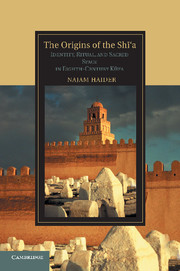
Book contents
- Frontmatter
- Contents
- Maps and Tables
- Acknowledgments
- Note on Transliteration and Dates
- Abbreviations
- Map IThe Middle East in the early Muslim period
- Part oneNarratives And Methods
- Part twoCase Studies
- Part threeThe Emergence of Shī’ism
- 6Dating Sectarianism
- 7The Problem of the Ambiguous Transmitter
- 8The Mosque and the Procession
- 9Conclusion
- Bibliography
- Index
8 - The Mosque and the Procession
Sacred Spaces and the Construction of Community
from Part three - The Emergence of Shī’ism
Published online by Cambridge University Press: 07 October 2011

Book contents
- Frontmatter
- Contents
- Maps and Tables
- Acknowledgments
- Note on Transliteration and Dates
- Abbreviations
- Map IThe Middle East in the early Muslim period
- Part oneNarratives And Methods
- Part twoCase Studies
- Part threeThe Emergence of Shī’ism
- 6Dating Sectarianism
- 7The Problem of the Ambiguous Transmitter
- 8The Mosque and the Procession
- 9Conclusion
- Bibliography
- Index
Summary
In Chapter 7, it was shown that ritual practice played a critical role in the construction of sectarian identity. The potency of practice was such that it often trumped adherence to seemingly problematic theological tenets. Traditions depict authorities from the late 1st/7th and early 2nd/8th centuries evaluating figures of uncertain loyalties by following them to mosques and observing them in prayer. These texts suggest that there was no established correlation between specific mosques and ritual practice as Kūfans from a range of sectarian identities might frequent the same venues and perform prayers in their own distinctive ways. This chapter traces the process by which this dynamic began to change through the increasing association of sacred space with ritual. The first section examines the transformation of neighborhood mosques affiliated with tribal groups into sectarian mosques. The second section discusses the integration of these sectarian mosques into a new religious geography comprised of friendly/sacred and hostile/accursed spaces. The final section highlights the merging of ritual and space in a new and powerful public affirmation of sectarian identity, namely pilgrimage (ziyāra).
From Tribal Mosque to Sectarian Space
To understand the process through which space was gradually appropriated by sectarian groups, it is necessary to begin with an examination of the urban development of Kūfa itself. In his seminal study of the city’s transformation from a garrison town to a major Muslim urban center, Hichem Djait highlights small neighborhood mosques founded by tribes and often named after prominent tribal elites. At the turn of the 1st/7th century, most Muslims frequented their local clan mosques except on special occasions (e.g., the Friday prayer) when they would venture to the cathedral mosque in the geographic center of the city.
Information
- Type
- Chapter
- Information
- The Origins of the Shi'aIdentity, Ritual, and Sacred Space in Eighth-Century Kūfa, pp. 231 - 248Publisher: Cambridge University PressPrint publication year: 2011
Accessibility standard: Unknown
Why this information is here
This section outlines the accessibility features of this content - including support for screen readers, full keyboard navigation and high-contrast display options. This may not be relevant for you.Accessibility Information
Accessibility compliance for the PDF of this chapter is currently unknown and may be updated in the future.