
Skip to main content Accessibility help
×
  • Cited by 8
    • Show more authors
    • You may already have access via personal or institutional login
    • Select format
    • Publisher:
      Cambridge University Press
      Publication date:
      05 November 2014
      17 November 2014
      ISBN:
      9781139342735
      9781107029934
      9781009679671
      Dimensions:
      (228 x 152 mm)
      Weight & Pages:
      0.81kg, 478 Pages
      Dimensions:
      (229 x 152 mm)
      Weight & Pages:
      0.769kg, 476 Pages
    You may already have access via personal or institutional login
  • Selected: Digital
    Add to cart View cart Buy from Cambridge.org

    Book description

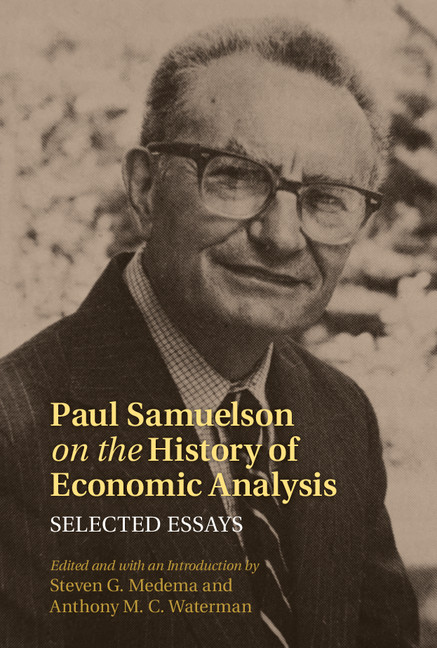
    As one of the most famous economists of the twentieth century, Paul Anthony Samuelson revolutionized many branches of economic theory. As a diligent student of his predecessors, he reconstructed their economic analyses in the mathematical idiom he pioneered. Out of Samuelson's more than eighty articles, essays, and memoirs, the editors of this collection have selected seventeen. Twelve are mathematical reconstructions of some of the most famous work in the history of economic thought - work by David Hume, François Quesnay, Adam Smith, Karl Marx, and others. One is a methodological essay defending the Whig history that he was sometimes accused of promulgating; two deal with the achievements of Joseph Schumpeter and Denis Robertson; and two review theoretical developments of his own time: Keynesian economics and monopolistic competition. The collection provides readers with a sense of the depth and breadth of Samuelson's contributions to the study of the history of economics.

    Reviews

    'This book’s editors begin with the observation that ‘perhaps 20 percent’ of Paul Samuelson’s scholarly publications ‘are clearly identifiable as studies of the history of economic thought’ (HET). As a tribute to this intellectual bequest, they have, with Samuelson’s animated collaboration, republished 17 of his HET papers and provided an exhaustive bibliography.'

    William Coleman Source: Economic Record

    Refine List

    Actions for selected content:

    Select all | Deselect all
    • View selected items
    • Export citations
    • Download PDF (zip)
    • Save to Kindle
    • Save to Dropbox
    • Save to Google Drive

    Save Search

    You can save your searches here and later view and run them again in "My saved searches".

    Please provide a title, maximum of 40 characters.
    ×

    Contents


    Page 1 of 2


    Page 1 of 2


    Samuelson’s Publications in the Historyof Economic Thought

    Essays and Technical Studies in the History of Economic Analysis

    1.“Wages and Interest: A Modern Dissection of Marxian Economic Models.” American Economic Review 47, no. 6 (1957): 884–912.
    2.“Wages and Interest: A Modern Dissection of Marxian Economic Models: Reply.” American Economic Review 50, no. 4 (1960): 719–721.
    3.“A Modern Treatment of the Ricardian Economy: The Pricing of Goods and of Labor and Land Services.” Quarterly Journal of Economics 73, no. 1 (1959): 1–35.
    4.“A Modern Treatment of the Ricardian Economy: Capital and Interest Aspects of the Pricing Problem.” Quarterly Journal of Economics 73, no. 2 (1959): 217–231.
    5.“The Transfer Problem and Transfer Costs: The Terms of Trade when Impediments Are Absent.” Economic Journal 62, no. 246 (1952): 278–304.
    6.“Review of H. Myint, Theories of Welfare Economics.” Economica 16, no. 64 (1949): 371–374.
    7.“Modern Economic Realities and Individualism.” The Texas Quarterly 6 (1963): 128–139.
    8.“Economists and the History of Ideas.” American Economic Review 52, no. 1 (1962): 1–18.
    9.“A Brief Survey of Post-Keynesian Developments.” In Keynes’ General Theory: Reports of Three Decades, Robert Lekachman, 331–347. New York: St. Martin’s Press, 1964.
    10.“Economic Theory and Wages.” In The Impact of the Union: Eight Economic Theorists Evaluate the Labor Union Movement, David McCord Wright, 312–342. New York: Harcourt, Brace, 1951.
    11.“Marxian Economics as Economics.” American Economic Review 57, no. 2 (1967): 616–623.
    12.“Understanding the Marxian Notion of Exploitation: A Summary of the So-Called Transformation Problem Between Marxian Values and Competitive Prices.” Journal of Economic Literature 9, no. 2 (1971): 399–431.
    13.“The ‘Transformation’ from Marxian ‘Values’ to Competitive ‘Prices’: A Process of Rejection and Replacement.” Proceedings of the National Academy of Sciences of the United States of America 67, no. 1 (1970): 423–425.
    14.“An Exact Hume-Ricardo-Marshall Model of International Trade.” Journal of International Economics 1, no. 1 (1971): 1–18.
    15.“What Classical and Neoclassical Monetary Theory Really Was.” Canadian Journal of Economics 1, no. 1 (1968): 1–15.
    16.“Irving Fisher and the Theory of Capital.” In Ten Economic Studies in the Tradition of Irving Fisher, William Fellner. New York: John Wiley, 1967.
    17.“The Way of an Economist.” In International Economic Relations: Proceedings of the Third Congress of the International Economic Association, Paul A. Samuelson, 1–11. London: Macmillian, 1969.
    18.“Economic Growth.” In Gendaisekai Hyakka Daijiten, vol. 1. Tokyo: Kodansha Ltd., 1971.
    19.“Marx as Mathematical Economist: Steady-State and Exponential Growth Equilibrium.” In Trade, Stability, and Macroeconomic Essays in Honor of Lloyd A. Metzler, George Horwich and Paul A. Samuelson, 269–307. New York: Academic Press, 1974.
    20.“Optimality of Profit-Including Prices Under Ideal Planning: Marx’s Model.” Proceedings of the National Academy of Sciences of the United States of America 70, no. 7 (1973): 2109–2111.
    21.“The Economics of Marx: An Ecumenical Reply.” Journal of Economic Literature 10, no. 1 (1972): 51–57.
    22. Samuelson’s “Reply on Marxian Matters,” Journal of Economic Literature 11, no. 1 (1973): 64–68.
    23.“Insight and Detour in the Theory of Exploitation: Reply to Baumol.” Journal of Economic Literature 12, no. 1 (1974): 62–70.
    24.“Rejoinder: Merlin Unclothed, A Final Word.” Journal of Economic Literature 12, no. 1 (1974): 75–77.
    25.“Review of V. K. Dmitriev, Economic Essays on Values, Competition, and Utility.” Journal of Economic Literature 12, no. 2 (1975): 491–495.
    26.“The Art and Science of Macromodels Over 50 Years.” In The Brookings Model: Perspective and Recent Developments, Gary Fromm and Lawrence R. Klein, 3–10. Amsterdam: North-Holland, 1975.
    27.“Adam the Immortal.” Pennsylvania Gazette, University of Pennsylvania, November 1976, 26–27.
    28.“A Modern Theorist’s Vindication of Adam Smith.” American Economic Review 67, no. 1 (1977): 42–49.
    29.“The Canonical Classical Model of Political Economy.” Journal of Economic Literature 16, no. 4 (1978): 1415–1434.
    30.“Noise and Signal in Debates Among Classical Economists: A Reply.” Journal of Economic Literature 18, no. 2 (1980): 575–578.
    31.“A Corrected Version of Hume’s Equilibrating Mechanism for International Trade.” In Flexible Exchange Rates and the Balance of Payments: Essays in Memory of Egon Sohmen, John S. Chipman and Charles P. Kindleberger, 141–158. Amsterdam: North-Holland, 1980.
    32.“Bergsonian Welfare Economics.” In Economic Welfare and the Economics of Soviet Socialism: Essays in Honor of Abram Bergson, Steven Rosefielde, 223–266. Cambridge: Cambridge University Press, 1981.
    33.“A Chapter in the History of Ramsey’s Optimal Feasible Taxation and Optimal Public Utility Prices.” In Economic Essays in Honor of Jørgen H. Gelting, Svend Andersen, Kartsen Larsen, P. Norregaard Rusmussen, and J. Vibe-Pedersen, 157–181. Copenhagen: Danish Economic Association, 1982.
    34.“Paul Douglas’s Measurement of Production Functions and Marginal Productivities.” Journal of Political Economy 87, no. 5 (1979): 923–939.
    35.“Schumpeter as an Economic Theorist.” In Schumpeterian Economics, Helmut Frisch, 1–27. London: Praeger, 1982.
    36.“1983: Marx, Keynes and Schumpeter.” Eastern Economic Journal 9, no. 3 (1983): 166–180.
    37.“The Keynes Centenary.” The Economist, 25 June 1983, 19–21.
    38.“The House that Keynes Built.” New York Times, 29 May 1983.
    39.“Succumbing to Keynesianism.” Challenge 27 (1985): 4–11.
    40.“Comment (on Axel Leijonhufvud’s ‘What Would Keynes Have Thought of Rational Expectations?’).” In Keynes and the Modern World, David Worswick and James Trevithick, 212–221. Cambridge: Cambridge University Press, 1983.
    41.“The Normative and Positivistic Inferiority of Marx’s Values Paradigm.” Southern Economic Journal 49, no. 1 (1982): 11–18.
    42.“Marx Without Matrices: Understanding the Rate of Profit.” In Marxism, Central Planning, and the Soviet Economy: Economic Essays in Honor of Alexander Erlich, Padma Desai, 3–18. Cambridge, Mass.: The MIT Press, 1983.
    43.“Thünen at Two Hundred.” Journal of Economic Literature 21, no. 4 (1983): 1468–1488.
    44.“Quesnay’s ‘Tableau Economique’ as a Theorist Would Formulate It Today.” In Classical and Marxian Political Economy: Essays in Honor of Ronald L. Meek, Ian Bradley and Michael Howard, 45–78. New York: St. Martin’s Press, 1982.
    45.“Land and the Rate of Interest.” In Theory for Economic Efficiency: Essays in Honor of Abba P. Lerner, Harry I. Greenfield, Albert M. Levenson, William Hamovitch, and Eugene Rotwein, 167–185. Cambridge, Mass.: The MIT Press, 1979.
    46.“Correcting the Ricardo Error Spotted in Harry Johnson’s Maiden Paper.” Quarterly Journal of Economics 91, no. 4 (1977): 519–553.
    47.“Yes to Robert Dorfman’s Vindication of Thünen’s Natural-Wage Derivation.” Journal of Economic Literature 24, no. 4 (1986): 1777–1785.
    48.“Out of the Closet: A Program for the Whig History of Economic Science.” History of Economics Society Bulletin 9, no. 1 (1987): 51–60.
    49.“Mathematical Vindication of Ricardo on Machinery.” Journal of Political Economy 96, no. 2 (1988): 274–282.
    50.“Wicksell and Neoclassical Economics.” In The New Palgrave: A Dictionary of Economics, John Eatwell, Murray Milgate, and Peter Newman, 908–910. London: Macmillan, 1987.
    51.“How Economics Has Changed.” Journal of Economic Education 18, no. 2 (1987): 107–110.
    52.“Wicksells Werk und Persönlichkeit—Eine kritische Analyse in Moderner Sicht.” In Knut Wicksell: Finanztheoretische Untersuchungen nebst Darstellung und Kritik des Steuerwesens Schwedens, Klassiker der Nationalökonomie, 25–36. Düsseldorf: Verlag Wirtschaft und Finanzen GmbH, 1988.
    53.“Ricardo was Right!” Scandinavian Journal of Economics 91, no. 1 (1989): 47–62.
    54.“Conversations with my History-of-Economics Critics.” In Economics, Culture, and Education: Essays in Honour of Mark Blaug, Graham Keith Shaw, 3–13. Aldershot, U.K.: Elgar, 1991.
    55.with Don Patinkin and Mark Blaug. “On the Historiography of Economics: A Correspondence.” Journal of the History of Economic Thought 13, no. 2 (1991): 144–158.
    56.“The Fitness Maximized by the Canonical Classical Model: A Theme From Houthakker and R. A. Fisher.” In Aggregation, Consumption, and Trade: Essays in Honor of H. S. Houthakker, Louis Phlips and Lester D. Taylor, 9–20. Boston: Kluwer Academic, 1992.
    57.“Marx on Rent: A Failure to Transform Correctly.” Journal of the History of Economic Thought 14, no. 2 (1992): 143–167.
    58.“Gustav Cassel’s Scientific Innovations: Claims and Realities.” History of Political Economy 18, no. 3 (1993): 515–527.
    59.“Two Classics: Böhm-Bawerk’s Positive Theory and Fisher’s Rate of Interest through Modern Prisms.” Journal of the History of Economic Thought 16, no. 2 (1994): 202–228.
    60.“The Classical Classical Fallacy.” Journal of Economic Literature 32, no. 2 (1994): 620–639.
    61.“Who Innovated the Keynesian Revolution?” In Economics, Econometrics and the LINK: Essays in Honor of Lawrence R. Klein, M. Dutta, 3–19. Amsterdam: North-Holland, 1995.
    62.“Isolating Sources of Sterility in Marx’s Theoretical Paradigms.” In Essays in Honour of Geoff Harcourt, vol. 1, Philip Arestis, Gabriel Palma, and Malcolm Sawyer, 187–198. London: Routledge, 1996.
    63.“Credo of a Lucky Textbook Author.” Journal of Economic Perspectives 11, no. 2 (1997): 153–160.
    64.“How Foundations Came to Be.” Journal of Economic Literature 36, no. 3 (1998): 1375–1386.
    65.“Requiem for the Classic Tarshis Textbook That First Brought Keynes to Introductory Economics.” In Keynesianism and the Keynesian Revolution in America: A Memorial Volume in Honour of Lorie Tarshis, O. F. Hamouda and B. B. Price, 53–58. Cheltenham, U.K.: Elgar, 1998.
    66.”Land.” In The Elgar Companion to Classical Economics, vol. 2, Heinz D. Kurz and Salvatori Neri, 27–36. Cheltenham, U.K.: Elgar, 1998.
    67.“Samuelson, Paul Anthony, as an Interpreter of the Classical Economists.” In The Elgar Companion to Classical Economics, vol. 2, Heinz D. Kurz and Salvatori Neri, 329–333. Cheltenham, U.K.: Elgar, 1998.
    68.“John Bates Clark: America’s First Great Theorist.” In John Bates Clark, the Distribution of Wealth, Klassiker der Nationalökonomie, 55–72. Dusseldorf: Verlag Wirtschaft und Finanzen GmbH, 1999.
    69.“A Quintessential (Ahistorical) Tableau Économique: to Sum up Pre- and Post-Smith Classical Paradigms.” In Economics Broadly Considered: Essays in Honor of Warren J. Samuels, Jeff E. Biddle, John B. Davis, and Steven G, Medema, 47–60. London: Routledge, 2001.
    70.“Ricardo, David (1772-1823).” In International Encyclopedia of Social and Behavioral Sciences, Neil J. Smelser and Paul B. Baltes, 13330–13334. New York: Elsevier, 2001.
    71.“Economic History and Mainstream Economic Analysis.” Rivista di Storia Economica 17, no. 2 (2001): 271–277.
    72.“A Modern Post-Mortem on Böhm’s Capital Theory: Its Vital Normative Flaw Shared by Pre-Sraffian Mainstream Capital Theory.” Journal of the History of Economic Thought 23, no. 3 (2001): 301–317.
    73.“Where Ricardo and Mill Rebut and Confirm Arguments of Mainstream Economists Supporting Gobalization.” Journal of Economic Perspectives 18, no. 3 (2004): 135–146.
    74.with Erkko M. Etula. “Two Alternative Hypothetical ‘Lost’ 1814 Ricardo Manuscripts: New-Century Bearings.” History of Political Economy 38. No. 1 (2006): 1–14.
    75.“Thünen—An Economist Ahead of His Times.” Preface to The Isolated State in Relation to Agriculture and Political Economy, Part III, Translated by Keith Tribe, Ulrich van Suntum, xii–xiv. Basingstoke, U.K.: Palgrave Macmillan, 2009
    76.‘The Harvard Circle.” Journal of Evolutionary Economics, forthcoming.

    Commentaries on Contemporaries and Near-Contemporaries

    77.“Lord Keynes and the General Theory,” Econometrica 14 (July 1946): 187–200.
    78.“Harold Hotelling as Mathematical Economist.” American Statistician 14 (June 1960): 21–25.
    79.“D.H. Robertson (1890–1963).” Quarterly Journal of Economics 77 (November 1963): 517–536.
    80.“A.P. Lerner at Sixty.” Review of Economic Studies 31 (June 1964): 169–178.
    81.“Galbraith.” Newsweek (July 3, 1967).
    82.“Marx’s Das Kapital.” Newsweek (October 16, 1967).
    83.“Who’s Who in Economics.” Newsweek (January 19, 1970): 78.
    84.“Joseph Schumpeter.” Newsweek (April 13, 1970): 75.
    85.“Lenin.”Newsweek (December 7 1970): 86.
    86.“John Maynard Keynes.” Part III of Geschichte der Politischen Okonomie, Horst Claus Recktenwald. Stuttgart: Kroner, 1971: 556–565.
    87.“Rosa Luxemburg.”Newsweek (October 25, 1971): 99.
    88.“Jacob Viner, 1892–1970.” Journal of Political Economy 80 (Jan/Feb 1972): 5–11.
    89.“Frank Knight – 1885–1972.” Newsweek (July 31, 1972): 55.
    90.“The 1972 Nobel Prize for Economic Science.” Science 178 (November 3, 1972): 487–489.
    91.“Nobel Laureate Leontief.” Newsweek (November 5, 1973): 94.
    92.“Remembrances of Frisch.” European Economic Review 5 (June 1974): 7–23.
    93.“Nobel Choice: Economists in Contract.” New York Times (October 10, 1974): op-ed page.
    94.“Joseph Alois Schumpeter.” in Dictionary of American Biography, Supplement 4, 1946–1950. New York: Charles Scribner’s Sons, 1974.
    95.“Alvin Hansen as Creative Economist.” Quarterly Journal of Economics 90 (February 1976): 24–31.
    96.“Nobel Laureates Meade and Ohlin.” New York Times (October 15, 1977).
    97.“Paul Douglas’s Measurement of Production Functions and Marginal Productivities.” Journal of Political Economy 87 (October 1979, Part I): 923–939.
    98.“The Year 1983: Keynes, Schumpeter and Marx.” Japan Economic Journal 11 (January 1983).
    99.“The Centennial of Keynes.” Nihon Keizai Shimbun (June 5, 1983).
    100.“Piero Sraffa (1898–1983).” Published as “Un genio con poche opere,” Corriere della Sera (March 6, 1983).
    101.“The 1983 Nobel Prize in Economics.”Science (December 2, 1983).
    102. Article on the MIT Economics Department. Technique (Massachusetts Institute of Technology), 1984.
    103.“The 1984 Nobel Prize in Economics.” Science (January 4, 1985).
    104.“The 1985 Nobel Prize in Economics.” Science (March 21, 1986): 1399–1401.
    105.“An Economist’s Economist.” (Obituary for Walter Heller) New York Times (June 23, 1987).
    106.“Walter Heller Obituary.” The Independent (June 20, 1987).
    107.“Sparks from Arrow’s Anvil.” In Arrow and the Foundations of the Theory of Economic Policy, George R. Feiwel, 154–178. London: Macmillan, 1987.
    108.“In the Beginning” (on Keynesian Economics at Harvard). Challenge (July–August 1988).
    109.“The Passing of the Guard in Economics.” Eastern Economic Journal 14 (4 1988): 319–29.
    110. Interview by Marjorie Turner for Joan Robinson and the Americans. Armonk, NY: M.E. Sharpe, 1989.
    111.“Trygve Haavelmo 1989 Nobel Laureate in Economics.” Bilanz (October 1989).
    112.“Remembering Joan.” In Joan Robinson and Modern Economic Theory, George R. Feiwel, 121–143. New York: New York University Press, 1989.
    113.“Galbraith as Artist and Scientist.” In Unconventional Wisdom: Essays on Economics in Honor of John Kenneth Galbraith, Samuel Bowles et al., 123–128. Boston: Houghton Mifflin, 1989.
    114.“Gottfried Haberler as Economic Sage and Trade Theory Innovator.” Wirtschaftpolitische Blatter (April 1990).
    115.“Tribute to Nicholas Georgescu-Roegen on his 85th Birthday.” Libertas Mathematica 10 (1990): 1–4.
    116.“Sraffa’s Other Leg.” Economic Journal 101 (May 1991): 570–574.
    117.“Tribute to R.M Goodwin.” In Celebrating R. M. Goodwin’s 75th Birthday, Massimo Di Matteo. Universita Degli Studi di Siena (May 1990).
    118.“Richard Kahn: His Welfare Economics and Lifetime Achievement.” Cambridge Journal of Economics 18 (1994): 55–72.
    119.“Tribute to Wolfgang Stolper on the Fiftieth Anniversary of the Stopler-Samuelson Theorem.” In The Stolper-Samuelson Theorem: A Golden Jubilee, 343–349. Ann Arbor: University of Michigan Press, 1994.
    120.“The To-Be-Expected Angst Created for Economists by Mathematics.” Eastern Economic Journal 20 (Winter 1994): 267–273.
    121.“Gottfried Haberler (1990-1995).” Economic Journal 106 (November 1996): 1679–1687.
    122.“Some Memories of Norbert Wiener.” Proceedings of Symposia in Pure Mathematics 60: The Legacy of Norbert Wiener: A Centennial Symposium, D. Jerison, I. M. Singer, and D. W. Stroock, 37–42. Providence, RI: American Mathematical Society, 1997.
    123.“Report Card on Sraffa at 100.” European Journal of the History of Economic Thought 3 (Autumn 1998): 458–467.
    124.“My John Hicks.” Indian Journal of Applied Economics, Part I:7 (October–November 1998). Also published as Chapter 1 in John Hicks: His Contributions to Economic Theory and Applications, K. Puttaswamaiah, 1–4. New Brunswick, NJ: Transaction Publishers, 2001.
    125.“Sraffa’s Hits and Misses.” In Critical Essays on Piero Sraffa’s Legacy in Economics, Heinz D. Kurz, 111–152. Cambridge: Cambridge University Press, 2000.
    126.“My Bertil Ohlin.” In Bertil Ohlin: A Centennial Celebration (1899-1999), Ronald Findlay, Lars Jonung, and Mats Lundahl, 51–61. Cambridge, MA: MIT Press, 2002.
    127.“Edmund Phelps, Insider-Economists’ Insider.” In Knowledge, Information, and Expecations in Modern Economics in Honor of EdmundS. Phelps, P. Aghion, R. Frydman, J. Stiglitz, and M. Woodford, 1–2. Princeton, NJ: Princeton University Press, 2003.
    128.“Multiple Priorities in Evolving Scholarly Disciplines.” History of Political Economy 35 (Summer 2003): 333–334.
    129.“Reflections on the Schumpeter I Knew Well.” Journal of Evolutionary Economics 13 (2003): 463–467.
    130.“Abram Bergson, Economist.” Economic Journal 115 (February 2005): F130–F135.
    131.“Franco: A Mind Never at Rest.” Banca Nazionale del Lavoro Quarterly Review 58 (June–September 2005): 5–9.
    132.“Wassily Leontief 1906-1999.” Foreword to Wassily Leontief and Input-Output Analysis, P. Puttaswamaiah. Vijayanagar. Bangalore: International Journal of Applied Economics and Econometrics, 2006.
    133.“Franco Modigliani, 1918-2003.” Foreword to Franco Modigliani, Peerless Twentieth-Century Macroeconomist, P. Puttaswamaiah. Vijayanagar, Bangalore: International Journal of Applied Economics and Econometrics, 2006.
    134.“Reflections on How Biographies of Individual Scholars Can Relate to a Science’s Biography” (Co-editor’s foreword). In Inside the Economist’s Mind, W. A. Barnett and P. A. Samuelson, viii–x. Oxford: Blackwell, 2006.
    135.“Franco, Dear Friend and Wonderful MIT Colleague.” In Reforming European Pension Systems, Arun Muralidhar and Serge Allegrezza, 5–7. Amsterdam: Dutch University Press, 2007.
    136.“John Hicks: An Economist Ever Greater than His High Reputation.” In Markets, Money and Capital: Hicksian Economics for the Twenty-First Century. Roberto Scazzieri, Amartya Sen, and Stefano Zamagni, 49–51. Cambridge: Cambridge University Press, 2008.
    137.“A Few Remembrances of Friedrich von Hayek (1899–1992).” Journal of Economic Behavior and Organization 69 (January 2009): 1–4.
    138.“Robert Merton Solow.” In International Encyclopedia of the Social Sciences, 2nd edn., William Darity. Farmingham Hills, MI: Macmillan Reference, 2009.
    139.“The Richard Goodwin Circle at Harvard (1938–1950).” In Computable, Constructive and Behavioural Economic Dynamics: Essays in Honour of Kumaraswamy (Vela) Velupillai, 49–55. Abingdon: Routledge, 2010.

    Metrics

    Altmetric attention score

    Full text views

    Total number of HTML views: 0
    Total number of PDF views: 0 *
    Loading metrics...

    Book summary page views

    Total views: 0 *
    Loading metrics...

    * Views captured on Cambridge Core between #date#. This data will be updated every 24 hours.

    Usage data cannot currently be displayed.

    Accessibility standard: Unknown

    Why this information is here

    This section outlines the accessibility features of this content - including support for screen readers, full keyboard navigation and high-contrast display options. This may not be relevant for you.

    Accessibility Information

    Accessibility compliance for the HTML of this book is currently unknown and may be updated in the future.
