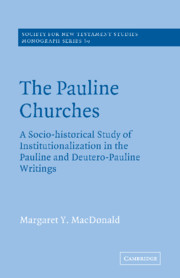
 The Pauline Churches
A Socio-Historical Study of Institutionalization in the Pauline and Deutrero-Pauline Writings
Book contents
- Frontmatter
- Contents
- Preface
- Abbreviations
- INTRODUCTION
- 1The project
- 2The social sciences and New Testament interpretation
- 3Methodological limits and possibilities
- 4Where from here?
- PART 1PAUL: COMMUNITY-BUILDING INSTITUTIONALIZATION
- PART 2COLOSSIANS AND EPHESIANS: COMMUNITY-STABILIZING INSTITUTIONALIZATION
- PART 3THE PASTORAL EPISTLES: COMMUNITY-PROTECTING-INSTITUTIONALIZATION
- 1Attitudes to the world/ethics
- 2Ministry
- 3Ritual
- 4Belief
- CONCLUSION
- Notes
- Biblography
- Index of Biblical passages discussed
- Subject index
Summary
The following study analyzes authority structures in the community of the Pastorals. It investigates how the pseudonymity of the epistles functions in an attempt to exercise control in community life. The importance of the Greco-Roman household as a model for ministerial organization is considered. The connection between criteria for leadership positions and the attempt to protect the household of God against divisive forces is illustrated.
The Paul of the Pastorals
Throughout this study the process of cumulative institutionalization, involving the construction, solidification, and transformation of the Pauline symbolic universe, has been considered. Three stages of the institutionalization process have been delineated. Paul's letters have been studied in terms of the process of ‘community-building institutionalization’. In these early days of the Pauline movement the process of institutionalization was relatively open – it could proceed in many different directions.
Colossians and Ephesians have been seen to reflect the process of ‘community-stabilizing institutionalization’. This level of institutionalization is associated with the disappearance of Paul. Paul's work was being carried out by a circle of his associates to whom it seemed natural to write in the name of their inspiring leader. At the level of ‘community-stabilizing institutionalization’, the Pauline communities were in possession of a fairly solidified symbolic universe shaped under Paul's influence. Future institutionalization would be guided by a corporate tradition which included the major contributions made by Paul.
Information
- Type
- Chapter
- Information
- The Pauline ChurchesA Socio-Historical Study of Institutionalization in the Pauline and Deutrero-Pauline Writings, pp. 203 - 220Publisher: Cambridge University PressPrint publication year: 1988
Accessibility standard: Unknown
Why this information is here
This section outlines the accessibility features of this content - including support for screen readers, full keyboard navigation and high-contrast display options. This may not be relevant for you.Accessibility Information
Accessibility compliance for the PDF of this chapter is currently unknown and may be updated in the future.