1.1 Introduction
The evidence concerning the institutional organization, the juridical nature and the inner intellectual life of the early Academy is notoriously scant and of problematic documentary value.Footnote 1 Especially unfortunate is our lack of detailed and reliable information about Plato’s motives and purposes for establishing the school, as well as his research work, manner of instruction and management activity within it.
In the face of this regrettable state of affairs and the scholarly logomachy caused by it, we may nevertheless at least reasonably suppose that, despite Plato’s disparagement of written expositions,Footnote 2 the close study of his dialogues must have played some significant role in the philosophical education and independent work of the Early Academics. Diogenes Laertius, relying on Favorinus, mentions a collective reading of Plato’s dialogue on the soul, viz. the Phaedo, attended by Aristotle and others.Footnote 3 Aristotle himself names explicitly or alludes to all Platonic dialogues, with the only and probably accidental exceptions of Euthyphro, Crito and Parmenides.Footnote 4 He also famously reports in Cael. A 10 a controversy over the problem of the eternity of the cosmos, most likely prompted by the Timaeus’ cosmogenetic myth.Footnote 5 Other examples could be referenced, but these few data should suffice to conclude that Plato’s dialogues were closely read and examined, their interpretation debated, and their views collegially discussed as part of the school’s diatribai.Footnote 6 This could hardly remain without consequences for the autonomous doctrinal elaboration of Plato’s early associates.Footnote 7
This chapter explores the case of the Sophist. Unlike that of other dialogues, such as Parmenides and Timaeus,Footnote 8 the Early Academic reception of the Sophist has not yet been subjected to a comprehensive reconstruction. This chapter is not meant to be exhaustive either, but aims to make a first step towards such reconstruction.Footnote 9 As my title suggests, I focus on the topics of categories, being and not-being. With respect to these topics, I argue that the Sophist prompted the reflection of the Early Academics on at least two main fronts: (1) the elaboration of binary divisions of entities; and (2) the critical reaction to Eleatic monism. In doing so, I also bring out ways in which this can shed light on aspects of the background of Aristotle’s ontology and theory of predication; and I rediscuss the problem, recently brought to scholarly attention especially by Sedley (Reference Sedley, Erler, Heßler and Petrucci2021), of the Early Academic composition of a textual canon functional to a work of systematization of Platonism.
1.2 Binary Divisions of Beings
1.2.1 The Sources and the Platonic Background
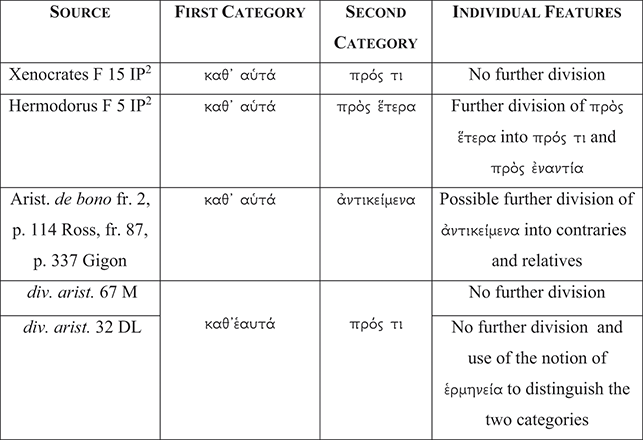
If we look at the extant Early Academic sources, we find no fewer than four instances of ontological classifications into two kinds or classes, often called in the literature ‘absolutes’ and ‘relatives’: Xenocrates F 15 IP2 = Simp. in Cat. 63.22–25; div. arist. 67 M/32 DL; Hermodorus F 5 IP2 = Simp. in Ph. 247.31–33; Alex. Aphrod. in Metaph. 56.13–21 = Arist. de bono fr. 2, p. 114 Ross, fr. 87, p. 337 Gigon.Footnote 10 None of these texts affords a mention of the term κατηγορία, but I follow a common use and speak of ‘categories’ (and cognates), by taking this term in its ordinary meaning of class, or division, in any general scheme of classification (cf. e.g. OED, s.v. 2b).
Despite various scholarly attempts to assimilate and integrate these texts, they display major differences in both terminology and content. Xenocrates’ F 15 IP2 and the div. arist. 67 M/32 DL divide beings into καθ’ αὑτά (or καθ’ ἑαυτά) and πρός τι; whereas Aristotle’s de bono contrasts καθ’ αὑτά with ἀντικείμενα. Hermodorus even places πρός τι, along with πρὸς ἐναντία, under a more general class of πρὸς ἕτερα. If the ἀντικείμενα of Aristotle’s de bono are to be interpreted, as seems plausible, in the sense of Cat. 10 and other akin Aristotelian texts,Footnote 11 that is, as including both contraries and relatives, then Hermodorus’ πρὸς ἕτερα and the ἀντικείμενα of Aristotle’s de bono are intentionally and extensively similar categories. But nothing entitles us to say the same of the πρός τι of Xenocrates’ F 15 IP2 and the div. arist. 67 M/32 DL. Further, the div. arist. 32 DL (but not 67 M) explains the opposition between καθ’ ἑαυτά and πρός τι through the notion of ‘expression’ (ἑρμηνεία), absent from all other sources. Moreover, Aristotle’s de bono and Hermodorus frame the bicategorial distinction in a discussion of principles, though in significantly different ways; whereas Xenocrates and the div. arist. 67 M/32 DL do not (more on this later). The scheme in Figure 1.1 enables us to visualize this more clearly:
Early Academic bicategorial schemes
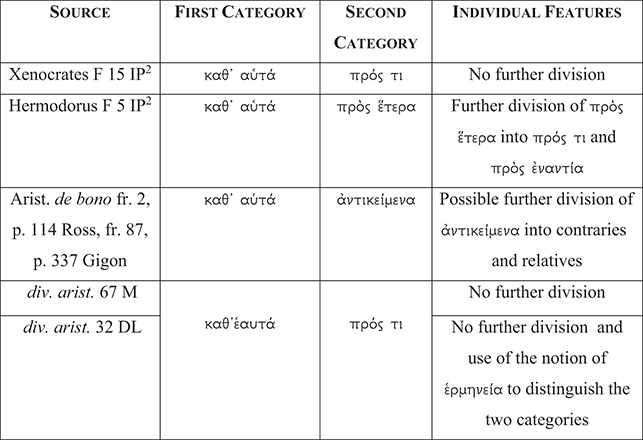
Figure 1.1 Long description
The table compares Early Academic bicategorical ontological schemes from four sources: Xenocrates (F 15 I P superscript 2), Hermodorus (F 5 I P superscript 2), Aristotle’s De bono (fr. 2, p. 114 Ross, fr. 87, p. 337 Gigon), and the divisio aristotelea 67 M/32 D L. It lists for each source the name of the first category (καθ’ αὐτά or, for the divisio aristotelea καθ’ἑαυτά), the name of the second category (πρός τι for Xenocrates and the divisio aristotelea; πρὸς ἕτερα for Hermodorus, ἀντικείμενα in Aristotle’s De bono), and individual features of each scheme - Hermodorus, unlike Xenocrates and the divisio aristotelea 67 M, further divides his second category into πρός τι and πρὸς ἐναντία; Aristotle’s De bono may implicitly divide ἀντικείμενα further into contraries and relatives, the divisio aristotelea 32 D L uses the notion of ἐρμηνεία (expression) to distinguish the two categories.
Thus, the only things these texts actually end up converging on are the binary character of their ontological classifications and the name of the first category. There is no unique and consistent ‘Academic doctrine of the categories’, just like there is no unique ‘Academic doctrine of principles’. That convergence, however, is salient and invites the supposition, in itself compatible with the non-dogmatic character of Plato’s teaching,Footnote 12 of a common Platonic inspiration of this categorization (cf. e.g. Berti Reference Berti2010, 141–142). This supposition is confirmed, as scholars have repeatedly pointed out, by Sophist 255c13–14:
ΞΕ. Ἀλλ’ οἶμαί σε συγχωρεῖν τῶν ὄντων τὰ μὲν αὐτὰ καθ’ αὑτά, τὰ δὲ πρὸς ἄλλα ἀεὶ λέγεσθαι.
Eleatic Stranger But I think you agree that among beings some are said in and of themselves, others always relatively to other things.
The traditional interpretation of this most controversial passageFootnote 13 takes Plato to be distinguishing two kinds of beings: beings in themselves and beings relative to others (cf. Crivelli Reference Crivelli2012, 143 and n. 116). I have argued elsewhere that this reading is the most cogent (cf. Granieri Reference Granieri2021). In any case, it was likely the one assumed by the Early Academics (cf. again Crivelli Reference Crivelli2012, 147–148).
Other Platonic passages have been invoked as a background of Early Academic bicategorial schemes.Footnote 14 None of them, however, is as germane or explicit as Sph. 255c13–14.Footnote 15 For example, Chrm. 168b–169b, Resp. 438a–e and Prm. 133c–134a set out classifications of relatives, not distinctions between absolutes and relatives. The unwritten doctrines have also been invoked, but we shall see in Section 1.2.3 that this indication is, though not impossible, at least debatable and in any case uneconomical. There is no need to appeal to the indirect tradition when the relevant evidence is already at hand in the dialogues and we know the Academics subjected the dialogues to scrutiny.
So the root of these various Early Academic bicategorial schemes is Sophist 255c13–14. This was my first thesis: the Sophist prompted the reflection of the Early Academics on the elaboration of binary divisions of entities. Before moving to my second thesis, however, I want to say more on the interpretation of these various schemes. I will not discuss each of them individually (cf. n. 10), but confine myself to challenging two received general interpretations of these binary schemes: (a) the former regards them as fundamentally equivalent to Aristotle’s substance/accidents contrast; (b) the latter makes them subservient to an argument for principles. Assessing these two views helps us shed light on the exact import of these various schemes.
1.2.2 The Ancient History of the Bicategorial Scheme and Aristotle’s Substance/Accidents Contrast
Let us start with (a). It first proves expedient to clarify its remote provenance. The ancient history of the bicategorial scheme is peculiar. Hellenistic traces thereof, especially in Epicurus, the Epicureans, the anonymous commentary on the Theaetetus (if the latter is to be given a bce date), and perhaps even the StoicsFootnote 16 suggest that it might have been the preeminent categorial scheme before the rediscovery of Aristotle’s Categories in the first century bce.Footnote 17 But even after the Categories gained center stage, the bicategorial scheme was not simply forgotten. Both Platonist and Peripatetic early post-Hellenistic commentators, notably Andronicus and Eudorus, displayed an interest in variously comparing and contrasting the Early Academic binary distinction with Aristotle’s ten categories.Footnote 18 Echoes of such an interest can be heard in the imperial commentators. They often dwelt, perhaps ultimately in the footsteps of Andronicus, on the aptness of a dual distribution of the ten categories, sometimes going so far as to suggest a fundamental equivalence between the Early Academic binary scheme and the Aristotelian substance/accidents contrast.Footnote 19
The operation seems prima facie reasonable. The first meaning of καθ’ αὑτό Aristotle lists in Metaph. Δ 18 is τὸ τί ἦν εἶναι (1022a25–27; cf. Z 4.1029b13–16). Book Z calls this what belongs primarily and absolutely to substance (πρώτως μὲν καὶ ἁπλῶς τῇ οὐσίᾳ) (cf. 4.1030b28–32; also 5.1031a12–14). At Γ 2.1003a33–b19 Aristotle famously claims that all non-substances are πρός substance. Z 1 builds on this point, by contrasting substances and not-substances in that the former are prior to the latter λόγῳ καὶ γνώσει καὶ χρόνῳ (10128a31–b7). In the same vein, the Posterior Analytics frequently voice the view that only substances are ‘in themselves’ (καθ’ αὑτά), that is, are what they are ‘without being something else’ (οὐχ ἕτερόν τι ὄντα); whereas non-substances are ‘accidents’ (συμβεβηκότα), existing in virtue of ‘being something other’ (ἕτερόν τι ὄν); for example, for the white to be is for some substance to be white.Footnote 20 Accordingly, there seem to be good grounds to make the Early Academic binary scheme overlap with the Aristotelian substance/accidents pair. As it happens, this interpretation has spanned the centuries and ended up constituting the currently prevailing interpretation of the bicategorical scheme.Footnote 21
However, neither the Sophist’s distinction between αὐτὰ καθ’ αὑτά and πρὸς ἄλλα nor its Early Academic developments can be identified or assimilated to Aristotle’s substance/accident contrast, for at least two reasons:
(1) First, for Aristotle what non-substances are πρός, are substances, and non-substances are πρός substances in that, for example, for redness to be is for some substance to be red. Not so for the members of any of the categories opposed to καθ’ αὑτά/καθ’ἑαυτά in Early Academic schemes. Take for example the div. arist. 67 M/32 DL: for double to be is just for it to be the double of a half (or to be said relatively to the half), not for something καθ’ αὑτό to be double. The τι of a πρός τι is not a καθ’ αὑτό but the correlative of that πρός τι.
(2) Second, the category contrasted with καθ’ αὑτά in the various Early Academic schemes is extensionally narrower than the ensemble of Aristotelian non-substances. For example, redness fits neither into Hermodorus’ πρὸς ἕτερα (it is neither a member of a pair of contraries, nor of correlatives), nor the ἀντικείμενα of Aristotle’s de bono (same reason), nor the πρός τι of the div. arist. 67 M/32 DL (it is not said relatively to a correlative and it does not need anything in the ἑρμηνεία) and, presumably, Xenocrates’ F 15 IP2.
The reading whereby the Early Academic bicategorial schemes are fundamentally equivalent to Aristotle’s substance/accidents contrast lacks therefore the cogency claimed for it. The former are no more similar to the latter than it is the distinction between in se and in alio in Spinoza’s Ethics p.1, a.1: omnia quæ sunt vel in se vel in alio sunt.
1.2.3 Principles
The second received interpretation I want to consider, namely (b), has been defended especially in the context of the reconstruction of the unwritten doctrines. Some have contended that the bicategorical scheme is to be understood within the broader framework of a so-called ‘categorial reduction’ argument, whereby the binary division of beings is functional to the positing of two first principles, the One and the Indefinite Dyad.Footnote 22 This reading encounters at least two difficulties:
(1) The reference to principles is not a common feature of these sources. Xenocrates’ F 15 IP2 simply makes no reference at all to principles. To take for granted that he connected categories and principles on the ground that he spoke of principles is to assume what must be proved. The div. arist. 67 M, too, makes no reference to principles, but some have seen one in the final line of 32 DL (ὧδε καὶ τὰ πρῶτα διῄρει κατὰ τὸν Ἀριστοτέλη). That line, however, is not itself part of the divisio, but concludes the entire corpus of divisiones reported by Diogenes, clearly and symmetrically matching the initial formula with which that corpus begins (D. L. 4.80.864–865: διῄρει δέ, φησὶν Ἀριστοτέλης, καὶ τὰ πράγματα τοῦτον τὸν τρόπον).Footnote 23
(2) Where reference to principles is present, it varies significantly depending on the source. Thus, in de bono fr. 2, p. 114 Ross, fr. 87, p. 337 Gigon the categories are evoked to prove the existence of two principles and each category is said to depend on both principles.Footnote 24 Hermodorus, on the other hand, crisply denies the existence of a second principle (cf. Simp. in Ph. 248.13–18) and draws his categorical tree not to prove the existence of first principles, but to locate matter within it and thereby deny to it the status of a principle (cf. Granieri Reference Granieri2023a).
All in all, we have then little more than a series of (more or less elaborate) attempts to divide beings into two categories (variously named), occasionally linked in different ways to some doctrine of principles. This does not detract from the fact that these attempts were probably all inspired by the Sophist.
So much for my first thesis. I have argued that Early Academic binary divisions of entities were prompted by certain considerations in the Sophist and I have explained how they were set out. I now move to my second thesis, namely that the Sophist is also in the background of Early Academic critical reactions to Eleatic monism.
1.3 Being and Not-Being
1.3.1 An Indirect Approach
Diogenes Laertius informs us that Speusippus wrote a Φιλόσοφος and Xenocrates a Περὶ τοῦ ὄντος.Footnote 25 Based on their titles, both works may have included ontological discussions provoked by and/or engaging with the Sophist.Footnote 26 Unfortunately, however, neither is extant and we know nothing about their content. Still, I want to develop the hypothesis that an indirect reconstruction of aspects of Early Academic reflections on being (regardless of their being contained in the aforementioned works), related to key themes of the Sophist, may be attempted by looking at a passage from Metaph. N 2 (1088b35–1090a2). Here Aristotle criticizes certain unnamed philosophers for framing the problem of principles in an obsolete way (ἀπορῆσαι ἀρχαϊκῶς), namely by making unduly concessions to Eleaticism. It is a vexed text, and I propose neither to analyze it thoroughlyFootnote 27 nor to give a completely new take on it. Instead, I want to focus on its target and draw some implications relevant to my present purposes. These implications may nonetheless contribute to the overall interpretation of the passage.
It will emerge that Aristotle targets primarily Early Academic views, possibly including the oral Plato’s, that framed their Zweiprinzipienlehren in terms of a response to Eleatic monism and its related denial of the possibility of not-being. Such denial also constituted, of course, a foremost problem tackled by the Sophist, but from a different angle, namely that (not of the question of principles and the explanation of the multiplicity of beings but) of the possibility of false predication. So my thesis is that the Early Academics (and possibly Plato in his oral teaching) seem to have taken up the same problem that the Sophist addresses as the fundamental trigger of the falsehood paradox (viz. not-being is impossible), but tackled it in the framework of a different context, namely by considering it as the primary impediment to accounting for the multiplicity of beings, thereby proposing various versions of the two-principle doctrine as a way out. If this is correct, then the Sophist, by giving centrality to the Eleatic riddle of not-being, though with respect to a different philosophical issue, prompted Early Academic reflections on being and not-being.
1.3.2 The Charge of ‘Obsoleteness’ in Metaph. N 2
A few words of context first. Metaph. N starts offFootnote 28 by stating that ‘everyone (πάντες) makes the principles contraries (τὰς ἀρχὰς ἐναντίας): as in natural things, so too regarding immovable substances’ (1.1087a29–30).Footnote 29 Despite the universal indefinite pronoun, the target is probably restricted to the Academics.Footnote 30 Against them, Aristotle first sets out a general argument for the thesis that no contrary can be a principle (1087a29–b4). Next, he turns to expound and cross-examine individual Academic positions, probably including Plato’s,Footnote 31 singled out according to their ways of conceiving of the second principle. For while they all share a conception of such principle as ‘matter’ (1087b5: ὕλην),Footnote 32 each of them describes it according to different notions: the great and small;Footnote 33 the many and few; excess and defect; the different; multitude; the unequal; and finally the indefinite dyad (1.1087b4–1088b35). After that, Aristotle engages in a diagnosis and a criticism of the pivotal reason underlying these various dualistic conceptions of the principles (1088b35–1090a2). I want to focus on this diagnosis (1088b35–1089a6):
There are many reasons which led them off into these causes, and especially the fact that they set the difficulty in an obsolete way. For they believed that all beings would be one – viz. Being itself, if one did not join issue with and refute the saying of Parmenides: ‘for never will this be proved, that things that are not are.’ They believed it necessary to prove that not-being is; for thus – of being and something else – could beings be composed, if they are many.
There are two interconnected issues of reference, to begin with: What does Aristotle mean by ‘these causes’ (ταύτας τὰς αἰτίας)? And who are ‘they’ (αὐτοῖς)? Now, this text immediately follows the critical presentation of the view of those who posit the Indefinite Dyad as the second principle-element along with the One (1088b28–35).Footnote 35 Probably, Aristotle has Xenocrates in mind.Footnote 36 It may then naturally be supposed that ταύτας τὰς αἰτίας refers to these two-principle elements and αὐτοῖς to those who posit them, that is, the same thinkers indicated by τινες at 1088b28 and κἀκείνοις at 1088b33. But there are reasons to be doubtful about such target restriction and to believe instead that αὐτοῖς ranges over anyone who has subscribed to a dualistic conception of the principles – of course including, but not restricted to Xenocrates – and ταύτας τὰς αἰτίας to any pair of principles composed out of the One and its contrary, however the latter is characterized. For the argument Aristotle sets out at 1089a7–1090a2 against these obsolete theories of ἀρχαί neglects specific characterizations of the second principle. More particularly, at 1089a35–b8 he mentions various options for the second principle, including the indefinite dyad, the great and small, and the unequal, as all affected by the same misconception of the origin of the multiplicity of beings. So the problem Aristotle concerns himself with in this passage can be formulated as follows: Granted that these thinkers are wrong to posit contraries as principles, and regardless of how they conceive of the second principle, what are the ultimate reasons that led them to think that it is necessary to posit two contrary principles-elements, viz. the One and its contrary?
There are many reasons, he replies, but the most important is their ‘obsolete’ way of setting up the problem of being and not-being – famously, Aristotle regards the correct set up of a problem as crucial to its solution (cf. esp. Metaph. B 1.995a24–b4). The obsoleteness lies in a mistaken preliminary concession to Parmenides, here mentioned as the representative of Eleatic ‘numerical’ or ‘strict’ monism, namely the view that there exists just one (token) entity.Footnote 37 These thinkers make the Eleatic assumption that being, taken in its own right, is one.Footnote 38 Yet they also sensibly recognized that the multiplicity of beings could not simply be denied and required an appropriate explanation.Footnote 39 Probably, this recognition was also due to their awareness of the insurmountable logical difficulties numerical monism faces, such as those Plato flags at Sph. 244b6–245d11 or Prm. 137c4–142a8. So, while they agreed that being per se is one, they also realized that a way must be found to account for the multiplicity of beings we ordinarily encounter.
The problem was that such multiplicity entails not-being – for any two distinct beings, X and Y, X is not Y, and Y is not X. But not-being, in an Eleatic framework, simply is not and, by logical necessity, can never be said to be. According to Aristotle, this was the crucial aspect of Eleaticism that Plato and the Academics believed had to be confronted. Thus, they thought that to explain the multiplicity of beings and avoid the reduction of all things to one, viz. being itself, they had to demonstrate (δεῖξαι) that not-being, in fact, is.Footnote 40 In this way, they would be in a position to claim that the multiplicity of beings results from the joint causal action of being (which remains per se one) and not-being. To this end, they posited alongside the One, identified with being itself, a second principle, identified with not-being and serving the function of differentiating and pluralizing the One. The multiplicity of beings results therefore from the joint causal action of these two principles.
It is unclear, in Aristotle’s reconstruction of the Academic account of the principles, on what grounds exactly the postulation of the second principle rests. Presumably it does not just bring back through the window what Parmenides had chased out the door. Rather, Aristotle’s account may suggest that it relies on a conception of the second principle primarily in terms other than absolute not-being, namely as the great and small, excess and defect, the unequal, and so on. But then this is hard to square with Aristotle’s initial remark in N that ‘everyone makes the principles contraries’. For that remark entails that the second principle, even if conceived of as the great and small, the unequal, and so on, is not-being by being a contrary of being (more later). And for those who think being is said in one way only, as Aristotle takes his predecessors to do, the contrary of being can only be absolute not-being. So it looks as though either Aristotle’s initial remark in N is somewhat overblown – possibly due to critical purposes – or Plato and the Academics fell into a contradiction.Footnote 41
Be that as it may, the first step of Aristotle’s diagnosis is clear: the ultimate philosophical reason that motivates Early Academic Zweiprinzipienlehren is the need to rule out Eleatic numerical monism; but this was done by leaving untouched the premise that being is per se one, and assaulting the Eleatic ban of not-being instead.
Aristotle thinks this way of framing the problem is a false-starter. Both in his criticism of the Academics in N2 (1089a7–1090a2) – which cannot be scrutinized here – and elsewhere, he argues, among other things, that being (just like not-being) is neither one nor univocal,Footnote 42 but is originally plural said in many ways, including those specified by the categories and by potency and actuality.Footnote 43 So there is no need to demonstrate that not-being is, to justify as much.
1.3.3 Two Paradoxes for a Single Contention
But what really matters for the present purposes is that this argument is based on a problem that is also pivotal to the argument structure of the Sophist. This problem concerns the impossibility of not-being:
(1) The Sophist tackles it from the angle of an analysis of the conditions of false predication. More particularly, it does so in the context of an assessment of the paradox of falsehood. This paradox can be spelled out as follows: (i) false speech says things that are not; (ii) false speech implies a reference to not-being; but (iii) Parmenides established that not-being is not, is unthinkable and unsayable; (iv) therefore, false speech is impossible.Footnote 44
(2) The Early Academics take up the same problem that the Sophist addresses as the fundamental trigger of the paradox of falsehood, but they tackled it from the angle of a different philosophical problem, namely that of an analysis of the conditions of the multiplicity of beings. More particularly, they do so in the context of an assessment of what we may call the paradox of multiplicity. This paradox can be spelled out as follows: (α) the multiplicity of beings is such that for any two beings, X and Y, X is not Y, and Y is not X; (β) the multiplicity of beings entails not-being; (γ) Parmenides established that not-being is not; (δ) therefore, the multiplicity of beings is impossible.
Thus from one single contention, namely the Eleatic declaration of the impossibility of not-being, arise two different paradoxes, those of falsehood and of multiplicity.Footnote 45 The various versions of the two-principle doctrine were meant as ways of removing the latter paradox.
One could hardly demonstrate with full certainty that the Early Academics took up the problem raised by that contention specifically from the Sophist, as opposed to, for example, oral discussions or, more generally, a common cultural background. The relative chronologies are uncertain. And correlation is not causation: the fact that both the Sophist and the various Academic Zweiprinzipienlehren are concerned with the Eleatic declaration of the impossibility of not-being is no proof that the latter were prompted by remarks in the former. Nonetheless:
(1) Plato’s engagement with Eleatic monism and the connected banishment of not-being is more prominent in the Sophist than any other dialogue.
(2) We have also seen that the close study of Plato’s dialogues was probably important in the scientific and educational life of the Academy.
(3) The N 2 passage quotes Parmenides’ fr. 7 v.1 DK (= D 8 v.1 Laks-Most) verbatim (1089a4), as the Eleatic Stranger emphatically does twice (237a8–9, 258d2–3). And in both cases Parmenides’ λόγος is invoked to assert the need to refute it.Footnote 46 It seems therefore that Aristotle wants to emphasize that the Sophist is in the background of Early Academic two-principle doctrines.
Thus, there are reasons to think that this is one of the fronts on which the Sophist prompted Early Academic philosophical elaboration and that what Aristotle condemns as an obsolete approach to the problem of the principles is at least partly suggested by the Sophist. Note that this is not intended as a genetic explanation of the construction of dualistic conceptions of principles. It is possible that the latter originated otherwise, and that the response to Eleatic monism was then invoked as its foremost justification (1089a1: μάλιστα).
The foregoing leaves us with an open problem. Whether Plato is included among the philosophers addressed by the N 2 criticism, as the reference to ‘the great and the small’ suggests, or the target is restricted to his followers in the Academy, Aristotle’s attribution to his rivals of a conception of the second principle as the contrary of being is problematic. The Sophist had in fact agreed with Parmenides that a contrary of being is impossible (see n. 41). There seems to be no ground for reintroducing this notion at the level of principles.Footnote 47 In my view, this aspect of Aristotle’s account remains difficult. Perhaps this characterization of the principles as contraries is due less to the Academics than to Aristotle himself. He might have introduced it for purposes that are both classificatory, that is, to group all of his Academic rivals under a single general thesis-statement, and polemical, that is, to refute that thesis-statement.
1.3.4 A Reading of the Sophist?
I have argued that the target of our N 2 passage are Early Academic views that framed their Zweiprinzipienlehren in terms of a response to Eleatic monism, thereby taking on a problem addressed, from a different angle, also by Plato’s Sophist, namely the denial of the possibility of not-being. This construal may also enable us to overcome a difficulty that has persistently troubled readers of this passage.
Traditionally, scholars have maintained that N 2 contains inter alia a critical reading of the Sophist (cf. n. 27), that is, provides an interpretation or commentary of this dialogue, for the purpose of assessing it. This claim has been underpinned by two main reasons:
(1) The N 2 passage, as we have seen, quotes Parmenides’ fr. 7 v.1 DK (= D 8 v.1 Laks-Most) verbatim (1089a4), just like Sph. 237a8–9, 258d2–3;
(2) At 1089a20–23, Aristotle mentions, according to a certain construction of the text, that someone wants to say that not-being and false have an identical nature (βούλεται μὲν δὴ τὸ ψεῦδος καὶ ταύτην τὴν φύσιν λέγειν τὸ οὐκ ὄν). The main verb here is in the singular (βούλεται). In the previous lines Aristotle used plurals (see e.g. 1088b28: εἰσὶ δέ τινες; b30: δυσχεραίνουσιν; b35: ποιῶσιν). The focus then seems to have narrowed to one person. It has been concluded that this could be no other than the Plato of the Sophist.
However, various difficulties have arisen as a result of the claim of a direct reference to the Sophist, including the following two. First, Plato never asserts nor implies, in the Sophist or anywhere else, that not-being and falsehood have an identical nature. Instead, he says that the former is a condition of the latter.Footnote 48 Second, even granted that Plato ever advocated a doctrine of the two principles, the Sophist never mentions it and a fortiori never combines it with its account of being and not-being. Some ancient Platonists saw in the critique of Eleatic monism at Sph. 244b6–245d11 (which they juxtaposed with the first deduction of Prm. ii) an allusion to the first principle above being.Footnote 49 But even if this were true,Footnote 50 it does not detract from the fact that the Sophist never makes not-being a principle of beings. Note that this is not an argumentum e silentio: the point is that the Sophist’s not-being cannot be a principle because it is a Form or Genus on a par with others;Footnote 51 more particularly, it cannot be a principle in the sense required by N, viz. as a contrary of being.
Various strategies have been deployed by scholars to overcome these difficulties. Some are very instructive and shed light on important aspects of Aristotle’s (dealing with the Platonic) conceptions of being, not-being, contraries and opposites.Footnote 52 However, it seems to me that the very assumption of a direct reference to the Sophist can be questioned:
(1) The quotation from Parmenides’ fr. 7 DK, paralleled by the Sophist, does not prove that Aristotle wants to provide a critical reading of the Sophist, and therefore engage with the positive doctrines it defends. It can be explained, as I suggested earlier, by supposing that Aristotle is pointing to the unitary root of two distinct paradoxes, that of falsehood (tackled in the Sophist) and that of multiplicity (tackled by Early Academic Zweiprinzipienlehren). It may then simply allude to the fact that behind the ‘obsolete’ framing of the doctrines of the two principles there is an Eleatic assumption also prominently operative in the Sophist. It is certainly likely that Aristotle means that since that assumption is flawed, so are both paradoxes, that of the false and of multiplicity, and thus the solutions that respectively the Sophist and various versions of the two-principle doctrine offer to overcome them. In this sense N 2 is, indirectly, a critique of the Sophist. But this is different from saying that N 2 offers a direct reading or interpretation or commentary of the Sophist.
(2) For the received interpretation, at 1089a20–23 the subject of βούλεται is an implicit αὐτός, referring to Plato. But this construal is neither necessary nor feasible.Footnote 53 It is not necessary because the subject can be τὸ οὐκ ὄν. The following translation results: ‘not-being means the false and this nature’. This solution is more economical and bolstered by several comparable passages in the Aristotelian corpus where βούλεται is accompanied by such verbs as λέγειν, σημαίνειν or δεικνύναι, with a logical or linguistic entity like λόγος as its subject.Footnote 54 Moreover, the received construal is not even feasible because, as noted earlier, in N 2 Aristotle refers to his opponents systematically in the plural and a sudden narrowing of the target is hardly explicable at this stage.
I therefore see no unescapable reason to assume that N 2 contains a critical reading of the Sophist, that is, a close critical engagement with the theses and arguments advanced in the dialogue, and in the specific form and with the distinctive purposes with which the dialogue voices them. What N 2 does contain, instead, is a cross-examination of the Eleatic assumption upon which both the Sophist and Early Academic two-principle doctrines are based – as opposed to the Sophist’s specific way of handling this assumption. In this sense, N 2 of course also does criticize an aspect of the overall project of the Sophist, notably one of its assumptions. But this can only loosely, I believe, be regarded as a critical reading or interpretation or commentary of the dialogue.Footnote 55 If this is right, the problems arising from reconciling Aristotle’s presentation in N 2 with the Sophist’s text no longer arise, or are at least attenuated. In fact, Aristotle criticizes a way (Eleatic and ‘obsolete’) of setting up the problems of being and not-being, not the theses and arguments developed in the Sophist.
1.4 Conclusions
1.4.1 Taking Stock
I have argued that the Sophist prompted Early Academics reflections on at least two main fronts: the elaboration of binary divisions of entities; and the critical reaction to Eleatic monism. As to the former point, I have shown that the Early Academic bicategorial schemes are neither equivalent to Aristotle’s substance/accidents contrast nor subservient to an argument for principles. As to the latter, I have argued, through an inquiry on the target of a notorious passage from Metaphysics N 2, that the Early Academics seem to have taken up the same problem that the Sophist addresses as the fundamental trigger of the falsehood paradox (viz. not-being is impossible), but they tackled it in the framework of a metaphysical account of the possibility of the multiplicity of beings.
1.4.2 Xenocrates’ Canon
With respect to both the construction of bicategorial schemes and the reaction to Eleatic monism, Xenocrates emerged as one of the Academics for whom the Sophist was important.Footnote 56 This allows me to briefly draw, by way of conclusion, a further implication from the present analysis. This implication concerns the problem, recently brought to scholarly attention especially by Sedley (Reference Sedley, Erler, Heßler and Petrucci2021), of the Early Academic composition of a textual canon functional to a work of systematization of Platonism.
Sedley has argued that Xenocrates was responsible for an influential work of systematization of Platonism. Part of this work consisted in the creation of a canon of texts considered as the main vehicles of Plato’s doctrine. This canon included, according to Sedley, only Timaeus and Phaedrus. I think Sedley is probably right both on the role of Xenocrates as a systematizer of Platonism,Footnote 57 and on the primary importance of Timaeus and Phaedrus for his enterprise. But if the foregoing inquiry is on the right track, then the Sophist, too, was key to both Xenocrates and Early Academic debates more generally.