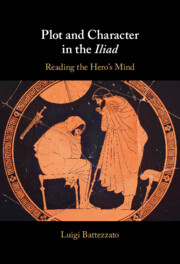
Book contents
- Plot and Character in the Iliad
- Plot and Character in the Iliad
- Copyright page
- Contents
- Preface
- Abbreviations
- Introduction
- Homeric Editions and Scholia
- Chapter 1 Epic Vicissitudes: Hector, Achilles, and Zeus
- Chapter 2 Textual and Narrative Coherence in Homer: Concepts and Preconceptions
- Chapter 3 Reading the Hero’s Mind
- Chapter 4 Hector
- Chapter 5 Achilles
- Chapter 6 Zeus
- Chapter 7 Anger, Gender, and Ancient Interpretations of the Iliad
- Chapter 8 Female Characters and Anger: Hera, Hecuba, Helen, Andromache, and Briseis in the Iliad
- Conclusions
- Book part
- References
- Index
Introduction
Published online by Cambridge University Press: 09 July 2026

Book contents
- Plot and Character in the Iliad
- Plot and Character in the Iliad
- Copyright page
- Contents
- Preface
- Abbreviations
- Introduction
- Homeric Editions and Scholia
- Chapter 1 Epic Vicissitudes: Hector, Achilles, and Zeus
- Chapter 2 Textual and Narrative Coherence in Homer: Concepts and Preconceptions
- Chapter 3 Reading the Hero’s Mind
- Chapter 4 Hector
- Chapter 5 Achilles
- Chapter 6 Zeus
- Chapter 7 Anger, Gender, and Ancient Interpretations of the Iliad
- Chapter 8 Female Characters and Anger: Hera, Hecuba, Helen, Andromache, and Briseis in the Iliad
- Conclusions
- Book part
- References
- Index
Summary
The Introduction presents the main themes of the book. Against the view that Homer’s epic poem is episodic or incoherent, the book reads the poem as a structured narrative driven by intention, miscommunication, and moral reversal. The book encourages the reader to pay close attention to textual details to ‘read the minds’ and understand the motivations of the characters – a methodology aligned with cognitive studies. It argues that the cognitive approach of ‘mind-reading’ is practised by all interpreters of fictional texts, including ancient commentators. The Introduction ends with an overview of the content of the book.
Keywords
Information
- Type
- Chapter
- Information
- Plot and Character in the IliadReading the Hero's Mind, pp. 1 - 10Publisher: Cambridge University PressPrint publication year: 2026
Accessibility standard: WCAG 2.2 AAA
Why this information is here
This section outlines the accessibility features of this content - including support for screen readers, full keyboard navigation and high-contrast display options. This may not be relevant for you.Accessibility Information
The HTML of this chapter
complies with version 2.2 of the
Web Content Accessibility Guidelines
(WCAG), offering more comprehensive accessibility measures for a broad range
of users and attains the highest
(AAA)
level of WCAG compliance, optimising the user experience by meeting the most extensive
accessibility guidelines.
Content Navigation
Table of contents navigation
Allows you to navigate directly to chapters, sections, or non‐text items through a linked table of contents, reducing the need for extensive scrolling.
Allows you to navigate directly to chapters, sections, or non‐text items through a linked table of contents, reducing the need for extensive scrolling.
Index navigation
Provides an interactive index, letting you go straight to where a term or subject appears in the text without manual searching.
Provides an interactive index, letting you go straight to where a term or subject appears in the text without manual searching.
Reading Order & Textual Equivalents
Single logical reading order
You will encounter all content (including footnotes, captions, etc.) in a clear, sequential flow, making it easier to follow with assistive tools like screen readers.
You will encounter all content (including footnotes, captions, etc.) in a clear, sequential flow, making it easier to follow with assistive tools like screen readers.
Short alternative textual descriptions
You get concise descriptions (for images, charts, or media clips), ensuring you do not miss crucial information when visual or audio elements are not accessible.
You get concise descriptions (for images, charts, or media clips), ensuring you do not miss crucial information when visual or audio elements are not accessible.
Visualised data also available as non-graphical data
You can access graphs or charts in a text or tabular format, so you are not excluded if you cannot process visual displays.
You can access graphs or charts in a text or tabular format, so you are not excluded if you cannot process visual displays.
Visual Accessibility
Use of colour is not sole means of conveying information
You will still understand key ideas or prompts without relying solely on colour, which is especially helpful if you have colour vision deficiencies.
You will still understand key ideas or prompts without relying solely on colour, which is especially helpful if you have colour vision deficiencies.
Use of high contrast between text and background colour
You benefit from high‐contrast text, which improves legibility if you have low vision or if you are reading in less‐than‐ideal lighting conditions.
You benefit from high‐contrast text, which improves legibility if you have low vision or if you are reading in less‐than‐ideal lighting conditions.