Skip to main content Accessibility help
×
Hostname: page-component-7b7567c8c-tnkh4 Total loading time: 0 Render date: 2026-11-16T15:06:59.201Z Has data issue: false hasContentIssue false

Introduction

Published online by Cambridge University Press:  28 May 2018

Richard Hunter
Affiliation:
University of Cambridge
Donald Russell
Affiliation:
University of Oxford
Get access

Summary

Plutarch

P. was a native of Chaeronea in Boeotia where he lived most of his long life (c. 45 – c. 120 AD) as the head both of a leading local family and of an informal philosophical ‘school’, modelled to some extent upon the Academy at Athens and devoted principally to Platonic philosophy and related learning; in his youth P. had studied in Athens under the Platonist Ammonius of Alexandria. P. also served as a priest at Delphi, and his three surviving ‘Pythian dialogues’ (Moralia 384d–438e) attest to his deep concern with, and knowledge of, the rituals and underlying theology of the oracle. Apart from his intimate familiarity with the intellectual life of Athens, P. also made, it seems, several visits to Rome and was on good terms with a number of influential Romans. Through one of them, L. Mestrius Florus, P. received Roman citizenship as (probably) L. Mestrius Plutarchus, and to another, Q. Sosius Senecio (consul 99, 107), he dedicated the vast enterprise of the Parallel lives, the works for which he is best known.

As well as the Parallel lives, most of which are preserved, we also possess a corpus of some seventy-eight miscellaneous works, several of which are certainly not by P., which are today known collectively as the Moralia; the title is owed to a subset of these works which may go back even to late antiquity, but which was finally brought together and placed at the head of his edition, under the label τὰ ἠθικά, by Maximus Planudes in the late thirteenth century and which has a much richer textual tradition than most of the rest of what we call the Moralia.

Information

Access options

Get access to the full version of this content by using one of the access options below. (Log in options will check for institutional or personal access. Content may require purchase if you do not have access.)

Book purchase

Temporarily unavailable

Save book to Kindle

To save this book to your Kindle, first ensure no-reply@cambridge.org is added to your Approved Personal Document E-mail List under your Personal Document Settings on the Manage Your Content and Devices page of your Amazon account. Then enter the ‘name’ part of your Kindle email address below. Find out more about saving to your Kindle.

Note you can select to save to either the @free.kindle.com or @kindle.com variations. ‘@free.kindle.com’ emails are free but can only be saved to your device when it is connected to wi-fi. ‘@kindle.com’ emails can be delivered even when you are not connected to wi-fi, but note that service fees apply.

Find out more about the Kindle Personal Document Service.

  • Introduction
  • Plutarch
  • Edited by Richard Hunter, University of Cambridge, Donald Russell, University of Oxford
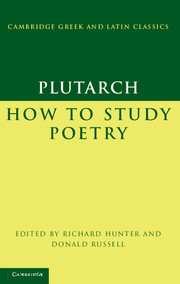
  • Book: Plutarch: <I>How to Study Poetry</I> (<I>De audiendis poetis</I>)
  • Online publication: 28 May 2018
  • Chapter DOI: https://doi.org/10.1017/CBO9780511976643.002
Available formats
×

Save book to Dropbox

To save content items to your account, please confirm that you agree to abide by our usage policies. If this is the first time you use this feature, you will be asked to authorise Cambridge Core to connect with your account. Find out more about saving content to Dropbox.

  • Introduction
  • Plutarch
  • Edited by Richard Hunter, University of Cambridge, Donald Russell, University of Oxford
  • Book: Plutarch: <I>How to Study Poetry</I> (<I>De audiendis poetis</I>)
  • Online publication: 28 May 2018
  • Chapter DOI: https://doi.org/10.1017/CBO9780511976643.002
Available formats
×

Save book to Google Drive

To save content items to your account, please confirm that you agree to abide by our usage policies. If this is the first time you use this feature, you will be asked to authorise Cambridge Core to connect with your account. Find out more about saving content to Google Drive.

  • Introduction
  • Plutarch
  • Edited by Richard Hunter, University of Cambridge, Donald Russell, University of Oxford
  • Book: Plutarch: <I>How to Study Poetry</I> (<I>De audiendis poetis</I>)
  • Online publication: 28 May 2018
  • Chapter DOI: https://doi.org/10.1017/CBO9780511976643.002
Available formats
×