This book is about the political economy of poverty relief. Poverty alleviation requires active government involvement in the provision of public goods such as health services, education, roads, water, and sanitation, among others. Poverty relief also presupposes some degree of redistribution to individuals and families through income supplements, direct aid-in-kind, pensions, and tax subsidies. All too often, transfers and public services fail to reach the poor because of misaligned political incentives and poor governance, which is manifested in corruption, abuse of power, rent-seeking, and dysfunctional or weak public institutions. Although there is consensus on the importance of good governance for poverty alleviation, not enough is known about the conditions under which it comes about and how it can be replicated.
Applying scientific knowledge and technical expertise is a fundamental first step in the design of successful poverty-alleviation policies. However, the real challenge of poverty relief is not to devise technical solutions – scientific knowledge exists, for example, to prevent infectious disease with simple interventions such as vaccines, oral rehydration, and antibiotics, or to improve the safety of drinking water. The critical problem is to structure the political process with clear incentives for politicians and bureaucrats to aid the poor while restraining their own rent-seeking.
A growing body of research in political science emphasizes that democratic political institutions are better at improving well-being than autocratic ones.Footnote 1 Although empirical findings in this literature are controversial, there is growing consensus that in democracies politicians tend to be more responsive to the poor. The basic logic behind this observation is that of electoral competition. Democracies produce strong incentives for politicians to choose policies that reflect what the median voter wants.
However, political democracy does not always generate effective poverty reduction. Politicians take opportunistic advantage of poverty-alleviation funds, redirecting money, jobs, and other benefits toward supporters and away from opponents, as well as diverting government resources for personal gain. Myriad are the complaints that political manipulation, corruption, and vote buying plague the delivery of social benefits to the poor.
In this book we place electoral politics and institutional design at the core of poverty alleviation. Government decisions about redistribution – who gets what, when, and how much – are shaped by electoral considerations. The particular design social programs take is to a large extent determined by politicians’ imperative to win elections and the existing institutional constrains. This book develops a theory with applications to Mexico about how elections shape social programs aimed at aiding the poor. Our theory first asks about distributive politics. Would political parties ever possess incentives to target the poor with transfers aimed at poverty alleviation or would instead give these to their supporters? Would politicians rely on the distribution of particularistic benefits rather than public goods?
Second, we study the welfare impacts of social programs. We measure the welfare impacts of these transfers looking at tangible outcomes: access to water, sanitation, and electricity, and reduction in infant mortality. The latter metric provides a rather compelling indicator of well-being linked to development policies. As noted by Wise (Reference Wise2003), the failure to save children from preventable deaths is usually seen as a tragedy and a “shameful” outcome that forces us to reexamine our public and social responsibility. Although pathophysiological factors, such as dehydration, may ultimately lead to a child’s death, it is social conditions that produce the circumstances in which mothers cannot nourish their children properly, protect them from water-borne infectious diseases or seek adequate medical interventions that might save their lives – circumstances that attest to failures in government policy and the overall social environment in which poor children live – and die.
The simple notion that societies should not let children die from preventable causes resonates strongly with Amartya Sen’s (Reference Sen1999) view of “development as freedom” and Partha Dasgupta’s (Reference Dasgupta1993) assertion that development is ultimately about “the manner in which people are able to live and die.” In fact, one of the greatest advancements in the human condition, as highlighted by Fogel (Reference Fogel2004) and Deaton (Reference Deaton2013), was the possibility for ordinary people to escape hunger and high mortality – originally in Europe and North America, but more recently in other areas of the world. The achievement of long life expectancy and low infant mortality, however, has yet to be replicated in much of the developing world.
Third, the book provides a systematic measure of the electoral payoffs of poverty relief transfers. How many more votes do discretionary particularistic transfers yield relative to entitlements? How many more votes are generated by expenditures on discretionary private goods as against public goods? These questions are central to distributive politics. Only by understanding the electoral consequences of various poverty relief strategies – how they shape voting behavior and electoral alignments – will we be able to comprehend why politicians execute the programs they do.
I.1 Abject Poverty and Government Action
Francisca, a forty-year-old Mayan woman, lived in a squatter village on a coffee plantation several hours’ walk from the nearest town. The village lacked potable water, a sewage system, and electricity. Francisca walked more than one hour every day from her adobe hut to the nearest well to collect water and to wash her family’s clothes. Only seven of Francisca’s thirteen children survived past their fifth birthdays. Her youngest child suffered a severe bout of dehydration at seven months and died before Francisca was able to reach the nearest clinic. All of Francisca’s daughters died, leaving her with seven sons and one adopted three-year-old orphan girl. If only a health clinic had been closer, or there were some ready cash to buy medicine, she might have saved her daughters from premature death. Francisca’s story serves as a dramatic illustration of what it means to be trapped in poverty when better-targeted government action could have saved her children’s lives.
Francisca’s story is a common one throughout the developing world, where the rural poor have limited or no access to a social safety net and where their children suffer and die from mostly preventable diseases. The leader of the 1995 Zapatista uprising in the South of Mexico, Subcomandante Marcos, decried the tragedy of such poverty trap:
Or shall we ask pardon from the dead, our dead, who died “natural” deaths of “natural causes” like measles, whooping cough, breakbone fever, cholera, typhus, mononucleosis, tetanus, pneumonia, malaria and other lovely gastrointestinal and pulmonary diseases? Our dead, so very dead, so democratically dead from sorrow because no one did anything, because the dead, our dead, went just like that, with no one keeping count, with no one saying, “ENOUGH!”
The Zapatista rebellion, of course, erupted at the end of Mexican president Carlos Salinas’ administration (1988–1994), which had promised to put an end to poverty and take Mexico to the “first” world. His government had initiated a major antipoverty program named Programa Nacional de Solidaridad (Pronasol). Acclaimed by the international community, the program relied on government transfers for projects proposed by community organizations and municipal governments throughout the country. Despite an average annual allocation to this program of 1.18 percent of GDP, the Zapatista rebellion poignantly attests that poverty remained unabated by the end of Salinas’ presidential term. As we show in this book, the program’s goal of reducing poverty was thwarted by the diversion of its resources in line with the electoral needs of the ruling party.
Much has changed in Mexico since 1995. In 1997 the government created a conditional cash transfer (CCT) program called the Programa de Educación, Salud y Alimentación (Progresa), now widely touted as one of the most successful poverty relief programs in the world. Progresa offered money to mothers within poor families in exchange for attending basic courses on preventive health care and hygiene, making regular visits to health clinics, and keeping their children in school. Beneficiaries become ineligible for the program only through failure to comply with these requirements.
To insulate Progresa from political influences, beneficiaries were selected on the basis of objective measures of social deprivation and poverty. Initially implemented in rural areas, the creation of Progresa represented a turning point in the design of social policy in Mexico (Levy, Reference Levy2006; Levy and Rodríguez, Reference Levy and Rodriguez2005). After the Partido Acción Nacional (PAN) defeated the hegemonic Partido Revolucionario Institucional (PRI) in 2000, the new administration expanded the program to urban areas using similar criteria to select beneficiary families. Renamed Programa de Desarrollo Humano Oportunidades, the urban part of the program has evolved into a demand-driven structure where applicants for benefits self-select instead of the government identifying eligible recipients.
A second important transformation occurred in the late 1990s, following the Zapatista rebellion. During the Ernesto Zedillo administration (1994–2000), social infrastructure funding underwent reform with the creation of the Fondo de Aportaciones para la Infraestructura Social Municipal (FISM). FISM implemented a major reformulation of federal transfers for public works and social infrastructure projects distributed according to poverty-based formulas to the more than 2,430 municipalities in Mexico. With the introduction of FISM, the PRI reduced its discretion to manipulate social infrastructure investments. The poorest municipalities receive disproportionate funds, which are now transferred in regular and predictable fashion. Once the funds reach the municipalities, their mayors play the central role in deciding how these are distributed. Patterns of local electoral accountability, or lack thereof, as we will see in this book, have become essential in shaping the provision and distribution of local public goods.
Prior to FISM, the government also spent considerable amounts of money on social infrastructure projects. But there was substantial leakage. For example, in a personal interview with a high-ranking public official in charge of federal finance at the time, we were told that when the new administration tried to audit Pronasol, many of the public infrastructure projects that had been reported in the books were either abandoned without completion or did not even exist.
Fifteen years ago, poor communities all over Mexico had very limited or no access to many basic public services. With her toothless smile, Francisca says that things have “improved a lot during the last years” and that her “children no longer die and seldom get sick.” Although clearly still impoverished, homes in her community now have access to water from a communal faucet (even if available only a few hours per day), proper sanitation, paved streets, and electricity. New roads also make the local health clinic more easily accessible. When her youngest child was recently sick with diarrhea, they were able to reach the clinic before he became dehydrated. Francisca now receives regular cash transfers from Oportunidades, which enables her to buy food, soap, and shoes for her previously barefooted children, and if there is spare cash, school supplies. This is a story repeated in thousands of villages and communities throughout the country. The contrast with Mexico’s previous history of clientelistic relief for the poor could not be starker.
Mexico was infamous for the extreme forms of political manipulation of public funds and social programs under the formerly hegemonic party. A study of Pronasol‘s wide-ranging operations and programs allows us systematically to understand what political scientists refer to as clientelism, a form of political exchange between politicians and the poor prevalent in the developing world. According to Kitschelt and Wilkinson (Reference Kitschelt and Wilkinson2007) a clientelistic relation is characterized by:
[First], a contingent direct exchange that concerns goods from which non-participants in the exchange can be excluded. Second, such exchanges become viable from the perspective of politicians, if voter constituencies respond in predictable fashion to clientelistic inducements without excessive opportunism and free riding. Third, short of constituencies’ spontaneous and voluntary compliance with the clientelistic deal, politicians can invest in organizational structures to monitor and enforce clientelistic exchanges.
Changing the rules for the allocation of local public goods and social infrastructure projects in Mexico produced a major impact on poverty reduction. Our approach highlights three elements in the transformation of social policies during this period. First, social programs became more progressive and better targeted to the poor. Since the early 1940s, Mexico began to put in place social insurance schemes tied to participation in the formal labor market. A common feature in Latin America and the Caribbean, the restriction of social insurance to formal sector workers led to the characterization of the region’s social insurance systems as “truncated welfare states” because the majority of the population, especially the poor, did not receive these benefits (Ferranti et al., Reference De Ferranti, Perry, Ferreira and Walton2004; Fiszbein, Reference Fiszbein2004; Rawlings et al., Reference Rawlings, Sherburne-Benz and Van Domelen2004). Recent decades have witnessed the emergence of parallel social protection schemes, including social investment funds such as Pronasol and FISM and, more recently, conditional cash transfers aimed at households in extreme poverty.Footnote 2
Second, the new social programs also reduced government discretion in the administration of the funds. It is always difficult to ascertain how much leakage bedevils antipoverty spending such that social welfare is not improved. This includes the possibility of mismanagement of public funds, as well as outright theft, corruption, and rent-seeking. The new social programs have reduced such leakages, although by no means eliminated them. Professional bureaucracies administer the programs, with a new emphasis on transparency. The use of poverty formulas along with technical measures to identify beneficiaries according to need has also limited politicians’ inclinations to respond to electoral and partisan imperatives rather than to the goal of poverty alleviation.
Third, subnational governments have become increasingly involved in the provision of local public works, with funds for these projects coming from redistributive federal transfers. Under PRI rule Mexico had a long history of centralized control over public spending. Decisions about social infrastructure projects were made and funded in the nation’s capital. This political equilibrium changed in the 1990s, as the opposition gained control of more subnational governments and the PRI lost majority control of the Chamber of Deputies along with exclusive control over the federal budget. New fiscal arrangements at the national level devolved decision-making power over the selection and funding of social infrastructure projects to states and municipalities.
Better targeting, less government discretion, and redistributive decentralization had profound effects on the poor’s welfare in Mexico. The clientelistic linkage between politicians and the poor that was prevalent during the authoritarian era has shifted to a new entitlement-based social protection regime. In 2009, we interviewed beneficiaries of Oportunidades in forty-eight poor rural communities in Oaxaca and asked about how they evaluated the program, if they felt that they could lose their benefits depending on their partisan loyalties and vote choices, and if they worried about the coming presidential elections. Our interviewees unanimously agreed that their benefits were secure. A Oaxacan mother of five told us in an interview: “Before, you had to be with the PRI to get anything from the government.” Another woman told us: “The governor controls everything in Oaxaca. However, here you can be PRDísta (Partido de la Revolución Democrática), back the governor [from the PRI], and still get benefits from Oportunidades,” even though the PAN controlled the federal government. “Although sometimes people who do not really need it get Oportunidades, it is less corrupt because benefits arrive regardless of the party you favor,” a young Zapotec father of two told us. Overwhelmingly, beneficiaries of the program were satisfied, although there were some concerns about whether the transfers were being targeted to the poorest among them.
I.2 The Governance of Poverty Relief
This book asks why and when politicians choose one form of redistribution as against another; we quantify how they impact the poor’s welfare; and we estimate the electoral payoffs of each of these strategies of poverty reduction. In the following sections we sketch our theory about strategic choice among different distributive strategies.
For analytical purposes we focus on two important dimensions in the design, implementation, and management of social policies. The first dimension reflects the process by which beneficiaries are selected into a program and considers the degree of government discretion to decide who gets a public transfer, how much it is worth, and who gets withdrawn from a program. Along this dimension we distinguish discretionary programs from formula-based programs.
Discretionary programs are what Dixit and Londregan (Reference Dixit and Londregan1996) refer to as “tactical redistribution,” which should be distinguished from “programmatic redistribution” or welfare transfers that are embedded in laws written in abstract and general terms and administered by autonomous bureaucracies. Programs with little formal government discretion offer benefits that are assigned according to objective or programmatic eligibility criteria – for instance, persons over sixty-five, women with children, unemployed workers – and in theory should not be withdrawn unless a beneficiary fails to meet the defined criteria.
The second dimension considers the type of benefits delivered – whether a program delivers nonexcludable public goods or targeted transfers of private goods. Public infrastructure projects, including roads, street pavement, sewers, health clinics, schools, running water, public markets, lighting, garbage collection, and so on are aimed at communities. Particularistic transfers such as cash benefits, land titles, scholarships, nutritional supplements, construction materials, and subsidized credit can be targeted to individuals. The more indivisible a transfer is, the less incumbent parties can employ them to target their supporters and punish their opponents.Footnote 3 A second difference between public and private goods is their reversibility. Discretionary private transfers can be withdrawn at any point in time, such as when a voter supports a rival at the polls. Infrastructure projects are fixed investments that are less vulnerable to opportunism because everyone in a given district can enjoy them.
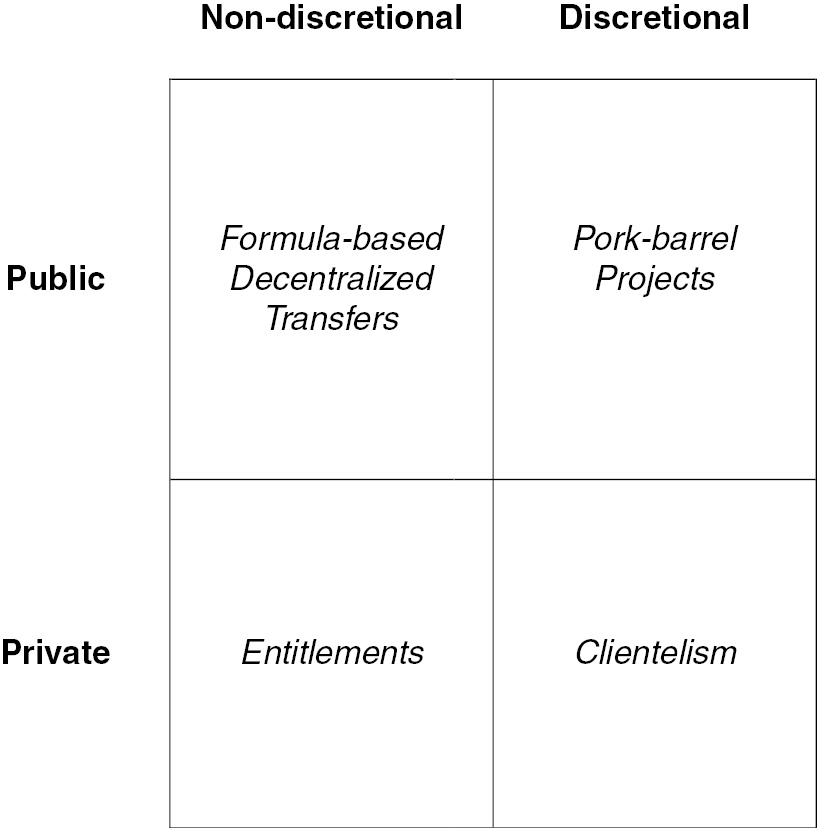
Figure I.1 classifies the types of social programs that will be analyzed in subsequent chapters of this book according to the two governance dimensions highlighted above. In the lower-right quadrant are discretionary programs targeted to individuals. These programs can be unambiguously administered through clientelistic networks. This form of electoral linkage, to be effective, needs an organizational structure of brokers or other intermediaries (e.g., bosses, caciques, or local notables) that help parties select voters according to their partisanship or other attributes (Stokes et al., Reference Stokes, Dunning, Nazareno and Brusco2013; Magaloni, Reference Magaloni2006; Calvo and Murillo, Reference Calvo and Murillo2013).
Types of antipoverty programs.
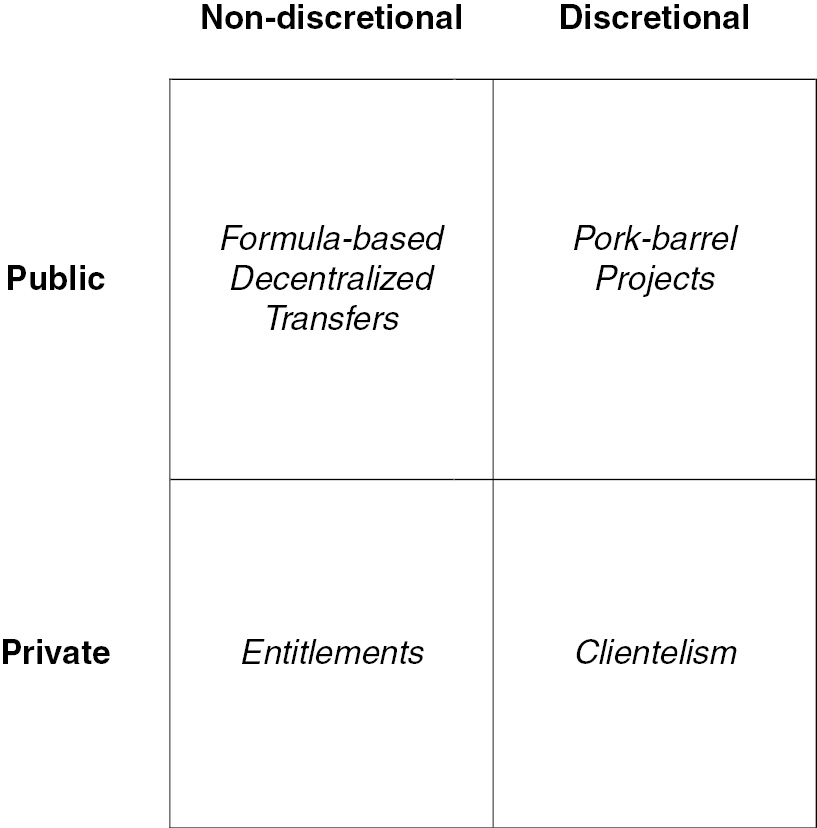
In the lower-left quadrant are nondiscretionary excludable transfers, or entitlements. A sine qua non for entitlement programs to work is that politicians are not able to select and deselect beneficiaries at will. As we discuss in Chapter 1, entitlements require an independent or depoliticized bureaucratic agency to be effective and to enforce the legal criteria for selecting beneficiaries.
Selection into these programs is frequently accomplished through means-testing so that only those with incomes below a certain threshold are eligible.Footnote 4 In the upper-right quadrant of Figure I.1 are discretionary social transfers spent on infrastructure, electrification, street pavement, road construction, and so on. This kind of discretionary public works funding is often referred to as “pork-barrel politics.” Originated in the United States, the term refers to public works whose benefits are concentrated in a particular district but whose costs are spread among all taxpayers. A key difference between clientelism and the pork barrel is that within a given district politicians can’t screen potential users with the latter instrument.
Public goods programs can be discretionary or, as in the upper-left quadrant, the funding transfers to subnational jurisdictions can be decentralized, allocated by formula. Highly relevant in federal systems, formulas for the distribution of public goods investments restrain discretion in the allocation of projects across jurisdictions and allow for some degree of redistribution.
Our book explains the choice among poverty relief strategies that fall in each of the quadrants of Figure I.1. It also measures how effective these types of distributive polices are at alleviating poverty, and we inquire into the electoral consequences of different poverty alleviation strategies. The programs we study represent significant budgetary allocations and, unlike campaign gifts and handouts,Footnote 5 they can make a critical difference for poverty alleviation. Our book is about the governance of social programs – how they are designed and their transfers delivered – and how it impacts the poor’s well-being. The book compellingly demonstrates that effective poverty relief requires nondiscretional and better-targeted poverty relief strategies. Yet perversely clientelistic and pork barreling transfers, we demonstrate with empirical evidence for the case of Mexico, yield significantly more votes while allowing politicians to extract more rents. Why clientelism is such a prevalent form of electoral exchange in developing societies, how it skews social policies aimed at the poor, and under what conditions it can be superseded by more democratic and accountable forms of exchange are some of the central questions this book addresses.
I.3 Discretionary Redistribution and a Theory of Vote Buying
The first element of our inquiry is to understand discretionary redistribution, corresponding to the social programs in the right quadrants of Figure I.1. When do politicians choose to buy votes with discretionary private goods and when with patronage over public goods provision? To what types of voters are these benefits targeted? How effective are private versus public goods at gaining votes? To answer these questions, we begin by developing a formal model of vote buying which is then evaluated drawing on extensive original data and statistical analysis. Our empirical focus is on subnational variation in Mexico, although our theory aims to be broadly applicable to distributive politics in other parts of the developing world.
The book develops a theory of vote buying based on a portfolio diversification logic driving the relative shares of discretionary private and public goods distributed in a given district. We build on distributive politics models and the core-swing debate (Cox and McCubbins, Reference Cox and McCubbins1986; Dixit and Londregan, Reference Dixit and Londregan1996; Stokes, Reference Stokes2005; Nichter, Reference Nichter2008). Our theory departs from these models in three fundamental ways. First, we assume that voters base their choices on material considerations alone, with ideology playing a secondary role at best. We ask how parties can construct long-lasting winning coalitions when ideology or other symbolic appeals are not effective to mobilize voters, either because these promises are not credible (Keefer and Vlaicu, Reference Keefer and Vlaicu2008; Wantchekon, Reference Wantchekon2004), or because poor voters place a much higher utility to material considerations – for example, how to provide for the next meal, a job, medicine, or clothes. Second, most of the existing models of distributive politics focus on vote buying on the spot – the distribution of transfers during an election in exchange for votes or turnout (Nichter, Reference Nichter2008). Our model focuses on vote buying embedded in an ongoing relationship. Third, our model takes party loyalty as conditional, or endogenous, rather than fixed. Voters‘ partisan attachments are constructed through reciprocal material and symbolic exchanges, past, present, and future.
A key implication of our theory is that politicians will funnel jobs, patronage, and other excludable benefits to their core voters. Our model is in line with Cox and Reference Cox and McCubbinsMcCubbins (Reference Cox and McCubbins1986), for whom political parties favor the core voter strategy mainly due to aversion to electoral risk. In a more recent extension of that argument, Cox (Reference Cox, Shapiro, Stokes, Elisabeth and Kirshner2009) incorporates the importance of mobilization and elite coordination as objectives inducing investment in core voters. We move beyond these formulations, sustaining that political parties will favor core voters to solve three salient problems of vote buying prevailing particularly in developing societies: (1) sustain stable electoral coalitions over time in the absence of other anchors like ideology; (2) mitigate voter opportunism; and (3) parties are able to extract more rents because it is cheaper to buy off voters the party knows best. This informational advantage allows parties to know voters’ “reservation values” and pay them the minimal amount necessary to buy their votes (Zarazaga, Reference Zarazaga2011). These claims, we hold, better capture the logic of machine politics.
Our predictions run counter to swing voter models that claim that parties should not waste scarce resources on loyal supporters and should rationally prefer to cater to swing voters whose choice might swing an election (Lindbeck and Weibull, 1986; Dixit and Londregan, Reference Dixit and Londregan1996; Stokes, Reference Stokes2005).Footnote 6 Stokes et al. (Reference Stokes, Dunning, Nazareno and Brusco2013) also predict that parties will favor core voters, although in their account this strategy is electorally inefficient and represents a waste of resources that stems from principal-agent problems between party elites and their brokers.
In our approach parties do not waste resources when they invest in core voters. In the absence of strong ideological attachments or other symbolic appeals, the ongoing buying of votes constitutes a primary way to sustain stable electoral coalitions. Nurturing voter loyalty through repeated exchange, in turn, allows political parties to simultaneously mitigate voter opportunism problems and reduce the costs of vote buying. The alternative would be to buy votes on the spot market, a far more costly and risky strategy because voters who are not tied to a party by a sense of reciprocity can always take the transfer and walk away.
The ongoing contract between the party and its core base is enforced, in our approach, through reciprocal threats of punishment. If the party fails to deliver particularistic transfers to a core voter, he can threaten to become disloyal in future elections. If the core voter, for his part, fails to reciprocate with his ongoing electoral support, the party can threaten to remove him from the spoils system. For this threat to be credible, the party needs clientelistic networks to gain local knowledge about its voters’ and enforce the “punishment regime” (Magaloni, Reference Magaloni2006). Vote buying and clientelistic contracts between a party and its core base usually go hand-in-hand because the latter are necessary to mitigate commitment problems. The alternative is to buy votes on the spot market, a treacherous and onerous way to build winning electoral coalitions.
An important corollary of our theory is that not all core voters will receive an equal amount of transfers. First, core voters might not possess enough leverage to oblige their party to treat them well – for example, it could be argued that ethnicity or other primordial attachments make voters relatively less mobile across parties, as seems to be the case in some contexts in Africa. In these settings, political parties might be able to keep a loyal base of voters without having to distribute too many transfers. Degree of electoral completion is another relevant variables to consider. When a party holds a virtual electoral monopoly, as was the case in very poor districts in Mexico, core voters do not possess leverage to oblige their party to fulfill its part of the contract and might receive benign neglect. The PRI, in fact, disproportionately targeted discretionary particularistic transfers to loyal places where its core base was deteriorating at a faster rate than in poorer areas. These core places were favored over poorer voters, the book compellingly demonstrates, because they were better able to threaten to become disloyal if the PRI refused to grant them transfers.
One reason why social programs administered through clientelistic networks fail to alleviate poverty is that they are not necessarily targeted to the poor, as this book demonstrates. Another reason why this form of electoral exchange is not effective at alleviating poverty is that it traps voters into supporting a party that extracts rents from them. The dilemma is that of coordination: if a core voter defects in isolation, she or he will be punished. If all other voters reason likewise the machine is sustained in equilibrium (Magaloni, Reference Magaloni2006; Diaz-Cayeros et al., Reference Diaz-Cayeros, Magaloni and Weingast2001). Core voters support the party in part because it gives them particularistic transfers and in part because of the threat of punishment.
When would parties diversify their portfolio by investing in more welfare-enhancing public goods over particularistic transfers? We argue that when a party’s core base of support is not sufficient to win elections, it will be compelled to mobilize support from other voter groups, including swing voters. This creates a dilemma analogous to the one described in Przeworski and Sprague (Reference Przeworski and Sprague1986) regarding socialist parties’ imperative to create multiclass coalitions to win elections. In their approach, socialist parties that needed to mobilize the support of middle-class allies alienated their working-class core, which became available for political mobilization by other political parties. We consider here an analogous dilemma: the political machine risks losing its core supporters if it delivers particularistic transfers to buy swing voters off.
Our theory and empirical evidence suggest that parties can employ particular portfolios of private versus public transfers to mobilize both core and swing voters. The distributive politics literature has tended to portray investments in core-versus-swing voters as an all-or-nothing strategy, overlooking the fact that political parties have at their disposal a basket of polices that includes particularistic and collective goods. Our main theoretical predictions regarding portfolio diversification is that the share of public goods over particularistic transfers in a given geographic area will increase as a party’s core base proves insufficient to guarantee victory.
The book thus identifies welfare benefits to voters stemming from electoral competition. The logic is akin to Bueno de Mesquita et al. (Reference Bueno de Mesquita, Smith, Siverson and Morrow2003), who argue that democracy is advantageous for the provision of public goods because leaders need to appeal to broader coalitions in order to remain in power and this is more easily accomplished through public goods provision than through private transfers. Persson and Tabellini (Reference Persson and Tabellini1999) present a similar logic holding that politicians who need to win elections by majority are more likely to deliver public goods to the electorate. Chhibber and Nooruddin (Reference Chhibber and Nooruddin2004) apply these same insights in their study of India.
Although electoral competition sharpens incentives to supply public goods, the theory and empirical evidence presented in this book makes explicit why politicians continue to resort to the distribution of discretionary particularistic transfers, and even when buying voters one-on-one would appear to be more inefficient than the supply of public goods. The reason is that as vote-buying strategy, public goods provision is riskier, even when it is assumed to be more cost-effective. With a systematic analysis of a variety of social programs in Mexico during the past decades, we demonstrate that investments in public goods do not yield as many votes per peso spent as particularistic transfers. Electoral risk compels politicians to diversify to public goods transfers in order to appeal to a majority, but also to resort to clientelism as a risk-hedging device (Magaloni et al., Reference Magaloni, Diaz-Cayeros, Estévez, Kitschelt and Wilkinson2007).
I.4 Formula-Based Poverty Relief
Despite the virtues of electoral competition, democracies in the developing world more often than not underprovide public goods. This book’s framework argues that in the absence of institutional reforms that explicitly aim at restraining government discretion and insulating social programs from political manipulation, public goods will continue to be underprovided and what is provided will suffer substantial leakage.
With the establishment of Progresa/Oportunidades and FISM, Mexico social polices shifted from discretionary to formula-based poverty relief. Although clientelism and pork-barreling politics were by no means abandoned, huge progress was made in that major poverty relief transfers began for the first time to be distributed according to formulas that privilege targeting to the poorest citizens.
How can countries transit from this suboptimal equilibrium where antipoverty policies are distorted? Why would politicians ever tie their hands reducing their discretion to administer social programs? We underscore three important processes encouraging the PRI to abandon Pronasol and to create formula-based poverty relief programs.
First, the Zapatista rebellion erupted in December of 1994. Mayan Indians took six municipalities in Los Altos de Chiapas by force and declared war on the government. The rebellion took place after six years of the antipoverty relief strategy and millions of pesos spent on social programs under the banner of Pronasol. The Zapatistas rebellion turned crystal-clear the corruption of the clientelistic social assistance regime and its incapacity to combat poverty in a meaningful way.
The Salinas and Zedillo administrations had reasons to believe that violence could spread much beyond Chiapas. As explained in Magaloni (Reference Magaloni2006) and Trejo (Reference Trejo2012) the outbreak of the rebellion motivated the electoral reforms that paved the road to democracy in Mexico. The rebellion also was critical in convincing the Zedillo administration, the PRI, and the economic elites that it was critical to combat poverty in a meaningful manner if Mexico wanted to avoid the spread of social unrest among the poor. The threat of social unrest made politicians more tolerant of technocratic solutions that sought to redress poverty through new policy innovations.
Second, Mexican voters rebelled against the system of corruption. After the Peso crisis of 1994–1995, they voted against the PRI in one local election after another. Furthermore, during the mid-term elections of 1997, the PRI lost the majority in the Chamber of Deputies necessary to pass legislation unilaterally. Voters’ rebellion versus the PRI triggered a major institutional transformation in Mexico. For the first time in the PRI’s history, the budget had to be negotiated with the opposition and the government could not operate without its endorsement. The Zedillo presidency had to negotiate legislation with the PAN. It was during this period that Progresa (later Oportunidades) and FISM were established. For the first time, social policies and the distribution of federal transfers to municipalities and states were established through interparty bargaining, which clearly limited the powers of the PRI.
Third, after the wave of defeats in the local elections and the PRI’s loss of the majority in the Lower Chamber of Deputies, governors, bureaucrats, party cadres, and politicians at all levels of government from this party had good reasons to believe that their party could lose the coming presidential elections of 2000.
Following the line of reasoning in Geddes’ (Reference Geddes1994) model regarding civil service reform, we argue that the PRI had incentives to restrain clientelism and pork barreling by creating an independent and professional bureaucracy because voters had collectively rebelled the PRI and this party reasonably anticipated it could lose power. Incentives to delegate power to an independent bureaucracy arose to prevent the PRI’s opponents from conquering the state in the future to serve their own patronage ends. The line of argumentation is also consistent with Moe (1995), who stresses the importance of political uncertainty in creating incentives to separate politics from the administration. He argues that in a democracy politicians often can only “shut out their opponents by shutting themselves out too. In many cases then [politicians] create structures than even they cannot control” (p. 125).
I.5 State Capacity
Separating the governance of poverty relief from the PRI had a major impact on the poor’s welfare. This book emphasizes two social programs, Progresa/Oportunidades and FISM, which represented a huge step at combating poverty in Mexico. In contrast to the public goods programs administered through Pronasol, the formula-driven FISM was more effective at delivering local public goods (sanitation, water, and electricity) to the poorest places. The CCT program, for its part, is the single most effective policy we analyze in this book that contributed to saving babies’ lives from the killer diseases so sharply described by Subcomandante Marcos.
To be effective CCT, programs require impressive state capacity. Aside from vast informational resources and bureaucratic coordination at the national level, they require close and continuous supervision in the localities where they operate. These programs put women and children at the center of poverty reduction. Making sure that the money arrives and stays in women’s hands and that these resources are directed at improving children’s health, nutrition, and education requires dense state and organizational capabilities. Essential for the proper implementation of CCTs is that the program’s officials on the ground keep the program insulated from illegitimate capture by local bosses, brokers, and political parties, and that they stay proximate to women’s everyday lives to protect them from potential abuses by health providers, teachers, and their husbands.
The problem of implementation is a local one that in our opinion can be properly understood only through ethnographic work. Enrique Bentzul generously shared with us valuable insights about what it takes to operate Oportunidades on the ground and to keep the program insulated from political influence. Enrique was rightly described to us as an “icon of Oportunidades in Los Altos de Chiapas.” He was born in San Juan Chamula and is fluent in Tzotzil and Spanish. He began working for the program in 1998 shortly after Progresa was created. In one of his first visits to a village in the municipality of San Juan Chamula, the community could not understand what the program’s officials were saying and Enrique decided to step forward to translate.
One of the first persons of his ethnic background to enjoy so much political authority in Chiapas, Enrique is now (as of 2012) the Coordinator of Regional Support of Oportunidades in Los Altos de Chiapas. He is in charge of administering the program in 18 municipalities covering more than 100,000 families, mostly indigenous. Our conversations with him, and numerous visits to villages in Oaxaca and Chiapas, have allowed us to understand that Oportunidades has become much more than its cash-transfers. It is a program that is fundamentally transforming local social structures in poor communities throughout Mexico.
“A program that puts women at the center stage necessarily causes a lot of trouble,” Enrique explains. “Take, for example, San Juan Chamula, where men have for centuries excluded and oppressed women and where powerful caciques (local bosses) have always ruled unchecked. Only if you are a man, a PRIísta and a Catholic have you a voice in Chamula.” In such settings, to safeguard Oportunidades state officials need constantly to negotiate on behalf of women. “This is a very violent and complicated region,” Enrique tells us. “My job basically consists in solving conflicts.”
In our interviews we were able to identify three generic forms of conflict. First is intrafamily conflict – most commonly, husbands taking the CCT money from their wives or physically abusing them. Because battered women normally are afraid to denounce such abuses, often the only way to detect intrafamily violence is through word of mouth. This is one way through which the women’s networks created by the program can help. Enrique tells us that when Oportunidades officials find out that a woman is suffering abuse, they intervene by arbitrating the intrafamily conflict and restraining the husband by threatening to withdraw benefits from the family.Footnote 7
A second form of conflict involves extortion by teachers and health providers. Oportunidades has transferred a great deal of power to health providers and teachers in thousands of villages and towns. They are charged with certifying whether beneficiaries comply with the program’s conditions. Thus, these individuals have a lot of leverage that can be used to extort women. The most typical abuses involve bribes, although other more serious crimes, including sexual violence, are not uncommon.Footnote 8 These abuses, Enrique tells us, are difficult to detect because women are often reluctant to report them for fear of retaliation. Often these abuses are detected through the vigilant presence of Oportunidades officials in the villages. Enrique makes sure that in Los Altos de Chiapas the program is monitored in every village through well-selected community liaisons. Furthermore, the program has instituted a clever system of complaints that allow women to voice anonymous grievances either in writing (a “buzón de quejas”) or by calls to special telephone lines.
A third generic type of conflict involves political parties, their local brokers, or caciques trying to politicize the program, and this is particularly pronounced when national or local elections are celebrated. Prior to the most recent presidential election, in 2012 it came to our attention that local Oportunidades promoters were offered 40,000 pesos (around 3,000 dollars) to campaign in the name of one or another political party, which is illegal. Efforts are made to temper these temptations in what is known as the electoral “shielding” (blindaje) of social programs: officials are not allowed to go into the field or enroll new beneficiaries for six months prior to the elections.
Preventing politicization of the program on the ground requires an optimal institutional design and constant oversight.Footnote 9 Crucial to the design of the CCT program is that local delegates such as Enrique and his operators are appointed, paid, and promoted by the federal bureaucracy rather than by local authorities; another important aspect is that these delegates control neither the selection of beneficiaries nor money transfers to them.
When a year later we interviewed Enrique again, prior to the 2012 federal elections, we learned that the traditional authorities in San Juan Chamula had recently incarcerated two Oportunidades officials. They were accused of allegially campaigning in Enrique’s favor for the coming municipal election and conditioning funds in exchange for vote pledges. The accusations were bogus, since Enrique had no intention to run for public office. In the days following the incarceration of the Oportunidades officials, hundreds of women in San Juan Chamula took to the streets to demand the liberation of the jailed officials and defend the program’s autonomy. In the end, the traditional authorities, mostly affiliated to the PRI, levied a large fine against those responsible for the false accusations.Footnote 10
Despite numerous and continual challenges, the organizational structure of Oportunidades works most of the time. The CCT program is present in almost every village in Mexico in the form of cash disbursements, health clinics, and hospitals, public schools and assorted officials involved in much more than program administration. This dense network of the state has impacted for good the lives of millions of women and children across poor villages in Mexico. The similarly dense patron-client networks of the past were never able to accomplish much.
I.6 The Poor’s Welfare
Studies of distributive politics are often narrowly focused on the question of whether politicians target core or swing voters.Footnote 11 Such studies largely disregard the critical issue of how electoral investment strategies impact voters’ well-being. This lack of attention to the welfare consequences of vote buying strategies opens a huge gap in the distributive politics literature. The gap is particularly worrisome in works on clientelism, which reveal the limits of democratic accountability in developing societies.
The failure of public service provision in developing countries can be attributed to both supply-side and demand-side problems. On the supply side, corrupted public institutions, unaccountable governments, and weak and dysfunctional states can be credited with poor provision of services. On the demand side, the scholarly literature has focused on issues such as ethnic fractionalization as a cause of free-riding and coordination obstacles and on lack of citizen information, among other factors.Footnote 12 In this book we focus on the supply side, asking how variation in the governance of poverty relief shapes welfare outcomes. Through comparison of the effects of clientelistic versus programmatic social protection policies, we provide direct and comparable measures of the welfare effects produced by different forms of “political linkage” (Kitschelt, Reference Kitschelt2000). The book integrates an analysis of the electoral returns of distributive politics with an analysis of their welfare consequences. It therefore goes beyond studies currently available.
At the onset of the Zapatista rebellion in 1994, Subcomandante Marcos denounced the tragic fate of indigenous women and men who powerlessly witnessed their children die from treatable diseases. The Chiapas uprising was a great surprise to many because it took place after massive expenditures for poverty alleviation under Pronasol. It is ironic to note that the hospital constructed with Pronasol funds during those years in the town of Guadalupe Tepeyac became one of the headquarters of the Zapatista rebellion and served as a prison for such high-level hostages as a former governor of Chiapas. According to most accounts, the state-of-the-art facilities in the hospital never became functional for lack of staff and medical supplies.
Poverty is a multifaceted condition going beyond a lack of income. It can encompass precarious living standards, deficient health, malnutrition, underdeveloped cognitive skills, and lack of access to public services. In this book we restrict the analysis of welfare consequences to two facets of poverty: access to basic public services and the life-and-death prospects of the most vulnerable population, infants. Our goal is to compare the efficacy of different forms of anti-poverty policies – the clientelistic program Pronasol and the entitlement program Progresa/Oportunidades, the pork-barreling within Pronasol and the formula-based social infrastructure program FISM. We also seek to assess whether electoral democracy and electoral competition play a role in attenuating poverty.
Our book contributes to a vibrant debate within the political science literature about regime effects on infant mortality rates (IMR). Existing comparative studies focus on the life-saving effects of democracy.Footnote 13 The book departs from this literature in two main respects. First, rather than using cross-national data, we focus on subnational variation in IMR in a single country as it democratizes. Second, the chapter studies the effects of the design of public policies in the reduction of IMR. A general assumption among public health practitioners and scholars is that well-designed policy interventions contribute to the reduction of IMR (Sepúlveda et al., Reference Sepúlveda, Bustreo, Tapia, Rivera, Lozano, Oláiz, Partida, García-García and Valdespino2006). There is some evidence in the literature, albeit contested, suggesting that democracies may be better at reducing IMR than autocracies. But few studies have been able to specify the channels and mechanisms through which political regime or democratic change may affect public health. We focus on social programs aimed at alleviating poverty.
Antipoverty policies can affect infant mortality directly or indirectly. Governments can provide public works that impact collective well-being through the provision of public goods. Social infrastructure programs such as FISM or Pronasol‘s public goods programs might have an indirect effect on infant mortality through their impact on sanitation, the construction of health clinics and roads. Clientelistic programs might have an indirect effect on infant mortality by increasing household income, allowing parents to access otherwise unaffordable emergency transportation, health services, and medicines. CCTs, for their part, might have both direct and indirect effects on infant health through three channels. The first is an indirect income channel going through households’ increase in cash availability that facilitates access to health services and medicines. The second is the indirect channel of female empowerment in the household. The third is a more direct effect related to how the program conditions the cash transfer on regular health visits and targets women with health education workshops.
Our empirical analyses demonstrate that when transferring funds to individuals for political motives underscores the design of social policy, the developmental goal of poverty reduction is greatly distorted. Despite millions of dollars spent, our book demonstrates that Pronasol had marginal effects at improving provision of basic services such as water, sanitation, and electricity in the poorest municipalities. The program’s particularistic transfers – including its cash transfers – were ineffective at reducing premature infant deaths. In contrast, the creation of better-designed policy targeted to poor women has had a decisive impact on saving children’s lives. Moreover, improvements of basic public service delivery through FISM also contributed to reductions in infant mortality.
Hence, new social programs such as FISM and Oportunidades that came as a result of stronger checks and balances increased electoral competition and decentralization, improved the provision of municipal public goods, and allowed poor families greater access to health services. Our results also demonstrate some direct effects of local democracy on improvements in public service delivery and reductions in IMR. Municipalities that experienced partisan turnover in power are better at preserving infants’ lives and providing basic services than municipalities that remained under one-party rule.
There are some painful lessons for Mexico to be drawn from the story our book recounts: thousands of children likely would remain alive had the reform of social policy occurred a few years earlier. Subcomandante Marcos was right in pointing out that children died from curable diseases and no one took notice. Pronasol‘s claims about “putting an end to poverty” are judged against a clearly defined metric: was the program able to save the lives of the most vulnerable? Our results suggest that its effects were at best marginal. Some poverty alleviation took place, but it paled in comparison to what better-designed poverty relief policies achieved.
I.7 How Voters Respond to Poverty Alleviation Programs
The last element of our analysis brings us to a fundamental question regarding electoral accountability in democratic societies. How did voters respond to these various poverty alleviation strategies? Recent scholarship has begun to explore in more systematic ways the electoral returns to government transfers and programs (Magaloni, Reference Magaloni2006; Magaloni et al., Reference Magaloni, Diaz-Cayeros, Estévez, Kitschelt and Wilkinson2007; De la O, 2011; Hsieh et al., Reference Hsieh, Miguel, Ortega and Rodriguez2011; Zucco, Reference Zucco2013; Becerra, Reference Becerra2012). These studies demonstrate that voters respond positively to government transfers, a finding that is hardly surprising. Our approach moves beyond this kind of work in that we systematically compare the electoral payoffs of various types of government transfers: discretionary versus nondiscretionary transfers delivering particularistic versus public goods.
Among the distributive politics scholarly work, Wantchekon’s (Reference Wantchekon2004) study stands out because it seeks to compare how voters respond to particularistic versus public goods. His study randomly assigns campaign statements to politicians in different localities in a real national election in Benin. The campaign statements are either phrased as promises to deliver particularistic payoffs or promises to deliver universalistic benefits. Wantchekon (Reference Wantchekon2004) finds that in most localities voters tended to respond more positively to the particularistic campaign statement possibly because they found the public goods statement noncredible. The study is about the electoral returns of campaign promises but is not able to measure how voters respond to actual policies. By focusing on effective budgetary allocations rather than campaign promises, we are better prepared to measure the vote-buying potential of public versus private goods, delivered through discretionary versus nondiscretionary programs.
Our study employs both aggregate municipal-level electoral returns and individual-level survey evidence to assess the electoral consequences of two decades of antipoverty programs in Mexico. Our findings demonstrate unequivocally that discretionary particularistic transfers delivered through clientelistic networks exhibit the highest electoral returns. These transfers were not disproportionately targeted to the poorest citizens despite the fact that they supported the PRI but to wealthier voters who could more credibly threaten to defect this party in future elections. The perverse nature of clientelism, we compellingly demonstrate with empirical evidence, is that voters are bought off with an array of material inducements that are not welfare enhancing in the long run. Clientelism perpetuates poverty and keeps the poor trapped.
Our findings also demonstrate that discretionary particularistic transfers yield more votes than discretionary transfers for public goods delivery, several times over. More welfare enhancing, discretionary public goods, or pork-barreling projects are riskier investments since they are targeted to places with typically smaller cores where project beneficiaries include nonsupporters.Footnote 14
Despite having uncovered remarkable electoral efficiency for clientelism, our results leave ample room for optimism. Our book compellingly demonstrates that poor voters in Mexico handsomely rewarded incumbents that were credited with establishing or expanding CCT programs. Fully consistent with democracy, voters respond positively to programmatic policies that can effectively alleviate poverty.
I.8 Roadmap
In subsequent chapters we explore the challenges of poverty relief in the developing world. Through a careful analysis of social programs in Mexico during the past two decades, we hope to understand how politics, electoral incentives, and political institutions impact the fight against poverty.
The first chapter places Mexico in comparative perspective by analyzing the transformation of social policies in Latin America during the recent generation. Political democracy has not always translated into effective poverty alleviation. This chapter documents the expansion of social protection in the region, distinguishing four paths of welfare system development: (1) clientelistic social protection; (2) entitled social protection; (3) universalistic social protection; and (4) failed social protection. By discussing variation in welfare regimes in Latin American democracies, the chapter highlights a central dilemma of poverty reduction: elected politicians often take opportunistic advantage of poverty-alleviation funds at the expense of the poor. Understanding how it is that democracies can transit from this suboptimal equilibrium to one where there is effective antipoverty action is a central task of the chapter.
The second chapter introduces the Mexican case properly and advocates for a disaggregated geographic approach to the study of poverty-relief strategies. It outlines the basic spatial patterns of poverty in Mexico, the mapping of political power across the territory, and the geography of public expenditure. It justifies our use of the municipal level as the politically relevant jurisdiction and unit of analysis.
The third chapter develops our theory of vote buying, from which hypotheses are derived regarding the particular strategies politicians choose in order to ensure their survival when deciding discretionary allocations of public resources. In particular, the chapter presents a model of conditional party loyalty and elucidates why party machines should favor their core supporters. The chapter also presents the portfolio diversification approach in which politicians choose to invest in a mix of both private and public goods to different voter groups.
Chapter 4 puts to the test our predictions about the political logic driving the allocation of discretionary funds, focusing on Pronasol expenditures and using municipal-level data. The Pronasol program comprised more than twenty programs for the delivery of public works and particularistic benefits. Our analysis reveals that the PRI disproportionately used Pronasol’s funds to target its loyal voters, thus distorting and abusing the program’s goal of combating poverty. Over time the program became increasingly clientelistic, allocating more and more resources to particularistic transfers rather than collective benefits. These transfers, we demonstrate, were initially used to lock core voters into the clientelistic contract, with politicians disproportionately targeting municipalities where PRI voter loyalties were more rapidly eroding.
Part II of the book accounts for the transformation of social policies in Mexico and their effect. The introduction to that part seeks to answer why the PRI chose to give up clientelistic social assistance setting up instead an entitled social assistance regime. We provide an account that while leaving ample room for agency on the part of the specific individuals and policymakers involved in crafting new institutional solutions to poverty relief, highlights the structural and institutional restraints under which they operated. It is clear that a threat of rebellion and voters’ profound discontent with the PRI’s system of corruption played a crucial role in the abandonment of clientelism.
The fifth and sixth chapters examine the welfare effects of the antipoverty policies. Chapter 5 focuses on how public goods expenditures within Pronasol and FISM improved social infrastructure or basic public services (water, sanitation, electricity) for poor localities. We also provide answers to the question of whether decentralization and local electoral democracy and accountability lead to improvements in the delivery of public services. Chapter 6 examines the impact of these same types of public expenditure on the indicator that is essential to progress in social welfare: the reduction of infant mortality rates.
Chapter 7 explores the impact of social programs on the political survival of politicians, accounting for their electoral effects in three presidential elections in Mexico, in 1994, 2000, and 2006. The analysis allows us to understand how voters respond to the different poverty relief programs explored in the book. Which strategy is better in generating political support – clientelism or entitlements, private or public goods? Chapter 8 answers the question by systematically comparing the electoral payoffs of various antipoverty programs, employing both aggregate municipal-level and individual-level data.
The book concludes with a summary of our findings and a prospective look into the future of social protection. We speculate that we are witnessing an important departure from the welfare state institutions characteristic of the twentieth century, to a new paradigm of social protection that requires strong state capacity and democratic institution building. The new regime is not predicated on solidarity and socialization of risk, but rather privileges individual targeting and local provision of public goods. We show that, for better or worse, these new approaches are embedded in an old Latin American tradition of fighting poverty through the piecemeal creation of poverty relief policies and self-reliance for the organization of social service delivery. This tradition is more in line with early modern policies of poor relief deployed before the rise of the welfare state.