Introduction
Published online by Cambridge University Press: 05 April 2013

Summary
On 11 October 1996, two and a half years after the end of apartheid, South Africa adopted a Constitution that gave the eleven judges of that country’s Constitutional Court the power to strike down any ‘law or conduct’ they found to be inconsistent with the new supreme law. The circumstances leading up to this constitutional-design choice have been analysed from several different perspectives: by historians interested in the internal dynamics of the constitution-making process, by transitional justice scholars interested in South Africa’s attempt to deal with its authoritarian past, and by comparative politics scholars interested in the causes and nature of South Africa’s turn to liberal constitutionalism. What has not been so extensively studied, however, is how it came about that a court that was given such a politically awkward and morally contested mandate – one that several mature democracies have been reluctant to give to their courts – was able to carry it out it so successfully. This book aims to fill that gap. In formal terms it is devoted to assessing the performance of the South African Constitutional Court in the first decade of its existence, from the establishment of the Court under the interim Constitution on 14 February 1995 to the retirement of its first chief justice, Arthur Chaskalson, on 31 May 2005. This time in the life of the Court is thought by many to have been exceptional. Of all the constitutional courts that were established after the end of the Cold War, only the Hungarian Constitutional Court under President László Sólyom comes close to it. The period in question includes such celebrated decisions as S v. Makwanyane, on the constitutionality of the death penalty, and the Court’s two major social rights decisions, Grootboom and Treatment Action Campaign. Through these and other decisions, the Court built an unrivalled reputation in the comparative constitutional law community for technically accomplished and morally enlightened decision-making.
Information
- Type
- Chapter
- Information
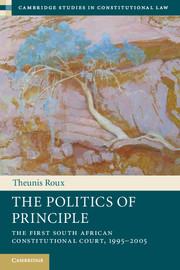
- The Politics of PrincipleThe First South African Constitutional Court, 1995–2005, pp. 1 - 12Publisher: Cambridge University PressPrint publication year: 2013
Accessibility standard: Unknown
Why this information is here
This section outlines the accessibility features of this content - including support for screen readers, full keyboard navigation and high-contrast display options. This may not be relevant for you.Accessibility Information
Accessibility compliance for the PDF of this chapter is currently unknown and may be updated in the future.