Book contents
- Frontmatter
- Contents
- List of Figures
- List of Tables
- Editors
- Contributors
- Preface
- Acknowledgments
- Introduction
- Section IFailures of Capture Scholarship
- 1A Revisionist History of Regulatory Capture
- 2The Concept of Regulatory Capture
- 3Detecting and Measuring Capture
- Section IINew Conceptions of Capture – Mechanisms and Outcomes
- Section IIIRegulatory Case Studies
- Section IVThe Possibility of Preventing Capture
- Conclusion
- Afterword
- Index
- References
2 - The Concept of Regulatory Capture
A Short, Inglorious History
Published online by Cambridge University Press: 05 June 2014

Book contents
- Frontmatter
- Contents
- List of Figures
- List of Tables
- Editors
- Contributors
- Preface
- Acknowledgments
- Introduction
- Section IFailures of Capture Scholarship
- 1A Revisionist History of Regulatory Capture
- 2The Concept of Regulatory Capture
- 3Detecting and Measuring Capture
- Section IINew Conceptions of Capture – Mechanisms and Outcomes
- Section IIIRegulatory Case Studies
- Section IVThe Possibility of Preventing Capture
- Conclusion
- Afterword
- Index
- References
Summary
The term regulatory capture, as I use it, refers to the subversion of regulatory agencies by the firms they regulate. This is to be distinguished from regulation that is intended by the legislative body that enacts it to serve the private interests of the regulated firms, for example by shielding them from new entry. Capture implies conflict, and regulatory capture implies that the regulated firms have, as it were, made war on the regulatory agency and won the war, turning the agency into their vassal. That at any rate is how I understand the concept.
The phenomenon of regulatory capture so understood must be as old as regulation itself – it was remarked for example by Woodrow Wilson in 1911 – but it first received sustained attention from political scientists, notably Marver Bernstein. In his book Regulating Business by Independent Commission, Bernstein proposed a “life cycle of regulatory commissions” having four phases: “gestation,” “youth,” “maturity: the process of devitalization,” and “old age: debility and decline.” That misleadingly suggests an internal process, like the life cycle of a human being, who is born, grows, matures, declines, dies – all without having to be attacked and taken over. However, it turns out that Bernstein is describing regulatory capture and not merely regulatory juvenescence and senescence.
Information
- Type
- Chapter
- Information
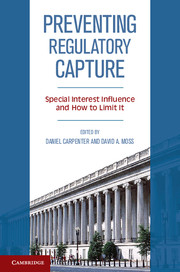
- Preventing Regulatory CaptureSpecial Interest Influence and How to Limit it, pp. 49 - 56Publisher: Cambridge University PressPrint publication year: 2013
References
, The New Freedom: A Call for the Emancipation of the Generous Energies of a People (New York: Doubleday, paperback ed. 2007 [1913]), 102Google Scholar
, Regulating Business by Independent Commission, ch. 3 (Westport, CT: Greenwood Press, 1955)CrossRefGoogle Scholar
, “The Theory of Economic Regulation,” Bell Journal of Economics and Management Science 3 (1971): 3CrossRefGoogle Scholar
, “A Theory of Competition among Pressure Groups for Political Influence,” Quarterly Journal of Economics 98 (1983): 171CrossRefGoogle Scholar
, “Toward a More General Theory of Regulation,” Journal of Law and Economics 19 (1976): 211CrossRefGoogle Scholar
, “Taxation by Regulation,” Bell Journal of Economics and Management Science 2 (1971): 22CrossRefGoogle Scholar
and , A Theory of Incentives in Procurement and Regulation, ch. 11 (Cambridge, MA: MIT Press, 1993)Google Scholar
and , “Regulatory Capture, Public Interest, and the Public Agenda: Toward a Synthesis,” Journal of Law, Economics, and Organization: Special Issue 6 (1990): 167CrossRefGoogle Scholar
's article “The Life Cycle of Regulatory Commissioners,” Journal of Law and Economics 24 (1981): 113CrossRefGoogle Scholar
Accessibility standard: Unknown
Why this information is here
This section outlines the accessibility features of this content - including support for screen readers, full keyboard navigation and high-contrast display options. This may not be relevant for you.Accessibility Information
Accessibility compliance for the PDF of this chapter is currently unknown and may be updated in the future.
- 19
- Cited by