


Across the Classic Maya lowlands, hieroglyphic writing was a mode of ritual practice at the intersection of individual performance, public reception, and other-than-human engagement. As Michael Coe first argued, the Classic Maya understood the script’s origins to be rooted in a primordial past in which the earliest humans had acquired writing from otherworldly sources.Footnote 1 This narrative found vibrant expression in depictions of other-than-human scribes in imagery, including in scenes accompanied by texts written by their human counterparts. The figure of the Classic Maya scribe merits closer consideration as an actor whose ritual engagement with gods and ancestors during hieroglyphic production reflected an other-than-human technological inheritance.
This chapter addresses the primordial origins and other-than-human patrons of the hieroglyphs who shaped the practice of writing among Classic Maya scribes. Using evidence from iconographic, epigraphic, archaeological, and ethnohistorical sources, I argue that mythology surrounding the hieroglyphs’ origins and other-than-human scribal figures informed historical scribes’ interaction with the practice and products of writing. Postclassic and colonial Maya accounts of writing’s ancient origins are diverse but consistently attribute its creation to the gods and ancestors. Consequently, for the Classic Maya, creation and use of written artifacts were ritualized activities, intentional performances through which scribes articulated material reality with the other-than-human realm.Footnote 2
I focus on the person and embodiment of the Classic Maya scribe, drawing on Bell’s localization of ritual practice in the body operating in its cultural-historical context.Footnote 3 Through the act of writing, practitioners engaged the gods and ancestors from whom they had received the hieroglyphic technology. This engagement made the scribal body “a ritualized body … a body invested with a ‘sense’ of ritual” and of the hieroglyphs’ other-than-human origins.Footnote 4 In particular, Classic Maya portraits of the scribe’s ritualized body as other-than-human vividly demonstrate the nature of engagement with hieroglyphic writing as a practice and as a product. Other-than-human scribes comprised a parallel ritual community that inhabited a distinct physical form but shared behaviors and tools with their historical counterparts. As “metapersons” who established “the terms and conditions of human existence,”Footnote 5 other-than-human scribes shaped the practice of writing by embodying a direct link to the hieroglyphs’ primordial roots.
Human scribes, in turn, legitimized their control over hieroglyphic knowledge and production through an embodied connection to the metaperson-patrons of artistic practice and, through them, to the realm of the gods and ancestors. By collectively participating in the ritually charged practice of writing, they forged a connection with the other-than-human beings who, as originators of the script, were themselves invested in the artifacts that their human counterparts created.Footnote 6 Cultivating relations with the hieroglyphs’ other-than-human progenitors allowed historical scribes to “[reenact] the divine act of creation with each artistic work” that they produced.Footnote 7 Other-than-human scribes reminded Classic Maya viewers of the script’s role in delineating a ritual community whose origins and significance extended far beyond the scope of human experience. They also recalled scribes’ “claims to divine power” by virtue of their ritual engagementFootnote 8 – claims that, although not on par with those of the divine king, nonetheless secured scribes a privileged place in Classic Maya society.
Writers of Classic Maya Hieroglyphs
The Classic Maya, like other precolonial Mesoamericans, did not distinguish between what Western scholarship today refers to as “text” and “image.”Footnote 9 The conceptual overlap finds expression in the Classic Mayan terms used to designate artisans. Semantic divisions paralleled distinctions in media rather than the presence or absence of linguistic content in artists’ creations. The Classic Mayan title that corresponds most closely to English “scribe” is ajtz’ihb, literally “s/he of tz’ihb” or “tz’ihb person.”Footnote 10 Tz’ihb was and remains the most common root in Mayan languages for “write” or “writing.”Footnote 11 This semantic narrowing is largely a product of the last several hundred years of colonial history, however, for the lexeme’s scope originally included all painted signs.Footnote 12 In other words, a Classic Maya ajtz’ihb could produce painted images, hieroglyphic texts, or even woven textiles; they did not necessarily or exclusively generate graphic representations of language.Footnote 13
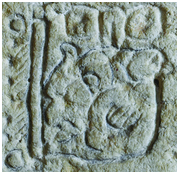
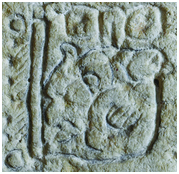
A second Classic Mayan term referred specifically to those who created three-dimensional signs through subtractive or transformative processes, that is, by reducing or reshaping the material mass with which they started working.Footnote 14 The lexical root probably begins with the vowel u- and includes the syllable lu and an undeciphered hieroglyph representing a bat head (T1523st), so its phonetic reading remains unknown.Footnote 15 Its semantic value can be deduced from context, however, and seems to have encompassed acts of sculpting, carving, incising, or molding of hard surfaces such as clay, stucco, stone, or bone.Footnote 16 Adding the agentive prefix aj- to the root yielded the title for practitioners of this craft – “sculptors” or “carvers” (Figure 3.1).Footnote 17
Full spelling of the title AJ-u-?[lu] (“sculptor, carver”) on Stela 15 from Piedras Negras, Guatemala, with the undeciphered bat head hieroglyph (T1523st) at the center.
A third Classic Mayan root, woj, could refer to hieroglyphs or other visual signs in any medium, although it primarily occurs in stone inscriptions from the northern and western lowlands.Footnote 18 To my knowledge, there is no epigraphic example of an agentive title based on woj, though a cognate form is attested in colonial Yucatec (ah wo[o]h “learned person, scribe”).Footnote 19 Distribution of woj spellings is also geographically and temporally limited, making it the least relevant of the three terms for our purposes.Footnote 20
Identifying Scribes
Archaeological, ethnohistoric, and epigraphic evidence indicates that Classic Maya scribes were proficient in calendrics, mathematics, astronomy, and mythology, all subjects that would have included information about temporal and spatial dimensions of proper ritual practice.Footnote 21 Yet in contrast to the wealth of materials they left behind, the Classic Maya persons who worked as scribes and the communities of practice in which they operated remain largely invisible to us. It seems that theirs was not a tradition that closely documented goings-on in local workshops, let alone individual biographies, at least not on durable materials. The most straightforward epigraphic evidence for scribes’ standing in Classic Maya society comes from a scattering of signatures that they left behind on stone and, to a lesser extent, on ceramics.Footnote 22 The hieroglyphic tags are short and unevenly distributed through space and time, but they make clear that some scribes belonged to the exclusive milieu for which they produced hieroglyphic artifacts.
The names of historical sculptors and calligraphers who signed their works include several theonyms, such as those of the storm god Chahk or the lightning god K’awiil, that were usually reserved for dynasts or members of the royal family.Footnote 23 A handful even carried the prestigious titles ajaw (“lord”) or ch’ok ajaw (“young lord, prince”) that were exclusive to members of the royal family.Footnote 24 Ethnohistorical evidence indicates that Postclassic Maya elites’ children and especially boys were taught to read and write,Footnote 25 and it seems unreasonable to assume that dynastic heirs would have been excluded from such training. Nonetheless, ajtz’ihb or the undeciphered “sculptor” moniker does not appear in the titular sequence of any known Classic Maya king or queen. As such, it seems that these titles were not simple badges of literacy awarded to anyone able to read or write. In using them in their signatures, scribes signaled that hieroglyphic practice was a significant component of their identity.
Other autographs feature a range of sub-royal titles, demonstrating that scribes’ social roles were diverse and extended beyond the royal family. Some are identified as itz’aat (“sage”), yajaw (“vassal”), or anab (a courtier of uncertain function), and one may even have been a chocolatier (ajkakaw, lit. “cacao person”).Footnote 26 A few texts in the northern lowlands pair the ajtz’ihb title with that of a diviner or ritual specialist (ajk’in, lit. “day person”), correlating two roles that drew on the gods’ creative powers.Footnote 27 Even scribes who did not sign with a title or special name may have been attributed elevated religious or cosmological standing by virtue of their affiliation with the royal court and the texts’ elite commissioners.Footnote 28
Although most signatures were sculpted in stone, there is good reason to believe that scribes working in other media enjoyed a similar social standing, and that hieroglyphic practitioners in fact wrote on multiple kinds of material surfaces.Footnote 29 Throughout this book, I refer to those who penned, brushed, sculpted, carved, incised, or otherwise created hieroglyphic texts as “scribes.” The etic designation is in part a pragmatic move, to make clear that I am focusing on Classic Maya artisans specifically in their capacity to produce writing, regardless of their other skills or duties. At times, I refer to practitioners as “scribe-artists” or “artist-scribes” when their crafting roles are ambiguous or relevant in a broad sense to the discussion at hand. For all their similarities and co-occurrences, Classic Maya hieroglyphic writing and iconography differed patently in their relationship to spoken language, structure, and communicative function. These differences that are reflected in how, when, and where scribes deployed the hieroglyphs.
Artifacts containing (only) imagery outnumber those with hieroglyphic texts, suggesting a smaller intended audience or producer community for the latter. Significantly, too, all known scribal signatures occur in association with other hieroglyphs, with or without accompanying imagery.Footnote 30 In other words, there is no indication that nonhieroglyphic creations were ever autographed in the same way as products of writing. A distinction between nonlinguistic “painting” and writing appears in a brief account of colonial Yucatec mythology, recorded in Spanish, that identifies the god Itzamna as the progenitor of “characters” or “letters,” the terms that Spaniards commonly used to refer to Indigenous hieroglyphs, and the goddess Ix Chebel Yax as the creator of “painting” and “weaving.”Footnote 31 The Classic Maya did not assume an emic distinction between those who wrote hieroglyphs and those who produced other graphic signs without a linguistic reading, but they did not conflate the visual codes or their creators either.
Excavating Scribes
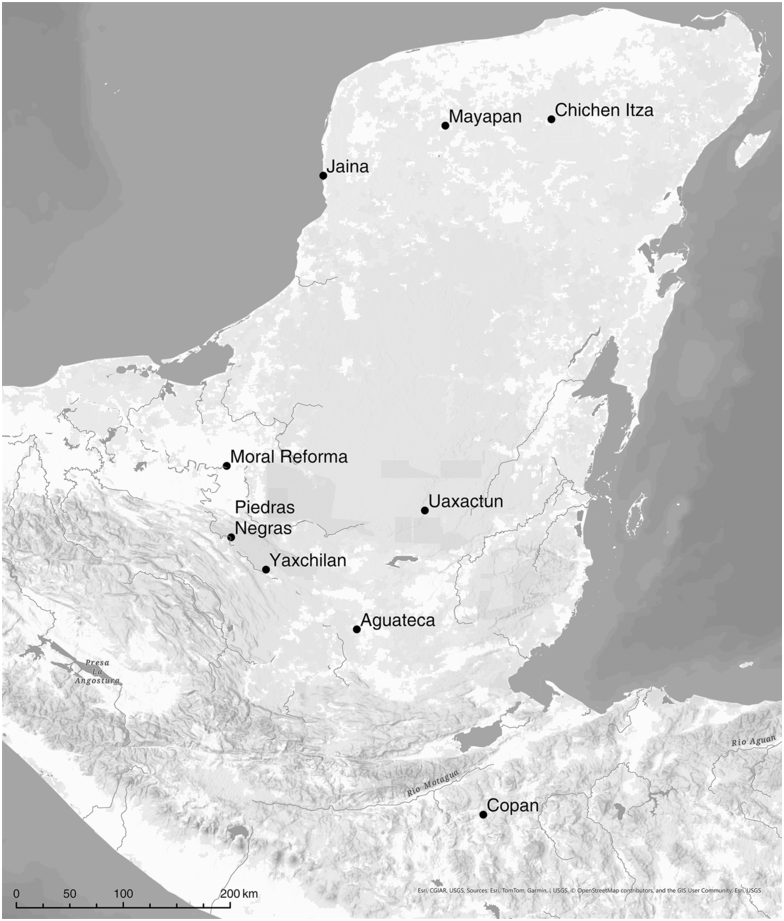
The few scribal workshops that archaeologists have been fortunate enough to locate have been critical for evaluating – and largely affirming – the proposition that scribes’ work was closely associated, spatially and socially, with an elite culture shared across the lowlands.Footnote 32 The only candidate for a Classic Maya house of scribal production or training that has been proposed on epigraphic grounds is the Osario pyramid at Chichen Itza in Yucatán, Mexico, which was adorned with a band of carved glyphs that may have represented a partial hieroglyphic syllabary (Figure 3.2).Footnote 33 Excavations have proven more productive in yielding tools and (partially) finished products of artist-scribes. Taken together, the archaeological evidence suggests that Classic Maya scribes, particularly those responsible for dynastic monuments and other royal commissions, operated in elite-dominated workshops as attached specialists.Footnote 34
Key Classic Maya sites with archaeological evidence for scribe-artists.
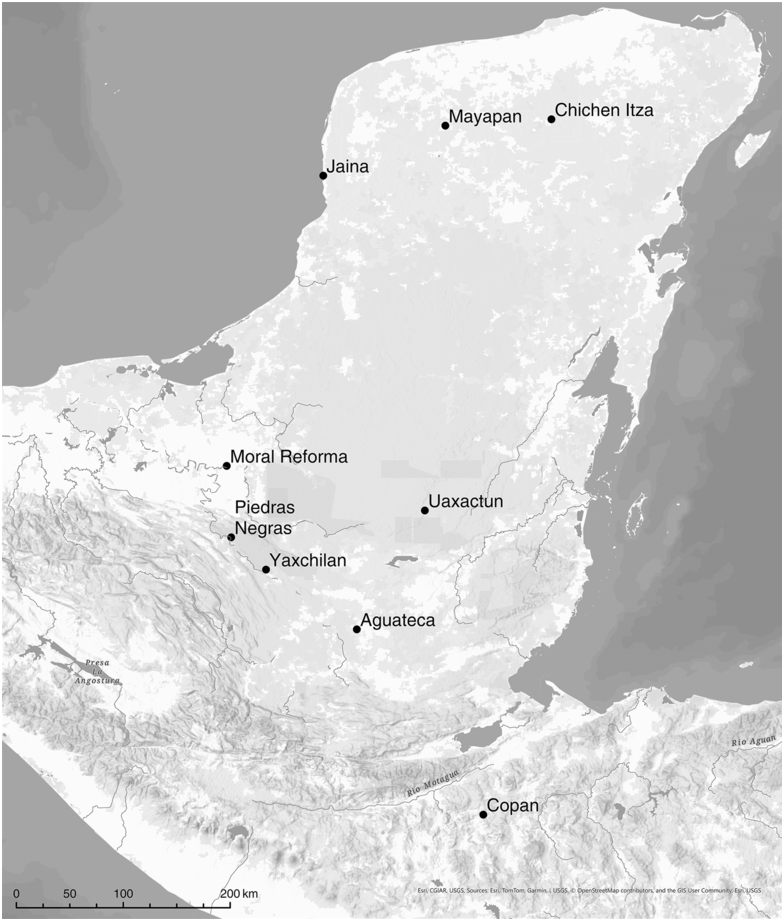
By far the most instructive context has been a rapidly abandoned elite residential complex that Takeshi Inomata and colleagues excavated at Aguateca, Petén, Guatemala (Figure 3.2). The setting included the probable workplace of a scribe or artist in the north and central rooms of a building known as Str. M8–10. Among the finds in both rooms were a number of finished shell and bone ornaments, greenstone beads, figurines, and other specialist products.Footnote 35 Archaeologists also recovered three conch shell halves that were likely used as ink or paint wells, as well as stone mortars and pestles for color preparation.Footnote 36 A clue to the possible identity of the north room’s user comes from a shell ornament inscribed with the title of the Aguateca k’uhul ajaw (“holy lord”) and the designation itz’aat.Footnote 37 Similar pestles and mortars were recovered alongside unworked bivalve shells in the central room of nearby Str. M8–4, suggesting that scribal activities were undertaken there as well.Footnote 38 A carved bone found on the bench in the same room bears the Aguateca k’uhul ajaw title and the moniker ajk’uhu’n, the latter a priestly title that may translate to “one who worships” or “venerates.”Footnote 39
Inomata and Laura Stiver propose that an elite artisan was active in the central and north rooms of Str. M8–10, whereas the southern room was designated for food storage, spinning, and weaving.Footnote 40 The occupants of Str. M8–10 apparently had access to a privileged area of Aguateca, given that the multiroom building was located less than 100 meters southeast of, albeit also behind and one level below, the palace group.Footnote 41 It is not possible to determine whether the mortars, pestles, and inkwells found in Str. M8–10 and M8–4 were used for writing or for nonhieroglyphic painting, hence the authors’ cautious reference to the occupant as a “scribe/artist.”Footnote 42 As noted previously, this distinction may not have been particularly meaningful for the Classic Maya, anyway, given the close relationship between text and image and the overlap in an ajtz’ihb’s training and practice.
Although the Aguateca context is highly unusual for its quality of preservation and documentation, similar finds have been excavated from a handful of mortuary contexts whose occupants are believed to have been scribe-artists. An older man was buried at Early Classic Uaxactun, Petén, Guatemala, with several objects that included a screenfold book or codex, of which archaeologists could only recover a few fragments.Footnote 43 Likewise, the person interred in Bu. VIII-6 in the Sepulturas complex of Copan in western Honduras was laid to rest with a jadeite pectoral and stuccoed barkpaper, the latter being the same material on which Maya codices were typically painted.Footnote 44 The Late Classic tomb was located in a building with a late eighth-century hieroglyphic bench whose text records the close ties that the family of the deceased enjoyed with the twelfth, thirteenth, and sixteenth kings of Copan; it also identifies someone – either the tomb’s occupant or a male ancestor – as an ajk’uhu’n and an ajaw.Footnote 45
Collectively, these findings lend archaeological weight to the idea that, even if some Classic Maya scribes were not themselves elites, their hieroglyphic practice associated them with the upper echelons of society.Footnote 46 In the contexts at Aguateca and Copan, the impression of scribes’ privileged status is further reinforced by artifacts inscribed with references to high-ranking titles, even if the artists working in the spaces where the artifacts were recovered were not the titles’ bearers. It is also clear from finds such as the Sepulturas tomb and from statements in some scribal signatures that elites frequently served as scribes’ artistic patrons or sponsors. The same relationship is attested indirectly by the prominence of dynasts and their direct subordinates in scribal and artistic compositions. Not all Classic Maya scribes would have had the same level of training, talent, or experience, but closer ties to the local royal family would have presumably correlated with better access to knowledge, resources, and prestige.Footnote 47
Portraying Scribes
Most illustrations of Classic Maya scribes or possible scribes occur on painted ceramics and would have been created by an ajtz’ihb. The figures often appear in a palatial environment, where they would have come into direct contact with high-ranking nobles and dynasts.Footnote 48 The scenes have been used to argue that those who wielded the hieroglyphic script were ascribed high status in Classic Maya society, just as Franciscan friar Diego de Landa observed among mid-sixteenth-century Yucatecan communities.Footnote 49 Still, scribal characters are in the minority in these images, and those who do appear display anatomical features that mark them as other-than-human, even as their bodies have anthropomorphic traits as well.
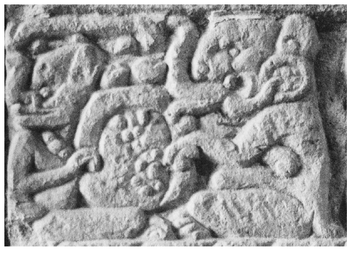
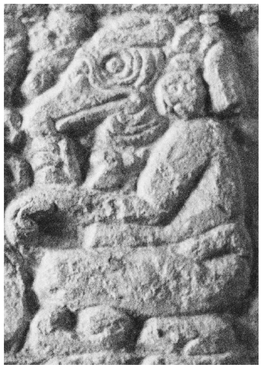
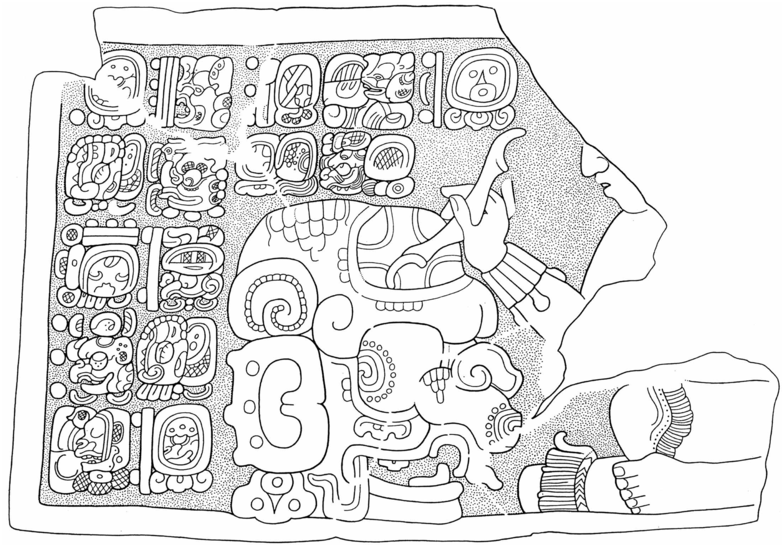
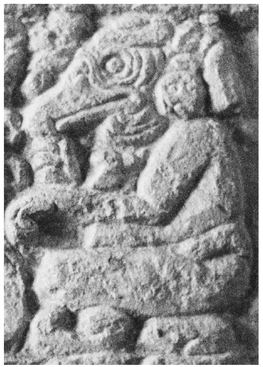
It is because of the relative absence of scribal portraits that the scene on the Emiliano Zapata panel is so exceptional (Figure 3.3). The fragmented limestone monument, named for the town in the Mexican state of Tabasco where it was recovered by authorities and is now on display in the local museum, is missing its right-hand side. What remains of the unprovenanced carving illustrates a person seated crossed-legged in front of an animated block with forehead markings identifying it as a k’an tuun “yellow/precious stone.”Footnote 50 The sculptor-scribe holds some sort of chisel or other tool in his right hand and is actively working the enlivened stone, which, as the last line of hieroglyphic text immediately above implies, represents the carved panel itself.Footnote 51
Emiliano Zapata panel.
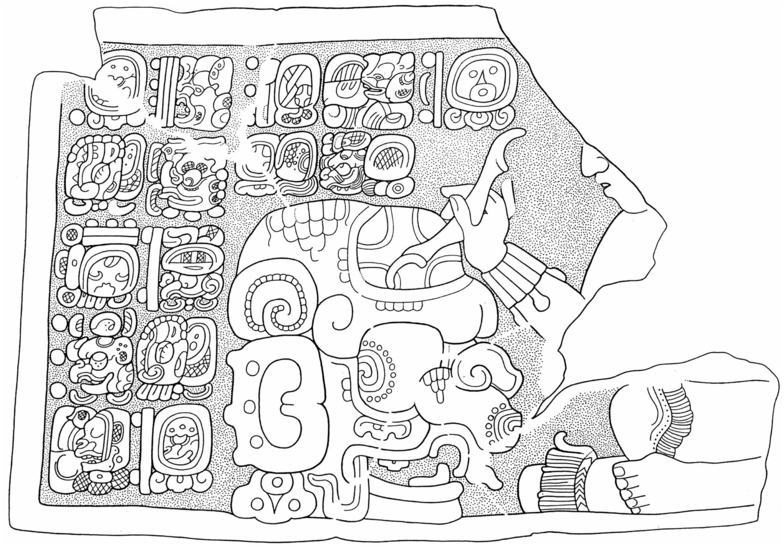
Self-referential inscriptions are not uncommon in the Classic Maya corpus, but the Emiliano Zapata panel is exceptional in going so far as to illustrate its own production. The carver’s portrait is also highly unusual because of his consistently anthropomorphic features. From the profile of the nose, chin, and mouth to the one visible hand and the delicate, if somewhat stylized toes on his left foot, the protagonist bears no traces of the so-called god markings indicating shininess or brilliance that adorn the bodies of other-than-human scribes (Figure 3.3).Footnote 52 Unlike the overwhelmingly “mythic” contexts of scribal scenes painted on ceramics, which are rarely “dynastic” or “historical,”Footnote 53 the modest Emiliano Zapata panel offers a rare illustration of a scribe in direct association with a historical text, even if the scribe’s identity is unknown.
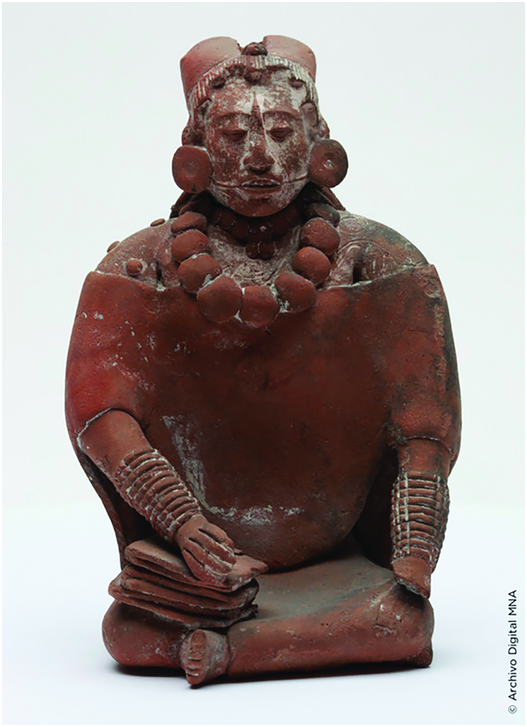
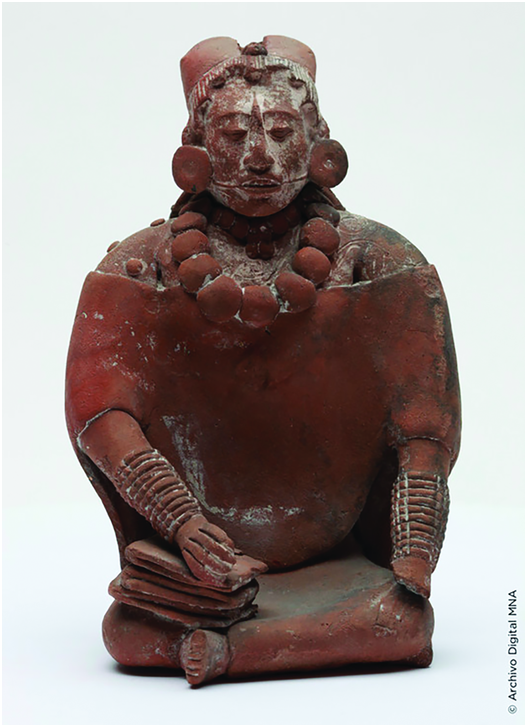
Another image of a possible human scribe, a ceramic figurine in the style characteristic of the island of Jaina in Campeche, Mexico, is atypical because she is clearly represented as female (Figure 3.4). The woman sits with what looks like a codex and bears traces of paint or tattooing across her face and exposed shoulders and upper chest but presents no traits indicative of other-than-human ontology. Rather, her body adornment and prominent jewelry, from the prominent earflares and oversized bead necklace to layered wrist bangles, point to a woman who occupied an elite or sub-elite role in her very human society. Still, the isolated figurine provides little insight into the social context of Maya hieroglyphic writing. Unlike the protagonist on the panel from Emiliano Zapata (Figure 3.3), she merely rests her right hand on the folded book on her lap, leaving open the question of whether she represents the codex’s user, creator, custodian, or a combination thereof (Figure 3.4).
Jaina-style figurine of seated woman with a folded codex.
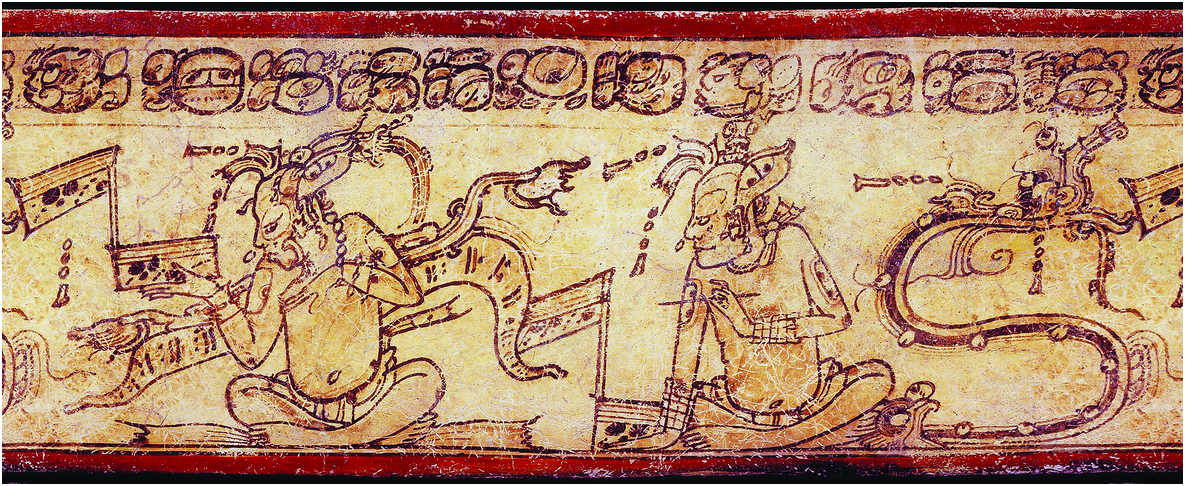
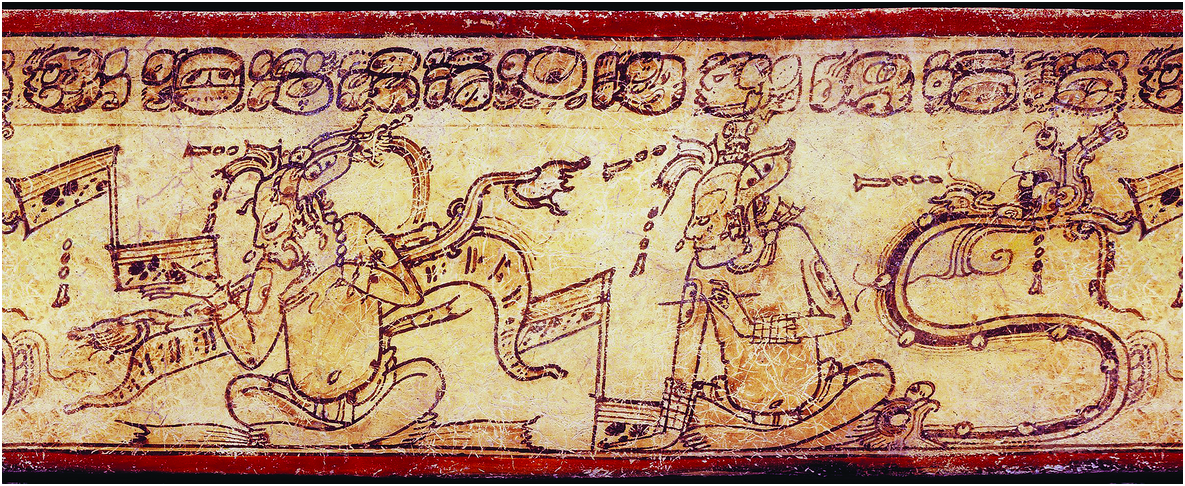
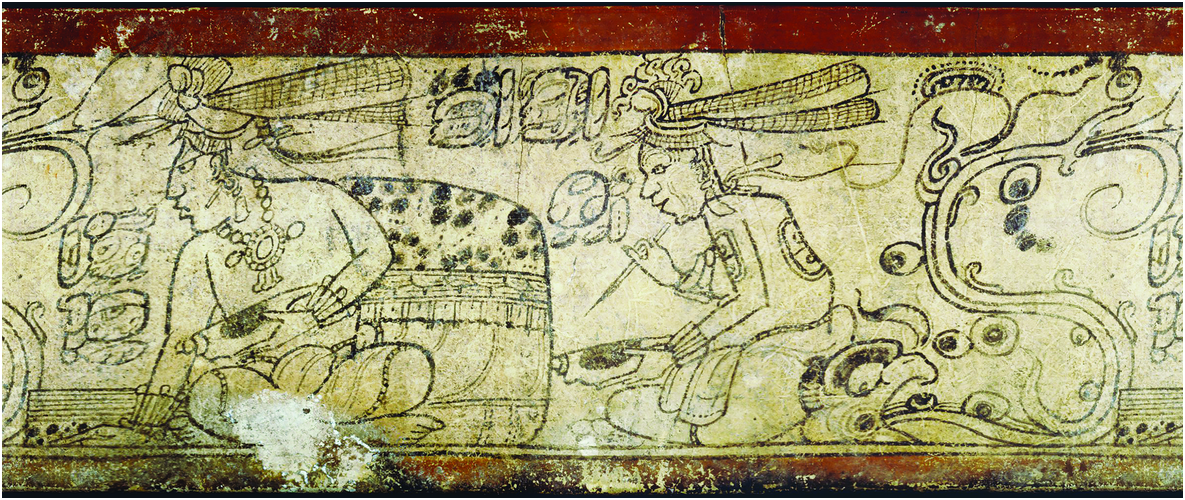
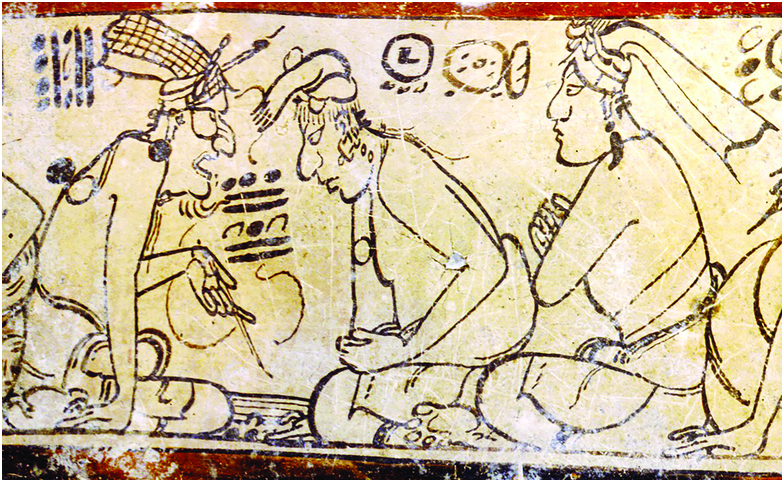
Scribes can be most reliably identified in Classic Maya imagery when they are shown with the materials and practices of writing. The most common instruments are inkwells and paintbrushes or quills, the latter two implements being all but indistinguishable iconographically (Figures 3.5–3.6).Footnote 54 More telling is an open or closed codex, which is usually shown in profile and lying flat on the ground in front of a seated scribe (Figure 3.5). Only in rare cases is a screenfold book ever portrayed such that the viewer catches a glimpse of its contents (Figure 3.7).Footnote 55 Another consistent indicator of scribal activity is what Coe has dubbed the “computer print-out” motif.Footnote 56 The white- or cream-colored, ribbon-like element is painted with bar-and-dot numbers and emanates like a fluttering codex page from the scribe’s body, usually around the midsection (Figure 3.5).Footnote 57
Classic Maya scribes with open codices, as portrayed on an unprovenanced Late Classic pot. A “printout” covered with numerical hieroglyphs emerges from behind the one on the left; the one on the right holds a brush or quill.
Classic Maya scribes with inkwells in a scene on an unprovenanced Late Classic ceramic vase. The one on the left sits behind a codex, while the one on the right holds a brush or quill.
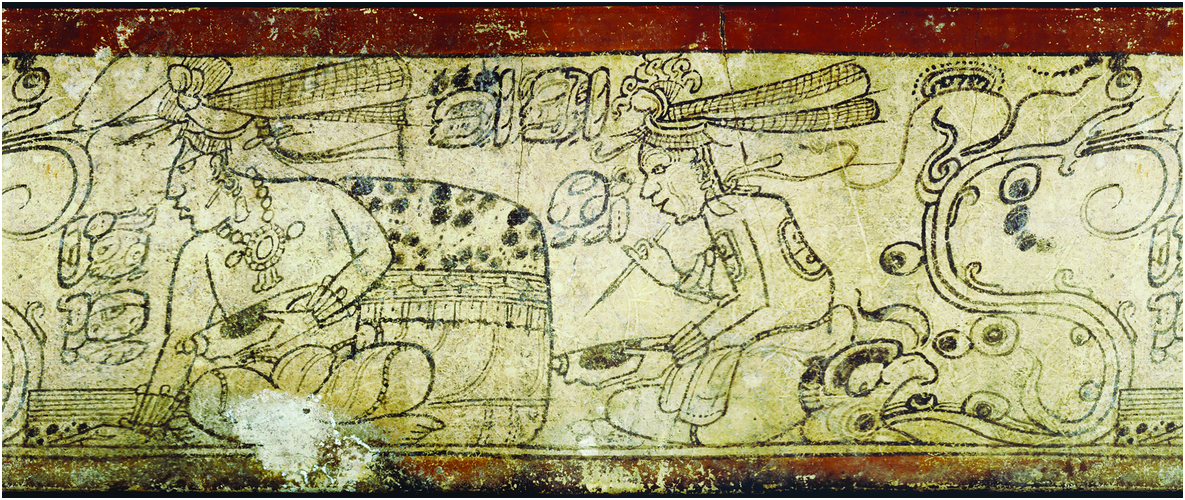
There is a tendency to assume that all Classic Maya figures shown with an inkwell and a brush or quill represent scribes, even when they are not actively using the paraphernalia and there is no codex or hieroglyphic text nearby.Footnote 58 Certainly, the former tools are indicative of broader participation in visual production, and there is ample linguistic, historical, and ethnographic evidence that an ajtz’ihb was trained to paint hieroglyphs and nonlinguistic imagery alike.Footnote 59 A scribe-artist illustrated on a vessel excavated at Copan, for instance, holds a brush that lingers over a mask, apparently mid-stroke, as a “printout” swirls away from his body, suggesting that he could produce hieroglyphic writing and nontextual crafts alike.Footnote 60 However, coproduction of text and image was likely commonplace for those using paint, as well as for sculptors and others working with subtractive media.Footnote 61 Portraits of artists painting masks or tooling other, likely nonhieroglyphic artifacts indicate that an inkwell, quill, or brush cannot alone securely identify its user as a producer of writing (compare for example, characters with and without a codex in Figure 3.6).Footnote 62 As such, I concentrate on the most secure representations of scribes as writers, namely those associated with a barkpaper codex or Coe’s printout motif.Footnote 63 Although I occasionally refer to scribal figures shown with just an inkwell and a brush or quill, I avoid drawing any conclusions based on their images alone.
Historical or Other-than-Human
The persons whose creative capacities were necessary to produce hieroglyphic artifacts are rarely subjects of the illustrations that often accompanied their texts. Why the inequality in representation? Scribes’ written products were widely visible in Classic Maya society, at least in elite circles. They were erected in public spaces, inherited as heirlooms, gifted and exchanged across long distances, deposited in royal tombs, even targeted for destruction in moments of historical revision or political reform.Footnote 64 Clearly, however, their makers’ portraits were not an iconographic priority, nor were hieroglyphic ascriptions of creatorship. Scribal signatures are relatively infrequent and concentrated in a handful of Late Classic communities where such expressions appear to have been more customary.Footnote 65 Autographing one’s hieroglyphic products may not have been expressly discouraged, but it was not typical practice in most polities.
One could posit a social inhibition against representing these actors, especially on stone sculptures where kings, queens, and their offspring predominated. Classic Maya persons of lesser rank, if illustrated at all, generally appear in marginal positions as allied subordinates or unwilling captives.Footnote 66 Dynastic portraits were considered extensions of the protagonists’ political and religious authority and remained the purview of royalty, simultaneously representing and reinforcing the power from which they originated.Footnote 67 Only during the late Late and Terminal Classic periods do we observe modest diversification among the subjects of monumental imagery. Even then, however, most beneficiaries of this trend were lesser nobles who ruled locally or were important vassals to a nearby king, reflecting a gradual diffusion of political power and the decline of divine kingship.Footnote 68 Yet the expansion in representational privilege apparently did not extend to scribes, or at least not to individuals explicitly identified as such. It is perhaps telling that what appears to be a rare monumental portrait of an other-than-human scribe, on Stela 1 from Moral Reforma, shows the simian character as a bound captive, his centipede-raptor tail curving around the monument’s edge, as he sits at the feet of a dancing overlord.Footnote 69
A Divine Creation
For the Classic Maya, writing was a technology characteristic of but not exclusive to humans, a product of the realm of the gods and ancestors, rather than an earthly invention.Footnote 70 The hieroglyphic script’s status as an other-than-human creation fundamentally shaped Classic Maya scribes’ practice. In some ancient civilizations such as China, the origins of writing were ascribed individual sages who were unusually wise and inventive but still human.Footnote 71 Similarly, several Judeo-Christian sources from the late second century BCE and the first century CE postulate that writing was invented by Old Testament forebearers such as Adam or Abraham.Footnote 72 For the Classic Maya, however, the human practice of writing was ritualized precisely because it arose from the ancestors and gods’ creativity. In Plato’s account of an ancient Egyptian myth about the origins of writing, the god Amun disparages Thoth’s invention as a hindrance to true wisdom by externalizing information storage and replacing the need for learning.Footnote 73 For the Classic Maya, in contrast, the hieroglyphs were a prized intellectual resource that complemented oral transmission, rather than replacing or diminishing it.Footnote 74
The clearest narratives of writing’s origins are recorded in colonial-period sources, including a sixteenth-century Kaqchikel manuscript from the town of Sololá in highland Guatemala. In preparing to emigrate from their primordial homeland, Tulan, to their contemporary territory, the first ancestors received a series of “burdens” (riqa’n) from their progenitors that included the 260-day and 365-day calendars, music, carving, weaving, and “writings” (tz’ibanïk).Footnote 75 The fact that the cultural goods are designated as riqa’n – the same Kaqchikel lexeme could refer to a local office or responsibility (Spanish cargo) held on behalf of othersFootnote 76 – underscores the bearers’ collective charge to maintain them for their descendants.Footnote 77 Soon after leaving Tulan, in contrast, the ancestors were given weapons, shields, armor, and “accompanying gifts” or bestowals (rachya’ik) of bee and wasp stings, mud, rain, and clouds.Footnote 78 The rachya’ik accompanied the ancestors as they continued the migration.Footnote 79 Unlike the riqa’n received in Tulan, however, the rachya’ik were not entrusted to the ancestors’ care on the community’s behalf, a sign that they were not intended to be a multigenerational inheritance.
Other Maya narratives explicitly identify the hieroglyphs’ other-than-human creators, implying that religion and the script were closely intertwined since primordial times. According to a colonial Yucatec account, the creator of hieroglyphic writing was the deity Itzamna, son of the Sun god and the first priest or ajk’in.Footnote 80 The richest narrative of writing’s origins, however, is found in a sixteenth-century source known as the Popol Vuh. According to its K’iche’ authors, brothers Jun B’atz’ and Jun Chowen were designated as the first “flautists and singers, writers and sculptors, jade workers and precious metalsmiths” (e aj su’, e aj b’ix … aj tz’ib’ … aj k’ot, e aj xit, e aj puwaq) who could bring joy and comfort to those around them with their talents.Footnote 81 Nonetheless, Jun B’atz’ and Jun Chowen became prideful over time and mistreated their younger half-brothers, the famous Hero Twins Junajpu’ and Xb’alanke’, out of envy.Footnote 82 On account of their arrogance and jealousy, the older boys were transformed into spider monkeys, destined to live among the trees as they continued practicing their crafts.Footnote 83
Because the elder twins retain their names after the transformation, the Popol Vuh implies that the distinction between howler monkeys (Alouatta pigra or Alouatta palliata; K’iche’ b’atz’) and spider monkeys (Ateles geoffroyi; K’iche’ chuwen [antiquated] or k’oy) originated with the boys’ primordial misdeeds. Consequently, the tale presents artistic patronage as fundamental to both simians’ primordial identities, a feature that predates their respective creations. Even in the northern lowlands, colonial Yucatec dictionaries record chuen as a general term for “artist” or “artisan.”Footnote 84 A Yucatec chant documented in the late eighteenth-century manuscript known as the Ritual of the Bacabs also mentions a character named Sak Bats’ (“White Howler Monkey”) in a healing ritual that involved color paints and “artwork” (chuene).Footnote 85 An elaborate Postclassic effigy censer recovered from the temple at Mayapan, Yucatán, known as Str. Q58 takes the form of a howler monkey scribe-artist wielding a brush in the right hand and an inkwell in the left, and thus would seem to embody this figure.Footnote 86 The conceptual connection between other-than-human simians and writing can be traced back to the Classic period, where, in the absence of portraits of historical scribes, images of their other-than-human counterparts become even more valuable glimpses into the dynamics of hieroglyphic engagement in society at large.
Other-than-Human Scribes
Classic Maya scribes’ ritualized bodies represented “a specific embodiment and exercise of power” and of social relations that were relevant well beyond the boundaries of their craft community.Footnote 87 Although many portraits of other-than-human scribes can be dated to the Late Classic period based on style or associated hieroglyphic captions, most occur on artifacts without archaeological provenance. Still, the immediate context of the representations – where scribes are depicted, what are they doing, with whom or what they interact – grants some insight into their distribution and cultural significance, including the differential values that Classic Maya elites attributed to the practice, artifacts, and agents of hieroglyphic writing. Who, then, were its other-than-human practitioners and patrons? How did they relate to the very human scribes with whom they shared their craft?
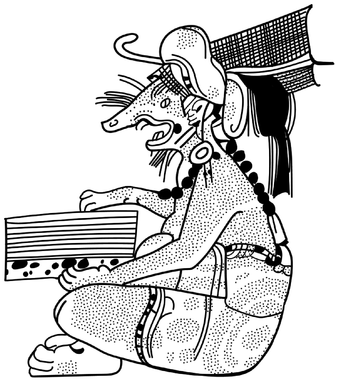
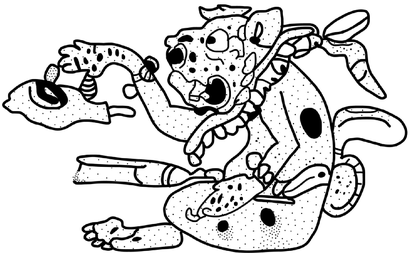
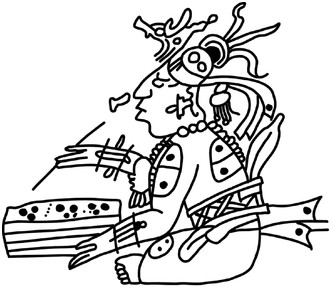
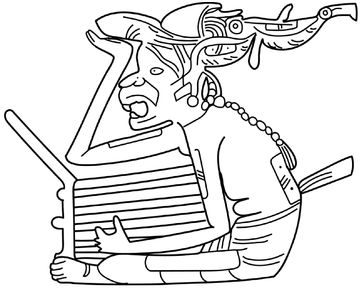
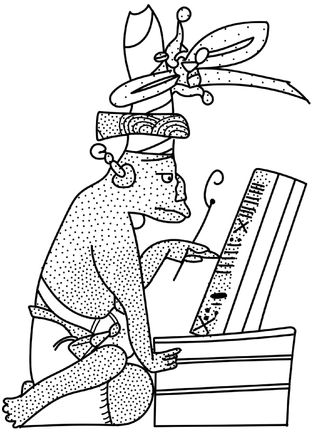
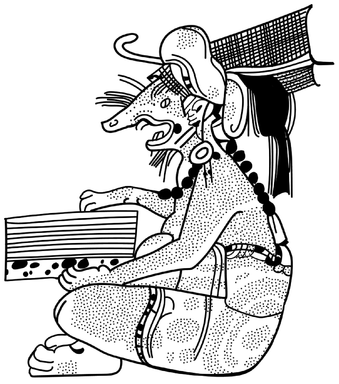
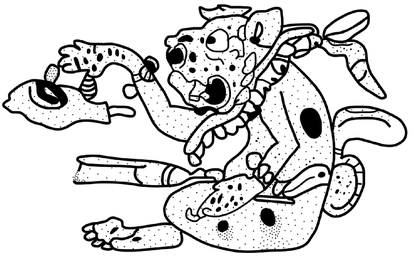
To judge from surviving imagery, the principal other-than-human patron of Classic Maya scribes was an outstandingly clever monkey character first identified by Coe.Footnote 88 The simian scribe is widely represented in images on ceramics and other portable media from across the lowlands. Although he – the figure is invariably represented as male – tends to be represented as a howler monkey (Figure 3.7), he sometimes appears as a slender spider monkey or combines features of both species.Footnote 89
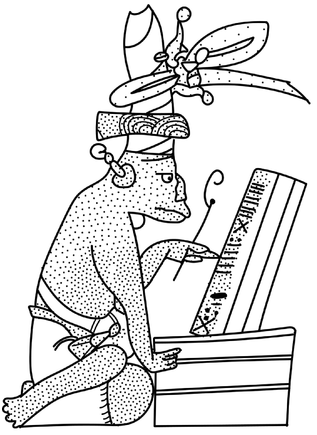
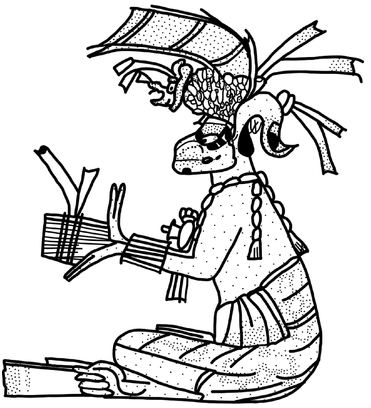
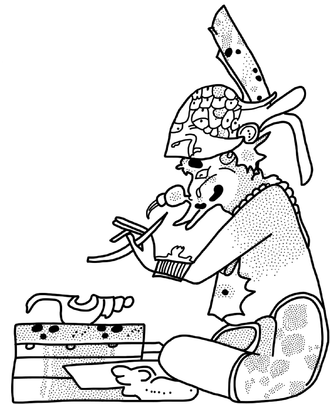
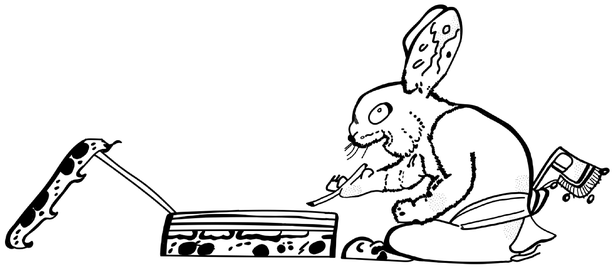
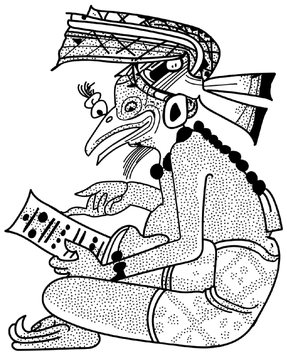
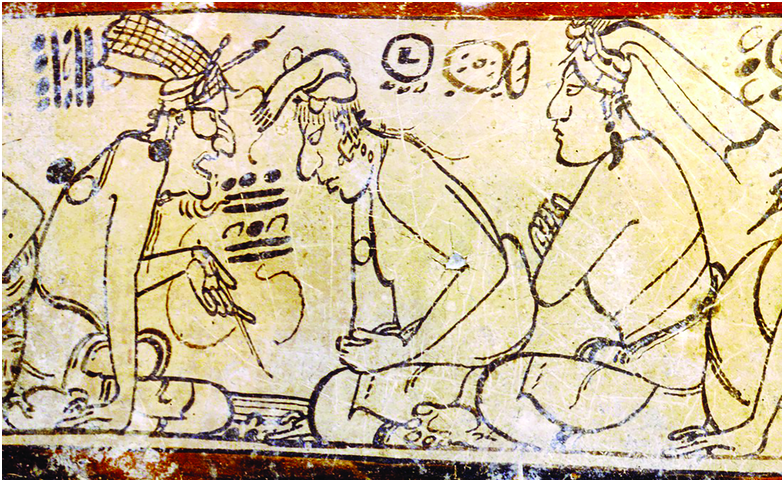
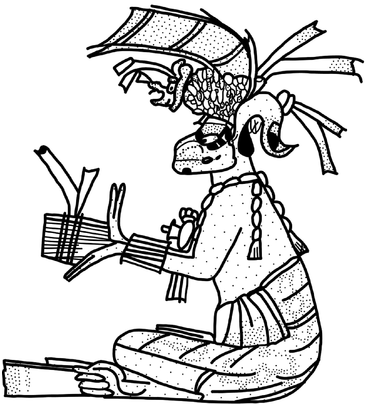
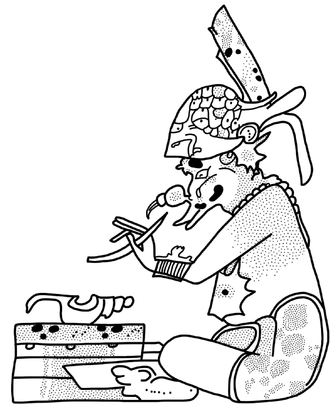
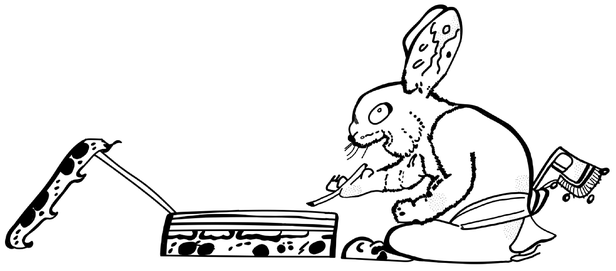
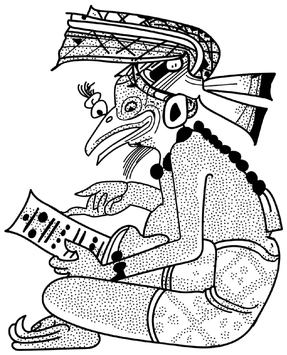
Compared to the monkey scribe, the more complete roster of other-than-human characters who engaged with hieroglyphic writing has received considerably less scholarly attention.Footnote 90 That they do not represent historical, human persons is evident from their hybrid form that combines baseline anthropomorphic features, such as limbs and body posture, with characteristics of animals or gods. As such, it more appropriate to group them by their most salient physical and especially facial features, rather than attempting a rigid classification.Footnote 91 The order of their portraits in Figure 3.8a–i reflects their descending frequency in Classic Maya imagery, but the distribution is highly uneven. The bodies of “hybrid anthropomorphic” scribes, which constitute approximately two-thirds of the corpus, meld human faces and limbs with other-than-human features, such as animal ears or tails, foliage sprouting from their bodies, or marks characteristic of gods (Figure 3.8a). The zoomorphic characters other than spider and howler monkeys, in contrast, are each known from no more than a handful of examples (Figure 3.8d–i).Footnote 92 Collectively, the diverse group illustrates Classic Maya assumptions about the ritualized practice of writing and limitations on its accessibility to humans and other-than-humans alike.
Classic Maya portraits of other-than-human scribal figures, sorted by physiological type.
hybrid anthropomorphic.
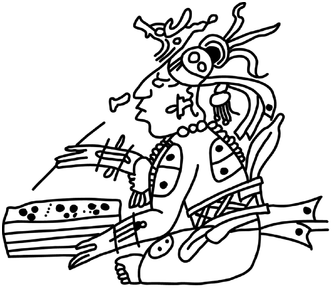
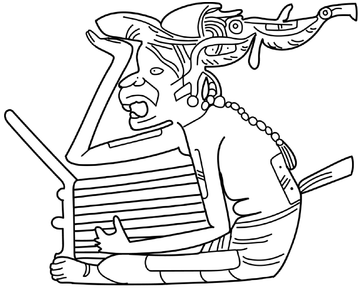
howler monkey.
Other-than-Human Portraits
Other-than-human scribes are consistently represented in Classic Maya imagery with the posture and proportions typical of human beings. Their bodies assume characteristically hominid poses as they sit, usually cross-legged and upright, a position that most of the animals would never assume in an earthly setting (Figure 3.8a–i). Other anthropomorphic features are usually limited to accessories such as a headwrap, earspools, or a loincloth. The combination of identifiably other-than-human and anthropomorphic traits in these scribes underscores their hybrid character.Footnote 93 At the same time, it situates these beings as an ontological tether between the other-than-human creators of hieroglyphic writing, the human scribes who used it, and the historical artists who illustrated them.
If the other-than-human scribe is partially zoomorphic, that identity is usually expressed most prominently in the face and particularly in the eyes, mouth, and nose. One scribe, for instance, displays the elongated fingers and toes of a human but is identifiable by his elongated snout and white facial coloring as a gray fox (Classic Mayan waax or wax) (Figure 3.8f).Footnote 94 Other-than-human scribes with anthropomorphic faces, in contrast, are marked as ontologically exceptional by floral, faunal, or godly features. Two hybrid scribes painted on a Late Classic codex-style ceramic vase, for instance, bear human visages but are marked as other-than-human by their cervine ears and, in one fellow’s case, flowers emanating horizontally from his upper body (Figure 3.5).
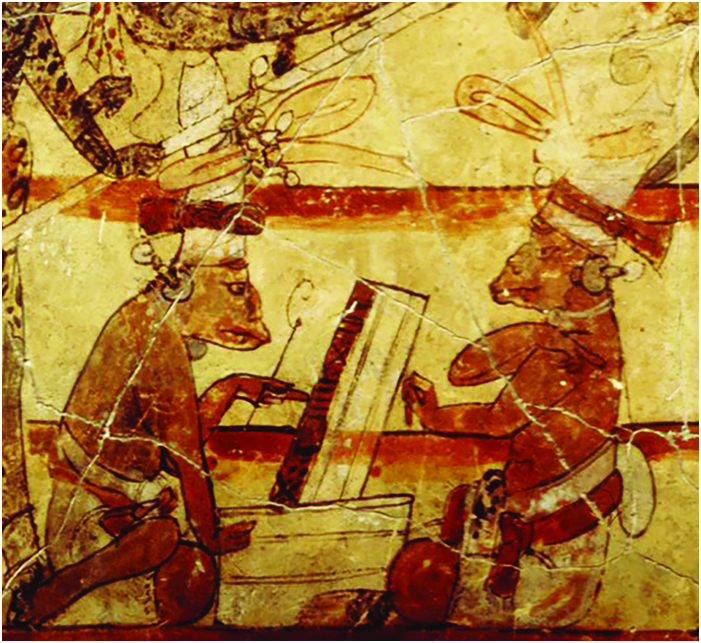
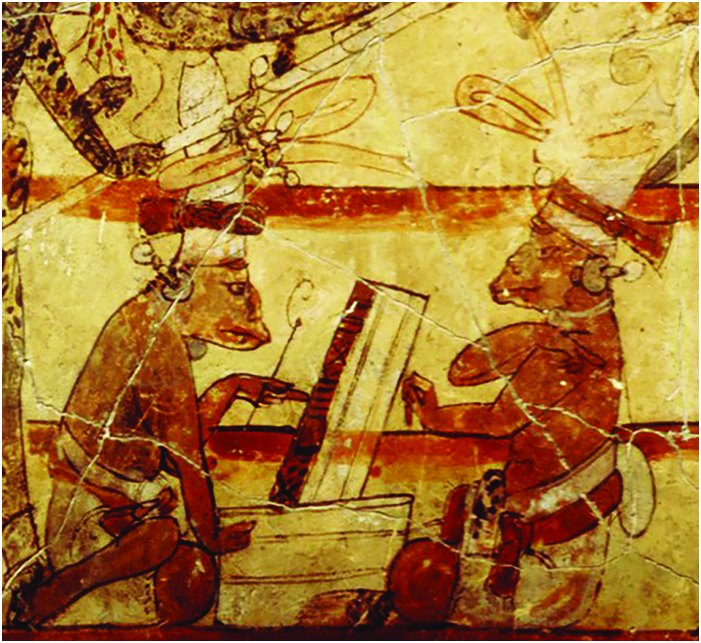
Some other-than-human scribes with primarily anthropomorphic bodies, in contrast, assume the guise of deities. In the Postclassic Madrid Codex, for instance, there are several representations of the rain god Chahk dipping a brush into an inkwell, sometimes with a hieroglyphic printout emanating from his mouth.Footnote 95 The old deity whom scholars have nicknamed God D, readily identifiable by his characteristically square eyes with square pupils, appears in a few scenes bending over a codex (Figure 3.9).Footnote 96 God N, in turn, can be recognized in at least one scribal portrait by his wrinkled face and typical netted headdress (Figure 3.6, right side).Footnote 97 The deity most commonly shown in association with the tools of the scribal trade, though, is the Maize god, whose elongated, cob-shaped cranium, youthful face, and floral tassels epitomized Classic Maya beauty.Footnote 98
God D (left) and two companions consult an open codex in a scene painted on an unprovenanced Late Classic ceramic vessel.
What should we make of other-than-human representations of scribes, especially those with zoomorphic traits? For starters, why show animals interacting with writing at all? The conceptual distance between animal and human certainly was not insurmountable for the Classic Maya, for whom “animal” and “human” were not ontologically exclusive categories.Footnote 99 Consequently, a variety of species could wield the script, not just fellow primates. Cosmogenic narratives documented in ethnohistorical and ethnographic sources from across the Maya region represent the earth as a living entity, and the various stages of creation are replete with agricultural references to growth and reproduction.Footnote 100 Some accounts describe the inhabitants of earlier creations, which the gods destroyed to make way for the current one, as monkeys or other nonhuman animals.Footnote 101 This trajectory mirrors the personal biographies of Jun B’atz’ and Jun Chowen in the Popol Vuh, who took the form of human boys prior to their downfall. It also suggests that the ontological distinctions of the present were not inherent to the cosmos but a product of historical contingency. Moreover, all beings remained interlinked as part of a larger society of metapersons that included gods, ancestors, animals, and additional other-than-human denizens with whom the Classic Maya shared their world.Footnote 102 Still, not all members of this society were not equal in character or ability, and such differences shaped access to writing among other-than-human beings, as among the Classic Maya themselves.
Cast of Characters
There are noticeable patterns in the classes of animals who are represented among other-than-human scribes and, just as importantly, those who are not. Most characters appear mammalian and specifically resemble species of intermediate size, much like the monkey patron himself. In this respect, they mirror the relatively large repertoire in the hieroglyphic script of zoomorphic icons that denote such creatures, among them the raccoon, rabbit, and fox.Footnote 103 Among these creatures, monkeys are the behaviorally and physiologically most like humans, which may explain their close and ancient association with Classic Maya artisans. Other animals represented as scribes also have limbs that require little imagination to anthropomorphize (Figure 3.8d–i). Even the only nonmammal, the vulture, bears primary remiges that evoke the splayed fingers of an open human hand when spread.Footnote 104
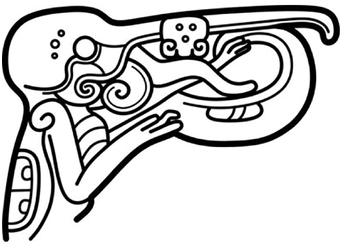
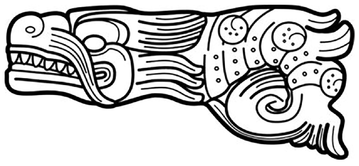
So, could anyone, zoomorphically speaking, pick up writing? The short answer is no. Most members of human society were barely literate, if at all.Footnote 105 Similarly, the ability to read and write in the hieroglyphs was not universal among other-than-human beings, either. The roster of other-than-human scribes was delimited by cultural conventions that we can only begin to reconstruct, though the portraits offer some clues. First, there is a striking absence of amphibians, fish, reptiles, and smaller mammals such as bats or rodents. Full-figure hieroglyphs demonstrate that, in the right contexts, historical scribes were more than willing to animate or even to anthropomorphize these and other creatures, including insects (Figure 3.10a–e).Footnote 106 In the case of amphibians, fish, and some reptiles, the decisive distinction may have been that these creatures are not terrestrially bound. Many species in these categories, including toads, caimans, and crocodiles, have four limbs (and in the case of the latter two, digits thereon) that would have been anatomically convenient for an anthropomorphic rendering.Footnote 107 However, the fundamental difference from humans in habitat – and water’s tendency to wash away painted text, at least – may have precluded these animals’ participation in other-than-human scribal culture.
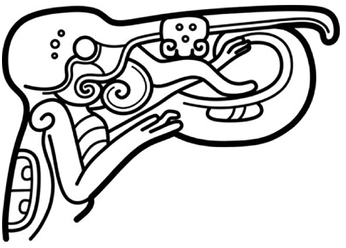
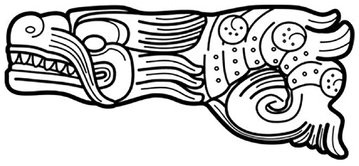
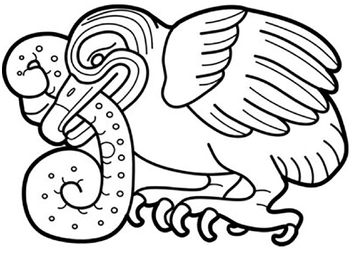
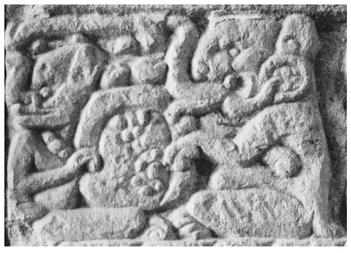
Full-figure hieroglyphic forms on Throne 2 at Yaxchilan: a) mosquito (syllable ya), b) fish (syllable u), c) bird with worm (syllable li); and on the Str. 9N-82 Bench at Copan: d) bat (undeciphered) (left) and gopher (logograph BAAH “head; first”) (right), e) vulture (logograph AJAW “lord”).
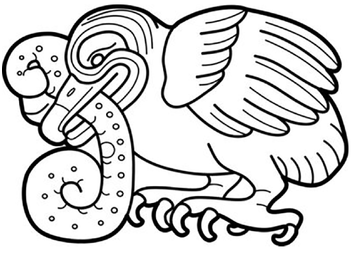
Notable, too, is the absence of jaguar, puma, or other large mammalian scribes, especially given these animals’ salience in elite names.Footnote 108 Archaeological and art historical evidence attests to the symbolic value of large felines and especially jaguars as “icons of power and prestige” among the Classic Maya.Footnote 109 This valence also applied in the realm of written artifacts, as attested in images of codices luxuriously encased in a jaguar’s spotted pelt (Figures 3.5, 3.6).Footnote 110 The felines’ absence among other-than-human scribes could reflect the close affiliation of pumas and jaguars with dynastic authority, which may have precluded analogies between them and craftspeople who worked for the ruler. After all, we have no images of Classic Maya queens or kings engaging directly in scribal or related arts, and no text refers to a sitting ruler as an ajtz’ihb or a “sculptor.” Still, the correlation is not straightforward. Known other-than-human scribes include at least one animal, the king vulture, whose visage doubled as the zoomorphic logograph AJAW (“lord”) and thus literally denoted the ruler in Classic Maya writing (Figure 3.10e).Footnote 111 Perhaps the absence of feline scribes is more reflective of their predator status as a potential threat to humans, rather than a function of their royal symbolism.
Whatever the reasons for selective zoomorphic representation among other-than-human scribes, context was key in determining with whom Classic Maya scribes admitted sharing hieroglyphic capacity. Ironically, perhaps, the figures’ animal features, which heavily concentrate in the face, reinforce the idea that scribal and related crafts, including the rituals that their practice entailed, were predicated on human capabilities. Other-than-human scribes consistently bear anthropomorphic limbs and appendages, which are often depicted mid-gesture as they engage with artifacts of their trade. Their body language, in other words, is very much like what one could expect from the ritualized bodies of human scribes engaged in writing. Printout motifs also cluster on other-than-human scribes with an anthropomorphic visage, to the exclusion of zoomorphic scribes.Footnote 112 Other-than-human scribes’ portraits suggest that, although the script may be a divine creation, no one can compose hieroglyphs without the dexterity of a human hand.
Gender Dynamics
In addition to signaling ontological constraints on the practice of writing, other-than-human scribal portraits imply that production of hieroglyphs was a principally male undertaking. A handful of signatures suggest the presence of female writers among the Classic Maya, as do several portraits of women associated with what may be brushes, quills, or codices.Footnote 113 A colonial Yucatec incantation from the Ritual of the Bacabs also identifies a goddess, Ix Hun Ye Ton, as a “patroness” of both “painting-writing” (ts’íib in modern orthography) and hieroglyphic signs (wooj).Footnote 114 However, other mythological accounts of Maya writing’s origins consistently represent key protagonists as male. Women are clearly underrepresented in epigraphic and iconographic evidence for Classic Maya scribes as well, whose surviving names and titles suggest that they were almost all men.Footnote 115 Even other-than-human scribal figures consistently presents as male, most visible in their flat, bare chests (Figure 3.8a–i).Footnote 116 “[T]he socialized agent” of the scribe, human or otherwise, embodied the gendered dynamics of engagement with hieroglyphic writing in Classic Maya society.Footnote 117
Evidence for female participation in hieroglyphic reading and writing may be scanter than in other civilizations that invented writing, but Classic Maya society was in no way exceptional in literacy being male-dominated.Footnote 118 In ancient Mesopotamia, most scribes were men, and one early source credits a primordial king with the script’s invention.Footnote 119 At the same time, attestations of female-produced writing in ancient Mesopotamia are comparatively abundant, even when one accounts for the cuneiform corpus’ much larger relative size.Footnote 120 Several goddesses were associated with scribal activities, among whom the most prominent was Nisaba. The earliest attested tutelary deity of writing and computation and a scribe in her own right, she appears in at least one Sumerian hymn as writing’s divine creator.Footnote 121 Nonetheless, Nisaba was gradually superseded and, by the first millennium BCE, entirely replaced in her role by the god Nabu.Footnote 122 The reasons for the cultural shift are unknown, but it was not exclusive to scribal arts. Across the Sumerian pantheon, male deities gradually rose in prominence at the expense of female counterparts during this period.Footnote 123 Samuel Meier notes a similar pattern in the succession of scribal patron deities in ancient Egypt, where mythology records that writing was created by the goddess Seshat but situates the god Thoth, the hieroglyphs’ original inventor, as patron of writing’s practitioners.Footnote 124 Even in traditions with mythology about writing’s origins involving female protagonists, men predominate in records for historical scribes across early writing cultures.Footnote 125
Scribal Practice over Hieroglyphic Product
The hieroglyphs’ other-than-human origins influenced how the Classic Maya viewed, sometimes literally, scribes and their work. The people, objects, and contexts of scribes’ ritualized practice entailed an intimate association between historical writers and the divine originators of the technology. This link is visualized most clearly in images of other-than-human scribes, whose physiology combines human traits with features that mark their more-than-human status. Yet they are depicted engaging with hieroglyphic writing much as historical scribes did. Their behaviors and tools, including brushes, inkwells, and books, were recognizable to Classic Maya viewers. So, too, were the social norms that their portraits expressed, including a predominance of male actors, an emphasis on manual dexterity, and access to privileged people, places, and goods. At the same time, their physical forms distinguished them from human viewers by underscoring the exclusivity and contingency of one’s capacity for writing.
Scribes’ hieroglyphic skill set them apart from much of society and was contingent on the gods who granted both creative capabilities and the technology to express them. Carving, painting, incising, or molding hieroglyphs “transfer[red] a vital charge, a living spark, of that original” into the inscribed surface.Footnote 126 It also engaged forces inherent to that surface, as visualized by the enlivened stone on the Emiliano Zapata panel or the faces of the so-called Jester God emerging from an open codex in the lap of a simian scribe (Figure 3.3).Footnote 127 Human scribes’ capacity to recognize, transmit, or draw out that force could only be attained by ritually accessing “metapersonal powers” of the gods and ancestors.Footnote 128 Classic Maya scribes’ intimacy with the other-than-human realm did not necessarily surpass that of the divine king or queen, who was uniquely tasked with ritually mediating on the community’s behalf.Footnote 129 However, scribes were uniquely positioned to articulate other-than-human and human concerns through hieroglyphic writing, fulfilling a primordial obligation that had been bestowed upon their ancestors.
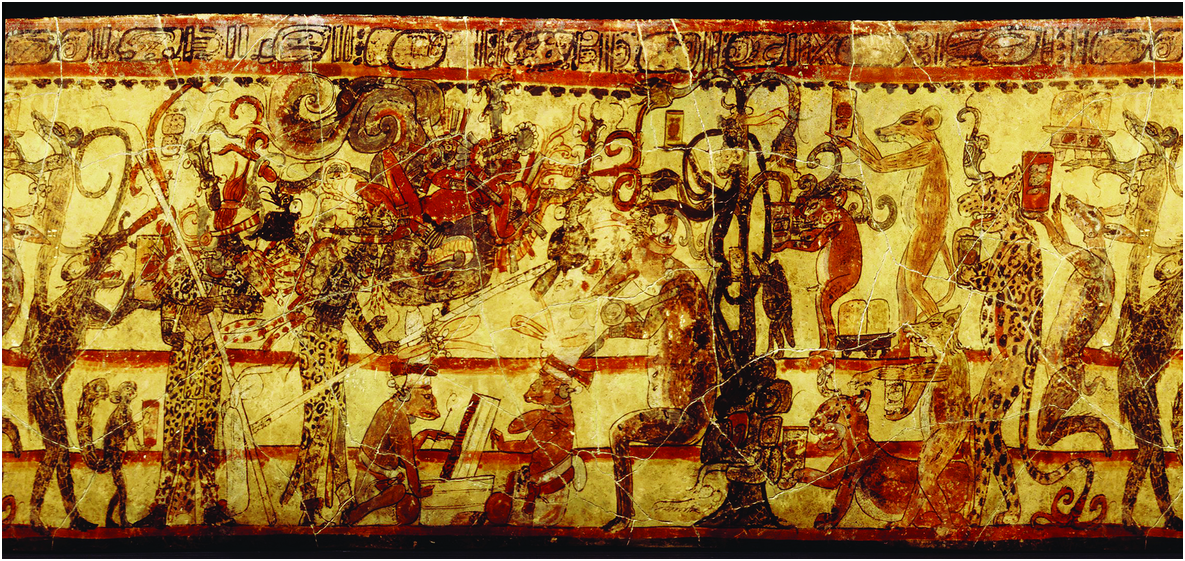
Writing, like other forms of crafting, was ultimately an act of creation. Consequently, hieroglyphic practice was a form of cosmological engagement with the script’s other-than human makers and the signs themselves, which could take on aspects of animate beings.Footnote 130 The elusive, almost obscure creativity that the Classic Maya ascribed to other-than-human scribes may be visualized in Coe’s printout motif.Footnote 131 Like other depictions of writing on paper or open codices, the typical printout emanating from a scribal body contains only bar-and-dot numbers (Figures 3.5, 3.11).Footnote 132 Perhaps the glimpses of decontextualized numbers on text-bearing artifacts and scribal bodies reflect a conceptual emphasis on mathematics in Classic Maya scribal culture or a literal proliferation of ancient accountants. Alternatively, they may express a trope found in cross-cultural accounts of early writing that David Lurie describes as an “externalized allegorization of noncomprehension.”Footnote 133 In other words, the images of written numbers attached to the bodies of other-than-human scribes would have been literally legible but contextually incomprehensible to Classic Maya viewers. Consequently, they would have made would-be readers reflexively aware of the normally private, internal experience of ignorance in the face of an unfamiliar notation.
Unprovenanced cylinder vase depicting a crowd of other-than-human figures, including the two monkey scribes depicted in Figure 3.7.
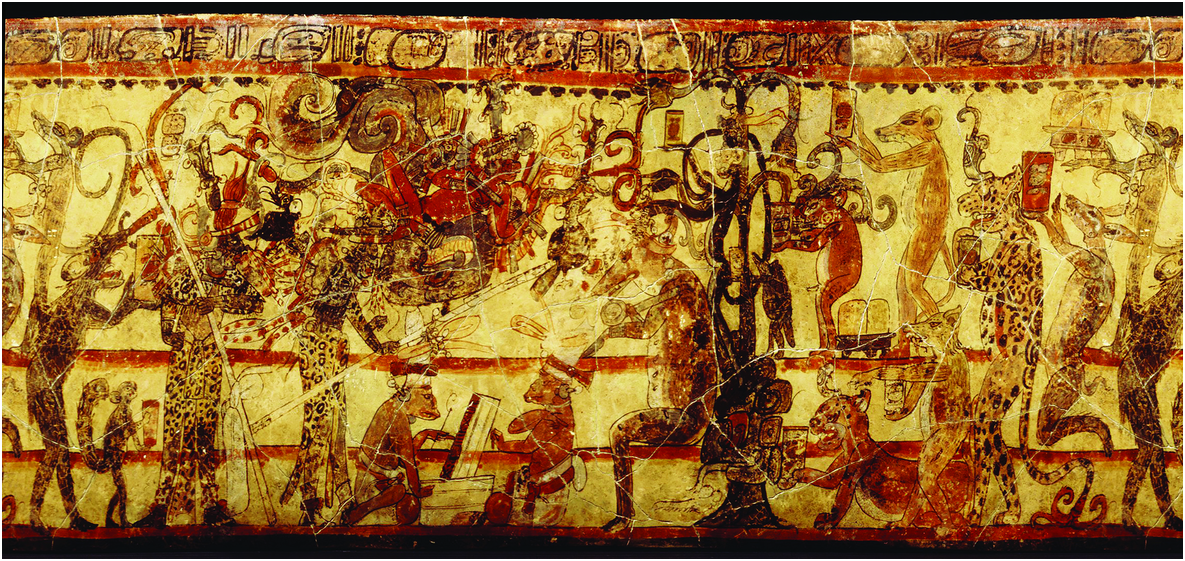
Other-than-human scribal portraits point to elites’ affiliation with a common hieroglyphic culture that underlay great diversity in how scribes wrote. A core aspect of that culture, it seems, was that scribal identity was tied more firmly to the practice of writing than to finished hieroglyphic products. When shown with a codex or other writing surface, most other-than-human scribes directly interact with the object, holding it in their hands or lap or laying a hand on it (Figure 3.8a–e, i). What precisely the scribes are doing remains ambiguous in most cases. Those grasping a writing implement or inkwell in front of a codex may be actively composing a manuscript, or reading it, if one interprets the former instrument as a pointer (Figures 3.5, 3.8f–g, 3.9, 3.11).Footnote 134 One unprovenanced codex-style vase depicts a speech scroll emanating from God D’s mouth and a pointer in his hand, hinting that he reads aloud from the book open before him (Figure 3.9).Footnote 135 Portraits of scribal bodies actively interacting with materials of their craft situated practitioners as “the primary means-cum-agents of production” of hieroglyphic writing.Footnote 136 Thus, scribes regularly appear wielding the tools or artifacts of their trade with intense concentration, even as other activities unfold around them (Figure 3.11).
Classic Maya imagery elevated the ritualized practice of writing, and to a lesser extent its material products, over the individual scribe. Veneration of texts and of the process of creating them also characterized early medieval Europe, where Roman statesman Cassiodorus praised as “[a] blessed purpose, a praiseworthy zeal, to preach to men with the hand, to set tongues free with one’s fingers and in silence to give mankind salvation and to fight with pen and ink against the unlawful snares of the devil.”Footnote 137 In East Asia, ritualized copying of scripture was similarly core to Buddhist devotees’ moral self-realization during the seventh to ninth centuries.Footnote 138 Classic Maya scribes’ understanding of the numinous obviously differed from that of a fifth-century Roman statesman or a late first-millennium Japanese Buddhist, but they all shared an understanding that writing was a tool for connecting with it.
At the same time, Classic Maya scribes did not share other past peoples’ preoccupation with depicting manuscripts in use or illustrating texts as rogue objects worthy of prime visual or even devotional focus.Footnote 139 In eighth-century Japan, Buddhist scriptural texts were venerated not just as products of “wholesome and meritorious” copying but as artifacts that could effect miracles or convey merit.Footnote 140 Similar devotional practices are attested in early South Asia, where Buddhist sutras were “constructed and maintained as sacred objects” and could even be temporarily enlivened by divine presence.Footnote 141 The sutras often appear in illustrations of ritual consultation, including scenes of oral recitation from a text or kneeling before a book atop a pedestal.Footnote 142 In contrast, Classic Maya images of codices or other hieroglyphic artifacts are strikingly rare when one considers how commonplace they must have been in elite circles.Footnote 143 In rare cases that a book does appear, it is almost never shown in isolation or outside of active use. Apparently, the value of a Classic Maya text derived primarily from an (other-than-)human actor’s engagement with it, rather than from its materiality as an artifact.Footnote 144
Instead, cultural primacy belonged to the ritualized practice of writing – active engagement with the materials, tools, and signs that composed a text – and the script’s origins with its “metaperson-owners.”Footnote 145 The Classic Maya emphasis on depicting scribes engaged with texts and on the other-than-human scribal form was, I suggest, a consequence of the primordial origins of hieroglyphic writing. The simian progenitors were not just acknowledged as creators of writing; they were also venerated by those who took up the craft. In the early sixteenth century, Dominican friar Bartolomé de Las Casas observed that Jun Chowen, one of the jealous brothers named in the Popol Vuh, was still worshipped in the Guatemalan highlands:
All creative officials, such as painters, feather-workers, sculptors, metal-workers, and the like, venerated and made sacrifices to those younger sons named Huncheven [Jun Chowen] and Hunahan [Junajaw or Junajpu’, a Hero Twin], because they ascribed to them great ingenuity and skill in performing their offices with elegance and perfection … they venerated them as divine men.Footnote 146
Las Casas’s account of artisans venerating Jun Chowen and Junajpu’ signals that the Popol Vuh’s K’iche’ authors were not documenting some distant story from the primordial past. The narrative of writing’s origins explained a set of ritualized practices that remained very much current. Another clue about the ritual implications of engagement with written artifacts, especially in the context of other-than-human relations, comes from a mid-sixteenth-century Yucatec ritual that entailed cleansing codices with pure, “virgin” water prior to using them for divination.Footnote 147 In this context, it is not surprising that appreciation for or even worship of the scribal craft was directed at its other-than-human originators. After all, the “dispositions” of these “metaperson-others … [were] decisive for the material result,”Footnote 148 namely for the hieroglyphic texts that historical scribes forged by skillfully manipulating the divine technology.
Production in scribal workshops would have been closely shaped by rituals performed before and during production as well. Proper conduct may even have been necessary to fully access the creative powers afforded by the gods.Footnote 149 Ethnohistorical descriptions from the sixteenth-century Yucatan peninsula describe fasting, censing, and bloodletting that Yucatec artisans performed before and while creating god effigies.Footnote 150 Crafting required participants to conform to expectations about ritually appropriate behavior that transformed themselves as much as the objects that they were fashioning, as Bryan Lowe has argued for eighth-century Japanese scribes who copied Buddhist texts.Footnote 151 Conducted with “a heightened awareness of interconnectedness and the relations between things,” ritual performance was as intrinsic to the “doings” of Classic Maya scribes, sculptors, and other artisans as the material shaping of an object.Footnote 152 Thus, knowledge that Classic Maya scribes acquired during training was not limited to the mechanics of replicating hieroglyphic signs or the religious, astronomical, and other information that writing recorded. It also encompassed ritual procedures entailed in scribal production, including people, places, and objects involved, and timing within the production sequence.Footnote 153 Socially, such “esoteric knowledge” about rituals surrounding crafting would have distinguished elite artisans creating royally commissioned monuments from their less privileged or skilled peers.Footnote 154
This chapter explored the figure of the scribe and scribal practice, which was inherently ritualized because of the godly origins of the Classic Maya hieroglyphic script. The remainder of the book examines various products of that practice, from individual signs and painted captions to events that hieroglyphic texts recorded, to consider what they can reveal about the influence of religion on how and what Classic Maya scribes wrote. Collectively, the following case studies suggest that hieroglyphic writing did not only reflect or record aspects of what we may call “religion.” Scribes’ compositions, and by extension they themselves, shaped how religion was expressed and practiced across the lowlands. At the same time, ritual performance was a critical context in which participants shared, in immaterial and material form, their knowledge about the hieroglyphic script and how to use it.
Chapter 4 considers one ritual act that elite scribes would have observed and perhaps participated in: the covering, wrapping, or bundling of stone monuments with woven reed or rush mats. Iconography and hieroglyphic texts indicate that some scribe-artists cited this performance by integrating images of woven mats in their own monumental creations to visibly underscore their work’s origins in ritualized production. In a handful of cases in which they incorporated hieroglyphic writing into the mat motif, too, scribe-artists articulated a material link between the perishable mat as a surface for ritual performance and the hieroglyphs as products of ritualized practice – a link that would prove much more enduring than the royal performances that their monuments were commissioned to memorialize.

 Open access