


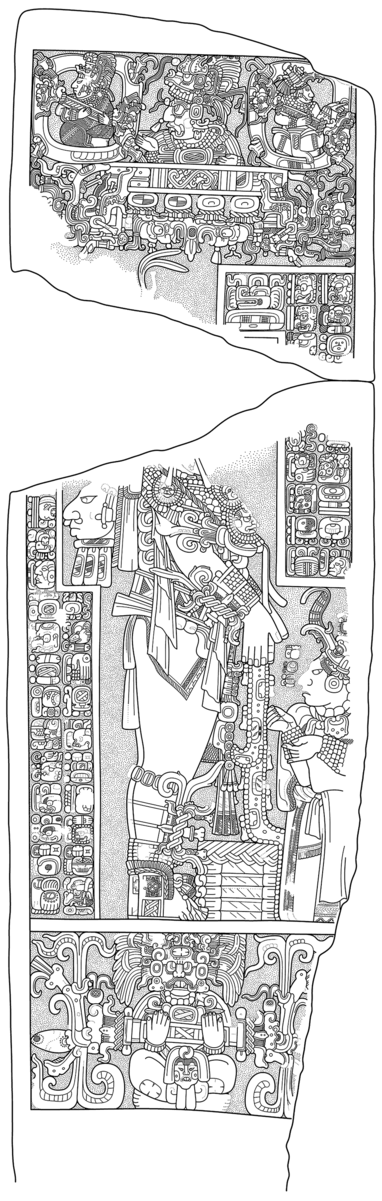
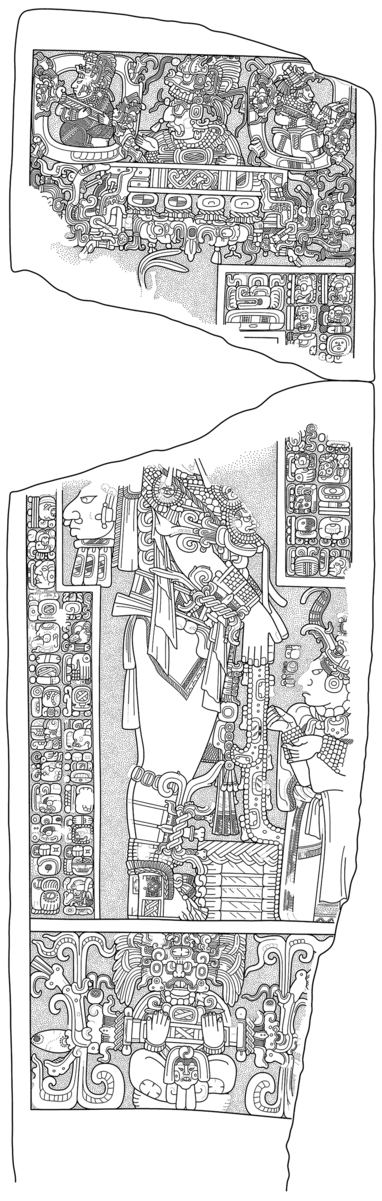
It was a warm day, a few weeks before the start of the rainy season, and Yaxchilan king Bird Jaguar IV was preparing to commemorate an important date in the Classic Maya calendar. The period-ending, 9.16.10.0.0 (March 14, 761), marked the halfway point of the era’s seventeenth k’atun, or interval of 7,200 days (Figure 4.1). Just as he had done five years earlier at the k’atun’s quarter mark on 9.16.5.0.0 (April 9, 756), the ruler let blood from his own body as an offering to the gods and ancestors on behalf of his community. Sculptors had memorialized the 9.16.5.0.0 ceremony on a tall limestone slab now known as Stela 3, which portrayed Bird Jaguar IV conducting the same autosacrifice between one of his wives and a vassal.Footnote 1 It still stood next to an earlier, modest hieroglyphic altar in the southeastern area of Yaxchilan’s Main Plaza as he prepared for the 9.16.10.0.0 rite.Footnote 2 On this occasion, however, the king instructed the artisans to focus more on his own portrait as they carved a new stela that he would have set up on the Main Plaza’s northwestern end (Figures 4.1–4.2).Footnote 3
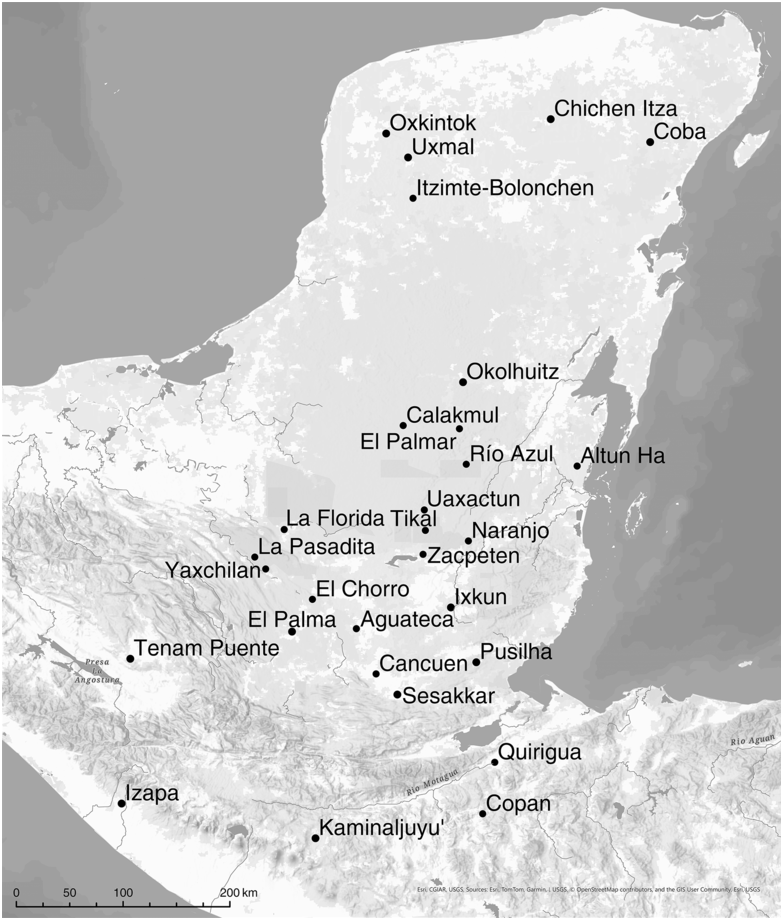
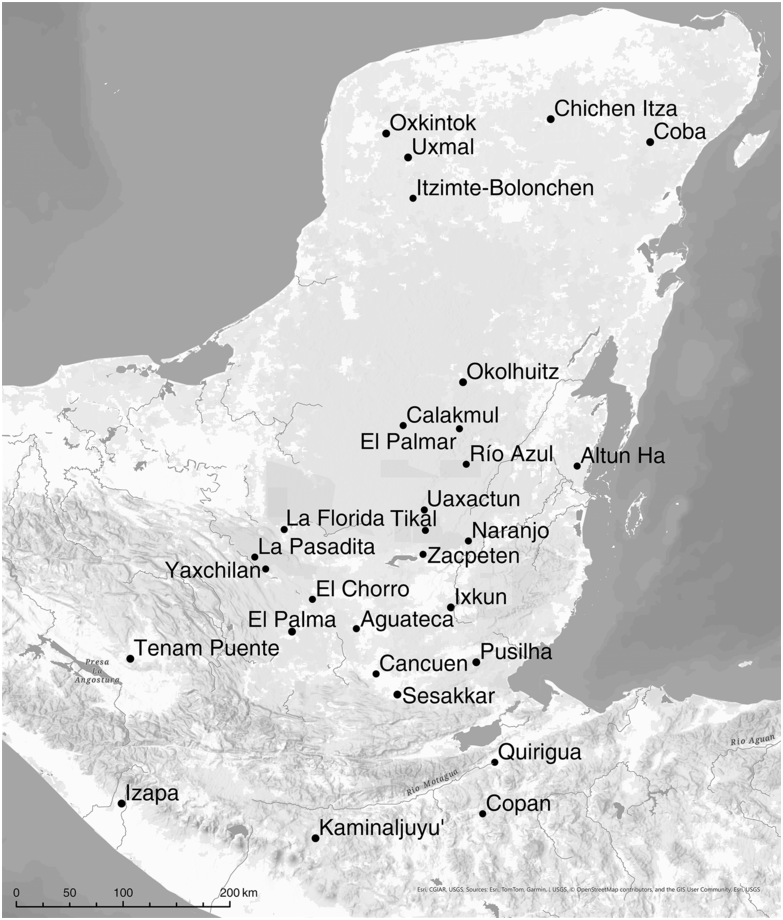
Select archaeological sites with representations of woven mats on stone.
When the appointed time arrived, Bird Jaguar IV, who was richly attired in an ornate headdress and large effigy ornament with dangling jade celts that tinkled against each other as he moved, stepped in front of the small altar. The cylindrical monument had been ritually swept clean, bound with strips of cloth that were secured around the perimeter by neat columns of knots, and covered with a woven reed mat. A vassal knelt nearby; his presence at the performance was as much a testament to his dependence on Bird Jaguar IV as an indicator of his privileged rank among the king’s many subordinates. With an obsidian blade sharpened for the occasion, the ruler carefully pierced his flesh, maintaining a stoic expression as he felt the familiar stab of pain. His hands guided the dripping blood downward onto the altar, where it soaked into the plaited reeds that would later be burned atop the same stone (Figure 4.1). The autosacrificial ritual was one of the most important obligations of Yaxchilan kings. It would be repeated time and again, not only by Bird Jaguar IV but by his son and successor, Shield Jaguar IV, just as their predecessors had performed it before them – a fact of which every ruler was reminded each time he processed past the upright stelae dotting the monumental landscape of his capital.Footnote 4
Free-standing stone monuments such as Yaxchilan Stela 1 are among the most physically durable and visually imposing artifacts of Classic Maya religion left to us today. They are also the single clearest testament to ritual’s role in sustaining divine kingship across the lowlands for almost a millennium. Stone monuments were both objects and records of ritual performance, and these functions extended well beyond the textual and visual information documented on their surfaces. The sculptures were the product of crafting practices that were themselves ritually charged. Thus, they offer compelling archaeological and linguistic evidence not only for the interaction of hieroglyphic writing and ritual practice but for the agency of Classic Maya crafters in that interaction. The monuments’ surface carvings almost uniformly emphasize royal commissioners and their associates. But those same commissioners depended on the ritual participation of artisans to create those same monuments, the fruits of scribes and sculptors’ practice that articulated ritual with artistic and hieroglyphic tradition.
A particularly striking instance of ritual inspiring hieroglyphic production survives in the form of a small corpus of inscriptions written in a layout that mimics a woven reed or rush mat. The text’s component glyph blocks are arranged such that they crisscross the writing surface diagonally, rather than following a straight horizontal or vertical line. The unusual format of these inscriptions, which number fewer than a dozen in total, has garnered more academic interest than any other in the history of Classic Maya studies. Headlined by Francis Robicsek’s seminal publication, scholars have primarily analyzed the woven texts as enduring expressions of political authority, symbolized by the mat as the seat of power.Footnote 5 From this perspective, hieroglyphic inscriptions laid out like a mat were public-facing emblems of dynastic legitimacy and influence. These arguments are grounded in ample evidence for the mat motif’s salience more generally as a political metaphor for elite authority and power, much of which Robicsek summarized in his initial study.Footnote 6 I do not doubt that the hieroglyphic format connoted such valences, too. After all, the script was a communicative medium whose production and comprehension were concentrated among Classic Maya society’s most politically influential members. Arranging a hieroglyphic text in a weave pattern would have amplified this message by gesturing to the physical mats that supported the body of the living ruler. However, the exclusive focus on political symbolism misses a basic conceptual link between the perishable woven surface and its stone representation – a link that helps explain why monuments were considered appropriate surfaces for representing mats in the first place.
The Classic Maya had robust tradition of skeuomorphy in which artisans rendered forms associated with one material in another medium. As Stephen Houston has argued, skeuomorphic transfer was intentionally “unilateral,” consistently moving from less to more durable forms of representation, with almost no known examples of the reverse phenomenon.Footnote 7 Many exchanges were also literal, in that the skeuomorphic version retained some functional or formal connection to the original. Potters derived globular ceramic forms like the squat, neckless tecomate from bowls or cups that had once been carved from gourds.Footnote 8 Similarly, textile designs modeled on stone facades may evoke the archaeologically ephemeral practice of draping cloth on architecture, with the advantage that the stone version, unlike its perishable inspiration, does not require frequent replacement.Footnote 9 Crafting across media was shaped by functionally unarbitrary concerns and cannot be explained by abstract ideology alone.
In this cultural context, woven mat motifs on monuments make cultural sense as a cross-media implementation of a tradition of covering stone monuments with the originals woven from dried reeds or rushes. The connection between stone and woven mat was literal and specific, and its meaning was linked more directly to the monumental surface than to its elite patron or protagonist. In semiotic terms, carving, painting, or incising woven mats on or into stone, bone, or clay surfaces represented a physically durable citation – a reference to a prior event or preexisting thing that is “reflexively mark[ed] … as not(-quite)” the sameFootnote 10 – of a materially ephemeral practice.Footnote 11 Hence, hieroglyphic inscriptions laid out like braided mats were another manifestation of a much broader Classic Maya tradition of “play of materials” across production techniques and physically disparate surfaces.Footnote 12 They visually combined the reed mat, a literal surface of ritual performance, with hieroglyphic signs, which connoted privileged access to knowledge and were themselves products of ritualized practice. The result was a powerful, enduring statement of royal authority and scribal agency. If we only consider the woven mat motif as a metaphor of political power, we miss the crucial intermediate step that explains why Classic Maya artists represented it on the specific medium of monumental stone in the first place.
Before continuing, a brief note on terminology: Just as painters and scribes were not necessarily distinct classes of artisans, Classic Maya sculptors and scribes overlapped significantly in both training and practice.Footnote 13 Differences in handwriting among signatures on a single monument attest indirectly to the reality that even the most visually uniform carvings were the product of many hands.Footnote 14 Even if the draftsperson who traced the hieroglyphs was not always the one who later carved them into the stone, workshops for monument production incorporated multiple individuals trained to write, especially at major dynastic centers with large epigraphic corpora such as Yaxchilan, Copan, Tikal, or Calakmul. Thus, I treat the terms “scribe” and “sculptor” as loosely interchangeable, using one or the other to emphasize various aspects of production without assuming that they corresponded to distinct individuals.
Stelae, Altars, and Their Classic Maya Makers
The Mesoamerican practice of erecting stone monuments as an expression of political power can be traced back to the Olmecs along the Mexican Gulf Coast. By the Middle Preclassic period, Olmec elites had co-opted the upright stela as the preferred monumental format for projecting royal authority.Footnote 15 Other groups along the Pacific coast of Chiapas and Guatemala adopted the tradition not long thereafter, and their creations provide the earliest evidence in the Maya region for systematic pairing of stelae with with low(er)-lying altars.Footnote 16 The Late Preclassic center of Izapa, Chiapas, stands out as a major center where elites erected stela-altar pairs to render their ritual performance and the authority derived from it “permanently visible on the stage of the sacred landscape,” in the words of Julia Guernsey.Footnote 17 Imagery carved on the stela reinforced the ruler’s central role as ritual actor, while the altar at its base marked the performance that had taken place.Footnote 18 Based on the prominence and frequency of stela-altar duos there, Izapa likely played a major role in shaping the older Preclassic monumental tradition into what would eventually become its Classic Maya manifestation.Footnote 19
By the Early Classic period, the stela-altar pairing was a standard feature of the monumental landscape at sites across the Maya lowlands. Nonetheless, stelae and altars vary widely in shape, size, and surface treatment, a sign that ideas about production and display varied locally and evolved over the course of Classic Maya history. David Stuart has argued that the stela’s association with ruling authority was grounded in its stony quality, which embodied enduring time and animate forces of nature.Footnote 20 The rigidly symmetrical contours that scholars today consider typical of Classic Maya monuments did not actually take firm root across the lowlands until the Late Classic period; Early Classic sculptors, in contrast, often refrained from significantly altering the stone’s natural shape even as they polished and burnished the exposed sides.Footnote 21 Even Late Classic sculptors, who intervened more forcefully when shaping a monument’s contours and surface, still acknowledged the material’s power by integrating into their creations significant natural features, such the bulge of chert emerging from the north side of Stela D at Copan, Honduras.Footnote 22
In contrast to vertical, standing stelae, altars feature a round, quadrilateral, or asymmetrical upper face whose width is invariably greater than its thickness. They were propped up on three or four stone supports or rested directly on the ground and were often carved around the perimeter or on the upper face with hieroglyphic writing, iconography, or a combination thereof. Those carvings, together with archaeological, ethnohistorical, and ethnographic evidence from across the Maya region, suggest that altars were focal points for sacrifices, offerings, and ritual display.Footnote 23 Many Classic Maya offerings included episodes of burning, which was a primary mode of feeding other-than-humans and has left its traces on surviving exemplars.Footnote 24 Considered a seat or throne for gods and ancestors, the altar manifested the ritual obligations of the ruler, who was embodied in the upright stelae that was often dedicated alongside it.Footnote 25 The complementarity is evident in many stela-altar pairs that represent “compositional and inscriptional units.”Footnote 26 In other words, their iconography or hieroglyphic texts reinforce each other in a coherent symbolic narrative.
Archetypically, the Classic Maya stela features a royal portrait carved on its wide front face, and the sides and back often bear additional iconography or a hieroglyphic text.Footnote 27 Many stelae display only texts, however, and others have no surface elaboration at all, especially Late Preclassic and Early Classic creations.Footnote 28 The stela’s formal association with ritual-political authority was not dependent on the presence of two-dimensional carving on its surface; it was inherent to the upright form itself. The vertical orientation was compared to a standing person, a metaphor made explicit in hieroglyphic records of stela erection that used the positional root wa’ “standing (up),” which in its basic denotation referred to an upright human body.Footnote 29 Even after the stela became the most common monumental vehicle for regal portraits among the Classic Maya, its conceptual link with the person of the ruler continued to run through the source material, not its superficial embellishment.
A handful of “plain” stelae preserve traces of color on their uncarved surfaces, as do some uncarved lintels.Footnote 30 But it is unlikely that all or even most Classic Maya monuments with smooth faces were modified in this way.Footnote 31 Some may have been wrapped in perishable materials such as cloth, at least temporarily, a point to which I return shortly.Footnote 32 But many probably stood as they were. Sunlight reflecting off the treated but unsculpted surfaces would have enhanced the naturalness of the raw stone from which the monument was hewn, in juxtaposition to its artificially modified form.Footnote 33 When they carved a king or queen’s portrait into a standing stone, Classic Maya sculptors were highlighting, rather than creating, a connection between stone and ruler that was already inherent in the portrait-less form. The stela manifested the ruler’s authority as a ritual actor who not only commissioned monumental sculptures but was licensed to perform the rites associated with them.
Dedication in Stone
Perhaps the most important event in a monument’s biography was its dedication. This ceremony was often recorded in the text inscribed on its surface and is the most frequently documented ritual in the hieroglyphic corpus, although most inscriptions provide few details about what actions or materials were involved.Footnote 34 In fact, Stuart has posited that the primary function of Classic Maya monuments was to memorialize “the activities surrounding the placement, creation, and activation of ritual things and spaces.”Footnote 35 An erect monument, in short, embodied a ritual performance that had been successfully completed. The proliferation of stelae, altars, and other stone monuments that were installed with uncarved or incompletely carved surfaces indicates that the iconography and hieroglyphic texts that have made these objects so valuable in the eyes of modern scholars were, in fact, secondary in their importance to the Classic Maya.Footnote 36 After its installation and dedication, a monument had fulfilled its primary function. Barring episodes of future removal and reuse – events that would have entailed their own ritual performancesFootnote 37 – the standing stones served primarily as an enduring testament to an event past, rather than as an object of future veneration.
The dynastic mandate to serve the community through ritual performance seems to have been a near-universal in the lowlands.Footnote 38 How that mandate was fulfilled, however, depended as much on cultural and political concerns as on other aspects of local history that contextualized the gods and ancestors in the human here-and-now. To my knowledge, no other ritual phenomenon is so widespread or frequent across the region as stone monuments, which were installed at major dynastic centers and minor settlements alike. Although some of that disparity surely reflects preservation bias, archaeological sites without free-standing stone monuments are a distinct minority. Dedication of sculpted stones, especially in the form of stelae and altars, defined divine kingship as a regional institution in a way that seems to have been unique among Classic Maya rituals.
Bundling and Wrapping
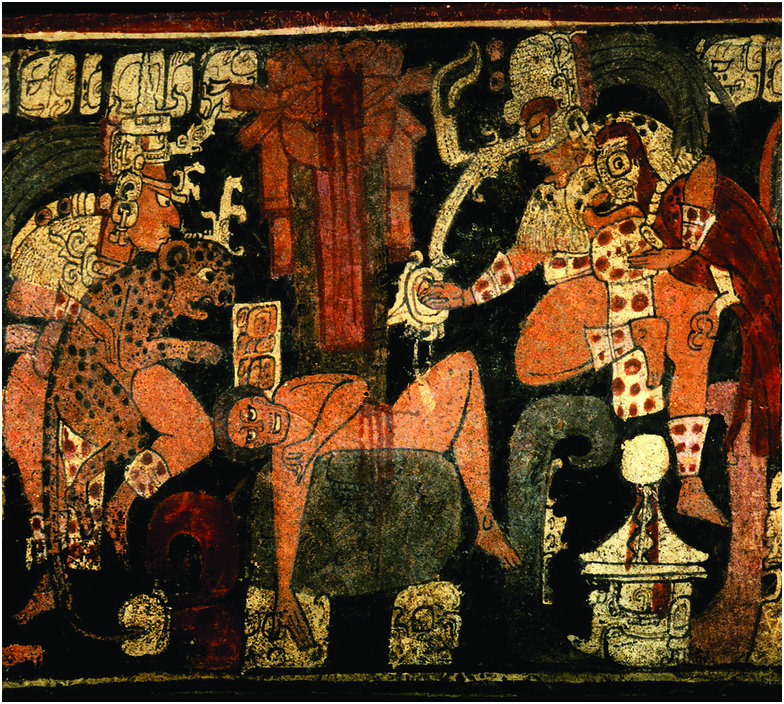
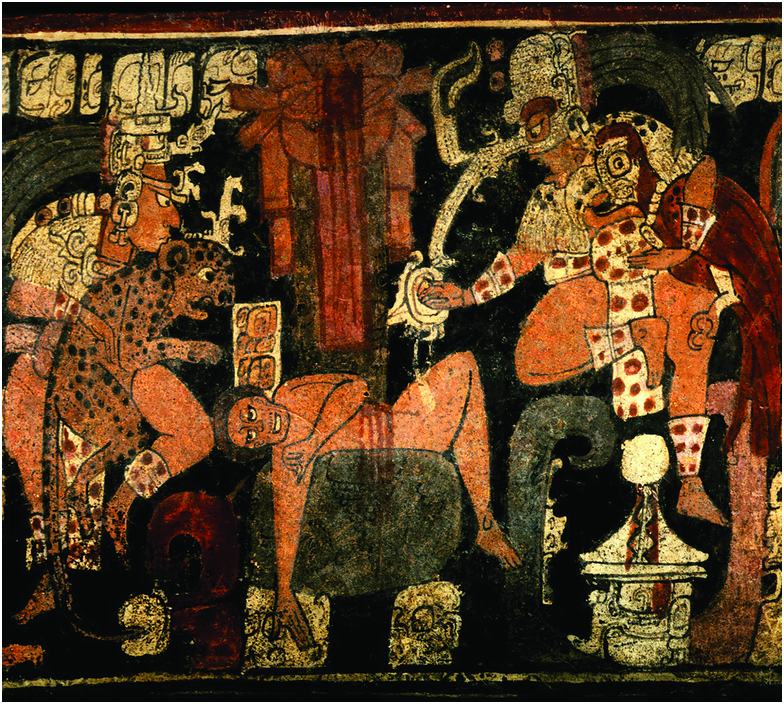
Many Classic Maya dedication rituals involved wrapping or tying a monument in short-lived materials, an expression of a much a broader Mesoamerican tradition of bundling special or sacred objects as offerings for gods and ancestors.Footnote 39 Holes drilled into the sides of Stela 1 at Ixkun, Petén, Guatemala, provide unusually direct physical evidence of a stone having been modified to accommodate a temporary, presumably perishable covering.Footnote 40 Buildings may have been covered in woven textile for similar reasons, as suggested by holes penetrating the facades of some structures and textile-like mosaic facades constructed on others, especially in the Puuc-style architecture of the Late and Terminal Classic northern lowlands.Footnote 41 Additional evidence for monument-wrapping comes from the crisscrossed or bundled appearance of some wrapped stelae in Classic Maya iconography.Footnote 42 One such scene, on an unprovenanced polychrome vase, illustrates a sacrificial victim bleeding atop a stone altar that stands before a stela bundled and draped with reddish cloth (Figure 4.3).
In a scene painted on an unprovenanced Late Classic vase, an upright stone stela, bundled and wrapped in cloth, stands behind an altar bearing a sacrificial victim.
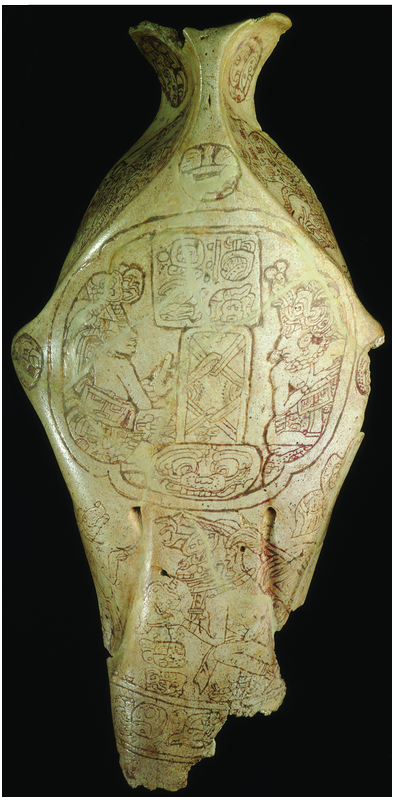
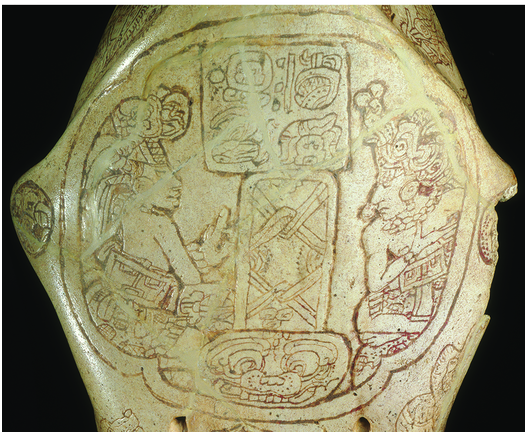
Another image incised into a Late Classic peccary skull from Copan illustrates an episode of stela-wrapping that is additionally referenced in the accompanying hieroglyphic text (Figure 4.4a–b). The scene shows two men facing each other across an upright rectangle embellished with small linear and globular marks that Classic Maya artists used to indicate a stony quality (Figure 4.4b).Footnote 43 The stela is bound with interlaced ties – perhaps cloth or paper, although the nature of the material is not clear – and the hieroglyphic caption above it records a ritual with a stone (k’al tuun), presumably the bundled monument below.Footnote 44 A round altar with similar stony markings stands in front of the wrapped stela, and its zoomorphic face expresses the animated quality of the material from which it was carved (Figure 4.4b).Footnote 45 As a whole, the image suggests that the practice of covering or adorning stone monuments with perishable, removable materials was more common among the Classic Maya than the archaeological record would indicate.
a) Overview and b) detail of carved peccary skull from Copan showing an upright stone wrapped with interlaced ties. Peabody Museum Expedition, M. H. Saville and J. G. Owens, 1892.
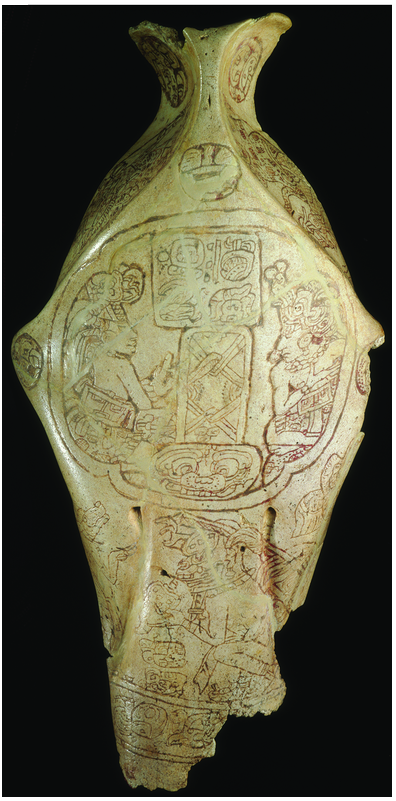
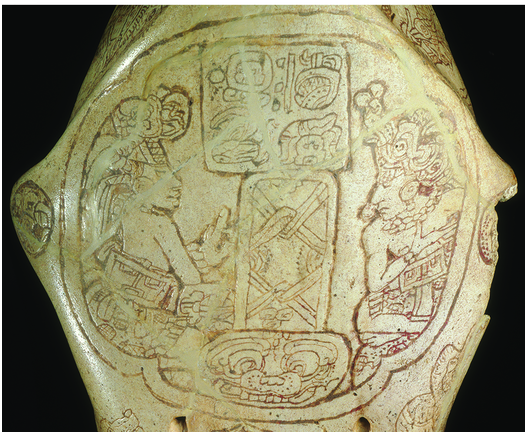
The Classic Mayan transitive verbal root k’al is frequently associated with dedicatory events and thus relatively common in hieroglyphic inscriptions. Its object is generally a stone monument or another piece of dynastic paraphernalia, such as the royal headband symbolic of rulership.Footnote 46 What act k’al denoted, however, is not always clear. A recent interpretation renders k’al as “lift up” or “raise,” referring to physical erection of a monument or, in the case of a portable object, to the act of bestowing it upon a recipient.Footnote 47 A more established reading of k’al as “tie” or “fasten” focuses on the ritual act of binding, for example, the royal headband around a dynast’s forehead.Footnote 48 The latter analysis is especially appealing for the event documented on the Copan peccary skull, given the stela’s wrapped appearance.Footnote 49
A separate inscription, however, implies that the root k’al did not account for all actions entailed in wrapping stone monuments. Based on lexical comparison with the Tzotzil transitive verb stem yoch (“loosen”), Simon Martin and colleagues tentatively suggest that the unique phrase yoochlaj uchumuk lakamtuun on Naranjo Stela 46, which was dedicated on 9.14.15.0.0 (September 14, 726), refers to “a ceremony involving the cloth that sometimes is shown wrapping the stela.”Footnote 50 Perhaps the event occurred a later stage of the stone-binding ritual or represented a specific technique of affixing the material to the “middle” (uchumuk, lit. “navel”) of the stela (lakamtuun),Footnote 51 a technique that somehow differed from or was more specific than the wrapping action denoted by k’al.
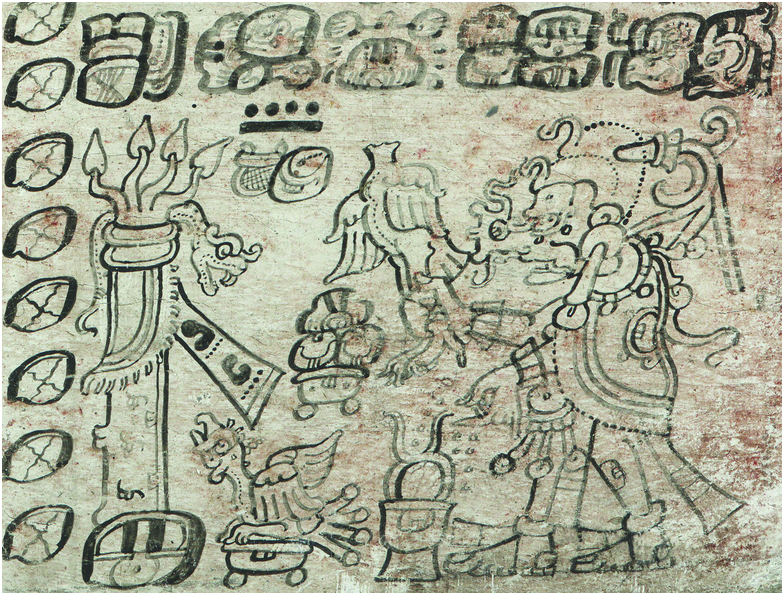
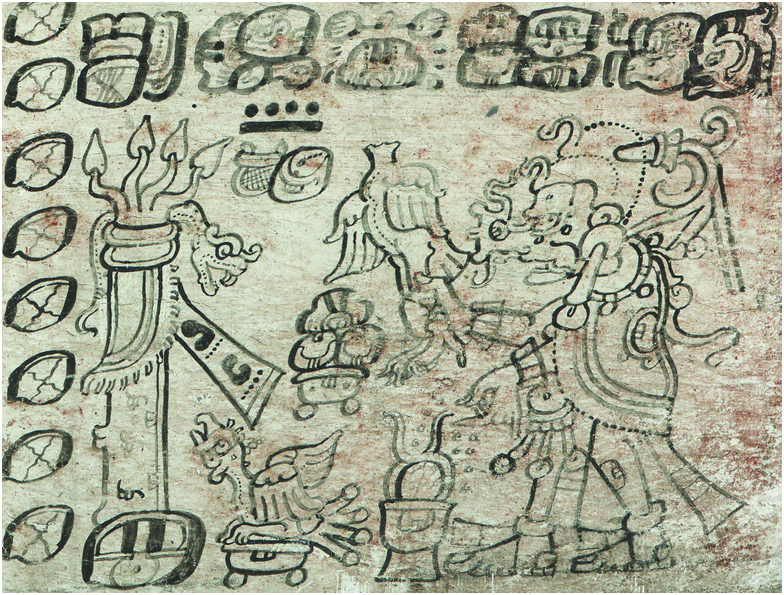
The perishable material wound or wrapped around stone monuments is generally assumed to have been cloth.Footnote 52 Cloth clearly was used in some cases, as in an illustration in the Postclassic Dresden Codex of a wooden column with a fringed wrapping around the top (Figure 4.5). Altars A’ and Y at Copan, in turn, were carved so that they are ringed with what appear to be textile strips secured with knotsFootnote 53 – a stone version of the wrapping applied to altars like the one over which Bird Jaguar IV let blood in the episode that opened this chapter (Figure 4.1). Some illustrations are more ambiguous, however, like the scene on the Copan peccary skull (Figure 4.4b), whereas others clearly show alternative materials on the monument, most notably rope.Footnote 54 After all, no linguistic evidence from dedicatory statements or from the colonial-period cognates of k’al or yoch stipulates the material involved.Footnote 55 Nor does Classic Maya iconography give any reason to assume that cloth would have been specifically or exclusively used to cover monuments.
A scene in the Postclassic Dresden Codex illustrates a standing wooden monument with fringed cloth wrapping at the top. Mscr.Dresd.R.310, SLUB Dresden, page 26c. Public Domain Mark 1.0.
Mats Carved in Stone
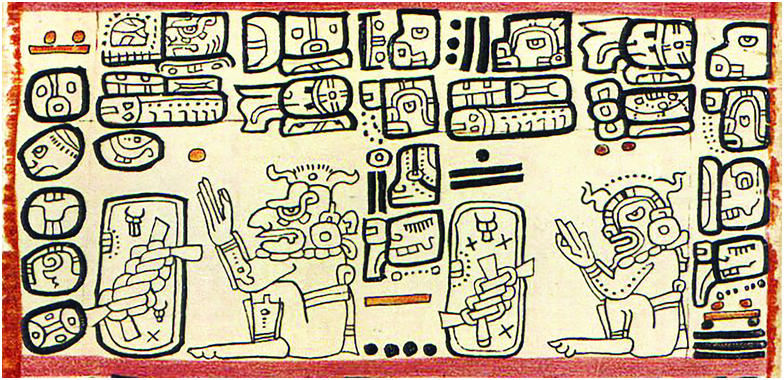
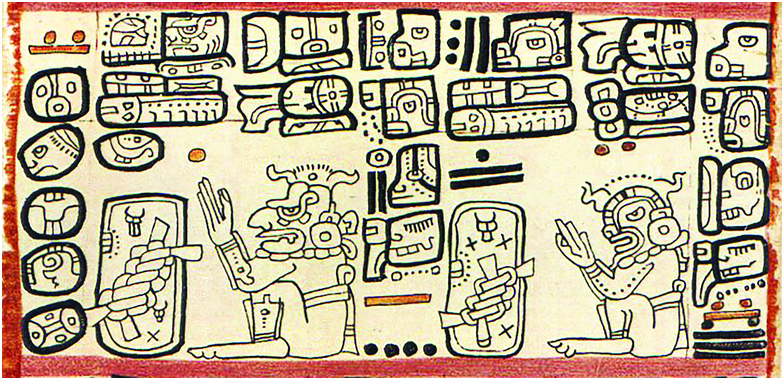
There is, in fact, compelling art historical and ethnohistorical evidence that woven mats were among the materials that the Classic Maya affixed to stone monuments. The most vivid image originates from the Madrid Codex, which portrays two gods who each sit crouched in front of an upright monument bearing a Postclassic version of the “stony” markings that we observed in the Late Classic scene from Copan (Figure 4.6; compare Figure 4.4). However, unlike the stela incised on the peccary skull, both stelae in the Madrid Codex scene have a prominent segment of interwoven mat affixed to one face (Figure 4.6). The accompanying hieroglyphic text does not explain the significance of the adornment; however, its form and placement are reminiscent of a mat strip that tops the bundled stela overlooking the sacrifice scene discussed previously (Figure 4.3). Most likely, both images illustrate the practice of affixing pieces of woven mat to stelae, providing a literal counterpart to skeuomorphic carvings of the woven mat motif that appear on stone monuments across lowlands.
Gods in the Postclassic Madrid Codex sit in front of upright stones covered in a segment of woven reed mat. Madrid Codex, page 101.
Carved representations of the mat motif often adorn a stela’s narrow sides or delineate the portraiture or hieroglyphic inscription on one of its broad faces. Thin, relatively subtle strips of twisted mat run around the surviving frame of Stela 5 from Itzimte-Bolonchen, for instance, and smaller versions of the same motif run horizontally across the front face of that site’s Stela 3 to define three iconographic registers.Footnote 56 In fact, this context accounts for the earliest Maya example of the mat design in stone, which appears on the Late Preclassic Sculpture 10 from Kaminaljuyu’ in highland Guatemala as a thin, detailed segment of braided mat carved around one face.Footnote 57 A much bolder iteration of this motif adorns the narrow, vertical sides of Monument 1 at Tenam Puente, where woven mat segments are carved as if they were tied to either side of the Late Classic warrior portraits carved on the stela’s broad faces.Footnote 58
On altars, woven mat segments are often represented at a larger, perhaps more life-like scale, making them more visually arresting for the viewer. A good example is found on Altar 9 at the small Late Classic site of Sesakkar, where a short but imposingly thick braid draws attention away from the comparatively small columns of hieroglyphs flanking it.Footnote 59 The motif was especially popular among sculptors at Tikal, where monuments of this type also provide the clearest representations of mats being tied around the stone’s perimeter, rather than simply draped over its face. The sides of Altars 3 and 19, for instance, are sculpted with four short, vertical segments of woven mat, which seem to be held in place by a horizontal braid of mat or rope in the middle and unwoven strands that branch off from each segment’s four corners.Footnote 60 Similar woven strips appear on the sides of royal seats in scenes carved into eighth-century wooden lintels installed in Tikal Temples I, III, and IV, reinforcing the identification of altars with thrones and of mats as surfaces for receiving divine bodies.Footnote 61
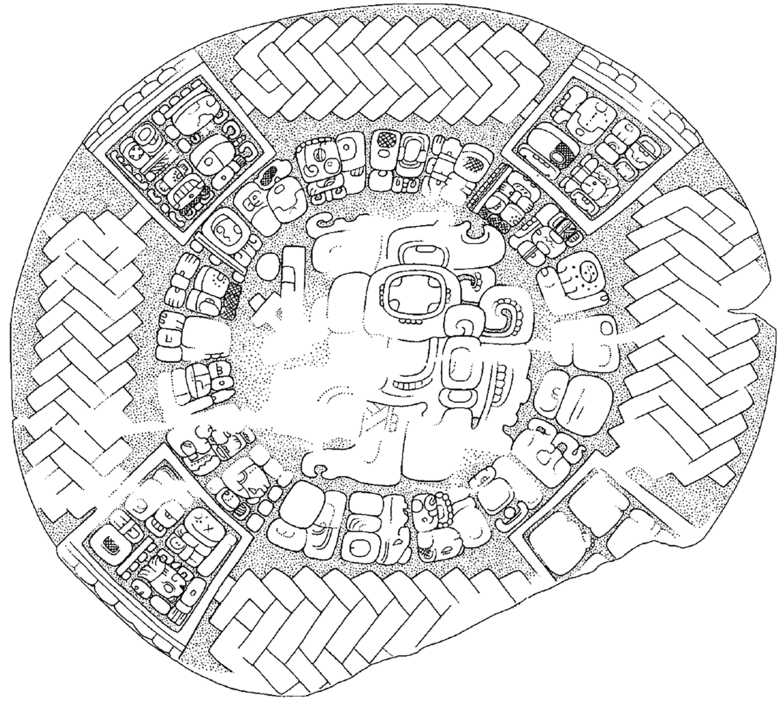
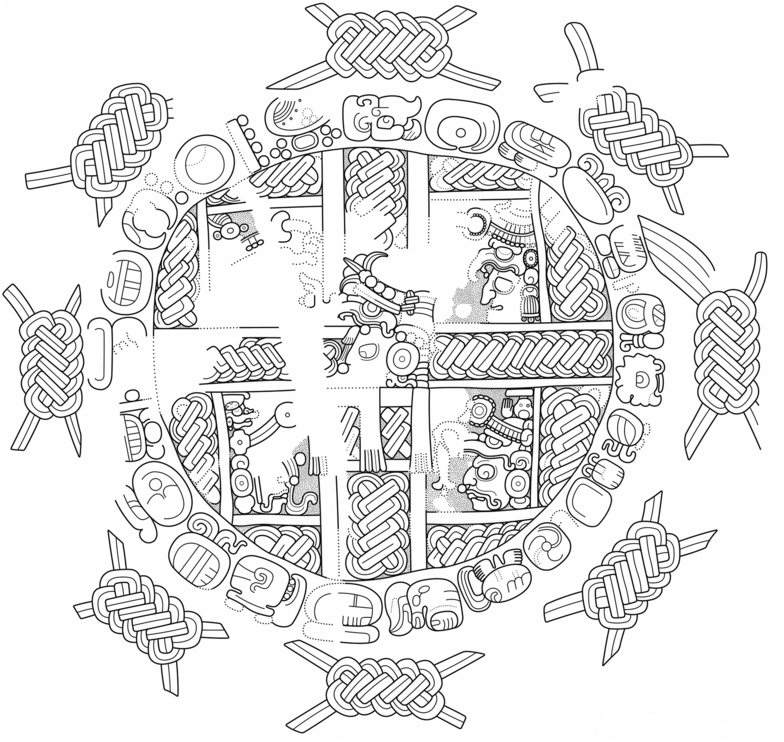
The most explicit evidence linking the carved mat motif and ritual performance, however, originates from two more modest sites in the central lowlands. Altar 1 from Zacpeten, Petén, Guatemala, features four large segments of interwoven mat distributed across its elaborately carved surface (Figure 4.7). They break the surface into four quadrants, while smaller mat pieces encircle the altar’s now-fragmented circumference. As Stuart observes, the mat pieces are arranged in accordance with “the four world directions” and may represent seats or “mat-thrones for effigy figures.”Footnote 62 The ritual salience of the monument’s motif is visually reinforced by four-by-four squares of hieroglyphic text that are interspersed among the mat segments. Each square is rimmed by an outline that evokes the form of Classic Maya incense burners, and pebble-like ellipses piled on top of it represent nodules of fragrant pine resin.Footnote 63 Fire damage at the center indicates that Altar 1 hosted “ritual burning of fire and incense,” perhaps to mark its dedication on 10.0.0.0.0 (March 12, 830).Footnote 64
Upper surface of Zacpeten Altar 1, which features four large sections of woven mat carved around its perimeter.
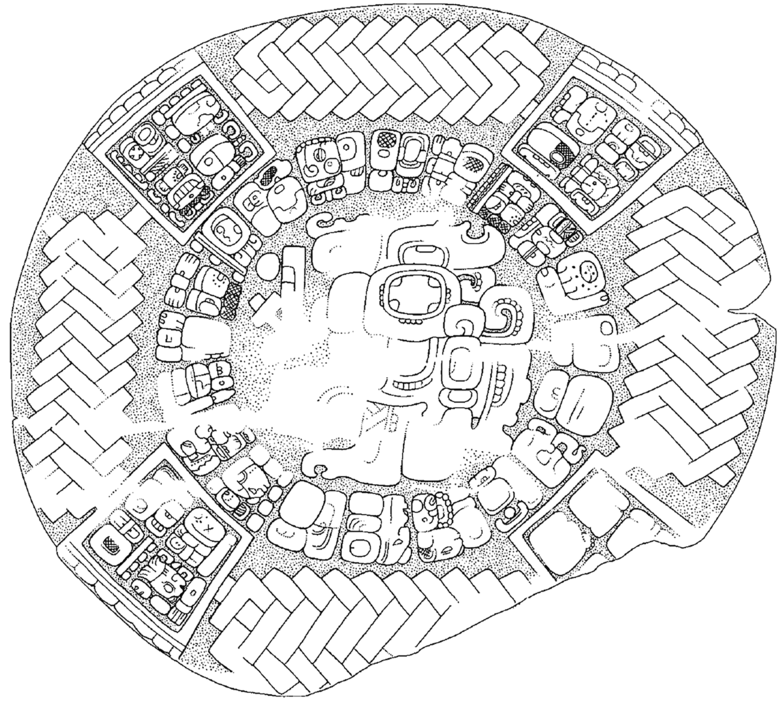
An even more ornate iteration of the mat motif can be found on Altar 10 from El Palmar, Campeche, Mexico. Eight sections of interwoven mat are spaced around the perimeter of the monument, which was dedicated on 9.6.0.0.0 (March 21, 554) (Figure 4.8).Footnote 65 Short, unwoven lengths extend outward from the corners of each mat segment, as if to fasten it to the stone disc. On the altar’s upper face, twelve additional mat pieces inside an outer ring of hieroglyphs bracket the anthropomorphic heads of five gods, the central one of whom may represent the king of El Palmar as the Sun god.Footnote 66 As in the case of Zacpeten Altar 1, El Palmar Altar 10’s iconographic program contextualizes the binding perishable mats to a stone altar within the other-than-human encounter that rituals performed around or on the altar would have facilitated.
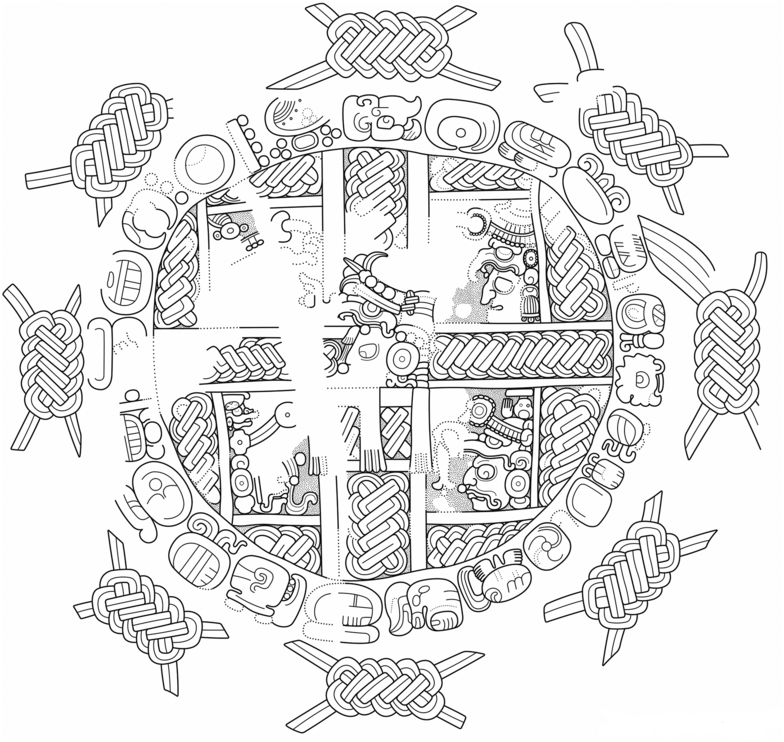
At a much larger scale, some Classic Maya structures even integrated the mat motif into their facades, suggesting that architecture could be wrapped or covered in woven mats as well. Large, carved mat squares flanked the doorway to the Late Preclassic Str. H-X at Uaxactun, alongside giant stucco masks and portraits of floating ancestors.Footnote 67 Vertical, braided strips were also painted on either side of a doorway in the Early Classic Tomb 1 at Río Azul, Petén, Guatemala, alongside symbols of a watery, other-than-human underworld.Footnote 68 In the northern lowlands, the Late Classic Str. 1 at Okolhuitz, Campeche, Mexico, features a woven band running horizontally across its western façade,Footnote 69 whereas the Early Postclassic Palace of the Governor at Uxmal, Yucatán, Mexico, incorporates multiple shorter woven segments into its exterior masonry.Footnote 70 The most famous example, however, is Str. 10L-22A at Copan, nicknamed the Popol Nah (“mat house”) by archaeologists for the large stone pieces of braided mat that were installed across its façade.Footnote 71 Although the Late Classic building is often interpreted as a place of governance due to the mat’s association with rulers, ethnohistorical and ethnographic evidence suggests that the Popol Nah may also have hosted dances, feasts, and other ritually charged activities.Footnote 72
Seventeenth-century sources indicate that the practice of adorning stone monuments or built architecture with woven segments of mat was not limited to the lowlands. Colonial missionaries in the western highlands of Chiapas, Mexico, noted that in the Tzotzil town of Zinacantán, “[s]mall reed shields were hung in the church and there were painted images of a flower with a jaguar-dragon in the middle.”Footnote 73 A colonial Tzotzil dictionary from the same area registers the compound word pokol puj, which combines puj (“reed”) and pokol(il) (“[round] shield”), as denoting a “reed shield they hang in the church.”Footnote 74 Dominican friar Alonso de Guzmán may have referred to such artifacts with an entry in his Tzeltal dictionary for painted or decorated mats (tzibal pop), although he does not offer any contextual information.Footnote 75 Farther south in highland Guatemala, Franciscan friar Thomás de Coto observed that the Kaqchikel placed a small, slim circle of woven palm known as a pocob (“round shield”) on “monuments” or “altars.”Footnote 76 These lexical observations suggest that the practice of applying perishable mats to more durable ritual surfaces was widespread among early colonial Maya communities and probably originated in precolonial times, even if the precise religious contexts in which it appeared were distinct.
Classic and Postclassic Maya display of woven mats on monumental stone was likely motivated by the symbolism of mats as surfaces for ritual performance. Importantly, those performances were much wider in scope than dedication rituals that involved binding or bundling; they extended to a variety of other rites as well. Landa observed, for instance, that sixteenth-century Yucatec priests prepared for a rite of passage known as Em Ku by sweeping the courtyard in which the ceremony would be performed and covering it with a layer of fresh leaves before laying down woven mats.Footnote 77 Similar practices of laying out mats to designate an area for ritual conduct are attested in later ethnographic sources from across the Maya region, from a Tzotzil curing ceremony in mid-twentieth-century Zinacantán to reinstallation of a patron saint’s image in a K’iche’ cofradia in early twentieth-century Chichicastenango, El Quiché, Guatemala.Footnote 78 Indeed, the mat on the Yaxchilan altar that received the blood of Bird Jaguar IV fulfilled a comparable function (Figure 4.1).
As sites for ritual performance, Classic Maya woven reed mats represented a literal interface for other-than-human relations, a locus where person, god, and ancestor convened to engage with each other. It is this cultural context, I suggest, that motivated sculptors and scribes to integrate the mat motif into their stone monuments. Alphonso Morales suggested as much almost three decades ago when he proposed that the woven layout on Copan Stela J, which will be discussed at length in the following section, could be a visual reference to the reed mats upon which the Classic Maya placed their god effigies within temples.Footnote 79 In creating stone representations of perishable mats, sculptors brought into their own material sphere an artifact of rituals that they would have observed or participated in themselves. Rather than inventing a connection between perishable artifacts and stone monuments, the carvers were citing existing ritual practices that involved wrapping or laying supple, perishable mats on sculpted surfaces. By incorporating the motif of the woven mat into their creations, sculptors made permanent a ritual act whose physical traces were otherwise so ephemeral.
Woven Writing
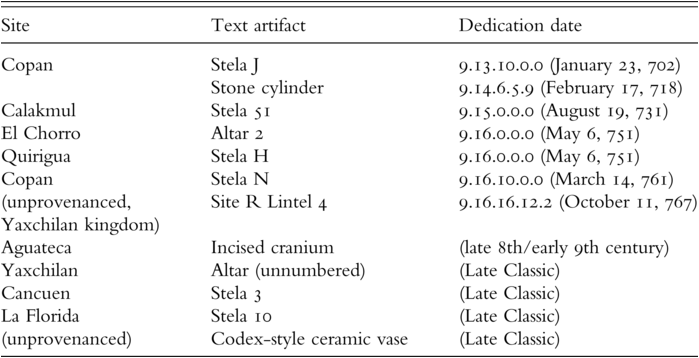
Instances of the mat motif on sculptures and architecture provide the clearest archaeological evidence for Classic Maya practices of bundling, covering, or draping woven mats on stone. Woven mats are carved in a wide variety of shapes and sizes, reflecting the perishable artifact’s diverse forms and uses among the Classic Maya, as well as its sheer ubiquity. Ethnohistorical and ethnographic comparison indicates that bundling or draping mats on free-standing monuments and buildings or wrapping them around portable objects expressed the artifacts’ fundamental role in ritual practice. On a handful of Classic Maya surfaces, however, visual representations of the motif were further embellished with hieroglyphs (Table 4.1). This practice resulted in an inscription laid out in the pattern of an interwoven reed or rush mat – a format that diverged markedly from the double-column textual structure that, based on its prevalence across the lowlands, was clearly something of a scribal default (Figures 4.1, 4.4). How, though, did the mat motif come to be associated with hieroglyphs? Why embellish segments of woven mats carved in stone, painted on ceramic, or incised in bone with writing?
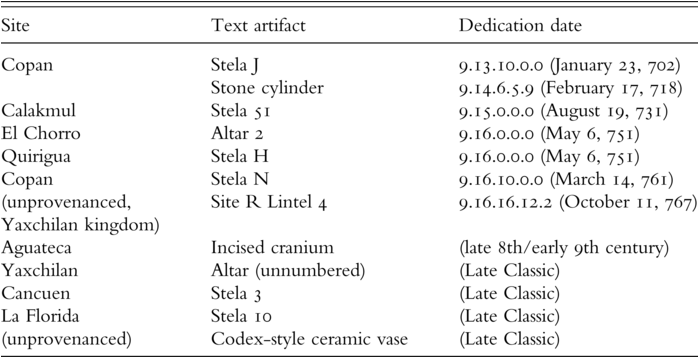
Table 4.1 Long description
Copan features two artifacts.
• Stela J. Dedicated on 9.13.9.0.0 (January 23, 702).
• Stone Cylinder. Dedicated on 9.14.7.5.9 (February 17, 718).
Calakmul features Stela 51, dedicated on 9.15.0.0.0 (August 19, 731).
El Chorro features Altar 2, dedicated on 9.16.0.0.0 (May 6, 751).
Quirigua features Stela H, also dedicated on 9.16.0.0.0 (May 6, 751).
Copan features Stela N, dedicated on 9.16.10.0.0 (March 14, 761).
Unprovenanced (Yaxchilan kingdom) features Site R Lintel 4, dedicated on 9.16.16.12.2 (October 11, 767).
Aguateca features an Incised Cranium, dated to the late eighth or early ninth century.
Late Classic Period Artifacts. The following artifacts are grouped under the "Late Classic" period.
• Yaxchilan. Altar (unnumbered).
• Cancuen. Stela 3.
• La Florida. Stela 10.
• Unprovenanced. Codex-Style Ceramic Vase (referenced from Robicsek and Hales 1981. Table 3B).
The origin of this connection may be found in the cultural valences of writing and their contextual overlap with woven mats within the realm of ritual. For one, the Classic Maya concept of tz’ihb appears to have included patterns woven or embroidered into textiles, which in some cases may have included hieroglyphs or hieroglyph-like signs.Footnote 80 Additionally, despite the prevalence of the double-column structure, Classic Maya scribes were more than willing to compose inscriptions in other layouts. Alternative formats for ordering the quadrilateral blocks into which individual hieroglyphs were grouped ranged from the relatively common horizontal row, like the central inscriptions on Zacpeten Altar 1 and El Palmar Altar 10 (Figures 4.7–4.8), to much rarer triple- or quadruple-column, mirror-image, or even spiral configurations.Footnote 81 As ritually charged surfaces that hosted other-than-human beings and royal bodies, mats were closely associated with divine kingship. So, too, was hieroglyphic writing, which was the product of scribes’ ritualized practice and a creation of the gods. Most, if not all objects bearing mat-formatted texts were commissioned by a dynastic king, to judge from their contexts and contents. By combining the woven mat, a key tool of ritual practice, with the gods’ hieroglyphic script, scribe-artists materialized the religious basis of their patrons’ authority.
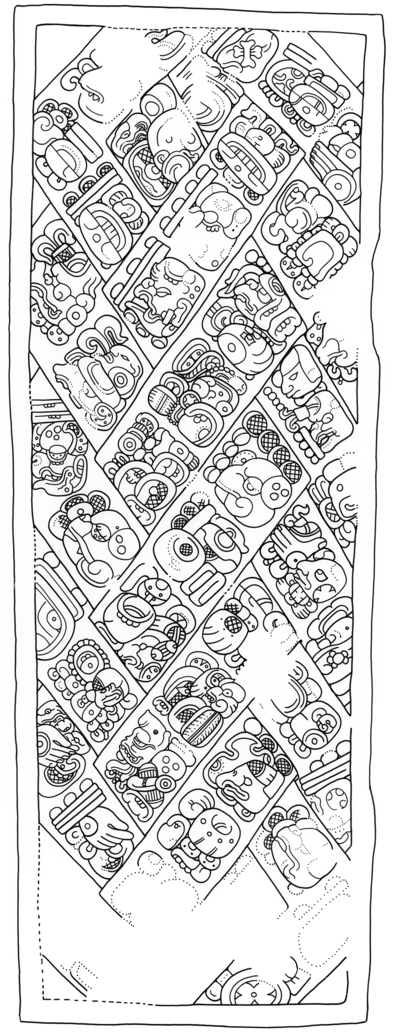
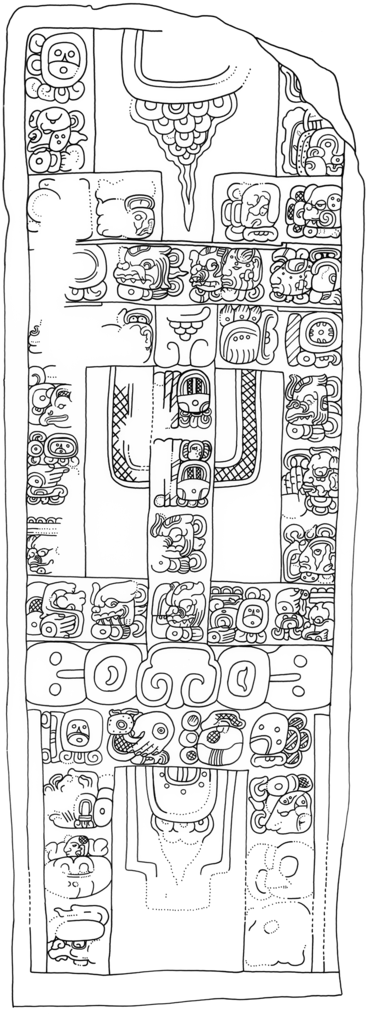
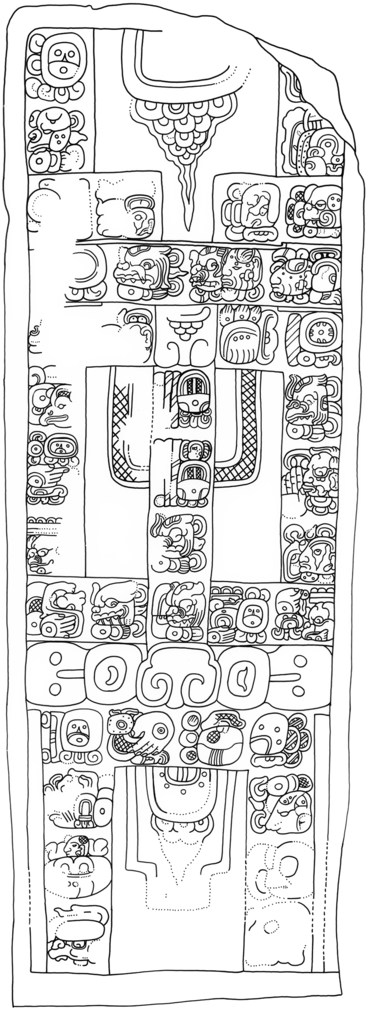
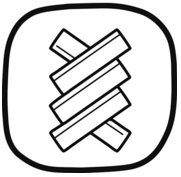
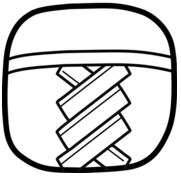
Inscriptions arranged in a woven mat pattern can be divided into two types. In the most visually complex iteration, lines of hieroglyphs are arranged as if they alternate over and under each other, obliging the reader to read through the visual interruption of intervening strips (Figure 4.9a). The alternative, more popular iteration evoked the idea of weaving with horizontal rows or strips of hieroglyphs that parallel or crisscross each other (Figure 4.9b). Although visually simpler, the latter variant still clearly references a woven mat and formally echoes the mat icon incorporated into a few Classic Maya logographs (Figure 4.10a–b). Both mat-inspired arrangements subverted the linear structure that ordinarily defined written as well as spoken language for the Classic Maya. They thus compelled readers to trace the woven structure with their eyes, searching for each successive sign as they made their way through the text.
Classic Maya logographs featuring crisscrossed mat symbols.
JAL (T0551st) “reed”.
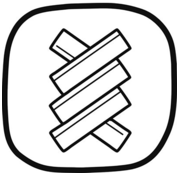
TZ’AK (T0573st) “order, put in a row.”
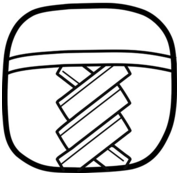
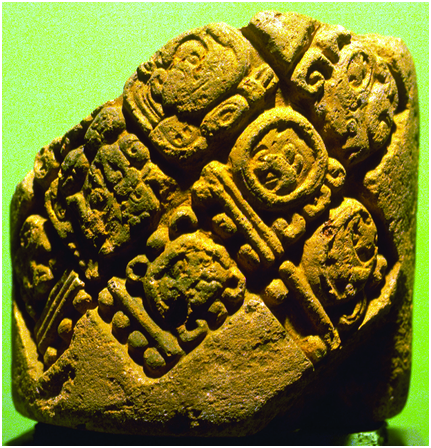
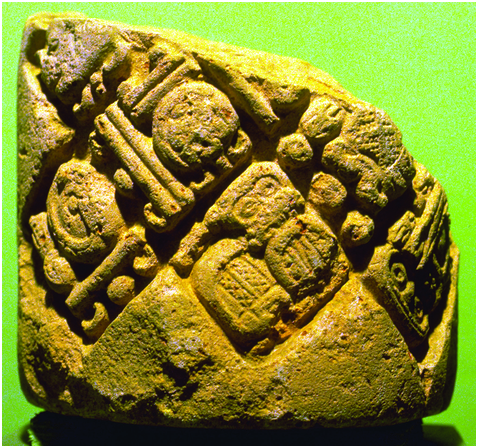
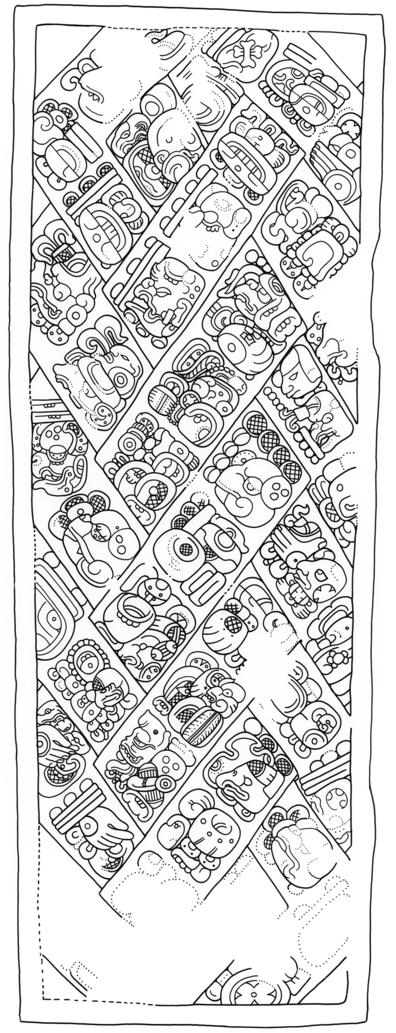
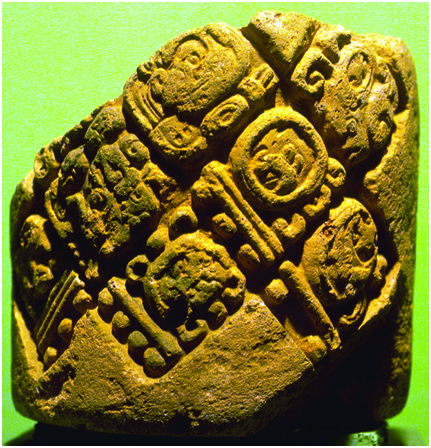
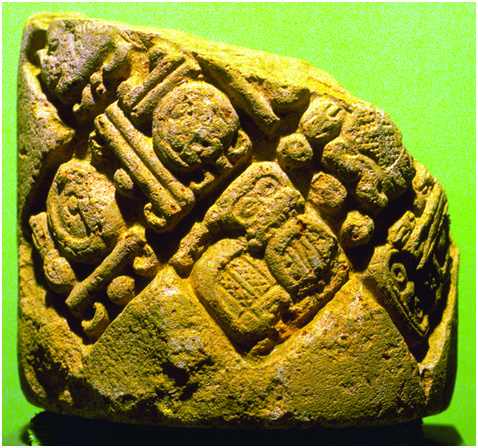
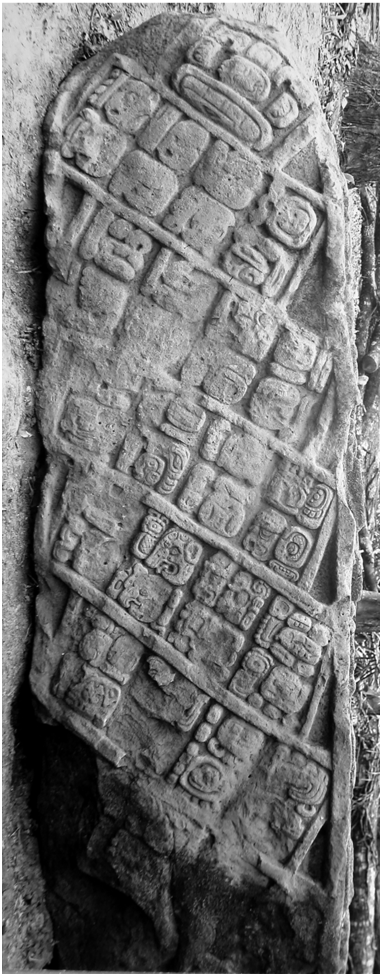
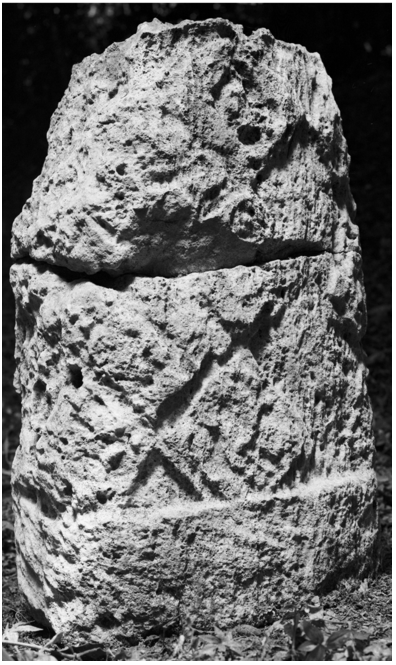
The only inscription known to have been structured in the more intricate, interlaced pattern covers the east face of Stela J at Copan (Figure 4.9a). Dedicated by Waxaklajuun Ubaah K’awiil in celebration of the 9.13.10.0.0 period-ending (January 23, 702), it is also the earliest inscription to have been written in either type of mat layout (Table 4.1). Elsewhere in the Maya lowlands, texts formatted to resemble a mat did not appear until at least a decade later, and they all take the form of the less complex parallel or crisscrossed pattern. The latter motif eventually appeared at Copan, too, on the base of Stela N and on a small, fragmented stone cylinder (Figure 4.11; Table 4.1).Footnote 82
A hieroglyphic inscription in mat format wraps around a fragmented stone cylinder recovered in the Las Sepulturas area (Group 9N) of Copan.
Following Stela J, the next Classic Maya monuments dedicated with inscriptions carved in mat layout were Altar 2 at El Chorro, Petén, and Stela H at Quirigua, Izabal, both in lowland Guatemala (Figure 4.12a, Table 4.1).Footnote 83 On Stela 51 from Calakmul and an unprovenanced lintel from the Yaxchilan kingdom, in turn, only a section of the text appears in a woven pattern.Footnote 84 Three additional sculptures with mat-formatted inscriptions – Cancuen Stela 3, La Florida Stela 10, and an unnumbered altar from Yaxchilan – can be generally assigned to the Late Classic period but are too eroded to date more precisely (Figure 4.12b).Footnote 85 Based on stylistic criteria, a crisscrossed text painted on an unprovenanced codex-style ceramic vessel probably dates to the Late Classic period as well (Table 4.1).Footnote 86
Hieroglyphic inscriptions in woven mat format on.
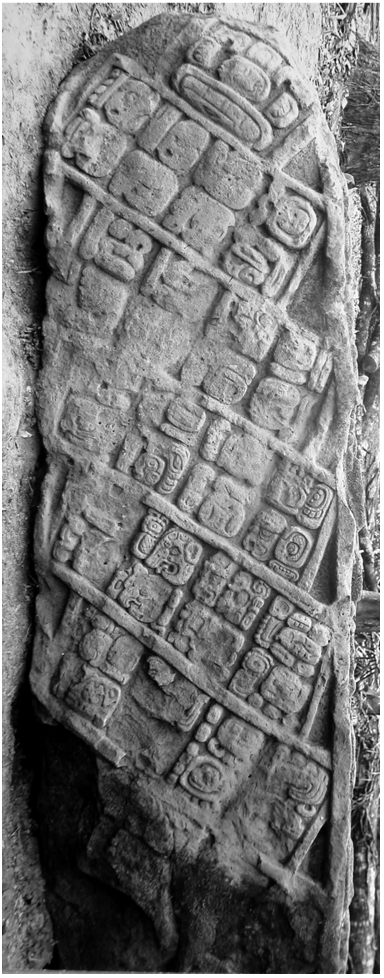
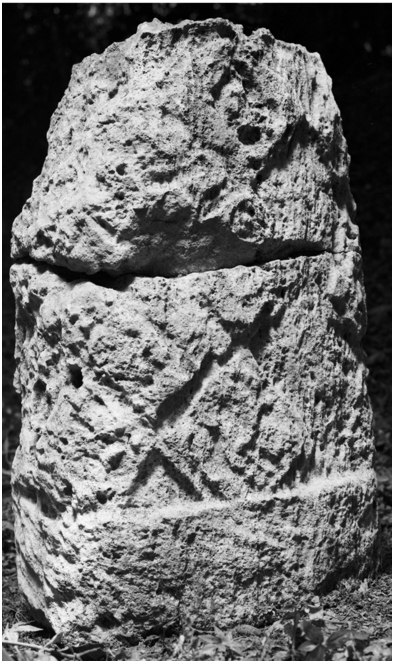
The most exceptional object with a crisscrossed hieroglyphic text, however, is an incised human cranium that was excavated from Str. M8–10 at Aguateca, the same building with the elite scribal-artistic workshop.Footnote 87 No legible calendrical information survives, but the artifact, which seems to have been carved into a helmet, has been archaeologically dated to the late eighth or early ninth century CE (Table 4.1).Footnote 88 Its inscription is also the only one in the mat-patterned corpus that records the Classic Mayan word pop “mat,” which occurs in a unique title, ch’ok pop (lit. “young mat”).Footnote 89 Although its sociopolitical significance remains unknown, the titular reference provides a rare epigraphic glimmer of the woven mat’s cultural relevance and may have even motivated that particular inscription’s anomalous format.
The Classic Maya practice of representing segments of woven mats on stone monuments may well have been innovated at multiple times and places, given its wide geographic distribution across the lowlands. The additional step of applying the motif to hieroglyphic texts, in contrast, was probably invented only once and at Copan, the site with the highest concentration and most diversity of mat-formatted texts.Footnote 90 The unusual format’s origin at Copan is unsurprising given the center’s innovative artistic and material culture, which drew on both Classic Maya features and non-Maya influences from the polity’s neighbors at the southeastern edge of Mesoamerica.Footnote 91
How scribe-artists conveyed the invention from Copan to other lowland sites is less obvious. The creators of Calakmul Stela 51, at least, may have received semidirect inspiration from the southeastern center. Namely, the Kaanul dynastic title recorded on Copan Stela A – which was dedicated on 9.14.19.8.0 (January 31, 731), less than a year before Calakmul Stela 51 – suggests direct contact between the distant polities that may have conveyed the idea of woven writing to the Kaanul capital (Table 4.1). The only clear case of unmediated transmission, however, involves neighbors and longtime political rivals Copan and Quirigua.Footnote 92 In formatting their hieroglyphic text, the creators of Quirigua Stela H were certainly referencing Stela J at Copan, their kingdom’s long-time overlord (Table 4.1). The crisscrossed hieroglyphic text is positioned on Stela H’s eastern face, just like the interwoven text on Stela J, and Stela H was erected near the entrance to Quirigua in 9.16.0.0.0 (May 6, 751), in a location parallel to where Stela J had been raised at Copan nearly fifty years earlier.Footnote 93 The authors of Stela H’s inscription also wrote an indirect link to Copan Stela J into its linguistic content. Stela H’s text is briefer and more eroded today than that on Stela J, but both inscriptions describe the respective stela’s dedication as part of a period-ending ceremony during which the local king scattered incense (Figures 4.9, 4.12a).
Nonetheless, with Stela H, Quirigua artisans sculpted a citation of Copan Stela J, not a copy. Perhaps the most obvious difference is format. The angled rows of glyph blocks run across Stela H’s eastern face in a consistently left-to-right direction, so that the reading order is easier to follow than on Stela J (Figure 4.12a). The greater depth of relief also makes the individual strips, and thus the mat motif as a whole, more easily perceptible. The low-relief, intersecting weave that characterizes the carving on Stela J’s eastern face, in contrast, demands more effort and better lighting to recognize, especially at a distance (Figure 4.9a). Furthermore, the sculptors of Quirigua Stela H paired visual references to Copan Stela J with iconography grounded in their community’s deeper history.Footnote 94 Similar to the Early Classic sculptures at Quirigua known as Monument 26 and Stela U, the western face of Stela H portrays the local ruler as an embodiment of the Maize god standing on an animated mountain.Footnote 95 As in his predecessors’ portraits, the deified king on Stela H carries a ceremonial bar that is marked at each end by miniature portraits of the lightning god K’awiil bearing implements of war.Footnote 96
Comparison of Copan Stela J and Quirigua Stela H indicates that scribal transmission of the woven layout was a process of adaptation, not straightforward adoption. Socially, then, it was similar to the work of the Postclassic Maya scribes who, centuries later in the northern lowlands, integrated central Mexican cosmogonies with their own in creating the Venus table in the Dresden Codex.Footnote 97 The interplay between Copan Stela J and Quirigua Stela H also illustrates the role of interpolity relations in shaping engagement with this mode of hieroglyphic presentation, as well as the inseparability of the political and the ritual in Classic Maya life. Despite its conceptual ties to Stela J, the sandstone Stela H clearly belongs to the Quirigua monumental corpus. Its tall, narrow proportions – it measures over 5.1 meters tall but just 1.3 meters acrossFootnote 98 – and vaguely undulating outlines are characteristic of Late Classic stelae at the site (Figure 4.12a). The rectangular, blocky Stela J at Copan, in contrast, features clear-cut edges and, although similar in width to Stela H (1 meter), falls short of 2.7 meters in height (Figure 4.9a–b).Footnote 99 Even the timing of Stela H’s erection may have been a conscious response to the earlier Stela J. Matthew Looper points out that the former sculpture’s dedication date corresponded not only to the thirteen-k’atun (260-year) anniversary of Monument 26’s dedication but also to the first k’atun-ending since the execution of Waxaklajuun Ubaah K’awiil, the very Copan ruler who had sponsored Stela J, at the hands of Quirigua king K’ahk’ Tiliw Chan Yopaat.Footnote 100 The Quirigua artisans’ formal and linguistic citation of the defeated rival’s most visually distinctive stela thus can be understood as an expressive compromise between appropriation and adaptation. The creators of Stela H borrowed stylistic features from Quirigua’s political rival and adapted them to local tradition to craft a monumental statement of political and cultural autonomy.
Practices Makes Permanent
The scribal practice of writing hieroglyphic texts in an interwoven format was a short-lived but visually salient extension of the widespread tradition of sculpting mats on monumental surfaces. Stone renderings of woven mat evoked the perishable, ritually activated surfaces that were so often associated with monuments in practice. As a hieroglyphic layout, the mat motif “inscrib[ed] a difference, or gap” between the scribe’s product and the comparatively fragile artifact that had conceptually inspired it.Footnote 101 Mat-formatted inscriptions citationally contextualized writing within a perishable surface that hosted ritual paraphernalia, actors, and practices. There was a performative element to the woven inscriptions, too. The symbolic evocation of rituals of bundling and wrapping with literal mats suggests that the layout was less about making text legible or visible than it was about “obscurity, shrouding, and marking it as sacred.”Footnote 102
Weaving Stela J
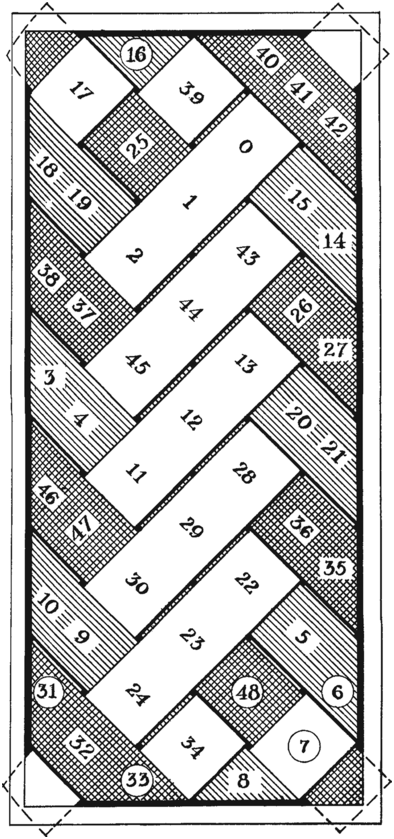
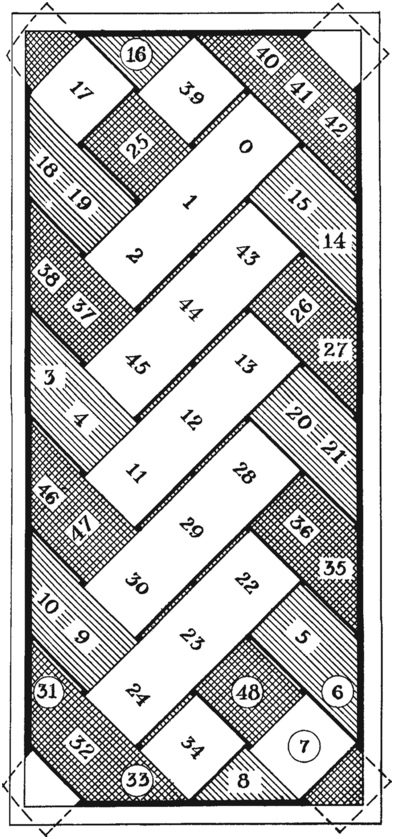
The structural complexity of the text on the eastern face of Copan Stela J, the most precise hieroglyphic imitation of a reed or rush mat’s undulating weave that the Classic Maya are known to have created, reveals that the cultural force of mat-formatted inscriptions lay as much their reception as in their production (Figures 4.13–4.14). In writing, scribes reenacted the ritual act of wrapping the text-bearing object in a woven mat.Footnote 103 Later, readers recreated the process of weaving as their gaze traced the interwoven hieroglyphs’ path over the inscribed surface. The glyph blocks on Stela J’s eastern side were not only carved at an angle to the straight edges of the stela; they were also laid down on linear strips that are visually braided together (Figure 4.13). As a result, a reader must follow the mat’s weave to interpret the hieroglyphically encoded message.
Schematic drawing of the eastern face of Stela J at Copan indicating the reading order of the hieroglyphic text.
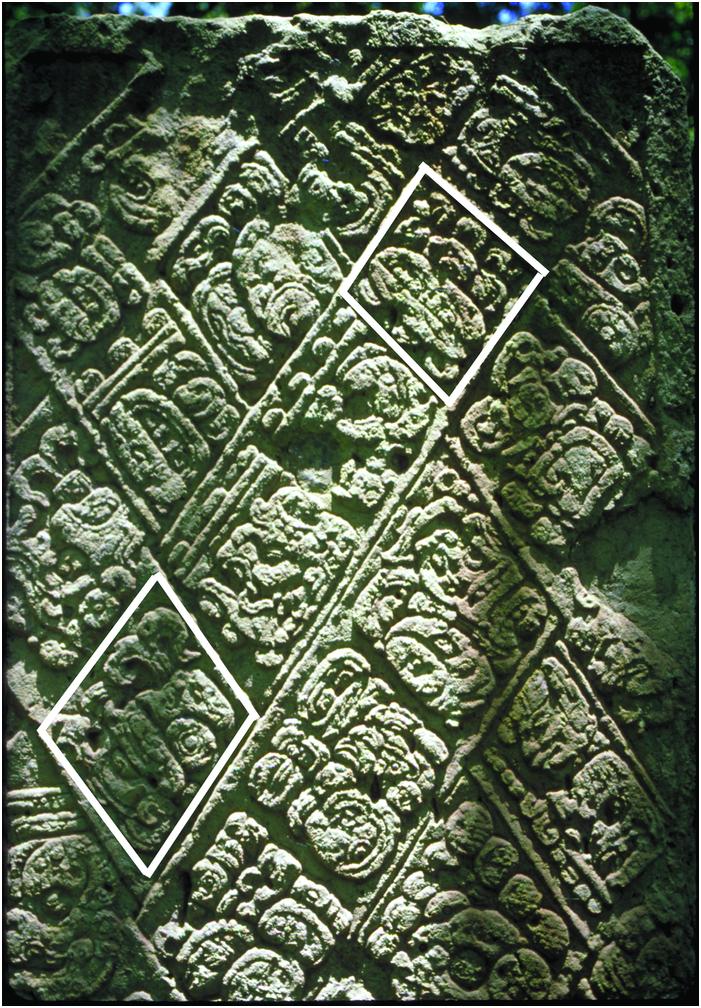
Detail of the upper half of the eastern face of Stela J at Copan with the Initial Series Introductory Glyph (ISIG; glyph block #0, top right) and the theonym (glyph block #37, bottom left) outlined in white.
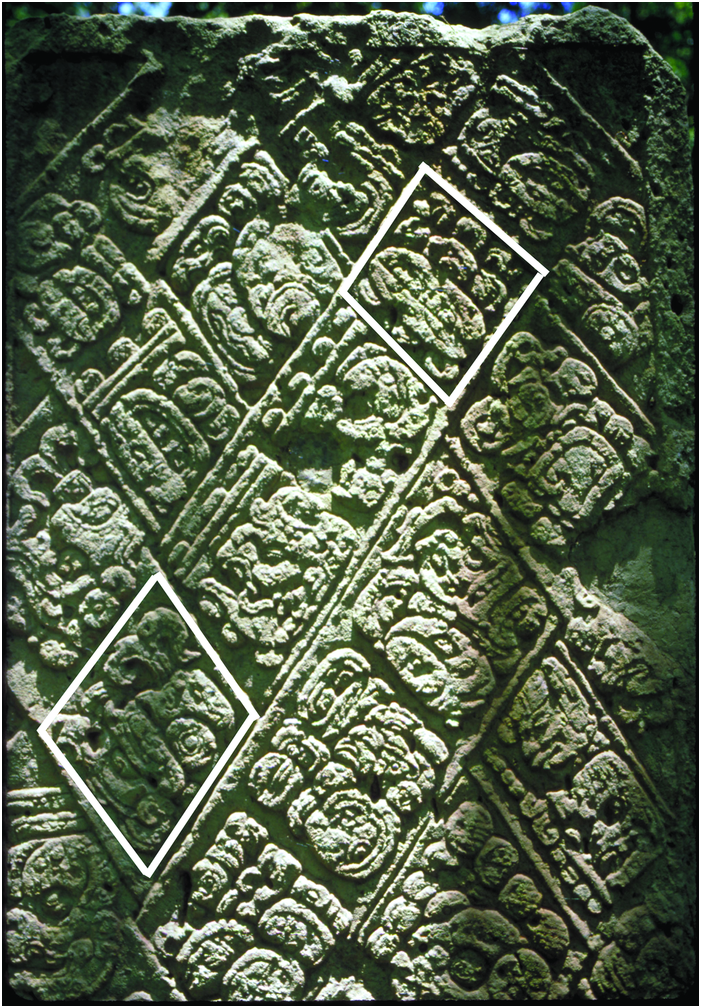
To begin, the reader of Stela J locates the so-called Initial Series Introductory Glyph (ISIG) that opens the text, near the monument’s upper right corner (glyph block #0 in Figure 4.13; Figure 4.14).Footnote 104 Following the carved edges of the same mat strip downward, the reader continues to the Initial Series, which provides a Long Count date that chronologically anchors the narrative in time. After just three glyph blocks, however, a seemingly out-of-place theonym interrupts the calendric sequence (Figure 4.14). Despite being oriented in the same direction and written at the same angle as the Initial Series hieroglyphs, the other-than-human name belongs to a later passage. Cued only by familiarity with the calendrical structure of Classic Maya inscriptions and raised lines around the theonym indicating that it belongs to a separate strip of stone mat, the reader must skip down and left to find the next glyph block in the Initial Series (glyph block #3 in Figure 4.13). From there, the text proceeds down to the right, along a horizontal strip of mat containing the rest of the Initial Series (Figure 4.13).
Upon reaching Stela J’s right edge, the calendrical sequence continues down to the left until reaching the monument’s base (glyph block #8 in Figure 4.13). From there, reading proceeds upward and from right to left, taking the reader’s eyes in a direction completely opposite how they had been moving previously. Those who continue working through the woven text in this manner are eventually rewarded with records of a period-ending celebration by Copan’s dynastic founder over 200 years earlier and the accessions of the current king, Waxaklajuun Ubaah K’awiil, and his predecessor, K’ahk’ Ti’ Witz’ K’awiil.
After reaching the end of the mat inscription at the bottom right corner of Stela J’s eastern face (glyph block #48 in Figure 4.13), the narrative continues on the monument’s western face with an account of ritual activities that had been initiated in the primordial past.Footnote 105 In an interesting juxtaposition, the hieroglyphs on the western side are arranged a crisscrossed format that follows the stela’s vertical contours (Figure 4.9b). Their comparatively straightforward configuration thus contrasts starkly with the layout of the eastern side.Footnote 106 The text on the western side begins in the upper left corner, just as on the eastern side, but there are only four places where the lines or strips of glyph blocks subsequently intersect with each other. Despite being superficially easier for the reader to access, however, the text is syntactically ambiguous and linguistically difficult to parse.Footnote 107 The interwoven text on the stela’s eastern side challenges the reader by disrupting the typical sequence of glyph blocks. The inscription on the western face may be visually more approachable, but its opaque reading order presupposes an advanced degree of literacy and mythological knowledge to access its contents.
Visualizing Ritual
For present-day admirers, the charisma of Classic Maya sculptures is predicated on visibility. Whether rising in situ from the ground at an archaeological site or filling the corner of an exhibition hall, stone monuments arrest our gaze by virtue of their sheer bulk and, as one approaches, their carefully sculpted surfaces. But the contemporary viewer’s perspective is distorted by the (often artificial) conditions in which monuments are now displayed and by a culturally conditioned overemphasis on sight for sensorially accessing them. For the Classic Maya, perception of a sculpture did not depend on its visibility, and engagement was instead predicated on other bodily and sensorial experiences.Footnote 108 Stone monuments were important features of the built environment, especially in larger urban centers, but they were not installed as objects of the concentrated, decontextualized viewing to which they are so often subjected today.Footnote 109
Despite their imposing size, many Classic Maya sculptures were originally positioned such that their full form and surface carving could only be taken in by a small cohort of individuals licensed to approach them. Even those who were permitted to come close to a monument could not necessarily do so easily, and they often had to circumambulate or assume uncomfortable postures to fully take in the piece.Footnote 110 Claudia Brittenham refers to this experience as “a kind of embodied looking, looking that was awkward, inconvenient, incomplete, and distracted” and often performed as one of many near-simultaneous actions during a ritual or other event conducted near or around the sculpture.Footnote 111 In some cases, carved surfaces could be glimpsed only with difficulty or not at all because the monument’s in-situ placement put them beyond the reach of human eyes.Footnote 112
Many stone monuments were not made to be read or viewed, certainly not at the level of detail indulged here. Yet visual inaccessibility did not negate a stone sculpture’s social existence. Megan O’Neil has described how Classic Maya monuments that could not be easily viewed or had been completely removed from sight remained “present and perceived” in collective memory.Footnote 113 Through burning, breakage, and other forms of ritual engagement both before and after interment, buried sculptures remained a source of “power or sacredness” for the people and places around them.Footnote 114 The same would have applied to Stela J’s eastern face and other monumental inscriptions written in mat format. For most viewers who approached them, the hieroglyphs would have been clearly visible but largely illegible.
Viewers of Copan Stela J’s eastern face would have observed its formal resemblance to the perishable mats commonly encountered in daily life. Close admirers would have noted that the glyph blocks, despite being at an odd angle relative to the stela face, are still arranged in linear strips whose paths could be traced by following the carved lines that delineated each strip’s edges. But the text’s visual structure and the stone’s physical contours mean that the reading order continually changes. In a typical monumental inscription, the ISIG opens the text in the upper left corner and is visually highlighted by being carved two or three times larger than the surrounding hieroglyphs. The starting point for reading Stela J’s eastern face, in contrast, is perceptible only to those familiar with the ISIG, which is neither in its usual position nor different in size from the rest of the text (Figure 4.14). Circling Stela J, the viewer encounters yet another, third text distributed across on the monument’s narrow north and south sides in the “perfectly regular” double-column format of most Classic Maya compositions.Footnote 115 Independent of their linguistic contents, these predictably ordered glyph blocks visually underscore the anomalous formats of both the mat text on the eastern side and the crisscrossed western inscription.
We thus find ourselves back where we started, with the artisans who created these artifacts. As Brittenham has argued, the “imperfect visibility” of some monuments was an intentional expression of “Mesoamerican theories of vision as an elite power.”Footnote 116 By strategically manipulating the viewer’s access to a carving or its message, sculptors expressed the widespread Mesoamerican belief that clear, unimpeded visual perception was both a privileged gift and an expression of authoritative control.Footnote 117 They also demonstrated that this gift was not exclusive to the rulers who commissioned monuments. Indeed, the closest, most intimate viewing of any sculpture would have taken place during production, when sculptors and scribes enjoyed unparalleled physical engagement with the stone as it took its carved form.Footnote 118 The viewing experience would have been especially intense in the case of mat-formatted inscriptions, whose complexity would have demanded extensive planning and close study of sketches prior to executing the design in stone.Footnote 119
In many respects, scribes’ unparalleled engagement with monumental texts was synecdochical for their privileged access to the “esoteric knowledge” entailed in making and reading Classic Maya hieroglyphs, which was not common to other members of society and allowed them “to speak the words of ancient heroes, kings, and scholars.”Footnote 120 A creation account in the Popol Vuh articulates sight and perception with knowledge in describing how the gods withheld their superior wisdom from humanity by “blind[ing] [the people] like breath upon the face of a mirror,” so that the people would properly worship them.Footnote 121 Similar to ancient China, where producers of ancient texts were regarded for their capacity to transmit knowledge through writing, rather than for creating it,Footnote 122 Classic Maya scribes could access the gods and ancestors in a way that those without that knowledge could not.Footnote 123 They embodied the close association between writing and wisdom as “ingenious … great sages. In their hearts, they knew everything from the first” – even if the simian creators’ jealous character prevented them from making full use of “these enchanted abilities.”Footnote 124 Through writing, Classic Maya scribes not only read and recorded other-than-human affairs; they also located themselves within the workings of the larger cosmos.
Citing Ritual
I have argued that the practice of representing woven reed mats in stone or other durable surfaces was inspired by a tradition of ritually wrapping, bundling, or covering altars, stela, and other objects with perishable mats. The practice of carving the mat motif can thus be understood as a multilayered elaboration of monuments’ basic function as objects and records of ritual. Altars with stone mats affixed to their perimeter and stelae outlined with braided weave asserted their creators’ status as ritual agents, both in the context of production and in the dedicatory bundling of the finished sculpture. In rare cases when artisans applied the mat layout to hieroglyphic texts, the visually complex products recalled the intimate relationship between ritual performance and esoteric knowledge that the Classic Maya scribe embodied. Although more conceptually challenging than a simple linear order, the mat format made visible the hieroglyphs’ other-than-human nature. It also ensured that the object surface and the signs that it bore retained their ritual identity for far longer than perishable mats would have allowed.
Ritual manipulation of the woven mat found expression in a finished sculpture that translated quotidian performances into material and, in many cases, monumental terms. The carved mat motif called attention to its similar-but-different status precisely because, unlike the woven surface that it cited, it could neither be removed from the object that it covered nor re-bundled around another.Footnote 125 Its endurance in space and time reminded the Classic Maya viewer that the ritual effects of shrouding monuments and other objects in woven mats persisted long after the core performance’s conclusion. This process of citation, of “repetition [that] begets difference,”Footnote 126 is often undervalued in interpretations of cultural and technological exchange. Citation helps account for episodes of transmission that result in change and for diversity that arises through innovation – in this case, the multiple ways and contexts in which Classic Maya sculptors reflexively marked their monumental surfaces as ritually salient by embellishing them with representations of perishable mats.
Within the already ritualized practices of monumental production, rituals that entailed wrapping or draping carved stones with mats offered an opportunity for innovation. Scribes and sculptors were implicated in the performance, at a minimum indirectly by shaping monuments and perhaps in some cases directly as participants in the act of bundling or covering them with woven mats. The ritual may have been guided by the royal actors who commissioned the sculptures; they certainly took credit for the performance, as many monumental texts attest. But divine kings or their subordinates also depended on the artisans who made objects essential for proper ritual conduct, including the monuments themselves. Stones sculpted with the mat motif make this tension explicit by attesting that the creators could bundle stone in mats carved by their own hands, resulting in a performance that was much more durable than that of the king or queen. By integrating the woven mat into their creative programs, scribes and sculptors actively shaped the ritual and crafting traditions in which they were operating.
Classic Maya kingship is often described as a regional institution because of kings’ shared titles, political networks, and responsibilities toward the gods. However, the rituals through which rulers fulfilled the latter responsibilities in particular varied according to local factors. An important consideration that shaped the ritual practices of kings, queens, and their representatives was audience, not only the other-than-humans engaged through the ritual but the humans who were present for each event. Many epigraphically documented performances record the presence of visitors from other settlements or polities. Following the ritual’s conclusion, the visitors would have returned home with knowledge and perhaps even artifacts of the experience, in addition to new or renewed political contacts. Chapter 5 considers how ritually motivated travel across the Classic Maya lowlands facilitated religious and scribal exchange, the products of which sometimes proved to be more enduring than the political ties that such rituals were also intended to cultivate.

 Open access