

34.1 Introduction
Linguists specializing in Romance languages have always been intrigued by the extent of diversification brought about by the geographical fragmentation, or Ausgliederung, since the Late Latin period. Cross-linguistic differences within Romance are pervasive, not only in basic vocabulary and fundamental parameters of grammar but also in phonetics and phonology. Vowel inventories, for example, range from just five cardinal phonemes /a, e, i, o, u/ in Spanish to systems boasting between 14 and 16 vowels in French. Reductive sound changes, and in particular vowel weakenings and losses, have also affected the Romance languages and dialects to a different extent, and have yielded phonemic centralized vowels and complex consonant clusters in some parts of the Romance-speaking area, most notably so in European Portuguese (EP). This in turn implies remarkable differences within Romance with respect to the range of admissible syllable structures and to the degree of contrast between accentually prominent and non-prominent syllables. Lexical stress is assigned within a three-syllable window from the right edge of phonological words in most Romance languages, but French stands out in arguably lacking lexical stress altogether (Martin, Reference Martin2015). In view of this diversity of phonological characteristics, anything but homogeneity can also be expected when it comes to the rhythmic organization of utterances.
This contribution offers a reassessment of traditional claims concerning rhythm in the three most widely spoken Romance languages: Spanish, Portuguese, and French. While research has increasingly focused on acoustic rhythm metrics in recent decades, we argue that the rhythmic signature of languages is crucially shaped by their phonological make-up. In Section 34.2, we offer a critical survey of phonetic approaches to rhythmic typology, before moving on to typologies based on phonological parameters. Section 34.3 sketches an account of the behavioural properties of linguistic rhythm, and puts both systemic and behavioural structures to the test in a study of a small sample of elicited speech (Section 34.4). Finally, Section 34.5 will endeavour some conclusions.
34.2 Phonetic and Phonological Approaches to Linguistic Rhythm
Intuitions about rhythmic differences between Germanic and Romance languages have been formulated time and again since the beginnings of comparative poetics and phonetics, albeit under varying terminological guises. English served as the showcase of a stress-timing language in which stressed syllables recur at roughly equal intervals in connected speech. Prosodic timing in Romance languages was felt to be different. According to Pike (Reference Pike1945), ‘many non-English languages (Spanish, for instance) tend to use a rhythm which is more closely related to the syllable than the regular stress-timed type of English’ – a statement that betrays a clear bias by its very wording. Perhaps the most famous development of Pike’s idea can be found in Abercrombie (Reference Abercrombie1967), who considers syllable-timing as the second principal rhythmic type alongside stress-timing. A syllable-timed rhythm would maintain equal duration of all syllables in a speech event. Since nothing prevents the number of syllables in inter-stress intervals to vary, stress-timing and syllable-timing are antagonistic principles. Research failed to find phonetic evidence for isochronous timing of either stresses or syllables in the acoustic signal, even when confounding factors such as speech rate variation or differences between acoustic and perceived syllable onsets were taken into account (see White and Malisz, Reference White, Malisz, Gussenhoven and Chen2020; Arvaniti, Reference Arvaniti, Knight and Setter2021). In particular, evidence for a consistent tendency towards isochrony of syllables in Romance languages was equivocal at best: besides showing significant geographical variation, Spanish, long considered a benchmark for syllable-timing, did exhibit considerable durational differences (see Dufter, Reference Dufter2003; Payne, Reference Payne, Gabriel, Gess and Meisenburg2021). In French, domain-final lengthening militates against syllable uniformity, and syllable reductions and non-realization of schwa likewise obscure strict CVCV (consonant-vowel-consonant-vowel) syllabic uniformity. The situation in Portuguese is characterized by striking differences between the complex syllable structures and reductions found in the European varieties, making European Portuguese a clear case of stress-based rhythm, as opposed to the intermediate rhythmic nature of Brazilian varieties (see Frota and Vigário, Reference Frota and Vigário2001; Payne, Reference Payne, Gabriel, Gess and Meisenburg2021: 284–287). Understandably perhaps, dialectal variation within individual Romance languages has attracted quite some attention among specialists of Italo-Romance (see Schmid, Reference Schmid, Caro Reina and Szczepaniak2014; Bertinetto, Reference Bertinetto2021), but much less so among specialists of Spanish (see, however, Pešková et al., Reference Pešková, Feldhausen, Kireva, Gabriel, Braunmüller and Gabriel2012, on Buenos Aires Spanish) and of French (but see, for Southern French, Meisenburg, Reference Meisenburg2013, and for French spoken in Ontario, Kaminskaïa et al., Reference Kaminskaïa, Tennant and Russell2016).
Nonetheless, scholars remained faithful to stress-timing in English, suggesting that there was a ‘conspiracy’ within the phonetic and phonological structure of the language that favoured such regular distancing of stressed syllables (Ladefoged, Reference Ladefoged1993). Dauer (Reference Dauer1983) was perhaps the first publication within phonetics that explicitly sought to adduce phonological determinants for language-particular rhythmic signatures. By the end of the twentieth century, several studies had elaborated on this idea and proposed phonological prototypes of stress-timing and syllable-timing, respectively (Bertinetto, Reference Bertinetto1988; Auer, Reference Auer1993; Laver, Reference Laver1994: 528–529). Syllable-timing phonology was generally described as adhering more closely to the CV ideal, both with respect to the inventory of syllable types and statistically at the level of syllable tokens. Furthermore, it was argued that, ideally at least, all syllables should be of equal status; that is, no reduced syllables featuring centralized vowels should be allowed, and, conversely, no metrically ‘strong’, and possibly phonologically distinctive, word stresses should disrupt the ‘flat’ prominence contour (see Dufter, Reference Dufter2003, for a critical assessment).
Starting with Ramus et al. (Reference Ramus, Nespor and Mehler1999), the search for acoustic correlates of rhythm classes gained new momentum, and phonetics rather than phonology occupied center stage once again in the study of rhythmic differences. According to Ramus et al., languages traditionally assumed as being syllable-timed do stand out against others, and in particular stress-timed languages, by exhibiting a higher proportion of vocalic intervals, as well as a lower durational variability of consonant intervals. Alternative metrics were proposed to assess rhythmical properties by measuring vocalic and consonantal stretches of the acoustic signal. Grabe and Low (Reference Grabe, Low, Warner and Gussenhoven2002) developed a more sophisticated metric of local durational variability of vocalic and consonantal intervals, which was to inspire much subsequent work in comparative acoustic rhythm research. Prieto et al. (Reference Prieto, del Mar Vanrell, Astruc, Payne and Post2012) even argued that durational metrics were more powerful than phonologically geared phonotactic measurements in the quest to differentiate English, Spanish, and Catalan speech data. Inspired by this line of research, Dufter and Reich (Reference Dufter and Reich2003) proposed a case study on French, Spanish, European, and Brazilian Portuguese using samples of speech obtained by different production tasks (careful reading, fast reading, and elicited unscripted). These speech samples were low-pass filtered to obscure segmental information and provide reasonable approximations of ‘pure prosodic’ stimuli. Subjects familiar with Romance languages then had to try to identify the individual languages in question. Results showed that French signals yielded the highest rates of correct identification, followed by Spanish, while Brazilian and European varieties of Portuguese were less consistently recognized.
Acoustically based rhythm research has recently been subject to criticism. To begin with, no independent justification was provided for the exact definitions of these rhythm metrics. Instead, as Arvaniti (Reference Arvaniti, Knight and Setter2021) points out, their selection from among a range of conceivable alternative measures was essentially circular: they were selected because they turned out to group together languages that were assumed to belong together on intuitive and typological grounds. Worse still, the values obtained proved to depend more strongly on the method of speech data elicitation than on the individual languages, read speech differing crucially from more spontaneous productions (Bertinetto, Reference Bertinetto2021), in which variability in timing is much greater and thus may override ‘underlying’ rhythmic regularities. On the perception side, Dufter and Reich (Reference Dufter and Reich2003) found better rates of correct language identification for low-pass-filtered spontaneous speech data as compared to stimuli created on the basis of read speech. Inter-speaker variation within individual languages also loomed large (Wiget et al., Reference Wiget, White and Schuppler2010), and sometimes had even greater effects than cross-linguistic variation. Again, speaker dependence was also clearly at play in Dufter and Reich (Reference Dufter and Reich2003). Finally, cultural differences in rhythm perception are demonstrable (Cameron and Grahn, Reference Cameron, Grahn, Hartenberger and McClelland2020), so that an exclusive reliance on acoustic measurements may not be sufficient to capture stable intuitions about cross-linguistic rhythmic similarities and differences in the first place.
Against the diminishing confidence in local acoustic measures of rhythm, two trends seem to be emerging. Within phonetics, models of timing have been proposed that seek to reconcile local and utterance-level determinants of timing, and relate durational properties to more abstract metrical patternings (Gibbon and Lin, Reference Gibbon, Lin, Wrembel, Kiełkiewicz-Janowiak and Gąsiorowski2020; White and Malisz, Reference White, Malisz, Gussenhoven and Chen2020; Gibbon, Reference Gibbon2023). Also, a somewhat rueful return to phonological considerations seems to be discernible in recent years (see Caro Reina, Reference Caro Reina2019; Bertinetto, Reference Bertinetto2021).
Yet, a phonological approach to rhythmic types will likely not yield discrete rhythm classes either. We suggest that phonological distinctions – or their absence – in a given language contribute to shaping its rhythmic signature in systematic ways. Not only the temporal dimension must be considered but also accentual metrical structure. As Jakobson (Reference Jakobson and Jakobson1962: 135) already recognized, distinctive quantity and distinctions in accent position come into conflict, since accentual prominence tends to be phonetically expressed by durational modifications as well (see Dufter, Reference Dufter2003: 126–129). Romance languages have almost entirely lost the distinctive vowel quantities of Classical Latin. Distinctive quantity in consonants has also been largely lost in Romance languages and in particular in the languages under consideration here, French, Spanish, and Portuguese. In contrast, word accent, whose position was clearly predictable in Classical Latin, has acquired some distinctive potential in all modern standard Romance languages except French (see Spanish término ‘term’ with antepenultimate stress versus termino ‘I finish’ with penultimate stress versus terminó ‘he/she/it finished’ with stress on the last syllable). In French, on the other hand, higher-level accentual prominence seems to serve primarily to demarcate phonological phrases, leading to a striking anisochrony of final lengthened syllables and phrase-internal syllables (see Figure 34.5). In this sense, we would like to echo Bertinetto’s (Reference Bertinetto2021) call for ‘studies targeting phonotactics and accentual texture’ for a better understanding of rhythmic differences between Romance languages and dialects.
To us, this indicates that although rhythmic metrics make a contribution of their own to the field, the phonetic realization is little more than the tip of a phonological iceberg. The intuitions and cognitive impacts of rhythm are related to an underlying principle that guides the phonetic surface rather than a constraint in the realization itself. Therefore, understanding accent and phrasing differences provides clues to the blueprint used by speakers to produce speech, which can be sometimes more or sometimes less rhythmic.
34.3 Rhythmic Performance
Perceived rhythmic differences in Romance may be explained partly as an outcome of the different phonological constellations employed to exploit time and prominence for systemic functions (demarcative lengthening of phrase-final syllables in French, distinctive stress in most other Romance languages). Nevertheless, we need to address the prosodic differences between Romance languages that are not related to those functions. Thus, we are dealing with prosodic configurations that are not tied to the construction of propositions and their discursive management but to preferences in timing and prominence relations, which should be regarded as rhythmic on the productive side of linguistic utterances.
We focus the discussion on Ibero Romance varieties and French, which are well documented and show a broad range of variation, due both to systemic differences and to rhythmic preferences (Vaissière, Reference Vaissière, Sundberg, Nord and Carlson1991; Abaurre and Galves, Reference Abaurre and Galves1998; Frota and Vigário, Reference Frota and Vigário2001; Reich, Reference Reich2002, Reference Reich, Meisenburg and Selig2004; Dufter, Reference Dufter2003, Dufter and Reich, Reference Dufter and Reich2003; Vigário, Reference Vigário2003; Reich and Rohrmeier, Reference Reich, Rohrmeier, Caro Reina and Szczepaniak2014, this volume; Caro Reina, Reference Caro Reina2019). The configurations of time and prominence work pretty much in the same way in these languages: lexical stress carries a few distinctive functions (both lexical and morphological) but is restricted to a three-syllable window at the end of words (see Roca, Reference Roca and van der Hulst1999).Footnote 1 In Ibero-Romance languages, lengthening is not a phonological rule, as in French, but a phonetic correlate of stressed and phrase-final syllables.
Rhythm has been treated in metrical phonology and related frameworks (Liberman and Prince, Reference Liberman and Prince1977; Hayes, Reference Hayes1995; Kager, Reference Kager1999) as a simple principle that attributes alternating strength to syllables or morae to construct metrical feet, such as trochees, iambs, or dactyls. In a more elaborated sense that spans different cognitive domains, rhythm refers to the optional performative behaviour with respect to abstract grids of relative prominence. Musicians, for example, may choose the level of a metrical grid they play on to vary the rhythmic characteristics of a piece of music (see Chapter 27). To put this into a simple schema, we can represent a four-quarter beat in a metrical grid in which musicians may play notes or beat a drum either on the base or any other level of a bar without violating the abstract representation of the metrical grid. It is possible to play on all, on the first and the third, or only on the first of a group of four beats in time, without changing the abstract grid (Figure 34.1).Footnote 2
Three levels of prominence.

In many languages, lexical stress is not projected by metrical algorithms but by lexical and morphological distinctivity, which is essential for the construction of meaning. Secondary prominence, however, gives rise to metrical feet, which are not involved in the construction of meaning.
Thus, speakers are almost as free as musicians, but with other instruments. By manipulating the sonority of vowels, speakers can pronounce all vowels maintaining all prominence levels, or pronounce only metrically strong vowels at the foot level by reducing or eliding metrically weak vowels, or, more radically, keep only the vowels that carry lexical stress. As long as the distinctive form of the phonological word can still be processed by hearers, all these options are in principle available.
European Portuguese (henceforth, EP) and Spanish from Bogotá, taken here as polar prototypes, differ the most in the phonetic realization of unstressed syllables. The preference for reduced, devoiced, and even elided vowels in non-prominent syllables in varieties of EP contrasts sharply with the strikingly stable vocalism across all metrical positions in Spanish.
If we take firstly an example from the IPA illustration of EP (Cruz-Ferreira, Reference Cruz-Ferreira1995) and contrast it with its correspondent form in Spanish, we see that an analogue analysis is possible.
In Figure 34.2, the words desistiu and desistió (‘gave up’) are schematically described regarding their phonetic realization and phonological structure. Note that in both versions of this word, the distinctive stress on the last syllable is not derived by the metrical assignment of strength but by a morphological rule that assigns values for tense, mood, aspect, person, and number based upon it: nearly all verb forms of third-person past perfect indicative carry final stress in both languages.Footnote 3 Therefore, it must be respected in order to construct meaning. All other levels are open for variation. The preference for the stress level in the rhythmic performance of word forms (indicated by the box at the stress level for EP and at the syllabic level for Spanish) leads speakers to omit the vowels of unstressed syllables. This, in turn, results in highly complex syllable structures with onsets that violate the sonority principle, since fricatives should not precede stops in onsets (Vennemann, 1988). Most speakers of Spanish select the base level and pronounce all syllabic nuclei, resulting in preferred syllable structures. The level of the foot may be selected as well, leading to the reduction/elision of weak vowels at the foot level, but we do not see evidence of this possibility in our data. In general, since rhythmic preferences in this sense are not involved in the lexical and morphosyntactic construction of meaning, they are less constrained by language-specific conventional rules (see Chapter 27). Thus, they should be accessible in all languages and free for individual and stylistic variation. Nevertheless, speech communities converge in preferred patterns.
Elision versus stability of sonority in unstressed syllables.

34.4 Experimental Data
To understand the variation of rhythmic performance as a conspiracy of systemic configurations and the selection of levels of prominence, we need to extend our study beyond undifferentiated consonantal and vocalic stretches of speech to the sonority of syllabic nuclei in different metrical positions. We conducted a production experiment to collect spoken data with participants who were born in the cities of Madrid, Bogotá, São Paulo, Lisbon, and Paris, and who spent at least their first 15 years there. In this experiment, they were asked to provide a short self-introduction, make touristic recommendations, and describe a recipe. Out of the 26 subjects (six for Madrid, six for Bogotá, two for São Paulo, six for Lisbon, six for Paris), we selected two recordings from each city, one from a female speaker, one from a male speaker, in which the productions were the most comparable (similar age and educational level of speakers, similar duration, same recipes). We chose such parts of our tasks that showed relaxed, semi-spontaneous speech and cross-linguistically comparable discourse traditions such as recipes, descriptions of walks, and introductions.
This interaction lasted around three minutes, of which short excerpts between 10 and 30 seconds were selected for annotation. We chose passages that were comparable with regard to their actual discourse move: explaining successive procedures in cooking, leading to a series of phrases with continuation rises. We further trimmed these excerpts in sequences of at least 18 randomly selected stressed syllables. The annotation was made up of five layers:Footnote 4
1. orthographic transcription;
2. basic differences of the sonority of syllabic nuclei on different metrical positions in two categories: full and reduced;Footnote 5
3. number of realized syllables among all canonical syllables to measure elision rates;
4. lexical stresses: in the case of French, we treated phrase-final syllables as stressed in order to make the data more comparable;
5. edges of phonological phrases (without further differentiation).
Sonority was perceptually assigned by the first two authors. The annotated data was processed through Praat (Boersma and Weenink, Reference Boersma and Weenink2023) and RStudio (RStudio Team, 2023) to extract the following measures, which will be presented in Section 34.4.2:
(i) number of canonical syllables;
(ii) number of realized syllables;
(iii) proportion of realized syllables among all canonical syllables;
(iv) number of reduced unstressed syllables;Footnote 6
(v) number of non-reduced unstressed syllables;
(vi) proportion of reduction among all unstressed syllables;
(vii) minimum and maximum of fundamental frequency (F0) before stressed, in stressed, and after stressed syllables;
(viii) intensity before stressed, in stressed, and after stressed syllables.
We start with examples before we turn to a quantitative overview. We show spectrograms, intensity, and F0 contours, the targets of which we annotated in standard ToBI (tones and break indices) labels. We added an IPA transcription, labelled the nuclei of syllables as ‘full (f)’ or ‘reduced (r)’, and indicated the positions of stresses and edges of phonological phrases.
34.4.1 Examples
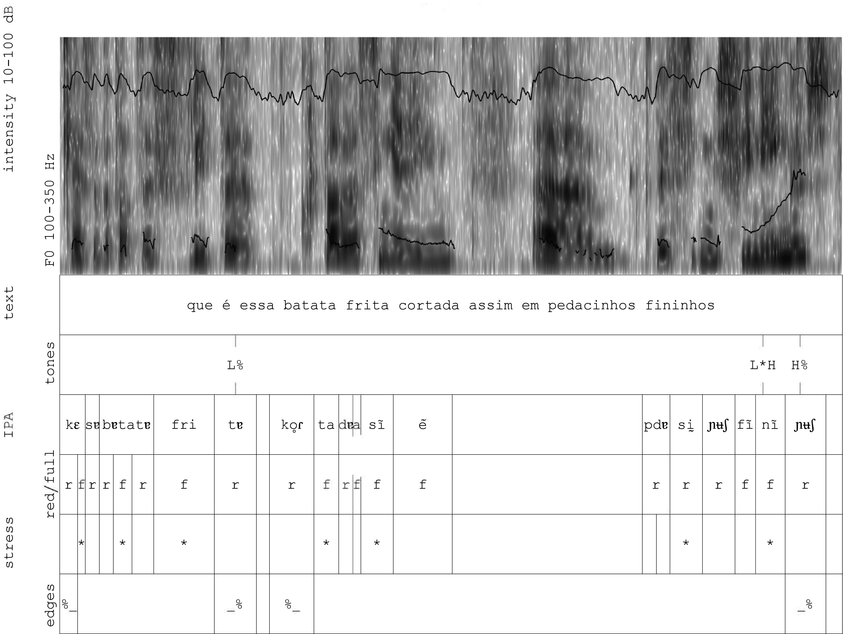
Our first example is taken from a speaker from Lisbon (Figure 34.3).
An utterance from a speaker from Lisbon.
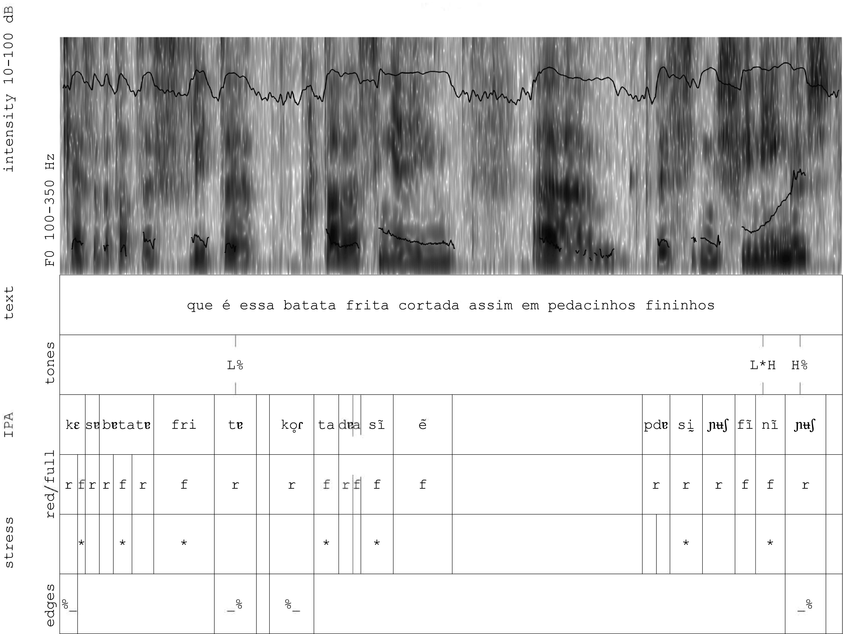
Figure 34.3 Long description
The levels are as follows. Spectrogram: It plots a fluctuating line of sound's frequency and intensity over time. Text. It includes a spoken sentence in a foreign language. Tones: This includes L percent, L asterisk H and H percent. I P A Transcription: This shows the precise phonetic representation of each sound. Stress: Indicates the stressed syllables in the sentence that are marked with asterisks. Edges: Includes symbols like hyphen and percentage.
This example shows a preference for prominence at the word stress level: all other nuclei are centralized or devoiced in articulation and thus reduced in sonority. Intonation and intensity seem to not contribute to a regular rhythmic pattern: only the nuclear configuration at the right boundary shows salient tonal events, with a rising pitch accent and a high boundary tone. Intensity does not seem to vary between sonority peaks. The fact that the duration of unstressed cor is longer than stressed ta in cortada seems to suggest that duration in this case is correlated more to conversational hesitation (just as in the following em) than to metrical positions. In all other cases, unstressed syllables are shorter or show similar duration. Clearly, it is the sonority of syllabic nuclei that shows rhythmic alternation of strength.
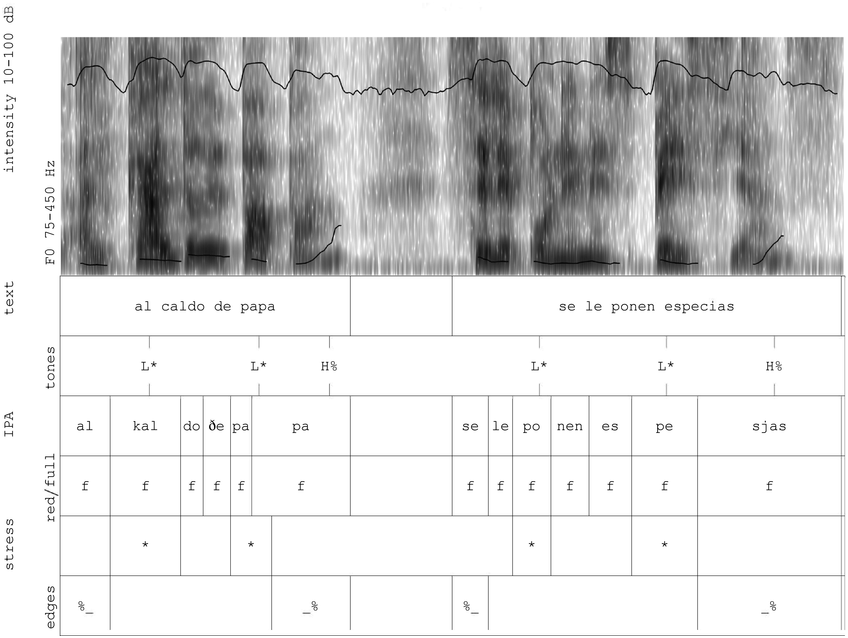
This configuration is very different to what we find in Spanish from Bogotá (Figure 34.4).
An utterance from a speaker from Bogotá.
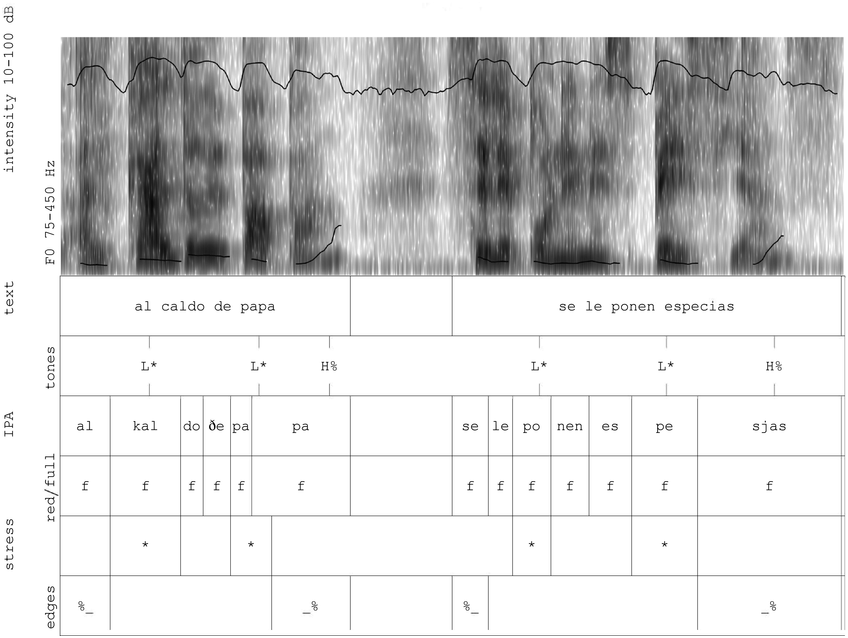
Figure 34.4 Long description
The levels are as follows. Spectrogram: It plots a fluctuating line and a broken line of sound's frequency and intensity over time. Text. It includes a spoken sentence in a foreign language. Tones: This includes L asterisk and H percent. I P A Transcription: This shows the precise phonetic representation of each sound. Stress: Indicates the stressed syllables in the sentence that are marked with asterisks. Edges: Includes symbols like hyphen and percentage.
All but one syllabic nuclei are realized with full sonority. We see late rising pitch accents (L*+H) and high tones at both final boundaries. Both papa (‘potato’) and especias (‘spices’) show differences with respect to intensity, the stressed syllables being clearly louder than the following unstressed syllables. Just as in the example from EP, though, intonation is basically limited to the nuclear configurations at the final edges of phonological phrases.
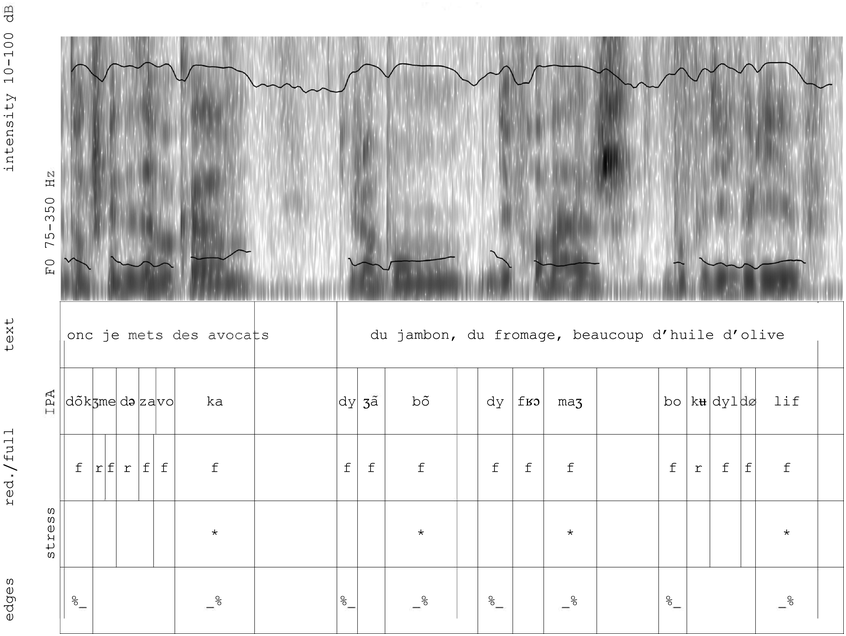
Figure 34.5 illustrates yet another configuration in an utterance by a Parisian speaker.
An utterance from a speaker from Paris.
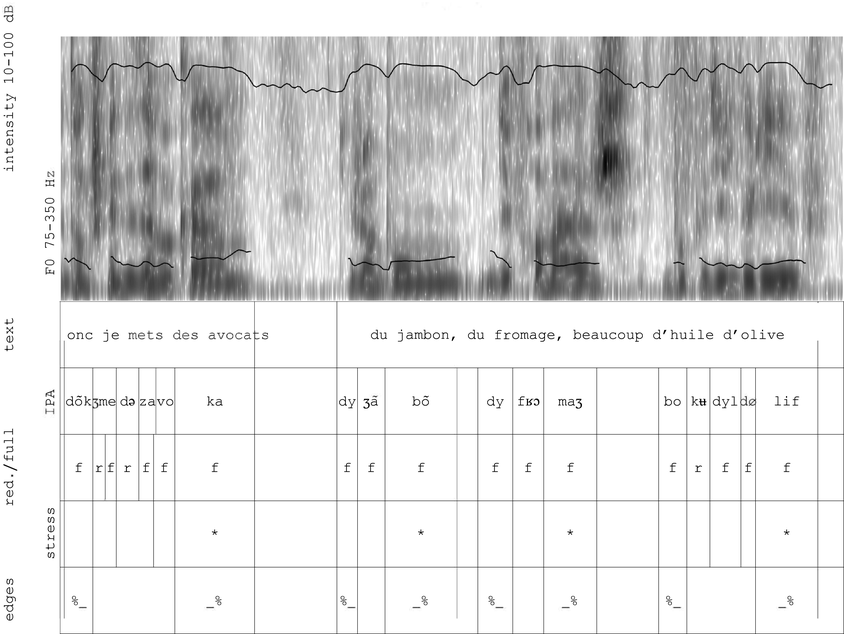
Figure 34.5 Long description
The levels are as follows. Spectrogram: It plots a fluctuating line and a broken line of sound's frequency and intensity over time. Text. It includes a spoken sentence in a foreign language. Tones: This includes L asterisk and H percent. I P A Transcription: This shows the precise phonetic representation of each sound. Stress: Indicates the stressed syllables in the sentence that are marked with asterisks. Edges: Includes symbols like hyphen and percentage.
The most salient feature of this chain of four phonological phrases is the lengthening of their final syllables. With the exception of the final fall, no tonal movement can be analyzed here, which is why we dropped the analytical line for tones. Only three out of 17 syllable nuclei have been reduced and only one (the clitic subject pronoun je) has been elided. The intensity also shows no interpretable contrasts. This is a radical example of the phonology sketched above: lengthening is the decisive cue for edges of phrases and the most salient feature of the rhythm of French, setting it clearly apart from other Romance languages.
34.4.2 Quantitative Overview
No inferential statistics have been carried out, due primarily to the small sample but also to the high variation between speakers of the same language that reflects the optional nature of rhythmic preferences. The rhythmic design of utterances as such (set apart from perceived rhythm due to systemic functions of time and prominence outlined in Section 34.1.2) is a prosodic option that shows only preferences within linguistic communities and should not be treated as a rule of grammar. This is probably one of the reasons why the Portuguese utterances in Dufter and Reich (Reference Dufter and Reich2003) were confused with Spanish: due to the similarity of the systemic functions of prominence and timing, speakers are free to make individual choices between different rhythmic options.
A descriptive quantification of the parameters of our data partly shows the expected configurations but also yields some unexpected results, as shown in Table 34.1.
| Paris | Lisbon | São Paulo | Bogotá | Madrid | |
|---|---|---|---|---|---|
| (i) number of canonical syllables | 118 | 104 | 86 | 86 | 104 |
| (ii) number of realized syllables | 97 | 90 | 82 | 85 | 93 |
| (iii) proportion of realized/all canonical syllables | 0.822 | 0.865 | 0.953 | 0.988 | 0.894 |
| (iv) number of non-reduced unstressed syllables | 63 | 23 | 27 | 51 | 49 |
| (v) number of reduced unstressed syllables | 6 | 30 | 21 | 7 | 10 |
| (vi) proportion of reduced/all unstressed syllables | 0.087 | 0.566 | 0.429 | 0.121 | 0.169 |
The first two lines count possible syllables projected onto the segemental string (i), the syllables that speakers elided from this projection (ii). The third line informs about the proportion of elided out of all possible syllables (iii), independent of their metrical position. Interestingly, the variety that elides most is not EP, taken to be the most ‘stress-timed’ within the Romance languages, but Parisian French, a language that represented a prototype for ‘syllable-timing’ in many early approaches (see Section 34.1). This might find an explanation in the phrase-based prosody of French. Recall that we labeled phrase-final syllables as ‘stressed’, as it has become the practice in many works on French phonology (see Gendrot et al., Reference Gendrot, Adda-Decker, Santiago, Gibson and Gil2019, among many others). These occur less often than the lexical stresses of Spanish and Portuguese. Thus, there are fewer syllables that may be elided in these languages than in French.Footnote 7 Our speakers from Bogotá are those who elided fewer syllabic nuclei than all others, followed by the speakers from São Paulo. The measures from (iv) to (vi) shows us the reduction rate in unstressed syllables. As expected, both varieties of Portuguese show far more vowel reduction processes than both varieties of Spanish and French, with Lisbon leading the whole group (values (iv) and (v) and the proportion in (vi)). Thus, taking elision and reduction together, the Bogotá speakers’ performance most closely resembles that of a ‘syllable-timed language’ (see Section 34.1). We may refer to this configuration as a baseline rhythm.
If we look at the mean progression of F0 in different metrical positions (viii), we basically find differences in scaling but not in the overall picture of uptrends and downtrends, which would be required to motivate different regular patterns. The data presented in Table 34.2 are F0 values for minimum and maximum values before, during, and after stressed syllables for male and female speakers combined in each variety.
| Paris | Lisbon | São Paulo | Bogotá | Madrid | |
|---|---|---|---|---|---|
| Min F0 before stressed | 144,987 | 160,87 | 174,872 | 140,172 | 155,862 |
| Max F0 before stressed | 253,613 | 185,743 | 214,955 | 232,881 | 168,116 |
| Min F0 stressed | 155,091 | 162,333 | 170,069 | 154,802 | 157,046 |
| Max F0 stressed | 338,446 | 193,206 | 222,884 | 193,288 | 193,669 |
| Min F0 after stressed | 169,514 | 173,649 | 185,511 | 157,037 | 164,294 |
| Max F0 after stressed | 363,214 | 201,488 | 229,715 | 214,937 | 191,876 |
The fact that all languages show a rising general contour may partly be due to the fact that many utterances in our corpus correspond to lists (of ingredients and procedures for recipes) couched in phonological phrases with cross-linguistically expectable continuation rises at the edges following a focused content word: the tones show rises through the accented syllables, in the case of French, also initial rises (Max F0 after stressed), which prove to be far from optional. This configuration again corroborates that both boundaries of the phonological phrase are salient positions in the prosodic configuration of this language. All Iberian varieties show also a smooth rise through the stressed syllables, with the exception of Bogotá, where our data seem to suggest a fall, since maximum F0 is higher before stressed syllables than on them. What is important in the observation of F0 in our data is that the intonational contour follows pragmatic rather than rhythmic functionality and thus may not serve to entrain rhythmic patterns.
The observation of intensity reveals some interesting results. As before, Table 34.3 presents values for male and female speakers of each variety combined, in this case for intensity regarding the stressed syllable and its adjacent syllables.
| Paris | Lisbon | São Paulo | Bogotá | Madrid | |
|---|---|---|---|---|---|
| before stressed | 68,64 | 68,396 | 66,832 | 71,046 | 68,218 |
| stressed | 70,352 | 73,231 | 69,596 | 72,533 | 71,673 |
| after stressed | 71,439 | 70,474 | 67,185 | 71,436 | 70,654 |
The data from Lisbon and São Paulo show the sharpest difference between unstressed and stressed syllables, while the speakers from Bogotá exhibit the smallest difference for this parameter. Our data from Madrid show less intensity before stress than the data from Bogotá, thus corroborating the results from the observation of sonority. Again, the data from Paris confirm our observation of F0: it is not only final lengthening but also the salient configuration of initial edges that set up the phrase as the pivotal domain of French, as is evidenced by the high value for syllables after ‘stressed’ syllables that refer to phrase-initial syllables. With respect to rhythm, we see that parameters that are not related to systemic functions, such as sonority and intensity, are the best parameters for eurhythmic performance.
34.5 Conclusions and Outlook
We traced phonetic and phonological approaches to linguistic rhythm through nearly a century of research and projected their perspectives on to Romance languages. What should have become clear is the fact that this family of languages contains very different siblings that employ very different types of rhythm. In many respects, French appears as the odd one out within the modern Romance languages, and its rhythm is no exception. It has lost the lexical stress that other Romance languages inherited from Latin and uses timing and tuning to profile the phonological phrase as its most salient domain. By contrast, Spanish and Portuguese both exhibit similar phonological regularities in word stress placement and lack segmental quantity distinctions. Even so, they turn out to differ strikingly in the degree of accentual prominence. In our data from Lisboan Portuguese, unstressed syllables are more likely to undergo weakening or elision than in São Paulo Portuguese and far more than in the Spanish varieties from Madrid and especially from Bogotá.
Many questions arise from this general picture. Firstly, weakening and elision are not processes that may apply without restrictions, since they blur the distinctive potential of word forms that may then no longer be understood. The thresholds at which rhythmic reduction begins to impair comprehensibility are far from well understood, but they represent an important perspective for studies in second-language acquisition and contact linguistics. Also, more refinement of our analysis is needed. Thus, the need to control for the role of foot construction in the reduction processes across Romance is imperative, since it could suggest that metrically weak unstressed syllables are more prone to reduction than strong unstressed syllables. Italian is a language with very-well-documented dialects that offers promising empirical grounds for research in this direction. In a more theoretical perspective, rhythmic variation that is not a consequence of phonological timing and distinctive prominence. Instead it might be a consequence of speaker-specific choices, similar to the performance changes in music. The selection of levels of prominence in the performance of a piece of music can be, as shown, compared to the strengthening and weakening of unstressed vowels in language.
Summary
Our contribution offers an overview of phonetic and phonological approaches to linguistic rhythm and their application to the study of rhythmic differences within Romance. We argue that systematic cross-linguistic and cross-dialectal differences partly follow from different phonological functions of prominence and timing and partly from routinized rhythmic interpretations of metrical prominence structure.
Implications
We argue for a distinction between systemic and behavioral parameters to describe linguistic rhythm. The rhythm of individual utterances results both from the phonological functions of prominence and timing tiers, and the language-specific interpretations of prominent and non-prominent positions. Romance languages and dialects provide an ideal testing ground for studying rhythmic macro- and micro-variation.
Gains
An approach to linguistic rhythm that seeks to disentangle (i) functional phonological determinants (such as contrastive stress and distinctive segment and syllable duration), (ii) language-specific rhythmic preferences, and (iii) performance at the level of individual utterances may advance our understanding of underlying cognitive rhythmic preferences, despite ubiquitous variation related to speaker, speech style, and other facets of speech.



 Open access