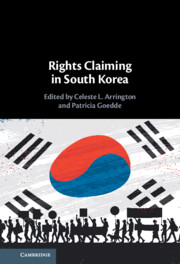
Book contents
- Rights Claiming in South Korea
- Rights Claiming in South Korea
- Copyright page
- Dedication
- Contents
- Contributors
- Acknowledgments
- Abbreviations
- Introduction Rights in Action
- Part I Rights in Historical Perspective
- 1 Legal Disputes, Women’s Legal Voice, and Petitioning Rights in Late Joseon Korea
- 2 Defying Claims of Incompetence
- 3 “Equal” Second-Class Citizens
- Part II Institutional Mechanisms for Rights Claiming
- Part III Mobilizing Rights for the Marginalized
- Part IV Shaping Rights for New Citizens and Noncitizens
- Conclusion Findings and Future Directions
- Index
- References
3 - “Equal” Second-Class Citizens
Postcolonial Democracy and Women’s Rights in Post liberation South Korea
from Part I - Rights in Historical Perspective
Published online by Cambridge University Press: 17 April 2021
By

Book contents
- Rights Claiming in South Korea
- Rights Claiming in South Korea
- Copyright page
- Dedication
- Contents
- Contributors
- Acknowledgments
- Abbreviations
- Introduction Rights in Action
- Part I Rights in Historical Perspective
- 1 Legal Disputes, Women’s Legal Voice, and Petitioning Rights in Late Joseon Korea
- 2 Defying Claims of Incompetence
- 3 “Equal” Second-Class Citizens
- Part II Institutional Mechanisms for Rights Claiming
- Part III Mobilizing Rights for the Marginalized
- Part IV Shaping Rights for New Citizens and Noncitizens
- Conclusion Findings and Future Directions
- Index
- References
Summary
Through an analysis of the codification of family law, this chapter argues that the process of institutionalizing democracy in South Korea created ambivalent legal bases for women’s rights. Amid the peninsula’s division, the occupation of the US Military Government, the onset of the Cold War, and the Korean War, South Korea began to institutionalize democracy before it could complete the process of decolonization. In the historical context of postcoloniality, women came to symbolize democracy and capitalism with the new Civil Code that remade women into full legal subjects with rights. Yet, women were also treated as the last remaining repositories of Korea’s “national tradition” in the legislative discussions that led to the promulgation of the new Civil Code. As a result, women’s rights were significantly compromised. This duality demonstrates key tensions in the conceptualization of equal rights in contexts of postcolonial democracy.
Keywords
Information
- Type
- Chapter
- Information
- Rights Claiming in South Korea , pp. 63 - 82Publisher: Cambridge University PressPrint publication year: 2021
References
Primary Sources
Daehanminguk jeongbu gongbo cheo. 1948. “Gungmu hoeuiui gyeoljeongeul eodeo jejeonghan beopjeon pyeonchan wiwonhoe jikjereul ie gongpo” [Reorganization plan by the law code compilation committee promulgated by cabinet decision]. Gwanbo 4: 17–18.Google Scholar
Gukhoe samucheo. 1948. Gukhoe sokgirok [The stenographic records of the National Assembly]. 1 (18).Google Scholar
Gukhoe samucheo 1957. Gukhoe sokgirok [The stenographic records of the National Assembly]. 26 (30).Google Scholar
Hanguk Beopje Yeonguhoe Pyeon. 1971. Migunjeong beomnyeong chongnam (Gungmunpan) [Military law and ordinance of US Military Government (Korean version)]. Seoul: Hanguk beopje yeonguhoe.Google Scholar
Jang, Gyeong-geun. 1948a. “Miguk sabeop jedo” [American judicial system]. Beopjeong 3 (1): 20–28.Google Scholar
Jang, Gyeong-geun 1948b. “Chinjoksangsokbeop ipbeop bangchim mit yogang saan” [A private draft of the policy and principle of the Civil Code]. Beopjeong 3 (9): 13–17.Google Scholar
Jang, Gyeong-geun, and Jang, Seung-du. 1949. “Minbeop chinjoksangsok pyeon yogang haeseol (2)” [Relatives and inheritance of the Civil Code (2)]. Beopjeong 4 (11): 13–19.Google Scholar
Minuiwon. 1957. Minbeop ansimui jaryojip [Source documents for reviewing the Civil Code draft]. Seoul: Minuiwon.Google Scholar
Min, Mun-gi. 1953. “Hojeok jeongbiui jeeon” [Opinion on reforming the family registry]. Dong-a Ilbo, January 16, 1953.Google Scholar
Sin, Il-cheol. 1957. “Saenghwal inyeomui jaebalgyeon: uri naraui amerikanijeum” [Rediscovery of life ideology: Americanism in our country]. Saebyeok 4 (1): 49–52.Google Scholar
Yu, Jin-o. 1953. Singo heonbeop haeui [Companion to the Constitution]. Seoul: Tamgudang.Google Scholar
Secondary Sources
Bae, Gyeong-suk. 1988. Hanguk yeoseong sabeopsa [The legal history of Korean women]. Incheon: Inha University Press.Google Scholar
Chatterjee, Partha. 1986. Nationalist Thought and the Colonial World: A Derivative Discourse. Minneapolis: University of Minnesota Press.Google Scholar
Chatterjee, Partha 1990. “The Nationalist Resolution of the Women’s Question.” In Recasting Women: Essays in Indian Colonial History, edited by Sangari, Kumkum and Vaid., Sudesh New Brunswick: Rutgers University Press, 233–53.Google Scholar
Choi, Eun-a. 2005. “Hojuje pyeji ihu, ‘gajog’eul ditgo ‘gaein’ euro” [After the abolition of the household head system, beyond the “family” to the “individual”]. Ingwon undong sarangbang. www.sarangbang.or.kr/writing/53258.Google Scholar
Hahm, Chaihark, and Kim, Sung Ho. 2015. Making We the People: Democratic Constitutional Founding in Postwar Japan and South Korea. Cambridge: Cambridge University Press.Google Scholar
Han, So-bum. 2018. “Seongpongnyeok kkeutjangnaeja” [Let us end sexual violence]. Hankook Ilbo, August 19, 2018. www.hankookilbo.com/News/Read/201808191607711243.Google Scholar
Hasunuma, Linda, and Shin, Ki-young. 2019. “#MeToo in Japan and South Korea: #WeToo, #WithYou.” Journal of Women, Politics, & Policy 40 (1): 97–111.Google Scholar
Heo, Ra-geum. 1996. “Seogu jeongchi sasangeseoui gongsa gaenyeomgwa gabujangjeokseong chabyeolseong” [The conceptual distinction of “public” and “private” in patriarchal western political thought]. Yeoseonghang nonjip 13: 333–57.Google Scholar
Hong, Sung-eun. 2018. “Dojeohi an sseul su eopneun geul #metoo: eummoronul naeseuneun ideurege mutgo sipda” [#MeToo blog: what I would like to ask those who believe the conspiracy theories]. HUFFPOST, March 7, 2018.” www.huffingtonpost.kr/entry/story_kr_5a9f406ce4b0d4f5b66b577f?utm_id=naver.Google Scholar
Hong, Yang-hui. 2005. “Singminji sigi hojeokjedowa gajokjedoui byeonyong” [Transformation of family system through hojeok (family register) system in Korea by Japanese colonialism]. Sahakyeongu 79: 167–205.Google Scholar
Jang, Mi-kyoung. 2001. “Simingwon (citizenship) gaenyeomui uimi hwakjanggwa byeonhwa: jayujuuijeok simingwon gaenyeomeul neomeoseo” [The enlargement and change of the concept of citizenship: beyond the concept of liberal citizenship]. Hankuksahoehak 35 (6): 59–77.Google Scholar
Jang, Ye-ji. 2019. “Seongchuhaeng insabobok An Tae-geun, 2 simseodo jingyeok 2nyeon” [An Tae-geun, who retaliated with personnel decisions for exposing sexual harassment sentenced to two years in prison at the appeals court]. Hankyoreh, July 18, 2019. www.hani.co.kr/arti/society/society_general/902342.html.Google Scholar
JTBC. 2018. “Geomchal nae seongpokhaengdo isseotjiman bimillie deopyeo” [Sexual violence in the Prosecutors Office was concealed]. JTBC News, January 29, 2018. http://news.jtbc.joins.com/article/article.aspx?news_id=NB11582419.Google Scholar
JTBC 2018. “Inteobyu: ‘Ahn Hee-jung seongpongneok’ pongno, Kim Ji-eun ‘dareun pihaeja inneun geot ara’” [Interview: “Ahn Hee-jung’s sexual violence” revelations, Kim Ji-eun said, “I know that there are other victims”]. JTBC News, March 5, 2018. http://news.jtbc.joins.com/article/article.aspx?news_id=NB11598736.Google Scholar
Keating, Christine. 2011. Decolonizing Democracy: Transforming the Social Contract in India. University Park: Penn State University Press.Google Scholar
Kim, Eun-kyung. 2016. “Tal singmingi gajok beopeseo minjujuui uijewa yeoseongui gungmin hwa: ‘cheoui haengwi neungnyeog’eul jungsimeuro” [The democratic issues of family law and nationalization of women in postcolonial Korea – focused on “the capable person system of wives”]. Sarim 57: 269–94.Google Scholar
Kim, Eun-kyung 2017. “Poseuteu singmin/jegugui aireoniwa neisyeonui jagi byeonju: jeyicha segye daejeonhu hanil gajokbeop jejeonggwa yeoseongui wichi” [Irony of post-colony/empire and self-variation of nation: family law establishment of Korea and Japan after World War II]. Hanguk geunhyeondaesa yeongu 82: 253–79.Google Scholar
Kim, Eun-kyung 2018. “Hangukgwa ilbonui gajo beopeseo cheoui jiwiwa yeoseongui ‘gwolli’ (1945–1960)” [Position of wives and women’s “right” in the new civil codes of South Korea and Japan (1945–1960)]. Yeoseong gwa yeoksa 29: 339–73.Google Scholar
Kim, Heon-ju, and Kim, Jeong-hwa. 2018. “Yeoseong ingwon oechimgwa hamkkye jaraneun namseong hyomo” [Misandry that grows with the slogan for women’s rights]. Seoul Sinmun, July 9, 2018. www.seoul.co.kr/news/newsView.php?id=20180709010020&wlog_tag3=naver.Google Scholar
Kim, Yeong-mi. 2007. “Haebang ihu jumindeungnokjedoui byeoncheongwa geu seonggyeok: hanguk jumindeungnokjeungui yeoksajeok yeonwon” [Changes in the resident registration system and the characteristics thereof: historical origins of the resident registration card]. Hankuksa Yeongu 136: 287–323.Google Scholar
Lim, Sungyun. 2019. Rules of the House: Family Law and Domestic Disputes in Colonial Korea. Berkeley: University of California Press.Google Scholar
Minjuhwa undong ginyeom saeopoe, Open Archives, https://archives.kdemo.or.kr/isad/view/00700365.Google Scholar
Newsis. 2018. “Oneureun yeoseong, 27-ilen namseong … hyehwayeok siwi seongdaegyeolrui jangeuro” [Today the women, on the 27th men – Hyehwa station demonstration becomes the stage for sexual competition]. Newsis, October 6, 2018. https://newsis.com/view/?id=NISX20181005_0000435600&cID=10201&pID=10200.Google Scholar
Pak, Byeong-ho. 1975. Pallye gyojae: chinjok sangsokbeop [Precedents textbook: family and inheritance law]. Seoul: Beommunsa.Google Scholar
Park, Myoung-kyu. 2009. Gungmin, inmin, simin: gaenyeomsaro bon hangugui jeongchijuche [Nation, people, citizen: Korean political subjects in the History of concepts]. Seoul: Sohwa.Google Scholar
Pateman, Carole. 2001 [1988]. Namgwa yeo, eunpyeondoen seongjeong gyeyak [The sexual contract]. Trans. Lee Chwunghwun. Seoul: Ihwu.Google Scholar
Pateman, Carole 2018 [1990]. Yeojadeurui mujilseo [The disorder of women: democracy, feminism and political theory]. Trans. Lee Pyeonghwa and Lee Seongmin. Seoul: Doseochulpan b.Google Scholar
Seo, Eo-ri. 2018. “Dandok: ‘Naneun Jeong Bong-joo jeon uiwonege seongchuhaeng danghaetda’ hyeonjik gija pongno” [News reporter exposes, “former congressman Chung Bong-joo sexually harassed me”]. Pressian, March 7, 2018. www.pressian.com/news/article/?no=188158.Google Scholar
Ueno, Chizuko. 2009 [1994]. Geundae gajokui seongnipgwa jongeon [Kindai Kazoku no Seiritsu to Shūen] [The establishment and end of the modern family]. Translated by Imijimunhwa yeonguso. Seoul: Dangdae.Google Scholar
Yang, Chang-su. 1994. “Jaryo: Beopjeon pyeonchan wiwon chonghoe uisarok (cho)” [The draft record of the Law Code Compilation Committee]. Beophak 35 (2): 298–323.Google Scholar
Yang, Hyun-ah. 2011. Hanguk gajokbeop ikgi: jeontong, singminjiseong, jendeoui gyocharo eseo [Reading the Korean Family Law: tradition, coloniality, and gender]. Seoul: Changbi.Google Scholar
Yang, Seong-hui. 2018. “Yang Seonghuiui jikgyeok inteobyu, Cho Hanhyejeong [Haejoang Cho] yeonse dae myeongye gyosu: ‘namjaneun gukga, yeojaneun gajeong’ ibunbeop kkaeya seongpyeongdeung ganeung” [Yang Seong-hui interview of Cho-Han Haejoang Yonsei University professor emerita: gender equality only possible by shattering the binary of “men for the state, women for the homes”]. Joongang Ilbo, December 28, 2018. https://news.joins.com/article/23243748.Google Scholar
Yi, Tae-yeong. 1992. Hanguk gajokbeop gaejeong undong 37-nyeonsa [37 years history of the family law reform movement in Korea]. Seoul: Hanguk gajeong beomnyul sangdamso.Google Scholar
Yoneyama, Lisa. 2016. Cold War Ruins: Transpacific Critique of American Justice and Japanese War Crimes. Durham: Duke University Press.Google Scholar
Yonhap News. 2019. “Top Court Reaffirms Ex-Governor Guilty of Sexual Abuse.” Yonhap News, September 9, 2019. https://en.yna.co.kr/view/AEN20190909001900315?section=search.Google Scholar
Accessibility standard: Unknown
Why this information is here
This section outlines the accessibility features of this content - including support for screen readers, full keyboard navigation and high-contrast display options. This may not be relevant for you.Accessibility Information
Accessibility compliance for the HTML of this chapter is currently unknown
and may be updated in the future.