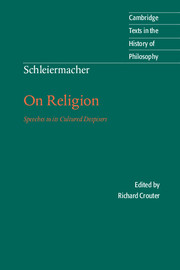
Book contents
- Frontmatter
- Contents
- Acknowledgments
- List of abbreviations
- Introduction
- Chronology
- Further reading
- A note on editions
- On Religion: Speeches to its Cultured Despisers
- First SpeechApology
- Second SpeechOn the Essence of Religion
- Third SpeechOn Self-formation for Religion
- Fourth SpeechOn the Social Element in Religion; or, on Church and Priesthood
- Fifth SpeechOn the Religions
- Index
- Cambridge texts in the history of philosophy
Third Speech - On Self-formation for Religion
Published online by Cambridge University Press: 05 June 2012

Book contents
- Frontmatter
- Contents
- Acknowledgments
- List of abbreviations
- Introduction
- Chronology
- Further reading
- A note on editions
- On Religion: Speeches to its Cultured Despisers
- First SpeechApology
- Second SpeechOn the Essence of Religion
- Third SpeechOn Self-formation for Religion
- Fourth SpeechOn the Social Element in Religion; or, on Church and Priesthood
- Fifth SpeechOn the Religions
- Index
- Cambridge texts in the history of philosophy
Summary
What I myself have freely confessed as deeply lodged in the character of religion, the endeavor to make proselytes out of unbelievers, is nevertheless not what impels me to speak to you now about the formation of humans toward this sublime capacity and about its conditions. Religion knows no other means to that final goal than that it expresses and imparts itself freely.
When religion stirs with all its own power, when in the flow of this movement it sweeps along with it every faculty of one's mind into its service, it thus also expects to penetrate to the innermost being of every individual who breathes its atmosphere. Every homogeneous particle will be touched and, seized by the same vibration, the awaiting ear of a seeker will rejoice upon attaining consciousness of its existence through an answering, kindred tone. Only in this way, through the natural expressions of its own life, does religion wish to arouse what is similar. Where this is not successful, it proudly disdains every external attraction, every violent procedure, calmed in the conviction that the hour is not yet present in which something congenial to itself could stir. This unsuccessful outcome is not new to me. How often have I struck up the music of my religion in order to move those present, beginning with soft individual tones and longingly progressing with youthful impetuosity to the fullest harmony of religious feelings?
Information
- Type
- Chapter
- Information
- Schleiermacher: On ReligionSpeeches to its Cultured Despisers, pp. 55 - 71Publisher: Cambridge University PressPrint publication year: 1996
Accessibility standard: Unknown
Why this information is here
This section outlines the accessibility features of this content - including support for screen readers, full keyboard navigation and high-contrast display options. This may not be relevant for you.Accessibility Information
Accessibility compliance for the PDF of this chapter is currently unknown and may be updated in the future.