


It is possible to argue that from the 1850s the burgeoning forms of capitalist development that took place in Latin American countries spurred the creation of numerous banking enterprises, but perhaps equally important were institutional innovations that came as a result of political and legal reforms.Footnote 1 This chapter focuses on the new laws and regulations that shaped early banking policies and practice in five nations, Chile, Colombia, Argentina, Brazil and Mexico. Such initiatives posed significant challenges for local elites and pushed them to engage in numerous and intense disputes as to the banking and monetary models that were judged to offer the best chances of future success. Particularly notable were the confrontations between advocates of free banking and promoters of banks with monopoly of issue. In short, Latin American elites were quick to participate in ideological and theoretical polemics that were characteristic of contemporary international debates on finance in an early age of economic globalization.
The model of a free banking system was characterized by the freedom to create banks as well as the authority to allow for the plurality of issue of banknotes.Footnote 2 In distinct contrast, an alternative regime was one where a dominant bank received the privilege of monopolizing the issue of paper money. The financial expert and historian Charles Goodhart has argued that the debates between supporters of free banking and their adversaries were particularly intense in Europe and the United States during the early and mid-nineteenth century but that the liveliness of the discussions diminished thereafter.Footnote 3 This argument, however, is not entirely consistent with the Latin American experience, where controversies over the advantages of opting between the two models began from the late 1850s but were resumed repeatedly after the outbreak of financial crises until the first decade of the twentieth century.
In the pages that follow we highlight the vitality of these debates in Latin America as they speak to the close intersection between finance and politics, an issue that is not sufficiently emphasized in the historiography on the nineteenth century, which tends to focus mainly on political discourse, factional party struggles and disputes on constitutionalism and legislative practice. This chapter argues that it is also important to identify key discussions after midcentury that led to the establishment of new institutional frameworks in Latin America regarding public credit, monetary systems and fiscal regimes. Such changes were buttressed by the ratification of civil and commercial codes, as well as of norms and charters for the establishment of early joint-stock companies, including legal measures that stimulated the creation of formal capital markets needed to ensure a flow of fresh funds for investment in private enterprise or in public debts. In a word, all these questions were essential to the perennial challenge of creating institutional frameworks to underpin economic growth in the short and long term, but also to assure financial stability in countries that were experiencing an early process of capitalist transformation.
The choice between a free banking system or, alternatively, a regime with monopoly of issue was a major challenge because of its influence on monetary and credit systems. The decision adopted could significantly influence the financial development of each economy, but it should be observed that there was frequent divergence between the abstract models discussed and the concrete practices adopted. Indeed, the creation of banking systems in the different nations of Latin America was based on dissimilar economic and social structures, as well as on distinct political trajectories, forcing both governments and banks to experiment with diverse legal and institutional frameworks.
Due to the lack of previous experience of Latin American elites with commercial banks, it was logical that they should have looked to other latitudes where there already existed a considerable body of laws and regulations regarding banks and monetary policies. Particularly relevant in terms of previous examples of reforms in the banking sector were the legal and contractual guidelines already put in place in England, Scotland and France. Some of these antecedents were adopted in Latin America, but often with original reformulations. In this regard it is pertinent to cite an argument by a perceptive historian who has studied organizational reforms in late-nineteenth-century Japan, noting that the process of change was not passive, for “the successful imitation of foreign organizational patterns requires innovation.”Footnote 4 Many contemporary Latin American politicians and early economists who wrote on these subjects in the third quarter of the nineteenth century in Argentina, Brazil, Chile, Colombia, Mexico, Peru and Uruguay believed that without new and clear rules it would be impossible to reduce the economic uncertainty derived from the political instability as well as the military and social confrontations that had been endemic in most of Latin America since independence. In this sense, monetary and banking innovations were considered to be part of a broader process of liberal reforms aimed at political and economic modernization.
In the pages that follow we begin with consideration of the free banking model that gained predominance during the third quarter of the nineteenth century in Chile and Colombia. In the case of Chile, for example, the rules of the game were discussed even before the establishment of banks and the rise of embryonic banking systems. Hence, it is possible to identify the Chilean case at midcentury as an instance when the model of free banking was inserted ex ante into the earliest banking legislation and, thus, the birth of banks there was in some regards the result of deliberate policies. In Colombia, on the other hand, small banks sprang up in many localities and operated with a high degree of freedom and autonomy, at least until 1880. In contrast, in Brazil, Argentina and Mexico, the advocates and practitioners of free banking proved less successful, since a tendency toward the predominance of one or two large banks of issue soon prevailed in these three cases.
The sequence of debates and discussions varied from country to country. In Chile parliamentary and press debates between supporters of free banking and advocates of government banks reached their peak between 1855 and 1860, when the first banking law was ratified. In Colombia, a similar juncture occurred shortly before the promulgation of the Constitution of 1863, as a consequence of the political rise of the Radicals and their federalist project, subsequently leading to the creation of a highly decentralized bank regime. In Brazil, the local parliament was the scene of intense controversy during the late 1850s and early 1860s over the relationship between banks and the state, especially regarding the institutional framework of the Empire’s monetary and financial system. In Uruguay, discussions on a new monetary law began in 1863, both in the Chamber of Deputies and in the press, but debates on the nature of the banking system and the regulatory frameworks considered to be desirable went on for years.Footnote 5 In Argentina, the confrontation in the national legislature between supporters of free banking and advocates of the monopoly of issue took place in the mid 1860s, yet was relatively brief, since the latter soon triumphed. In Mexico, on the other hand, where banking development came more slowly, the most heated debates took place later, during the 1880s and 1890s.
Free Banks versus Monopoly of Issue
Today it is assumed as a truism that the money market is special and requires a neutral authority – that is, a central bank – to regulate it and operate correctly. Based on this premise, traditional economic historiography has frequently associated periods of plurality of banks of issue as problematic episodes, in which financial instability can be caused by the lack of a lender of last resort, leading to an excess issue of banknotes and resulting in phases of high inflation. Nonetheless, several decades ago, a revisionist current of analysis challenged this conception. Particularly relevant were the pioneering studies by Hugh Rockoff on the monetary history of the United States, as well as the works on the history of the experience of free banking in Scotland and England by Lawrence White.Footnote 6 The latter author showed that free banking systems in emerging capitalist economies could function with considerable effectiveness, at least in certain circumstances and historical periods. In particular, White suggested that the case of Scotland in the eighteenth century had proven to be one of the most interesting and successful episodes of free banking in history. Apart from the case of Scotland, other examples that have been studied in the financial historiography dealing with the nineteenth century are the experiences of plurality of issue in the emerging banking systems of Australia, Canada, the United States, Spain, Sweden and Switzerland.Footnote 7
The varied experience of Europe and the United States with banks and banking legislation had a notable impact on Latin American elites. Not surprisingly, the first debates that influenced the region’s politicians and financiers were those that took place in the Parliament and press in Great Britain during the mid 1840s. The British banking system was one of the most advanced of the time, and therefore much attention was paid to the critical role played by the Bank of England as an early central bank that was privately owned but fulfilled public functions. Its board of directors included managers of the leading merchant banks of London who maintained extensive mercantile and financial relations with correspondents all over the world and, notably, throughout the western hemisphere.Footnote 8 Not surprisingly, therefore, from an early date there was coverage in the press of various Latin American countries on the contemporary discussions in England that revolved around central bank functions and banking reforms.Footnote 9
Especially influential were the discussions on monetary and banking policy in the British Parliament during 1844, notably the confrontation between the “currency school” and the “banking school,” a controversy that had notable repercussions on an international scale, both in practice and in theory. The financial reform of 1844, known as the Peel Act, established a special department within the Bank of England in charge of issuing paper money, but operating on the basis of gold reserves. In parallel, there was created a credit and banking department that dealt with the discounting of bills of exchange, commercial paper and treasury bills. This dual combination of functions was due to the fact that the Bank of England had a privileged relationship with almost all English banks but also handled government accounts. This great bank came to enjoy a quasi-monopoly of issue of banknotes from 1844 onwards, since whenever any private bank initiated a reorganization or merger, it was obliged to cede its right to print paper money to the central bank. For this reason, all banks in England and Wales progressively would lose their privileges of issuing banknotes, although this was not so much the case in Scotland and Northern Ireland, where even today several banks continue to print their own money.Footnote 10
In any case, discussions on the British experience were not exclusive, since news about banking development in other nations, particularly France, Germany and the United States, was also being disseminated in Latin America from midcentury by means of books, pamphlets and the press, exercising influence on the formulation of banking policies in diverse countries. There was, for example, a special interest among members of the Latin American political elites in learning about the operations of the Banque de France, a powerful bank with a monopoly of issue that was privately owned but had quite unique characteristics. Since its foundation in 1800, the Banque de France had operated as the main financial institution in France, which handled the current accounts of the government and, in addition, enjoyed the privilege of issue of banknotes.Footnote 11 In practice, it was a joint-stock company, owned by 200 large shareholders during the time of the Second Empire (1851–1870), but combined a variety of private and public functions. In turn, this large financial entity operated as a key player in French regional finance in the mid-nineteenth century as it set up fifteen provincial branches that discounted the bills of other local banks and thus expanded access to credit for a wide universe of clients.Footnote 12
The Banque de France was admired worldwide for its solidity in maintaining large reserves of gold and silver, making it a key actor in the operation of the bimetallic monetary system during the mid-nineteenth century, as has been demonstrated by the financial historian Marc Flandreau in fundamental studies of monetary history.Footnote 13 It should be emphasized, in this regard, that in Latin America the bimetallic regime or, alternatively, the silver regime remained dominant until late in the nineteenth century, when the gold standard began to gain terrain. Moreover, a good number of the first “national banks” established in different Latin American countries adopted the model of the Banque de France.
The experience of the early banking regimes of the United States was occasionally considered in early banking tracts in Latin America but could not be easily imitated due to its complexity. According to financial historian Howard Bodenhorn, in the early decades of the nineteenth century there was a very sui generis system of free banking in the United States with diverse monetary and banking rules, depending on the respective state.Footnote 14 The legislation on free banking adopted by the State of New York in 1838 is frequently cited, but things changed notably after the Civil War (1861–1865), when the federal government imposed distinctive rules for national and state banks with respect to reserves and the holding of government bonds. As we will see later in this book, the rather peculiar United States model of “national banks” did exercise influence in Latin America in the 1880s, but adaptation proved difficult.
Significantly, even before the first banks were actually created, in cities such as Santiago de Chile, Havana, Lima, Buenos Aires, Rio de Janeiro or Mexico, a considerable number of books, pamphlets and articles on banking theory and practice of the time began to be published and circulated. This literature appeared from the 1840s and 1850s: it reveals that there were members of the mercantile and political elites of Latin America who were in the process of acquiring knowledge on the banking and financial revolution underway in Europe and the United States. This learning process was important for the formulation of new financial institutions in various countries of the region.Footnote 15
Experiments with free banking prospered in a few countries in Latin America but certainly not all. In order to explore the diversity and complexity of the monetary, banking and financial problems of the time, it is worthwhile reviewing the relevant debates in different Latin American countries between 1850 and 1880. This makes it possible to distinguish between those situations that were closer to the free banking model, such as the Chilean and Colombian cases, and those where doctrines in favor of official banks with a virtual monopoly of issue were imposed. At the same time, it is worthwhile taking a look at countries like Mexico where mixed systems eventually prevailed. Contemporary debates on the regulation of banks unleashed intense political conflicts in parliaments and were taken up in the rich nineteenth-century press of each country.
The “Triumph” of Free Banks in Chile
One of the countries that pioneered debates on banking models was Chile, leading to the establishment of one of the most successful free banking models worldwide between 1860 and 1878.Footnote 16 From the start, the Chilean political authorities were explicit in promoting a frankly liberal system, as can be seen in the text of the first banking law ratified in 1860. On this occasion, President Manuel Montt argued that the government sought to establish a system even less regulated than that of the United States, and asserted that the new regime proposed for Chile would be as free as possible.Footnote 17 However, the proposed law was not the result of a sudden decision, but rather the consequence of an interesting prior history since the political and ideological discussions on the nature of banking had already begun in the 1840s.
A consensus on the need for the creation of some kind of national bank began to emerge quite early within the Chilean mercantile and political elites, although there existed dissent over whether such an entity should be private or governmental.Footnote 18 In 1845, the Chilean Congress appointed a commission to study the issue. The deputies recommended the creation of a national bank of credit and issue, but the project did not materialize since the discussions on the subject were more controversial than expected. The intensity of the debates was reflected in compilations of articles such as those published by the influential newspaper El Mercurio de Valparaíso, and gathered together in a volume published in 1845.Footnote 19 Another example was the text written by the distinguished intellectual and politician José Lastarria, titled Proyecto de lei sobre creación de un Banco Nacional, printed in Santiago in 1850. Later on, an additional number of pamphlets on banking projects and laws would be published quite frequently, as well as articles in the Chilean press that reflected a reasonably good knowledge of international banking theory and practice.Footnote 20
Before any commercial banks had been founded in Chile, the minister of finance, Manuel Camilo Vial, presented a report to the Chilean Congress in 1847 in which he stated that although doctrinally there was a profound difference between the two schools, he believed that plurality of issue of banknotes could be reconciled with the existence of a dominant public bank. He argued, somewhat ambiguously, that the establishment of private banks would provide the practical concepts, norms and legal reforms “essential to the foundation of a State Bank.”Footnote 21
The theoretical and political debates intensified from midcentury, as new banking practices were gaining strength. The trend toward financial and economic modernization was driven by a series of liberal institutional reforms that laid the foundations in Chile for the development and operation of new companies in the form of joint-stock companies, including the ratification of the Law of Corporations in 1854, the Law of Mortgage Banks in 1855, the Civil Code in 1857, the General Banking Law of 1860 and the Code of Commerce of 1865.Footnote 22 These new regulations spurred the creation of several banks and the establishment of small but dynamic stock exchanges in Santiago and Valparaíso, facilitating trade in the shares of the first Chilean insurance, banking, mining, gas and railroad companies. This reflected a qualitative leap in the country’s early capitalist development. According to the historian Steven Volk: “The 1850s became the great pivot on which the modern Chilean state swung.” He adds that this was the period of “the blossoming of a banking and finance system that would link mining to agricultural interests, cementing intraelite loyalties and providing the basis for upper-class control far into the twentieth century.”Footnote 23 Such a hypothesis would appear to be confirmed by the growing importance of networks of local merchant bankers who were active in the burgeoning stock market, financing mining and railroad enterprises, but who also became owners of many of the most productive rural estates.Footnote 24
In the case of Chile, it is important to note that several of the first banks were created on the basis of alliances between the strongest English mercantile houses with offices in Santiago and Valparaíso and a range of important domestic firms. The British companies, called “commission houses,” exercised a dominant role in much of the flourishing Chilean export trades, based on copper (exported to Great Britain as well as to India and China), silver and nitrates (destined mainly for Europe) and wheat flour (that went to Peru, California and Australia). Among the most prominent houses operating in these commodities from Santiago and Valparaíso were the firms of Antony Gibbs and Company; Frederick Huth and Company; Balfour, Williamson; and Graham, Rowe and Company. All of these firms used networks of correspondents in various ports on the Peruvian and North American Pacific coast, as well as in Europe and the United States.Footnote 25
The importance of these firms in international trade can be gauged by noting that the house of Gibbs and its agencies alone came to control about 30 percent of total Chilean mining exports during the 1860s, later rising to 60 percent in the 1870s. But in addition to participating in the finance of foreign trade, these merchant banks acted as private creditors to numerous local miners and landowners. In the case of J. Thomson, Watson and Company – to cite an example of participation in the finance of mining – the firm regularly charged 12 percent interest on advances given to mine owners, 5 percent for taking charge of transport contracts, 3 percent on sales of minerals in England and 0.5 percent on shipping insurance. The financial profits were considerable and allowed these enterprises to expand rapidly.Footnote 26
In 1855 some of the most important merchant houses in the port of Valparaíso joined with several locally based British firms to create one of the first modern credit institutions in Chile: the Banco de Depósitos y Descuentos de Valparaíso. Its original bylaws indicated that it would have a nominal capital of 2 million pesos in shares, a very considerable sum for the time. It was also stated that by internal rules, the bank would be dedicated strictly to commercial operations, discounting bills of exchange and promissory notes, receiving deposits and opening current accounts, as well as making investments on behalf of its clients in government bonds and other securities.Footnote 27 Four years later, several wealthy merchants from Santiago (and some from Valparaíso) decided to create another rival company, the Banco de Chile (1859), with a capital of 400,000 pesos, which prospered notably, possibly because it obtained a permit to issue banknotes. At the same time, and due to the interest in the expansion of credit, the Chilean government decided to authorize the creation of a very different institution, the Caja de Crédito Hipotecario in 1855, specifically dedicated to serving clients who wanted loans in exchange for mortgaging their properties.Footnote 28 This mortgage credit model closely followed that of contemporary German mortgage banks.
As a result of the initial process of financial expansion, the Chilean Congress resolved to discuss and approve a new monetary law and a banking law in 1860 that would regulate future monetary and credit operations. The new banking law authorized the establishment of joint-stock banks that could issue banknotes, signaling the triumph of the “free bank” school. In some ways this new law was the result of a doctrinaire campaign that had great success at the University in Santiago, in the press and in the legislature. This campaign was driven by the widespread diffusion in Santiago and Valparaíso of the works of liberal economists and, in particular, of a school of thought that acquired great prestige as a result of the arrival of the French economist Jean Gustave Courcelle-Seneuil, who was hired by the Chilean government in 1855 to serve as advisor to the minister of finance and as professor of political economy at the university, where he taught until 1863 with considerable success.
Courcelle-Seneuil was an admirer of the free banks of Scotland and, in general, of the doctrine of free banks, as can be seen in his book Traité des opérations de banque (1853), translated into Spanish and published in Santiago in 1859. His text was, at the same time, a theoretical treatise, a synthesis of historical banking models and a practical manual for the banker.Footnote 29 His proposals, moreover, coincided broadly with the popular free trade ideologue Michel Chevalier, one of the most widely read French economists of the time throughout Latin America. It should be noted in this regard that while the texts of some English economists such as Smith, Ricardo or MacCulloch were known, a greater number of works by French authors circulated, such as those of Courcelle-Seneuil, Jean Baptiste Say, Louis Wolowski and Isaac Pereire, among others.Footnote 30
In any case, it should be emphasized that the banking law, enacted on July 23, 1860, established a de jure free banking regime in Chile and facilitated the creation of new banks in the country.Footnote 31 The few obligations imposed by the law required issue banks to submit monthly reports on their activities. In turn, the issue of banknotes by any bank had to be limited to 150 percent of its paid-in capital, although no rules were imposed regarding the composition of such capital, which did not necessarily have to be in silver or gold. Nonetheless, the banknotes had to be payable to the bearer in gold or silver and were limited to bills in denominations of 20, 50, 100 and 500 pesos. It was also established that the owners of the banks had unlimited liability and, therefore, were obliged to guarantee the liabilities of the financial entities with their personal assets.
The “free banking” advocates achieved unparalleled success, although this has not always been sufficiently emphasized in Chilean monetary history, since the bulk of the published works have focused on a later period when debates on “gold versus paper money” predominated, especially between the 1880s and 1920s. However, in recent years revisionist works have focused on the episode of liberalization of banking in Chile in the period from 1860 to 1878, and conclude that the Chilean case represents a successful example of free banking, contributing to economic growth. They argue that the reason for its subsequent failure stemmed not from its adherence to laissez-faire but from the impact of government policies that undermined financial stability.Footnote 32
In 1865, the new banking system faced its first major challenge as a result of a major naval war, unleashed as a result of the seizure of the Chincha Islands of Peru by Spanish naval forces, followed by the bombardment of the port of Valparaíso. The Chilean authorities soon found themselves in need of new resources to finance war actions against the Spanish Navy. In order to avoid panic and a possible financial crisis, the government authorized the creation of the Banco Nacional de Chile in October 1865 (which absorbed the Banco de Chile) and allowed it to issue up to 1.5 million pesos in inconvertible banknotes. Then on July 20, 1866, the minister of finance negotiated a loan for more than 4 million pesos with the largest commercial banks, in exchange for which these financial entities received privileges that ensured that their banknotes would be received as legal tender in the tax offices for a term of twenty years.Footnote 33 The government intervention in the financial market was broadened in 1873 when an agreement was signed with the Banco Nacional de Chile that acquired the de facto nickname of government bank, since it was entrusted with the management of virtually all fiscal accounts. However, it should be noted that this firm remained privately owned and was controlled by some of the largest Chilean fortunes of the time, including the participation of foreign merchants who were shareholders: 490 of the first 2,240 shares had been bought by English investors, and both its first president and manager were British.Footnote 34
In spite of the naval war with Spain, new banks continued to be created embracing the freedom of issue of banknotes under the banking law. In 1870, the issuing banks included Banco Nacional de Chile, Banco de Valparaíso, Banco Agrícola, Ossa y Cia., Agustín Edwards y Cia., MacClure y Cia. and Montenegro y Cia. However, there was already a notable difference between the volume of issue by the different enterprises. As of December 1869 the Banco Nacional had already issued more than 2.7 million pesos in banknotes (out of 4.5 million bills registered), while the Banco de Valparaíso had notes worth 600,000 pesos in circulation and the Banco Edwards notes worth 1 million pesos.Footnote 35
The banking expansion advanced steadily. Several new banks were created in the northern and southern regions of Chile, but the multiplication of branches of the three main banks – the Nacional de Chile, the Banco de Valparaíso and the Banco Edwards – took place essentially in the capital and in the central valley. In 1866, there were still only four banking offices outside the capital, but by 1873, there were in operation twenty-three regional branches. This was a reflection of an economy that was growing at high rates, driven mainly by the boom in exports of copper, silver and wheat, as well as by the increase in domestic investment and the receipt of a small flow of foreign capital. Much of the latter was directed to the construction of state railroads through the placement of Chilean bonds in England for a nominal value of 4.4 million pounds sterling, before the outbreak of the international financial crisis in 1873.
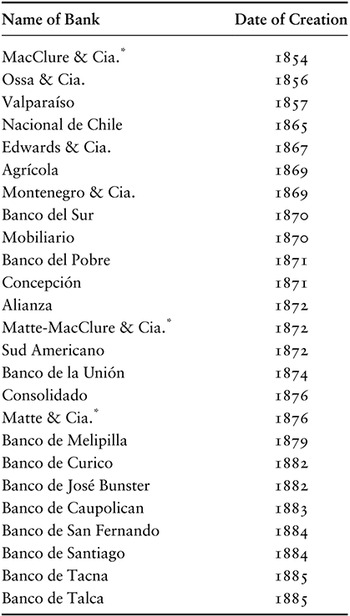
Between 1870 and early 1873, a feverish financial boom was unleashed in Valparaíso and Santiago that led to a remarkable multiplication of joint-stock companies. There were only ten joint-stock companies registered in Valparaíso in 1854, but by 1873, 150 joint-stock companies were active on the capital markets of Valparaíso, Santiago and Concepción.Footnote 36 And among them, banks led the way (see Table 4.1).

Table 4.1 Long description
The left column lists bank names such as Mac-Clure and Cia, Ossa and Cia, Valparaíso, Nacional de Chile, Edwards and Cia, Agrícola, Montenegro and Cia, Banco del Sur, Mobiliario, Banco del Pobre, Concepción, Alianza, Matte-Mac-Clure and Cia, Sud Americano, Banco de la Unión, Consolidado, Matte and Cia, Banco de Melipilla, Banco de Curico, Banco de José Bunster, Banco de Caupolican, Banco de San Fernando, Banco de Santiago, Banco de Tacna, and Banco de Talca. The right column lists the corresponding creation years, ranging from 1854 to 1885. The table appears in black text with gridlines separating each row.
* A private banking house that later changed its name.
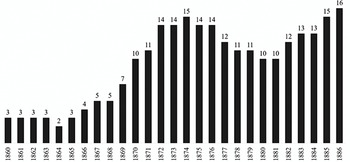
The expansion of the Chilean economy was abruptly interrupted by the global financial crisis of mid 1873, which soon undercut exports as well as the government’s fiscal revenues, which depended mostly on foreign trade taxes. The Chilean banking system was therefore threatened by shortages of hard currency reserves. In order to avoid panics, the directors of most banks acted to restrict credit, but this produced a series of negative impacts within the Chilean economy. A recession soon set in and lasted for several years due to the drop in exports, credit restrictions and the weakening of the Santiago and Valparaíso stock exchanges (see Figure 4.1).
Number of commercial banks in Chile, 1860–1886.

Figure 4.1 Long Description
Each year is labelled along the bottom from left to right. The chart begins with 3 banks from 1860 to 1863, then drops to 2 in 1864. It rises again to 3 in 1865, 4 in 1866, and 5 in both 1867 and 1868. The count increases to 7 in 1869 and reaches 10 in 1870. Growth continues with 11 banks in 1871 and a sharp rise to 14 in 1872 and 1873. The peak of 15 banks occurs in 1874, followed by slight declines: 14 in 1875 to 1876, 12 in 1877, and 11 in both 1878 and 1879. The number falls to 10 in 1880 and 1881 before recovering to 12 in 1882, 13 in 1883 and 1884, then climbing to 15 in 1885 and a new high of 16 in 1886. The bars are tall, black vertical columns, each labelled at the top with its numeric value.
From mid 1874 a number of small banks began to close their doors, although the causes were varied. It has been argued that, in practice, the rate of bank failures in Chile was not high in comparison with other countries of the time. Economist Briones has underlined two characteristics with respect to the resilience of the Chilean banking system: (1) there was no obligation for banks to maintain hard currency reserves; (2) owners assumed responsibility for their banks’ liabilities.Footnote 37 Furthermore, he argues that despite high market concentration, there was a substantial degree of competitiveness among the Chilean banks, a fact that would seem to indicate that the experience of plurality of issue was positive as it appeared to favor economic growth as well as a reasonable degree of price stability.Footnote 38 On the other hand, the overwhelming predominance of banknote issue by the Banco Nacional, the Banco de Valparaíso, as well as the Banco Edwards, bespeaks a situation of rather limited competition due to the great weight of the largest banking entities in Chile. Moreover, the trend toward concentration became even more acute after the crisis of 1873, especially as reflected in the increase of key items in the balance sheets of the Banco Nacional, namely capital, deposits and loans. But it should also be noted that the increasing intertwining of the Banco Nacional with unstable public finances would seal its fate when the Chilean banking crisis of 1878 finally broke.
The end of free banking in Chile can be attributed to the fact that precisely in the year 1878 the government declared the inconvertibility of banknotes and simultaneously began to intervene directly in the market by issuing treasury bills that competed with those of private banks.Footnote 39 Ultimately, therefore, the demise of the era of free banking in Chile was spurred by problems generated by a long economic recession that had begun in 1873, but even more by the actions of the government several years later when in need of resources, as it proceeded to massive interventions in the money market.
Free Banking in Colombia, 1871–1885
Free banking in Colombia took place in an entirely different context from that of Chile, where there was a fairly cohesive national market. In contrast, Colombia, given the nature of its geography and its political development, represents an almost paradigmatic case of fragmented markets. This circumstance delayed political centralization and probably favored a free development of banking, as it was framed in a political context that espoused both economic laissez-faire and federalism as state policies. Administrative decentralization gave much autonomous power to regional elites in the formulation of local financial trajectories. The most important impetus to banking freedom was the result of the victory of the liberals in the civil war of 1860–1862, which led to the ratification of the Constitution of 1863, which sanctioned political federalism and delegated many tasks to local governments, including the power to regulate commerce and establish banks.Footnote 40
It is interesting to note that, in Colombia, banking laws preceded the existence of banks. Although private merchant firms were quite active in credit markets in trade and mining from colonial times and continued to be so in the early nineteenth century, the mercantile firms were not commercial banks as such. It is true that a number of small savings banks appeared in the decades between 1840 and 1860, but their economic impacts were limited.Footnote 41 As in Chile, several proposals were made in Colombia during this period to create a national bank.Footnote 42 In 1865, a law was ratified that ultimately allowed the establishment of a free banking system in the country, granting permission to any bank that wished to provide deposit, discount and loan services for up to twenty years, the only condition being that the banknotes of each new entity had to be payable on demand in silver or gold.Footnote 43 One of the privileges granted by the law was that the governments would be obliged to accept the banknotes as a means of payment in all public offices, in particular for covering taxes.
That the principles of free banking should have been adopted in Colombia with as much enthusiasm as in Chile has also been attributed to the influence of liberal schools of economics, including the local translations of texts by Courcelle-Seneuil and other French liberal economists.Footnote 44 Two finance ministers of the time who promoted liberal legislation, Miguel Samper and Salvador Camacho Roldán, represent good examples of the importance of these doctrinal schools, since both were influenced by texts of French economists. According to Andrés Álvarez, in the case of Samper: “his main intellectual influences came from France, especially from the group of liberal economists organized around the Société d’Economie Politique and the Journal des Economistes, of which he was an assiduous reader.”Footnote 45
Beyond the influence of certain currents of liberal economic thought, the creation of the first banks in Colombia was also influenced by the actions of local governments. Historian Juan Santiago Correa concludes that federalism provided incentives for regional elites to promote banking projects.Footnote 46 Among the first banks were the Banco de Bogotá, the Banco de Bolívar in Cartagena, the Banco de Antioquia based in Medellin and the Banco de Santander in the small city of Bucaramanga. All of them had in common that they were the first banks to be established in their respective regions and, as such, could obtain privileges for the issue of banknotes and receive special treatment from the respective provincial governments.
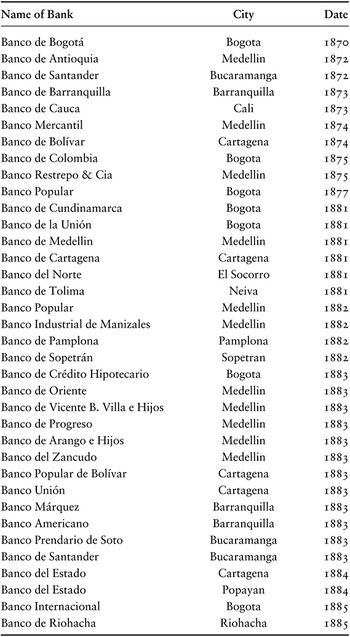
During the years from 1871, when the first commercial bank was founded in Colombia, until 1886, when permission for private entities to issue banknotes was revoked, there took place intense private banking activity in many different locations. Historian Adolfo Meisel affirmed that he had counted as many as thirty-nine banking entities during this period, many of which issued banknotes, but historian Correa Restrepo suggests a slightly lower figure of private banks in that era (see Table 4.2).

Table 4.2 Long description
The left column contains bank names such as Banco de Bogotá, Banco de Antioquia, Banco de Santander, Banco de Barranquilla, Banco de Cauca, Banco Mercantil, Banco de Bolívar, Banco de Colombia, Banco Restrepo and Cía., Banco Popular, Banco de Cundinamarca, Banco de la Unión, Banco del Norte, Banco Industrial de Manizales, Banco de Crídito Hipotecario, Banco de Oriente, Banco Americano, and Banco Internacional, among many others. The middle column identifies their founding cities, including Bogotá, Medellín, Bucaramanga, Barranquilla, Cali, Cartagena, Neiva, El Socorro, Pamplona, Sopetrán, Popayán, Riohacha, and others. The right column lists their year of creation, ranging from 1870 to 1885. The entries show rapid bank formation, with concentrated clusters of new banks appearing particularly in the early 1880s.
Several pioneering works on free banking in Colombia have given rise to an interpretation arguing that, in general, free banking in Colombia was successful.Footnote 47 Nevertheless, a new school of Colombian financial historians disagrees and argues, in addition, that the study of banking in this early period cannot be separated from the monetary context. Until 1865, only silver and gold coins circulated in Colombia, but it can be said that the economy was predominantly on a de facto silver standard since gold was used more as the leading export commodity than as currency. Most of the monetary reforms in Colombia focused on trying to unify circulation through amortization and recoinage in order to establish a semblance of order, since coins in different regions had varying legal values and weights.Footnote 48
In an incisive work, historians Álvarez and Acuña argue that the large gold exports reflected the operation of a form of Gresham’s Law in Colombia from 1865, as can be confirmed by review of the economic experience of the state of Antioquia and its capital Medellin, as well as of the state of Cundinamarca, seat of the national capital, the city of Bogota. They point to the fact that the monetary system in Colombia was initially based on the circulation of metallic currency (mostly gold), produced in various mints in the different states, but that relatively soon the metallic circulation was complemented by banknotes issued by the first banks, backed by metallic reserves. According to the authors cited, “All regions of the country adopted regulations based on compliance with convertibility and the proliferation of freely competing banking institutions.”Footnote 49
In the case of the region of Antioquia, historian María Mercedes Botero has emphasized the importance of gold mining, but has also linked it to the emergence of the first banks, which used their gold reserves to back early banknotes. She states: “Credit and banking activity flourished in the years between 1872 and 1883 as seven banks and four banking houses were established in Medellin, the state capital of Antioquia, as well as regional banks in Rionegro and Sopetrán.”Footnote 50 The region’s first formal credit and issuing institution, the Banco de Antioquia, founded in 1871, had sixty-two shareholders. Apparently the banking initiatives were the result of the demand for new monetary instruments by merchants who wanted paper money, as it reduced the need to accumulate gold. In short, the creation of banks gave rise to a sudden increase in the circulation of paper money, accompanied by a considerable circulation of silver coins, since gold was preferred for export and also used to cover the costs of imports.
Other historians contrast the situation in Antioquia with the national capital, Bogota, and the surrounding region of Cundinamarca, where the economy specialized in agriculture, commercial services and artisanal manufacturing.Footnote 51 Early banks there faced severe problems between 1876 and 1885, a time of various short-lived civil wars that provoked financial panics and bank runs. The supposed success of Colombian free banking in this region has been questioned by some researchers since the Banco de Bogotá, the largest financial institution in the country, had to suspend the convertibility of its banknotes from November 1876 to May 1877 in order to avoid bankruptcy. In fact, the Banco de Bogotá was able to overcome this crisis not because it was part of a free banking system, but as a result of an alliance with the government. However, this very association led to the bank’s instability.Footnote 52 This is partially confirmed by the fact that another important bank in Bogota, the Banco de Colombia, established in 1875 with few ties to the government, survived the crisis without the need to suspend payments.
In conclusion, although it is true that there is a lack of information to allow a complete evaluation of banking trajectories in the years between 1871 and 1886 in Colombia, two schools of interpretation clash in their analyses. The more general institutional studies suggest that the banking experiments in a large number of regions were relatively successful as illustrated by notable growth in the number of banking entities and the maintenance of local macroeconomic and financial stability, despite regional differences and rivalries.Footnote 53 On the other hand, more recent empirical studies argue that the free banking model did not favor balanced or rapid financial and economic development and tended to foster multiple rivalries that accentuated the fragmentation of regional markets.
The end to free banking in Colombia was caused by the political evolution that led to the defeat of the liberals and the establishment of a more conservative and centralist regime in the 1880s that had no interest in continuing with the experiment of free banking. The decline began when the liberals lost power in the country. With the arrival of General Julián Trujillo to the presidency in 1878, the “regenerationist” movement (a conservative current that proposed state intervention as one of its political banners) gained strength, and the first steps were taken to dismantle the liberal regime. In 1880 the government promoted the establishment of the Banco Nacional as a public bank, and in the years of 1885–1887, during a new civil war, the old free banking system was put on hold. The prerogative that allowed private banks to issue notes was eliminated and power was granted to the Banco Nacional to serve as the only entity with the authority to issue banknotes in all of Colombia. Clearly political economy was a determining factor in this case. In summary, a major unresolved issue is not so much why free banking originated and disappeared in Colombia, but rather the need to explain why the Conservative regime of the 1880s was willing to sacrifice a functional system of local banks in the name of centralism and therefore risk profound regional resentments and future financial instability.
Debates in Brazil: A Government Bank or Free Banks?
Our review of the early banking experiences in Chile and Colombia emphasizes the need to reflect on the complex relationships between finance and the formation of Latin American states during the nineteenth century. A parallel set of debates in Brazil, Argentina and Mexico, countries where banking was beginning to take off, illustrate many similar and critical issues. For example, from the mid 1840s, the first serious discussions began to emerge in Brazil on banking and currency and their role in the economy. There, as elsewhere in the mid-nineteenth century, a fundamental conflict was expressed in the ideological war between the “bullionists” (metalistas), who argued for a metallic currency and a restriction of banking, in opposition to the school of “pluralists” or (papelistas), who favored more financial intermediation and flexibility in the issue of paper money, as well as a liberal banking legislation.Footnote 54
In the case of Brazil, the main ideologue of the “free banks” was Bernardo de Sousa Franco, author of Os Bancos do Brasil in 1848, a pioneering study of great interest.Footnote 55 In this book, Sousa Franco proposed a banking reform that would lead to the creation in Brazil of several “banking regions,” each with its own issuing banks, a proposal that he was to ratify when he became minister of finance a decade later. In fact, a significant debate had already begun to take place in Brazil about the respective merits of free banking or, alternatively, the monopoly of issue by one large bank.Footnote 56 One of the main advocates of plurality of issue at that time was Irineu Evangelista de Sousa, the Baron of Mauá, the leading private banker of his time, who was a major shareholder in the Banco do Brasil from 1851. Nevertheless, he had to submit to the demands of the imperial government and the minister of finance, the powerful conservative politician Joaquin José Rodrígues Torres, who demanded the adoption of orthodox policies that were aimed at maintaining a strict gold standard. In his memoirs, Mauá wrote that he believed that one way to boost credit was to liberalize the Banco do Brasil’s policies and create branches in all regions of the huge country, but that he met with firm rejection of his proposals by other members of the Board. After an interview with the minister, he decided to separate himself from the management of the bank.Footnote 57
In 1857, Mauá found a new opportunity to promote his vision of a banking system. The situation was ideal as his friend, Bernardo de Sousa Franco, had now been appointed minister of finance with the support of the Liberal Party, which favored the proposal to establish a free banking system. In fact, Sousa Franco almost immediately decreed the plurality of issue of bankotes, leading Rodrígues Torres to resign from the presidency of the Banco do Brasil. In less than a year a handful of banks of issue were established in different regions of the country. Not surprisingly, the incorporation of the new companies with the right to issue banknotes (paper money) provoked a strong rivalry for a few years with the Banco do Brasil. The Banco Comercial e Agrícola was the first entity created as a result of Sousa Franco’s reform, but by February 1858 five other banks received permission to issue banknotes both in the capital and in the provinces: these were the Banco do Rio Grande do Sul, the Banco de Pernambuco, the Banco de Bahia, and the Banco do Maranhão, in addition to the Banco Rural e Hipotecario do Rio de Janeiro. According to some interpretations, such reforms implied a decisive break with the monopoly of issue by the Banco do Brasil and marked a new phase of banking evolution in Brazil. But, in reality, the plurality of issue of banknotes was not simply the consequence of a new doctrinal concept as much as the ratification of already widespread banking practices that included the circulation of vouchers and promissory notes that had been practiced by various small banks in Rio de Janeiro from the early 1840s onwards.Footnote 58
The reforms of the incipient banking system spurred a series of intense polemics and struggles in Brazil between liberals and conservatives during the 1850s and 1860s, and therefore represent a key chapter in the political history of the legislature of the Brazilian Empire. Even though other legislative discussions on the abolition of the international slave trade and the promotion of future railroads were intense, the most heated debates actually revolved around the need to formulate an institutional framework for monetary and banking policy.Footnote 59 Conservative politicians adopted very orthodox positions based on the convenience of limiting the issue of paper money and, above all, on maintaining strict convertibility. The emperor and his closest circle as well as the conservative members of the Chamber of Deputies rejected free banking and insisted on the importance of maintaining the monopoly of issue of paper money by the Banco do Brasil. The imperial elite conceived this bank as a key instrument for the maintenance of the political and social order of the regime dominated by a slave oligarchy, composed of the owners of the leading coffee and sugar landowners, in alliance with several networks of merchant firms, all in close contact with many important political and military leaders.Footnote 60
Nonetheless, economist historian Andrés Villela has argued that a good number of coffee plantation owners did not espouse the most conservative policies, since they actually had a marked interest in the expansion of credit sources and free banking. Coffee exports were booming at midcentury and a slightly depreciating currency would allow planters and merchants financial gains since the gold obtained at the foreign point of sale could later be translated into a somewhat higher amount of income in paper money in Brazil, due to the devaluation of the exchange rate. As a result, at certain junctures, there were members of the propertied classes that opposed a rigid monetary policy based on the gold standard that would restrict the issue of paper money, and pressed for the extension of a larger volume of credit through the commercial banks.Footnote 61
This interpretation may help to explain why the liberal party – which had many landowners in its ranks – supported the banking liberalization policy of 1857. But unfortunately, minister Sousa Franco did not anticipate a set of serious problems, which were to doom his reforms to early failure. As historian Thiago Gambi pointed out, the liberal minister did not anticipate the crisis of 1857, which began in the United States and spread to other countries.
Panic spread through the financial market of Rio de Janeiro and the situation only began to improve when the government asked Baron de Mauá for help in obtaining advances in gold which he transferred from London. The crisis ended in the last quarter of 1858, but the plurality of issues was considered the major cause of the crisis. The press and the parliament criticized the Minister of Finance and the Olinda-Souza Franco cabinet fell in December 1858.Footnote 62
Shortly thereafter, a new financial reform was ratified in 1860 that reasserted the predominance of the Banco do Brasil within the banking system as a whole and reestablished its role as the main issuer of paper money. This was a result of the political triumph of the Conservative Party, led by Francisco Salles Torres, who took over the Ministry of Finance, replacing the liberal Sousa Franco.Footnote 63 At the same time, the Conservative politician and financier Rodrígues Torres returned to the presidency of Banco do Brasil.Footnote 64 In short, the metalistas triumphed again and a new law reimposed the principle of convertibility of banknotes to gold. This position suited the interests of the import merchants as well as the powerful officials of the Ministry of Finance, who wanted a strong currency that would facilitate the payment of public external debts in gold.Footnote 65
The imperial government proved to be consistently supportive of orthodox monetary policies since the gold standard encouraged exchange rate stability and prudence in monetary policy, but also bolstered the servicing of public debts, both domestic and foreign. Foreign investors considered regular repayments on Brazil’s foreign debt as a sine qua non for continuing to participate in the issue of additional bonds. The economic historian Summerhill has explained how the imperial government managed to implement a successful policy of the placement of public debt (external and internal), which depended on relatively stable exchange rates.Footnote 66 Apart from the considerable issue of bonds by the imperial government on international markets, it is also relevant to point out that by the 1860s several thousand Brazilian investors were buying and selling domestic government debt on the Rio de Janeiro Stock Exchange.
The defeat in 1860 of the free banking policy promoted by Sousa Franco, followed by the triumph of the metallistas, forced banks to maintain high cash reserves, a policy that tended to benefit the Banco do Brasil. This large entity regained a dominant position in the financial market in Rio de Janeiro but, on the other hand, the new legislation was detrimental to financial enterprises in other provinces, especially in Bahia, where five credit companies were operating in the port of Salvador and six banks in the inland towns of a thriving sugar-growing region. The strict supervision that came with the banking reform provoked the fear of the directors and shareholders of these local companies, since they assumed that the government was seeking to dissolve them. As a result they abruptly reduced their activities, provoking numerous mercantile bankruptcies. In Pernambuco, the failure of the sugar and cotton harvests in 1859 led inevitably to a large increase of overdue bills in the portfolios of the local banks. To this was added the new pressures to reinforce convertibility after 1860, further weakening the local bankers, who could not count on the credit support of the Banco do Brasil, and forcing a good number of them to submit and to become branches of the financial colossus from the capital.
Nonetheless, the preeminence of the Banco do Brasil was weakened after suffering heavy losses during the financial crisis of 1864, which led to the bankruptcy of several major private banking houses in Rio de Janeiro. Furthermore, the outbreak of the Paraguayan War in 1865 soon led political and military authorities to question the ability of the main bank to finance its armies and navy. Consequently, the imperial government resolved to authorize the Treasury to begin issuing paper money for this purpose, and froze the former monopoly of issue by the Banco do Brasil.
As early as August 1866, the Banco do Brasil was already in a position of acute financial and commercial weakness, a situation described in a final report of the Senate Finance Committee, which stated: “With two-thirds of its portfolio composed of bills receivable which cannot be discounted in the short term, being of difficult and doubtful liquidation, the Bank of Brazil can no longer satisfy the essential conditions ratified when it was created.”Footnote 67 Shortly thereafter, on September 12, 1866, the Senate passed a new law ordering the Banco do Brasil to immediately cease the issue of banknotes, although it was allowed to continue with commercial discounts and mortgage operations. At the same time, the government declared that existing banknotes still in circulation would continue to be accepted at the tax offices, although they were to be gradually withdrawn. The government helped to liquidate notes after the end of the Paraguayan War in 1870. Economic historian Villela concludes his analysis of this episode in Brazil’s monetary and banking history by stating: “The 1866 law turned the clock back to the 1830s, when the Treasury replaced the first Banco do Brasil as the sole issuer of paper money in the Empire.”Footnote 68
The Defeat of the “Free Banking” Projects in Argentina
While in Chile, Colombia and Brazil the respective merits of a system of “free banks,” or, alternatively, of a system dominated by a large government bank, were fiercely debated, in Argentina these issues also began to be discussed among different factions of the political elite. The first antecedent can be found in the writings of Mariano Fragueiro, who had settled in Chile in the 1840s to conduct business in commerce, mining and railroads, but also devoted time to publish two long essays in defense of the creation of state banks.Footnote 69 He returned to Buenos Aires in 1847 and soon published a book, entitled Organización del crédito, in 1850. In this work he advocated that the state should take a preeminent role in the regulation of credit, very much in the style of the French Saintsimonian school, which had been proposing this type of financial model for many years.
After the defeat of the caudillo Juan Manuel de Rosas in the Battle of Caseros in 1852, Fragueiro became minister of finance of the new Argentine government of the Confederation, headed by José de Urquiza, and in that capacity he promoted the creation of a national bank, with headquarters in the river port of Rosario. But this project soon foundered due to scarce metallic reserves and to lack of confidence on the part of local merchants. The main reason for the failure was that after 1854 the Confederation government could not access the Buenos Aires customs revenues, which were the most important tax sources in Argentina. The State of Buenos Aires established its autonomy from the government of the Confederation in July 1853 and ratified its own Constitution in 1854. The conflicts between the Urquiza forces and those of the State of Buenos Aires intensified in the years 1859–1861, until the latter finally triumphed. As a result of the victory of the army of Buenos Aires in 1861, commanded by General Mitre, a series of complex negotiations led to the union of all the Argentine provinces under the umbrella of a national government in 1862.
From the start, the new political authorities found it urgent to propose a series of laws to the legislature in order to organize public finances as well as to reform the monetary system and promote a banking regime. In May 1863 the minister of finance, Dalmacio Vélez Sarsfield, presented a measure for the ratification of a “Law of Free Banks,” which garnered the support of quite a few senators. Quite explicitly, the advocates of the proposal expressed their interest in promoting a system similar to the one then operating in the United States based on a plurality of banks of issue. In presenting the bill, Senator Lucas González presented the majority argument of the commission in favor of free banks:
In fact, Mr. President, two quite distinct systems have been and are in practice in the matter of Banks, as in other economic matters. The first is the regulatory, monopolistic, prohibitive, privileged system, the French system for example; the second, the liberal system, such as that of Scotland and the United States, which leaves the management of commercial operations to the care of the merchant and the banker. The first system leads us to State Banks, true political instruments placed in the hands of governments.Footnote 70
The Vélez Sarsfield bill proposed to allow the establishment of commercial banks with the right of issue (backed by gold), and was approved by the senators, but on reaching the Chamber of Deputies it aroused great opposition from many representatives who wished to defend the monopoly powers of the Banco de la Provincia de Buenos Aires. Soon afterwards the bill was shelved and expired.
The real controversy in this debate therefore did not consist in deciding whether to authorize the operations of other commercial banks (several were being set up in Buenos Aires, Rosario and Córdoba), but in determining whether to deny the virtual monopoly of issue of banknotes exercised by the Banco de la Provincia. The most vocal opponent of this monopoly was the distinguished intellectual Juan Bautista Alberdi, who stated that “The Banco de la Provincia is the true dictator of Buenos Aires.” Furthermore, Alberdi considered this institution to be an enemy of free enterprise: “It is constituted socialism as enshrined by Saint Simon, Fourier or Proudhon.” And he added that the state bank of Buenos Aires had a power superior to many of its peers abroad:
There is no lack of known examples of State Banks, and of large States, which do not have greater solvency or credit power than the Banco de la Provincia de Buenos Aires has. Such are the Banks of Russia, of Austria, of Brazil, of Turkey, which issue public debt in the form of legal or compulsory paper money.Footnote 71
Despite criticism, the Banco de la Provincia de Buenos Aires continued to dominate the monetary and banking system for a long time. Much of the entity’s success was derived from the confidence it garnered among its many clients, rural landowners, professionals and merchants in the province of Buenos Aires, a region experiencing fast growth. At the same time, the government soon began to implement monetary policies aimed at reinforcing confidence in paper money by reducing the large volume of banknotes that had been issued during previous military conflicts. In fact, after 1862 the Banco de la Provincia began to withdraw its banknotes from circulation, leading to a sharp decrease by 1867 of one third of the 300 million pesos that had made up the paper money stock at the beginning of the decade. This policy was widely applauded because it reduced the dangers of inflation. At the same time, the commitment by the government and the bank to guarantee the convertibility of banknotes into silver, gold or hard foreign currencies gained strength. In 1865, the first “metallic bills” were issued by the Banco de la Provincia, backed by silver and gold reserves. More importantly, in 1867 a monetary law was ratified that adopted the principle of convertibility of all paper money, in particular the circulating paper money issued by the provincial bank, and established the rate of 25 pesos paper for each peso fuerte (payable in silver or gold). The norms for monetary exchange were complex, but they implied that for the first time Argentina entered the gold standard, and this gave its monetary system prestige for a time, at least, before the outbreak of the financial and political debacle of 1876.Footnote 72 During these years an official exchange bureau operated within the Banco de la Provincia and assured the possibility of exchanging circulating paper money for banknotes with a metallic guarantee. This would be the first of five periods of convertibility in Argentine history during the nineteenth and early twentieth centuries.
In any case, the real power behind the monetary and financial throne in Argentina continued to be the Banco de la Provincia de Buenos Aires, since not only did it supervise the collection of a part of the state customs, receive government deposits, purchase state bonds and grant direct loans to the national government, but it also exercised a monopoly over the issue of paper money, at least until 1872.Footnote 73 Such immense power made it an indispensable intermediary for both the national and provincial government in all financial spheres. The symbiotic but contradictory relationship between the nation and the largest and richest province, therefore, constituted a key element in the evolution of Argentine political and financial dynamics that would last for decades.
The monopoly of the provincial bank was maintained until 1872, when the Banco Nacional was created, receiving the right of issue and soon competing successfully in some credit markets, especially in the interior provinces. However, the new institution had difficulties in attracting private customers in Buenos Aires and relied heavily on government deposits. Following a major fiscal and financial crisis in 1875, the Banco Nacional almost collapsed and, once again, the Banco de la Provincia emerged as the country’s main financial power. In fact, it would not be until the 1880s that the advocates of free banking in Argentina returned to the forefront of financial debates, although it should be noted that the model adopted at that time was a far cry from the banking experiments that took place in other Latin American countries.
Early Banking in Mexico: Debates and Illusions
Debates and discussions on institutional models of finance in Mexico long had a stronger component of illusion than reality, since banking development was clearly incipient in the 1860s and 1870s. After the invasion and occupation of Mexico by French and Austrian troops during 1863–1867, many arguments were advanced regarding ways of obtaining economic benefits from this bloody colonial adventure. Proposals were soon broached on different types of banks that could be created, including those in favor of a government entity like the Banque de France, while other proposals were presented on behalf of the establishment of a Mexican Crédit Mobilier, as well as initiatives to create private commercial banks. The number of pamphlets and books on banking institutions that began to circulate in Mexico during the French-run Empire of Maximilian was considerable, and reflected the fact that a public opinion on the subject had begun to emerge. A review of the titles of the books indicates that many were written by French economists such as Isaac Pereire, Louis Wolowski, Charles Coquelin and Courcelle-Seneuil, as well as numerous pamphlets on more specific aspects of credit, all published in Paris in the mid 1860s and in some cases translated into Spanish, since there was already a clientele in Spain and Spanish America interested in this subject.Footnote 74 In short, members of the Mexican mercantile and professional elites were becoming familiar with the banking discussions and polemics already common in Europe.
In Mexico, however, most of the debate was carried out at an ideological level, since banking practices were only introduced after the establishment of the Bank of London and Mexico (1864). As in other Latin American countries, there initially existed in Mexico a predisposition to favor the model of free banks. For example, the first professor of political economy in the country, the former minister of finance Guillermo Prieto, argued strongly in favor of free banks in his work Lecciones elementales de economía política (1871), which can be considered the pioneer textbook on economic science published in Mexico.Footnote 75 Prieto argued against state banks and maintained that entities such as the Banque de France suffered from all the vices of a monopoly. He argued in favor of free banks, pointing out the respective advantages of the banking regime in Scotland and the United States. He also added that the joint-stock company form had immense advantages in economies where capital formation was slow, since this type of enterprise could raise capital from both inside and outside the country. On the other hand, Prieto took a strong position against state banks: “The existence of a single and privileged bank in the manner of Austria or France creates a special society within the general society … On two equally fatal principles rests the Bank of France, for as Coquelin remarks … Such an organization, suffers from all the vices of a monopoly.”Footnote 76 Notwithstanding these arguments, a decade later, when the Mexican government did begin to promote banking development in a sustained manner, it favored a French-style model that granted a large number of privileges to one large bank, the Banco Nacional de México (Banamex), which was established in 1884.Footnote 77 Although controlled by private capital (European and Mexican), it took charge of most of the state’s financial operations for more than thirty years. Between 1884 and 1889, it enjoyed a quasi-monopoly in the issue of banknotes and this also helped it to become the largest bank in the country.
The main ideologues of this powerful bank were its own lawyers, Indalecio Sánchez Gavito and Pablo Macedo, authors of a polemic but influential work entitled La cuestión de los Bancos (1885). After reviewing the banking history of England, France, Spain and the United States, they pronounced themselves in favor of a large government bank, stating: “We believe that the preferable system, especially for Mexico, is that of a single bank,” and they added that the ideal model was the Banque de France, since they considered it the best-managed bank in the entire world.Footnote 78
In any case, the Bank of London and Mexico, the other major commercial bank in the Mexican capital, was unwilling to throw in the towel and opposed Banamex’s quasi-monopoly on issue of banknotes. Lawyers for the Bank of London and Mexico launched a lengthy legal process to assert its rights to issue and finally succeeded in obtaining this privilege after 1889, an antecedent that also helped other banks to obtain concessions for the issue of banknotes, although in a more limited fashion.Footnote 79 The arguments in favor of a free banking scheme therefore were not buried indefinitely in Mexico and influenced the reformulation of the Commercial Code in 1889, as well as being incorporated in a rather special way in the first national banking law in 1897. This was due in part to the work of Joaquín Casasús, who was the main lawyer of the Bank of London and Mexico as well as of numerous provincial banks.
Casasús wrote several classic texts on Mexican legal and financial history in which he expressed his preference for the Scottish free banking system.Footnote 80 However, he was not inflexible, and in a classic work on the incipient Mexican banking system, Casasús stated that there were five possible models for the organization of issuing banks at the international level: (1) banks vested with a monopoly of issuance within a given limit, but operating with the competition of other banks; (2) banks vested with a monopoly of issue of banknotes without competition by rivals; (3) a plurality of banks authorized to issue banknotes on the basis of official concessions; (4) multiple banks, free from any administrative intervention or any rule formulated by the state; (5) a plurality of banks subject only to the law and supervision of the public powers.Footnote 81 For Casasús, the first model corresponded to that of the Bank of England, the second to the Banque de France and the third to the banking system in the United States. The latter was the least admirable: “The most evil of the systems under whose rule banks of issue can be constituted, is undoubtedly the American system, because it has made the state the sole issuer of banknotes and because it has given as collateral the public debt of the state, making the issue of banknotes a strictly administrative function.”Footnote 82 Casasús himself worked tirelessly to liberalize the national banking market and collaborated with the minister of finance, José Yves Limantour, the true czar of Mexican finances at that time, to ratify the banking law of 1897, which promoted the multiplication of regional banks. In any case, before the approval of this law, there already were nine banks of issue operating in Mexico; two of them were headquartered in the country’s capital and the remaining seven were in the state capitals. Among them were the Banco Comercial (formerly Banco de Santa Eulalia) and the Banco Minero in the State of Chihuahua, created in 1875 and 1882, as well as the Yucateco and Mercantil banks in the State of Yucatán and those of Durango, Zacatecas and Nuevo León, all founded between 1889 and 1891. With the banking law of 1897, the national government granted new concessions that led to the establishment of twenty-one banks in the provinces, each with restricted issuing rights.
In short, while Banamex and the Bank of London and Mexico dominated the banking system from the late nineteenth century until 1910, they were part of a set of banking entities that combined commercial functions with major roles in the monetary system since they were the source of the bulk of banknotes in circulation.Footnote 83 Economist Mónica Gómez has reviewed this experience in detail and argues that “the analysis of this historical experience can be used as evidence in favor of free banking,” as was confirmed when the banks of issue in Mexico “were able to weather the banking panic, provoked by the international economic crisis of 1907–1908, without loss to the banking public – banknote holders and depositors – and without fiscal cost.”Footnote 84
Relative stability, however, was not sufficient to allow plurality of issue by all banks, whether in the capital or in the provinces. In fact, the authoritarian regime headed during thirty years by General Porfirio Díaz found it convenient to rely mainly on two major banks in the capital – Banamex and the Bank of London and Mexico, which had branches throughout the country – to coordinate actions needed to confront serious financial crises, such as the one that exploded in 1907, after which both the Finance Ministry and Banamex itself responded with a series of measures that would prevent the collapse of the banking system as a whole.
Conclusions
The review of the Mexican case clearly indicates that the debate pitting the advocates of free banking against the defenders of a single bank of issue continued to resonate down to the end of the nineteenth century and even at the very beginning of the twentieth century. Throughout this period, plurality of issue remained in force in many Latin American countries, although some privileged banks progressively assumed more weight. The circulation of a considerable variety of banknotes in diverse nations continued at least until the formation of the first central banks, which did not occur in Latin America until the 1920s and 1930s. In this regard, it is feasible to argue that the advocates of free banking enjoyed their hour of glory during the 1860s and early 1870s, while in the last quarter of the century, the promoters of large banks with special issuing privileges and several branches tended to predominate, although not absolutely. At the same time, care must be taken to underline the fact that the trajectory of the still incipient banking systems was variable, since it was not uncommon that regimes with a plurality of issue banks could be operative, even if they were also characterized by the predominance of a few large banks that enjoyed particularly close ties with the respective governments.
The Chilean and Colombian experience with free banking is of great interest as it evokes the importance of political economy in the economic and financial trajectories of both countries. In contrast to the European and Anglo-Saxon cases where the emergence of banking systems preceded regulations, these two Latin American examples clearly exemplify the problem of creating a banking system ex nihilo. In these two cases, a free banking system was established through the ratification of a series of public policies that were favorable to such a regime, lasting at least eighteen years in the case of Chile and about fifteen years in Colombia. But it is also worth considering that apart from the Chilean and Colombian examples – which have been underlined as those closest to a pure model of free banking – the challenge of creating banks and their institutional framework involved a series of profound debates in legislatures and in the press in almost all the countries of the subcontinent. From the 1860s, and in subsequent decades, political elites were forced to pay special attention to the legal design of the financial skeleton of those economies that were embarking on the road to capitalism.
However, there was nothing preordained in the liberal reforms regarding the forging of a new institutional framework for the nascent banking sector, which is why it could not be predicted which model would be most convenient, whether it was free banking, a bank with monopoly of issue of banknotes or, alternatively, a mixture of plurality of issue within a banking structure subject to high concentration. As we have seen, the outcome in each national case was the consequence of a complex combination of ideological, political, business and economic factors that assumed distinctive characteristics, depending on the specific country and historical circumstance.

 Open access