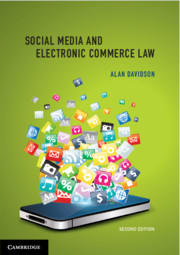
Book contents
- Frontmatter
- Contents
- Acknowledgements
- Table of cases
- Table of Statutes
- Table of International instruments
- Part 1Introduction
- Part 2Social Media
- Part 3Electronic Commerce
- Part 4Conclusion
- 20Reflections and conclusions
- Appendix AElectronic Transactions (Victoria) Act 2000
- Appendix BAustralian Privacy Principles
- Index
20 - Reflections and conclusions
from Part 4 - Conclusion
Published online by Cambridge University Press: 06 August 2018

Book contents
- Frontmatter
- Contents
- Acknowledgements
- Table of cases
- Table of Statutes
- Table of International instruments
- Part 1Introduction
- Part 2Social Media
- Part 3Electronic Commerce
- Part 4Conclusion
- 20Reflections and conclusions
- Appendix AElectronic Transactions (Victoria) Act 2000
- Appendix BAustralian Privacy Principles
- Index
Summary
Social media and electronic commerce have evolved with unprecedented speed and energy. As with lex mercatori, where merchants and commercial parties embraced new methods and opportunities with a cavalier attitude to the law, so do participants in the online world. The law makers have the job of reacting to and providing an appropriate response to this ever-changing landscape. In the majority of circumstances, traditional legal principles will apply. This book reflects on the jurisprudential underpinnings, and at how they absorb and assimilate changing circumstances and create new structures and new rules.
The lawyer is trained not to know all the laws but to master the ability to research current law. The lawyer must carve a path through a labyrinth of regulations, primary and secondary sources, rulings, practice notes, periodicals and databases. No single law firm or department can physically store all the materials that may be called upon, but the internet can now deliver this avalanche of material, with only two preconditions. First, the authors and handlers of the material must be willing to permit public access, and second, the lawyer must be aware of its presence.
Australian lawyers and commercial parties need to monitor the changing Australian and international legal environment to ensure that their social, legal and commercial risk is controlled and minimised. Governments and courts must remain vigilant to keep abreast of social media issues and electronic commerce developments. Regulations in cyberspace must evolve in a way that maintains the global community’s commitments to fundamental human rights and to national governance, and that reflects the range of global values and human diversity. The application of the rule of law , and of human rights law, must move into cyberspace. There are ‘profound consequences for the future of the rule of law in cyberspace’, which has developed into its own unique notion: ‘the rule of cyberspace’. This rule of cyberspace is but another step in the path of social and jurisprudential development.
Information
- Type
- Chapter
- Information
- Social Media and Electronic Commerce Law , pp. 401 - 402Publisher: Cambridge University PressPrint publication year: 2015
Accessibility standard: Unknown
Why this information is here
This section outlines the accessibility features of this content - including support for screen readers, full keyboard navigation and high-contrast display options. This may not be relevant for you.Accessibility Information
Accessibility compliance for the PDF of this chapter is currently unknown and may be updated in the future.