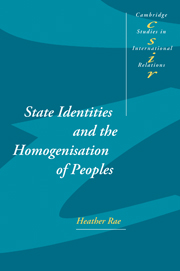
Book contents
- Frontmatter
- Contents
- Preface
- Introduction
- 1State formation and pathological homogenisation
- 2The ‘other’ within Christian Europe: state-building in early modern Spain
- 3State-building in early modern France: Louis XIV and the Huguenots
- 4Pathological homogenisation and Turkish state-building: the Armenian genocide of 1915–1916
- 5‘Ethnic cleansing’ and the breakup of Yugoslavia
- 6Evolving international norms
- 7On the threshold: the Czech Republic and Macedonia
- Conclusion
- Bibliography
- Index
- CAMBRIDGE STUDIES IN INTERNATIONAL RELATIONS
Preface
Published online by Cambridge University Press: 22 September 2009

Book contents
- Frontmatter
- Contents
- Preface
- Introduction
- 1State formation and pathological homogenisation
- 2The ‘other’ within Christian Europe: state-building in early modern Spain
- 3State-building in early modern France: Louis XIV and the Huguenots
- 4Pathological homogenisation and Turkish state-building: the Armenian genocide of 1915–1916
- 5‘Ethnic cleansing’ and the breakup of Yugoslavia
- 6Evolving international norms
- 7On the threshold: the Czech Republic and Macedonia
- Conclusion
- Bibliography
- Index
- CAMBRIDGE STUDIES IN INTERNATIONAL RELATIONS
Summary
This book is the result of an abiding interest – perhaps puzzlement would be more apt – in how human beings can come to accept that systematic mistreatment of other human beings is somehow morally justifiable. That the project has taken the particular form it has, as an inquiry into what I call pathological homogenisation – forced assimilation, expulsion, genocide – practised by state-builders, is due to my good fortune in being taught as an undergraduate by Andrew Linklater, now Woodrow Wilson Professor of International Relations at the University of Wales at Aberystwyth.
As well as being an inspirational teacher of international relations, Andrew drew my attention to the problem of inclusion and exclusion in the modern system of states and how the boundary of the state has been drawn not only in territorial form but also as a moral boundary. My sense was that while it is important to search for more inclusive forms of political community, work remained to be done on how exclusion – the sort of moral exclusion that justifies mass slaughter of civilians, for example – can come about. Although this interest has taken me off in a different direction I hope that my intellectual debt to Andrew is obvious, though any shortcomings are of course my own responsibility.
Another important influence that animates this project, though one that I was not perhaps aware of for quite some time, was my father's history as a soldier in the British army between 1933 and the mid-1950s.
Information
- Type
- Chapter
- Information
- State Identities and the Homogenisation of Peoples , pp. xi - xivPublisher: Cambridge University PressPrint publication year: 2002
Accessibility standard: Unknown
Why this information is here
This section outlines the accessibility features of this content - including support for screen readers, full keyboard navigation and high-contrast display options. This may not be relevant for you.Accessibility Information
Accessibility compliance for the PDF of this chapter is currently unknown and may be updated in the future.