4.1 Introduction
A wide variety of factors influence the teaching practices of language educators all over the world. These include government policy, curriculum and materials used in the classroom, teachers’ and community beliefs, and the languages of the learners. A Malaysian classroom, where the government prohibits the use of the community language in the English classroom, or an EMI classroom in urban Kenya, where the community beliefs drive the use of English, will be different from a classroom in rural India, where the teacher uses the local language to establish a personal bond with students. Similarly, the textbooks the government has prescribed and the inputs the teachers have received might also change the way in which the learners’ community language is used in the classroom. Even for teachers who work in similar contexts, their own beliefs and differences among their learners can impact the way languages are being used in the classroom.
1. What comes to your mind when you think of a translanguaging classroom?
a. How is it similar/different from your classroom (if at all)?
b. What ideas/approaches are being used in the classroom?
c. How do the learners interact with each other and with the teacher?
d. How does language learning happen in the classroom?
2. Do you think your answers will be like the answers given by other teachers working in different contexts? Why/Why not?
The wide variety of classroom contexts worldwide provides various opportunities and challenges for translanguaging to teachers. Hence, the term ‘translanguaging classroom’ might have different meanings for teachers in different contexts. In other words, your answers to the questions in Reflection Task 4.1 might be different even from colleagues you work with and very different from those in a different country, which might explain why different scholars also have different opinions about translanguaging. While this has caused some critics to call translanguaging a ‘terminological house with many rooms’ (Jaspers, Reference Jaspers2018, p. 2), we believe that it is a reflection of the variety of educational contexts, cultures and teaching practices around the world: ‘There are many scholars exploring a wide range of topics and issues under the broad shade of the translanguaging family tree. This extended family reflects the differences in practices and contexts where we live our multilingual lives’ (Dixit & Anderson, Reference Dixit and Anderson2025, p. 67).
This chapter aims to explore and build upon the variety of educational contexts discussed in Chapter 3 to present a comprehensive framework that should help you to understand the features of your classroom and identify approaches suitable for your context. We start this chapter with the examples of four teachers and their classrooms from four different contexts: Swapna’s classroom in India, George’s classroom in Kenya, Mamun’s classroom in Bangladesh and Oksana’s classroom in Ukraine. We describe these classrooms’ contexts and explore the opportunities and challenges they present from a translanguaging perspective. Building upon these four examples, we develop a general understanding of practices, approaches and theoretical underpinnings of translanguaging classrooms in different contexts. This is followed by discussion of a framework that can prove a helpful tool to reflect on the opportunities and challenges for translanguaging in your context.
4.2 Four English Language Classrooms
In this first section of the chapter, we visit four ELT classrooms from around the world, learning about the students, the teacher, the curriculum and wider contextual factors influencing learning. Exploring these classes in detail will help us to illustrate important differences both within and between contexts even within the same country or city. It is likely that one or perhaps two of these examples are similar to contexts within which you have studied or taught yourself. All four classes present diverse opportunities for translanguaging pedagogies, although none of the teachers have much, if any, awareness of translanguaging theory. Despite this, translingual practices are already present in their classrooms and supporting learning – see if you can spot some of them as you read!
4.2.1 Swapna’s Primary Class in India
Swapna works in a government primary school in a rural part of Maharashtra, India. Her school has fifty-four learners from grades 1 to 5. There are two teachers in her school. Her headmaster teaches grades 1 and 2 and looks after the administrative work. Swapna teaches all subjects, including Marathi (the state language), English, Mathematics, Science, Social science, Arts and Craft and Physical Education for grades 3 to 5 in one multigrade classroom. Although there is dedicated time allotted to English, it only gets a little attention as the majority of curriculum time is given to Marathi and Mathematics. The village where Swapna works is in a mountainous area, disconnected from urban life. While the language of instruction is Marathi, the community language of the area is Thakari, a tribal language, which Swapna speaks. The majority of the learners in Swapna’s class are first-generation schoolgoers, coming from lower socio-economic strata.Footnote 1 Since the people and the learners rarely travel to local towns, the learners get little opportunity for exposure to Marathi. Their exposure to English is limited to the classroom.
4.2.1.1 Challenges in Swapna’s Class
In Swapna’s classroom, the learners’ limited exposure to Marathi and English creates a gap between their linguistic resources and the demands of the curriculum. For instance, the textbooks, which are designed for learners with stronger Marathi, often seem alien and inaccessible to her learners, so Swapna faces practical hurdles in implementing translanguaging strategies. While government publications (e.g., Government of India, 2020) advocate the use of the community language as a resource, the transition from policy to practice remains uneven and she finds it hard to identify practical ways to bring the theory into the classroom.
Swapna herself is not confident in her English usage. She is a generalist primary teacher, who teaches all subjects to the learners. However, she finds herself less equipped in terms of English proficiency and pedagogical knowledge. The English language textbooks are far above the learners’ ability level and her own lack of confidence in English and limited pedagogical training in multilingual education further complicate matters. There have been a few training workshops recently about English teaching, which have helped Swapna to learn some useful activities for the classroom including singing rhymes and chanting alphabets (both Marathi and English) or vocabulary items such as numbers, vegetables, animals, etc. The students are gradually learning to read and write in English, but this is also a challenge because Marathi is written using a different writing system (called Devanagari/देवनागरी), and there is no written version of their community language. Because assessments are conducted in written format, Swapna must translate instructions from English and Marathi to Thakari to ensure learner comprehension. In short, learners’ limited exposure to Marathi and English, the gaps between the textbooks and the ground realities, and reliance on rote learning and translation during instructions and assessments are some of the key challenges in Swapna’s classroom. This reliance on translation, while necessary, highlights the need for more structured and intentional translanguaging practices that go beyond mere translation and actively leverage the learners’ linguistic repertoire (García et al., Reference García, Johnson and Seltzer2017).
4.2.1.2 Opportunities in Swapna’s Class
Despite the challenges she faces, the multilingual nature of Swapna’s classroom also presents significant opportunities. The learners’ strong foundation in Thakari can serve as a powerful bridge to learning Marathi and English. By intentionally integrating Thakari into lessons, Swapna can create meaningful connections between the learners’ lived experiences and academic content (see Chapter 5). For example, complex concepts in Marathi or English can first be introduced and explained in Thakari, allowing learners to build on their existing knowledge. Because Swapna can read and write in all three languages, she is able to highlight similarities and differences in letters, sounds and words. Similarly, vocabulary and phrases in English can be taught by drawing parallels with Thakari and Marathi, helping learners navigate the linguistic space between their home language and the target languages. Her learners are able to use simple phrases in English, such as ‘Good morning’, ‘May I…?’, ‘Excuse me’ (etc.) during their interaction with the teacher. They also like to recite the rhymes taught in the school. As a result of these opportunities, they enjoy English activities, and they have fun enacting them even when she is not present. This aligns with the idea of foreign language enjoyment (see Dewaele et al., Reference Dewaele, Witney, Saito and Dewaele2018), where learners enjoy learning the new language. Since Swapna teaches all subjects in the class, it gives her the opportunity to take English beyond the English lesson and try and integrate it a little in other subjects. This also helps to prepare them for their secondary education, when many of her learners will experience EMI to learn other subjects. The learners’ awareness of their multilingual environment, though informal, is a valuable resource that can be harnessed to foster metalinguistic awareness and cognitive flexibility. Moreover, the learners’ deep connection with their natural surroundings and daily life offers a rich repository of experiences and vocabulary that can be integrated into lessons. Swapna has developed a number of resources to help with this, including home-made posters and alphabet charts (see Figure 4.1).
A home-made poster that Swapna uses to help her to link classroom learning to the rich environment that her learners know so much about.

Figure 4.1 Long description
The girl is dressed in traditional clothing, walking along a path with a duck pond to her right and farmers harvesting grain to her left. Behind the farmers are traditional houses and a bird singing in the tree. On the right of the picture, the path leads towards a lake where there are fishing boats on the lake. Behind the lake are mountains and the sun rising behind them, and several birds flying above the sun.
For instance, lessons on nature, agriculture or local festivals can be taught using Thakari terms, with gradual transitions to Marathi and English equivalents. This approach not only makes learning more relevant but also validates the learners’ cultural and linguistic identity. The learners’ enthusiasm for rhymes and activities, as well as their ability to enact them, even in Swapna’s absence, suggests a natural curiosity and motivation. Learners’ strong foundation in Thakari, their informal multilingual awareness, their local culture and environment capital and their natural curiosity all present plenty of opportunities in the classroom for translanguaging.
4.2.2 George’s Tertiary Class in Kenya
There are over fifty students in George’s classes in a university in Mombasa, Kenya. They are learning English for Academic Purposes (EAP) to support their university studies which, for all modules, are officially taught in English (i.e., EMI). His learners speak a wide variety of home languages, coming from all over Kenya and even from other countries. All also speak some Kiswahili, a national lingua franca in Kenya and community language in many cities. In George’s university, course materials are in English, and teachers are expected to engage in English-only instruction. His learners have varying opinions about EMI – some consider it to be essential for their future careers, and others think it’s just a way to separate the rich from the poor and have low motivation for the EAP classes as a result. George has an advanced level of English and an MA in TESOL, which included modules on aspects of CLT.
4.2.2.1 Challenges in George’s Class
While Kenyan students usually begin their schooling in a local community language, this switches suddenly to English partway through primary education before many have developed full literacy in the community language. As a result, Kiswahili and other community languages are often used informally by teachers to support learning, particularly in rural areas, throughout secondary education (Sheikh et al., Reference Sheikh, Rich and Galvao2023). By the time students get to university, it is assumed that their English is good enough for them to study any subjects through English, but this is rarely true, particularly for more disadvantaged learners. For many EMI contexts around the world, aspirations are the primary motivation behind the choice to use English rather than the ground realities. Curricula for all subjects are ambitious, complex and content heavy, and the language used is technical. Because of these challenges, the learners, and sometimes their lecturers (who do not have any training in language teaching), have lower levels of English than are required for effective EMI. Some lecturers read directly from English language textbooks without necessarily understanding or interpreting the content. Because the learners know that George understands English very well, they sometimes request he explain difficult concepts from their subjects using Kiswahili, but he knows he may get into trouble for doing this.
While George likes the idea of CLT, he finds it difficult to implement, partly due to large classes that make groupwork and pairwork noisy and difficult to control (most students just switch to Kiswahili), and partly due to the materials he is expected to use, which aren’t very communicative. His curriculum is based on an old, international EAP textbook, which is loaded with heavy academic terms and technicalities. Assessments are based on this textbook and largely test knowledge of vocabulary and grammar. Even if George tries to use communicative language teaching strategies, his students are not used to using English for classroom communication, and have little motivation for such activities, which makes changing things difficult.
4.2.2.2 Opportunities in George’s Class
While the English-only policy and focus on EMI seem to minimise opportunities for translanguaging, there are still opportunities that George can exploit in his classroom. To begin with, the students have a common community language (Kiswahili) that all are familiar with (albeit to varying degrees), meaning it can be used by them to build understanding. In addition, some students are also aware of how English is being used as a gatekeeper for lower socio-economic strata of society. This awareness is the first step towards their understanding the sociolinguistic dynamics of the use of English, enabling them to advocate for translanguaging opportunities in their studies – and greater social justice as a result.
Due to the difficulties experienced throughout their education, George’s learners have a wide range of strategies for making ‘secret’ use of Kiswahili, particularly to translate vocabulary, simplify difficult text and understand new concepts. They are able to help each other during individual study activities and even tests (e.g., through whispering), occasional discussion activities and especially between lessons and during breaks, when they engage in informal discussions about lesson content, also making use of internet and generative AI resources to help them understand, produce required assignments and progress in their studies. George is both allowing, and occasionally even promoting, such activities. He makes time for both self-study and brief discussions during the classes, also permitting use of modern-day technology on their phones, such as generative AI, when appropriate. Even though he doesn’t use this phrase, George is creating more ‘translanguaging spaces’ for his students. He has heard of translanguaging and likes the idea of it yet assumes it’s not an option for him because of the English-only policy he must follow. In his own teaching, George also makes secret use of Kiswahili, a little but often, and quietly, particularly when helping individual learners (e.g., through tutorials or when monitoring classwork) or presenting complex lexis (he elicits translations, if available).
Thus, despite institutional constraints, George is actually creating opportunities for translanguaging. Yet these could be enhanced further, for example by leveraging students’ sociolinguistic awareness to advocate for change, by building on their existing translingual practices to teach specific strategies and by creating more frequent collaborative, technology-enhanced spaces for multilingual engagement, even if George, in his own teaching, has to use mainly English to deliver the curriculum.
4.2.3 Mamun’s Secondary Class in Bangladesh
Mamun works in a secondary school in Bangladesh, with eighty learners in his grade 9 class. The group is a combination of learners coming from schools that have both English (i.e., EMI) and Bangla (the main community language in his town) as the languages of instruction. As a result, his class includes learners who can communicate in English and have a good command of the written language, studying alongside more disadvantaged learners who are at the elementary level with very limited knowledge of English. This second group of learners has developed a fear about the language and Mamun’s lessons as a result. His English textbooks are challenging, sometimes even for the stronger learners in the class.
Mamun considers himself to be a fairly confident user of English, but given the wide variation in the English language proficiency of learners, his typical lessons rely heavily on what is sometimes called ‘text interpretation’ (see Anderson, Reference Anderson2020b; Arafat, Reference Arafat2024). Like other teachers who use this approach, Mamun feels it is necessary to ensure that learners who are less proficient at English in his class understand the text and lesson content, upon which they are tested in both institutional and national exams more than their English proficiency. He reads the lesson first in English (texts are often complex literary works above his learners’ independent reading comprehension levels) and then explains it in Bangla before also explaining any difficult grammar or lexis. He writes the new words on the board and asks learners to write them down and memorise the spellings.
4.2.3.1 Challenges in Mamun’s Class
Mamun’s secondary class presents a complex linguistic dynamic, with learners from diverse backgrounds: some from EMI schools and others from Bangla-medium schools. This creates a stark divide in English proficiency levels, with one group of learners able to communicate in English and another struggling with elementary level knowledge. This is further complicated by the large number of learners in the classroom, meaning that he finds it difficult to provide individual support, particularly to learners with specific educational needs.
Mamum’s reliance on the text-interpretation method ensures that, regardless of their proficiency, his learners generally understand the texts, but do not really develop either their communicative competence or independent reading skills and literacy in English. While this approach helps those learners who come from Bangla-medium schools, those who come from English-medium schools sometimes feel underchallenged and bored in his lessons. As a result, few learners graduate from his classes with the ability to communicate effectively in spoken English, although most are able to read basic academic texts. Mamun is puzzled about the correct amount of English to be used in his classes. If he uses more English, a large group of learners cannot understand him, while if he uses more Bangla, he risks alienating many of his learners and questions are raised about his own language proficiency and whether he can truly justify the role of English teacher. He is afraid that his reliance on Bangla sends the wrong message not only to the learners but also to the staff members and parents, who might criticise and look down on him. Although he has an elementary understanding of translanguaging as a theory, he thinks that it is a naturally occurring phenomenon, with only limited scope as a pedagogical approach.
4.2.3.2 Opportunities in Mamun’s Class
Mamun’s classroom offers a number of opportunities for translanguaging. To begin with, the presence of both Bangla and English in the classroom creates a rich multilingual environment that can be leveraged to support learning. For instance, Mamun can use Bangla strategically to scaffold instructions, explain complex concepts and clarify grammar rules, ensuring that all learners, regardless of their proficiency, can access key lesson content. At the same time, he may gradually increase the use of English, particularly when working with learners with higher proficiency, to create a balanced and inclusive learning environment. Further, the text interpretation method that he uses, while limited in its current form, could be adapted to incorporate translanguaging strategies (see Anderson, Reference Anderson2023a). For example, instead of simply translating literary texts, Mamun can encourage learners to compare the same text in English and Bangla (see Chapter 7). This will help in developing metalinguistic awareness and a deeper understanding of both languages. He could also include more deliberate teaching of English vocabulary by encouraging learners to record important vocabulary and keep bilingual lists of these (with Bangla translations) for use in the future. Additionally, the mixed proficiency levels in the classroom could be turned into an asset by promoting peer learning (see Chapter 6). Learners with higher English proficiency could be paired with those at the elementary level, allowing them to collaborate on tasks that require the use of both languages. This not only builds language skills but also fosters a sense of community and mutual support among learners.
4.2.4 Oksana’s Adult Class in Ukraine
Oksana teaches a small class of fifteen adult learners who have all enrolled in a private EFL school in Odesa, Ukraine. These learners share a similar goal to improve their spoken and written English for work- or travel-related purposes and have been placed in classes according to their approximate proficiency in English. They all have good literacy and passive knowledge of English from their basic education, but the large classes and traditional methods involved meant that they never had the opportunity to develop their speaking skills or general communicative competence in English, which are the primary reasons that they have enrolled in her school. They expect to get plenty of exposure to and practice of English in her lessons but also have varying needs and interests with regard to specific areas of language and culture. Her institution requires her to use a global ELT course, which her learners have to buy, so she feels pressured to use it as the main curriculum component in her classes, even though she doesn’t always like the activities or texts. Progress tests are also based on this course and include a focus on all four skills (speaking, listening, reading and writing), tested monolingually.
Oksana loves English; she was always good at it at school and now it provides her with a good job. She has been to the UK twice and hopes one day to study or work there. She stays up-to-date with current language teaching trends by reading books and journal articles, and considers her methodology to be eclectic, drawing on a range of ways to teach that she has read about and seem to work well for her, including communicative language teaching and translanguaging, which, to her, sounds basically the same as ‘using the L1’. As a result of Oksana’s beliefs, her learners’ needs, motivation, prior learning and broader metacognitive skills, her lessons involve English-mainly instruction. Nonetheless, she makes a little ‘judicious use’ (Macaro, Reference Macaro and Llurda2005) of the community language. In her classes, this language, Ukrainian, is spoken fluently by almost all her learners. For example, she might translate a few vocabulary items before a listening activity, use a little Ukrainian for instructions or explain grammar rules to the learners through comparison with the community language. Her line manager is aware of this and supports its use in small amounts.
4.2.4.1 Challenges in Oksana’s Class
Oksana’s case seems rather different to the three previous teachers. While, for their learners, English is a largely mandatory feature of mainstream education, Oksana’s learners need it more for work and travel, and want to get acquainted with cultural elements of English as well. As a result, they are motivated yet also demanding, expecting to learn much more than is often realistic in the time they have. The selection of global ELT courses by the institution aligns with the primarily instrumental goals of the learners. This approach positions English as a detached, desirable commodity, more than a tool for meaning-making and learning. As this approach focuses more on ‘authentic’ or ‘native-speaker’ English experiences, the use of the local language is often stigmatised by many of the learners. Thus, despite her updated knowledge of ELT discourses and approaches, Oksana faces a constant dilemma: should she use the community language or not? She works with a number of international teachers in her school (from the UK and Australia), who do not know much (if any) Ukrainian, so teach in English only. As a result, some of Oksana’s learners also think that she should teach using only English and sometimes complain about her use of Ukrainian, which upsets her and impacts negatively on her identity and self-belief. Other learners are in her class because they like how she uses Ukrainian, which her manager notices and values. But she doesn’t know what to do – keep using her current approach or teach using English only. Is she really using the best pedagogy, or is she ‘cheating’ by using the community language?
4.2.4.2 Opportunities in Oksana’s Class
Once more there are plenty of opportunities for translanguaging in Oksana’s classroom, only some of which she is using, in part because of her sense of guilt about using Ukrainian. Her own insights into current ELT trends and awareness of multilingual teaching practices provide the first and most significant opportunities. She is aware of her identity as a non-native speaker teacher (supported by her manager), but is still viewing her knowledge of Ukrainian as a way of cheating, rather than a powerful tool to facilitate learning. By believing in her own expertise as translanguaging teacher (Anderson, Reference Anderson2018), Oksana would become better empowered to address learner concerns about language choice and explain her approach to them, even drawing upon published research evidence, if required. Her active professional development and reflective approach could also be leveraged to help her to make informed decisions about translanguaging opportunities, through, for example, experimentation and learner feedback (see Chapter 10). A further opportunity lies in the shared linguistic background of the classroom. While some learners hesitate to use the community language, others find it useful. This can be leveraged through the use of differentiation – for example, permitting, but not forcing, its use during discussion tasks when learners can choose between English-only and multilingual groups or pairs. Finally, the learners’ existing metalinguistic awareness presents an additional opportunity. Oksana can use their knowledge of Ukrainian grammar, vocabulary and culture to draw comparisons between the two languages, helping them to reflect on similarities and differences involved. She can encourage analysis of how cultural or grammatical concepts differ across languages and highlight how they can hone their goals of cultural integration abroad. By viewing translanguaging as a tool for higher order critical thinking and analysis, rather than as a compromise, Oksana can connect its use to learner aspirations, explain to them its potential as a sociocultural tool to accelerate learning (Vygotsky, Reference Vygotsky1934) and reinforce her own identity as a result.
–––
In their four classrooms, Swapna, George, Mamun and Oksana experience diverse challenges and, as a result, have different opportunities with regard to potential translanguaging pedagogies, which we will continue to explore in future chapters. Some common challenges include limited exposure to English for most of the learners involved, language policies and curricula imposed upon them, varying levels of learner competence and literacy in English and gaps between policy and practice. Yet, each classroom also offers distinct opportunities, such as learners’ usually strong foundation in community languages, shared linguistic resources between teacher and learners, the teacher’s extensive knowledge of their learners and their needs and evidence of translanguaging already happening naturally in their classrooms, albeit in varying ways and amounts.
Reflection Task 4.2 Now consider the extent to which your own classroom may be (or become) a translanguaging classroom:
1. Which of the opportunities for translanguaging identified in Section 4.2 so far do you feel are also present in your classroom?
2. Can you think of any further opportunities in these classes that we haven’t mentioned?
3. To what extent do you leverage similar opportunities at the moment?
4. If not, what changes might be necessary to make them work in your context?
Think about your own practices, your learners’ attitudes and beliefs and also institutional factors.
4.3 Factors Determining the Nature of Translanguaging Classrooms
Given the wide variety of contexts in which English is taught today, it would be inaccurate to claim that the scenarios in the four classrooms we’ve described provide a comprehensive picture of all English language classrooms worldwide. However, by exploring these examples, we aim to provide a wide range of insights into the different features and factors that influence the extent to which different translingual practices are available to different teachers of English. We hope that, whatever scenario you find in your classroom, by drawing upon and critically evaluating these examples, you can develop your own understanding of translanguaging pedagogy for your own classroom relative to these features and factors. Let’s look at some of these now.
4.3.1 Learners
Our discussion of the translanguaging classroom must, of course, start with the learners. In all four examples described in Section 4.2, we have seen how students determine and shape classroom dynamics. It is what they bring to our classrooms (their knowledge systems, languages, cultures and practices) that constitute the most important resources for all teaching, including translanguaging, but also what Heugh (Reference Heugh2021) calls ‘transknowledging’ – enabling knowledge and ideas to connect, interact and move between language systems and cultures. From the four examples, we have seen how learners’ resources, including their culture, knowledge, prior learning and other literacies (e.g., in other languages, as well as digital literacies) can create numerous opportunities for the translanguaging classroom. Similarly, the community languages that learners share, their opportunities for exposure to English, their developing English proficiency and literacy as well as their awareness of language learning itself (sometimes called metacognitive skills) can create both opportunities and challenges for learning. And lastly, we have seen how the affective or emotional side of their learning – including their motivation for the language, their anxieties, fears and social factors (e.g., the status of English in the community) – and their resulting emerging identities can also be important influences on learning. These all play important roles in the ways that we translanguage in our English language classrooms. For example, while many of Mamun’s and George’s students may be willing and ready to use the community language in discussion tasks to help them understand key texts and ideas, this will be less true in Oksana’s class, where activities may be more suitable and learners will feel a stronger desire to practise their spoken English.
4.3.2 Teachers
While learners are an integral part of translanguaging classrooms, teachers are also important in a number of ways. Firstly, from the four examples, we can see that teachers’ disposition and beliefs are crucial in determining the translanguaging that happens in the classroom, including the extent to which they identify with English as a language and a symbol of, for example, a good education or progressive values. If the teacher believes in the purity of English or is sceptical about the value of the community language, this automatically limits their opportunities for exploring translanguaging in their classroom (see Chapter 5).
A second factor, a teacher’s knowledge of their learners, is also a crucial influence on how they teach. All four teachers have a deep understanding of their learners, including their culture, knowledge systems, prior learning, personal backgrounds and ways of using language. These areas of knowledge offer numerous opportunities for implementing a translanguaging pedagogy. However, a third factor – what we might call the pedagogical knowledge of our teachers – also has a big impact on what happens in their classrooms, in some cases limiting their ability to translanguage. The teachers have been trained in very different ways: Swapna has been trained only in a limited range of activities. Mamun has been gradually socialised into a traditional pedagogy for his context. George and Oksana both try to make use of pedagogies originating in very different contexts that may be inappropriate or impractical in their own classrooms (see Canagarajah, Reference Canagarajah1999; Holliday, Reference Holliday1994a). As a result, most are finding it difficult to see how translanguaging pedagogy can be integrated into their current teaching practices. Mamun, for example, is unable to spot the potential opportunities for translanguaging we have discussed, even though his learners often make use of these opportunities themselves. Oksana has noticed some ways in which she can use the community language, yet still feels pressure from those around her to avoid it as much as possible; both experience what is sometimes called ‘guilty translanguaging’ (Anderson & Lightfoot, Reference Anderson and Lightfoot2021), in which teachers feel guilty for using this powerful resource due, essentially, to pressure to conform to prior ways of teaching.
Fourthly, as we have seen in the example of Swapna, her limited knowledge of English influences both her confidence in her ability and her decision-making through how much time she devotes to teaching English in the classroom. When combined with her concern that she is under-equipped to teach it, she avoids teaching English and focuses more on other subjects that she considers may be of more immediate relevance to her learners – particularly Marathi as the primary additional language that she knows they need to learn to progress in their studies. And finally, just as learners’ motivation, engagement, language confidence and anxiety all influence (and are influenced by) their success in learning English, we find that teachers can experience the same emotional responses that impact on their teaching. In short, teachers’ dispositions and beliefs, their identities with regard to English, their pedagogical understanding, knowledge and confidence in English and their emotional responses to the language all play important roles and interact in complex ways to influence what happens in their classrooms.
4.3.3 Contextual Factors
Beyond the learners and teachers, there are various factors that influence the classroom directly or indirectly. This includes the influence of the educational authorities in question (see Chapter 3), which manifests itself particularly through policy (particularly with regard to languages), curricula and materials, such as textbooks and exams, but also local norms and expectations. For Swapna and Mamun, the authorities in question are the government, yet for George and Oksana it is the institution (university or language school). While Mamun finds the textbooks to be too ambitious for many of his learners, Swapna suffers from a lack of material to provide exposure to English text (e.g., flashcards and storybooks), which are essential at early stages of literacy in a new language. George’s language choice is shaped by institutional policy in his university, and Oksana feels pressure to use the expensive coursebook in her language school as well as the influence of the exam material provided with the coursebook series. The presence of international ‘native speaker’ teachers who don’t use Ukrainian (often because they don’t know it) also exerts pressure on her both directly and indirectly, through some of her learners and how they think she should language in the classroom.
The local community is also an important influence. This includes attitudes towards education in general, which can sometimes include suspicion towards it (see Anderson & Mahapatra, Reference Anderson and Mahapatra2024) and also attitudes towards languages and language practices, as we see in Mamun’s school, where perceptions about the ‘prestige’ of English cause parents and other stakeholders to believe that teachers who use more English are better teachers. Finally, from the examples of Swapna and Oksana, we also see how community stability and the socio-economic status of the community impact classroom practices.
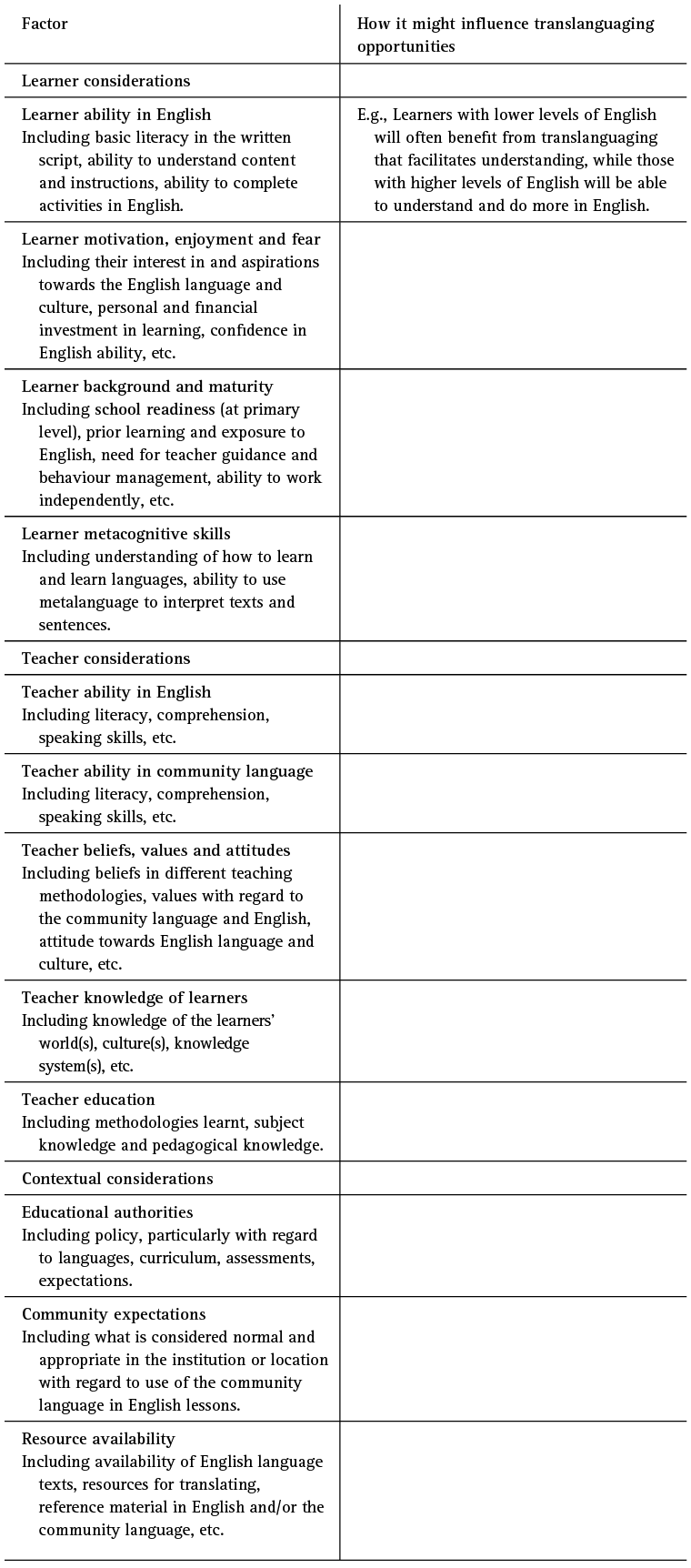
All the factors discussed here can be summarised and represented in the form of a framework (see Table 4.1).
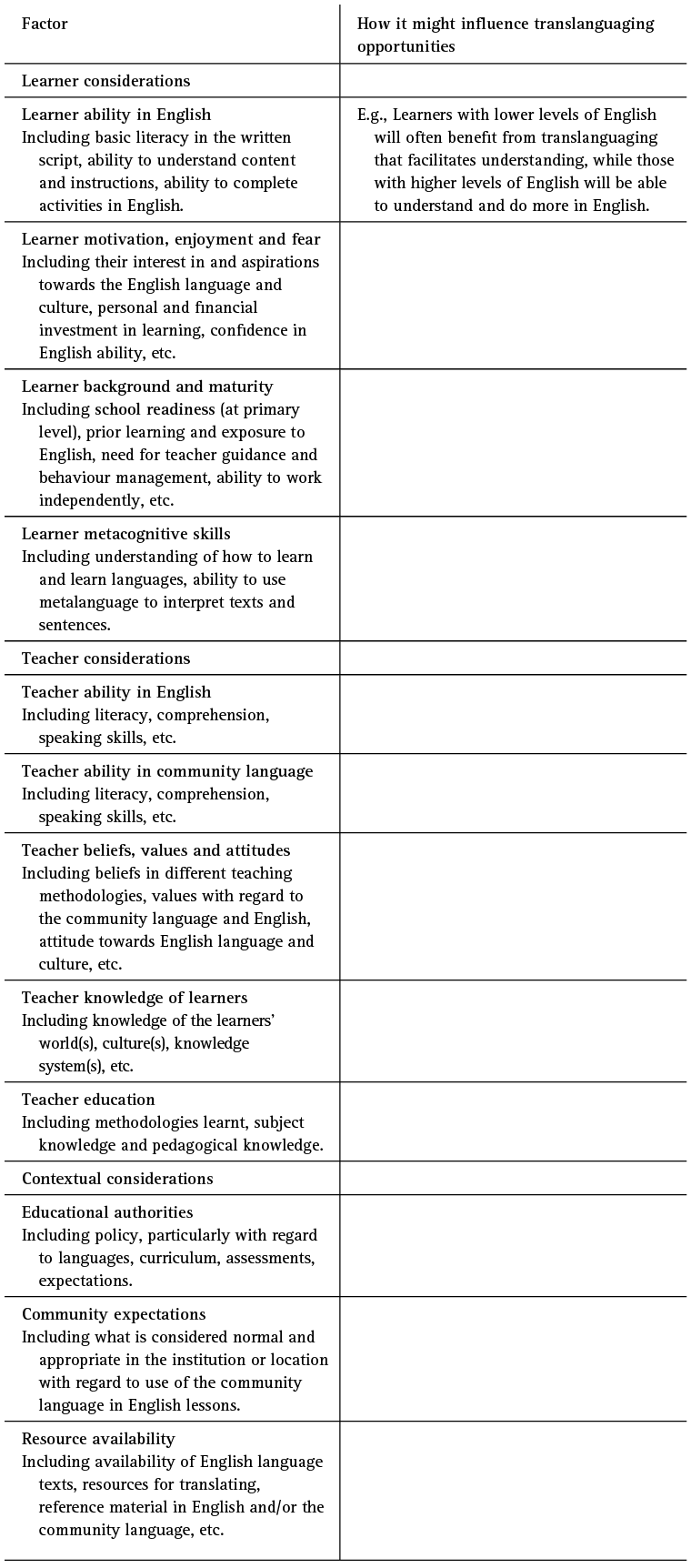
Table 4.1 Long description
Table has two columns titled Factor and How it might influence translanguaging opportunities. It is divided into three sections: Learner considerations, Teacher considerations, and Contextual considerations. Under Learner considerations, rows include learner ability in English, with examples such as literacy, comprehension, and task completion; learner motivation, enjoyment and fear, including interest, confidence, and investment; learner background and maturity, including prior exposure and independence; and learner metacognitive skills, including understanding how to learn languages. Under Teacher considerations, rows include teacher ability in English and in the community language, both covering literacy and speaking skills; teacher beliefs, values and attitudes; teacher knowledge of learners; and teacher education. Under Contextual considerations, rows include educational authorities, community expectations, and resource availability, each describing policy, norms, and access to materials affecting language use.
Think about your own current context, or a probable future context if you are a preservice teacher. For each factor in Table 4.1, make a personal evaluation and make notes on what the implications are for translanguaging in your classroom. For example, for the first factor, you could note: ‘Learners with lower levels of English will often benefit from translanguaging that facilitates understanding, while those with higher levels of English will be able to understand and do more in English.’ Are there any other factors that we haven’t mentioned that are also important? Take time to do this carefully – it will help you to identify the extent to which you may want to, or even need to, adopt an approach that prioritises English mainly instruction or an approach that involves more translanguaging.
4.4 Chapter Summary
This chapter has explored the translanguaging potential of a range of classrooms from around the world and further discussed how various factors, such as government policy, curriculum and materials, teachers’ beliefs and the languages of learners influence the nature of the translanguaging classroom in different contexts. We have discussed four case studies: Swapna’s rural primary classroom in India, George’s tertiary EMI classroom in Kenya, Mamun’s mixed proficiency secondary classroom in Bangladesh and Oksana’s adult English language school in Ukraine, exploring the challenges and opportunities in each classroom. Swapna’s classroom struggles with limited exposure to language and policy-practice gaps. Nevertheless, learners’ common linguaculture offer opportunities for translanguaging through peer interactions and contextualisation of the content. George faces pressure caused by controlling policies with regard to EMI and an overcrowded classroom. However, he can identify opportunities to promote translanguaging spaces for learners, given their sociolinguistic awareness and prior contact with translanguaging in secondary grades. Mamun faces challenges in terms of varied language proficiency and societal pressures, but peer collaboration and text comparison can potentially help him in the classroom. Oksana’s learners expect cultural as well as linguistic instruction, sometimes stigmatising the use of the community language, but their metalinguistic skills and institutional support can be leveraged to promote translanguaging in her classroom. Building on the understanding from these four classrooms, this chapter presented a framework to understand key factors that influence translanguaging practices. These include factors in three broad groups: learner considerations, teacher considerations and contextual considerations. By reflecting on the relevance and impact of these and other factors present in your context, we hope you are now ready to leverage all the opportunities for translanguaging in your own classroom. The remainder of the book will explore these opportunities in detail.