


As part of the reflective equilibrium approach, human rights will be key to interpreting TRIPS’ foundational norms. Human rights specify not only what is expected from States (and the private sector), but also from WTO adjudicatory bodies when it comes to interpreting and applying TRIPS’ obligations. Our previous analysis of the TRIPS’ foundations highlighted the conditionalities prescribed by Article 7 of TRIPS and the general claim to national autonomy present in Article 8 of TRIPS. Three conditionalities prescribed by Article 7 of TRIPS emerged as particularly relevant: social and economic welfare, mutual advantage of producers and users of technology, and a balance of rights and obligations. The general argument proposed in this chapter is to draw upon ICESCR’s rights to specify the interpretation of these norms. These interpretative resources are conceptualised as part of the republican-sufficientarian approach adopted in this work. They represent an important part of this nascent legal theory of the TRIPS.
This chapter firstly specifies the relevance of international human rights law in the context of the TRIPS, at the junction of WTO law and IP law. It secondly addresses the most relevant ICESCR rights in the context of the TRIPS. Complementing current scholarship on human rights and the TRIPS, this work frames its main argument around the right to science and the right to self-determination.
4.1 Human Rights as Interpretative Resources
This section is organised into two parts: a clarification and embedding of this work into the interface between WTO law, IP law, and human rights law and a conceptual framework on how to interpret human rights themselves, especially those of the ICESCR.
4.1.1 Embedding into the Trio: WTO, IP, and Human Rights
The objective of this section is to locate human rights as interpretative resources for IP norms as part of WTO law. The relations between IP law and human rights law are rich and diverseFootnote 1 and a systematic approach to these relations has distinguished between two main parts. On the one hand, specific IP rights can be conceived of and interpreted as human rights. We will briefly deal with this issue as part of our reflections on the right to science.Footnote 2 On the other hand, IP rights and human rights are considered distinct legal norms.Footnote 3 This part of the literature on the interface between human rights and IP should help in specifying how and what type of human rights could be used to interpret TRIPS. In this context, Helfer has provided an influential mapping of the interface between human rights and IP rights by distinguishing between three normative approaches: conflict, coexistence, and enhancement.Footnote 4
The section is organised along this mapping. The first subsection explores a conflict-based approach, the second locates a coexistence approach within the interpretation of WTO law, and the third deals with criticisms of the coexistence approach.
4.1.1.1 A Conflict Approach
Firstly, human rights and IP rights can be described as in conflict, particularly when States are bound by incompatible demands (to protect IPRs as foreseen by the TRIPS or national IP regime and to respect human rights as required by human rights treaties/national constitution). In this sense, a conflict approach relies upon a certain definition of a conflict of norms (genuine conflicts), as will be briefly explored further.
In this conflict perspective, scholars, NGOs, and human rights agencies have argued for the priority of human rights over trade considerations.Footnote 5 If this priority view is accepted, human rights function as an external constraint upon IPRs.Footnote 6 Human rights, then, do not put into question the justification of IPRs in the first place but instead represent a limitation that States must impose in fulfilling their human rights obligations.
This conflict view was widely advocated by human rights bodies at the beginning of the 2000s, mainly in the context of the AIDS crisis and the call to secure the right to health.Footnote 7 This perspective has reframed legal and public discourses as a conflict between legal entitlements whose natures seem different. Intellectual Property entitlements are only functionally important (based on a broadly instrumental argument), while human rights are linked to the protection of the human person. In this sense, it represents powerful rhetoric to argue for the priority of human rights.
At the same time, this view might be criticised for failing to specifically define a conflict situation and convincingly argue that genuine conflicts are plausible (assuming that they are possible).Footnote 8 This approach presupposes a definition of a conflict between legal norms.Footnote 9 Pauwelyn has been one of the key theorists arguing for a broad definition of conflict,Footnote 10 stating that two norms are ‘in a relationship of conflict if one constitutes, has led to, or may lead to, a breach of the other’.Footnote 11 Accordingly, a genuine conflict is defined as a conflict that cannot be prevented or solved by techniques such as the lex posterior rule or by interpretation. Following Pauwelyn, four conflict situations among different types of norms can be identified: command versus command, command versus prohibition, command versus right (right as exemption of the command), and command versus right (right as permission on its own).Footnote 12
A genuine conflict situation appears implausible in the context of the TRIPS mainly because the treaty entails important flexibility provisions that need to be interpreted in light of Articles 7 and 8. Overall, the interpretation and implementation of the TRIPS shall prove sufficiently flexible to avoid genuine conflicts between a TRIPS norm and a human rights norm.
However, because a genuine conflict is conceivable, several authors have considered this situation. Firstly, as Marceau argues, a WTO body cannot solve a genuine conflict.Footnote 13 Each State must address the conflict between obligations coming from its WTO commitments and from other Agreements, for example, human rights. Marceau speaks from a conflict between the ‘system of WTO trade law and the system of human rights’.Footnote 14 Secondly, following Pauwelyn, the solution to a conflict arguably can involve giving precedence to human rights law.Footnote 15 In short, the argument is the following: a distinction must be drawn between two different timings in the ratification of two conflicting international Agreements between two States.Footnote 16 If the human rights treaty was concluded first, the WTO Agreement should be assessed from the perspective of an inter se Agreement (Article 41 of VCLT in connection with Article 58 of VCLT). If the human rights treaty was concluded after the WTO Agreement, it prevails as lex posterior under Article 30(4)a of VCLT.
Note that the argument relies upon the distinction between integral and reciprocal obligations. According to Pauwelyn, the WTO in general should be looked at as a reciprocal treaty.Footnote 17 The key argument is to perceive the WTO obligations, mainly trade liberalisation commitments, as obligations that every Member State has towards every other Member State, but not towards the community of Member States as a whole.Footnote 18
However, this qualification does not necessarily hold for the TRIPS. As Grosse Ruse-Khan notes, Articles 7 and 8 of TRIPS clearly lay the basis of an integral approach. They set a common normative framework (in the form of objectives and principles) that every member State should respect and pursue.Footnote 19 Frankel also defends this conclusion by arguing that the logic of minimum standards and low-level harmonisation distinguishes the TRIPS from the GATT and GATS.Footnote 20 The TRIPS should be interpreted as a search for balance between its different objectives.Footnote 21 This qualification as integral obligations will be relevant in Chapter 5 when dealing with the TRIPS as a general framework impacting bilateral trade relations.Footnote 22
4.1.1.2 A Coexistence Approach: Human Rights as Interpretative Resources
Secondly, the interactions between IP rights and human rights can be addressed as a relation of coexistence. As Helfer puts forth, the two regimes ask the same question (assuming an instrumental justification of the IP regime): ‘how to give authors and inventors sufficient incentives to create and innovate while providing the public with adequate access to the fruits of their intellectual efforts’?Footnote 23 Both regimes can coexist in providing a satisfactory answer. The concept of the ‘balance’ appears key in this coexistence approach.Footnote 24
The strategy chosen with the Doha Declaration is paradigmatic of this approach: interpretation of IP protections (such as those prescribed by the TRIPS) must unfold in such a way as to make room for further interests to be directly integrated into the IP regime. Human rights considerations are integrated and internalised into the legal matrix of IPFootnote 25 and are part of the justification for striking a satisfactory balance within the IP system, ‘satisfactory’ here defined in light of the values acknowledged by the two regimes.Footnote 26
It is an attractive feature of the coexistence approach that, in the words of Helfer, it ‘expands the regulatory space available to governments via the increased use of IP flexibility mechanisms’.Footnote 27 Human rights are not primarily seen in conflict with IP rights – although the possibility of a genuine conflict exists – but are instead seen as resources for interpreting current IP provisions.Footnote 28 As Grosse Ruse-Khan argues, human rights bodies have also acknowledged the opportunity afforded by this coexistence approach by shifting focus towards the balancing mechanisms entailed by the IP system: ‘From a technical–legal perspective, this “capture” or “colonization” of well-known elements of the international IP system functions by means of interpretation – an interpretation of TRIPS which has to be made in light of human rights norms.’Footnote 29
This coexistence approach is operationalised through Article 31(3)c of VCLT. This interpretative rule captures, and in turn fosters, the non-isolation of WTO norms in the context of international law.Footnote 30 This integrative effect has gained prominence thanks to the International Law Commission’s systemic integration approach required to apprehend Article 31(3)c of VCLT.Footnote 31 International obligations must be interpreted from within their normative environment to ensure coherence and meaningfulness.Footnote 32
The three constituent features of Article 31(3)c of VCLT have been the object of numerous discussions, especially the criterion of being ‘applicable to the relations between the parties’.Footnote 33 In brief, as Hestermeyer proposes, international human rights laws – especially the ICESCR as focus of this work – could be said to pass this benchmark because of their almost universal membership and customary nature.Footnote 34 They enjoy an important legitimacy because of their highly representative membership and arguably represent largely shared intentions among WTO Members. The resources entailed by international human rights laws appear as the most relevant resources to provide interpretative guidance for foundational norms.Footnote 35
Two general caveats are important.Footnote 36 Firstly, if a rule of international law is not considered under Article 31(3)c of VCLT, it could be used under Article 32 of VCLT as supplementary rules of interpretation.Footnote 37 Secondly, WTO bodies can also refer to non-WTO interpretative resources under Article 31(1) of VCLT as a means of specifying the ‘ordinary meaning’ of a WTO treaty term.Footnote 38 In US – Shrimp, the AB referred to non-WTO agreements to give meaning to the term ‘exhaustible resources’ entailed by Article XX(g) of GATT.Footnote 39 The UNCLOS and the Convention on Biological Diversity were used as extra-WTO resources to interpret this concept. Although the AB did not specify which part of Article 31 of VCLT it based its approach upon, these Agreements are arguably relevant under Article 31(3)c of VCLT. Alternatively, it might be held that the references to non-WTO Agreements were meant to define the ‘ordinary meaning’ of ‘exhaustible resources’.
4.1.1.3 Criticisms of a Coexistence Approach
This subsection briefly clarifies the link to the third approach identified by Helfer (enhancement) and the considered criticisms of the coexistence approach.
As the third approach, IP rights and human rights can be considered to enhance one another and as Helfer proposes, operationalising this framework involves two steps.Footnote 40 To start with, it involves identifying the minimum entitlements that are required by international human rights law, which could affect the different interests of human beings protected as a matter of economic or social rights (e.g., in terms of health, food, or education). On this basis, one should proceed with the identification of the legal and policy mechanisms available to achieve those entitlements (the mechanisms of which IP is only one example). Where IP laws can contribute to achieving what human rights require, States should use them. Where these same laws represent a hindrance for human rights obligations, States should change them, either through revised interpretation or through policy changes.Footnote 41
This third approach does not seem incompatible with the second one. This approach focuses on the way States could consider their IP regime by looking at it through a human rights lens (thereby using, for instance, human rights impact assessments).Footnote 42 This framing echoes the sufficientarian approach defended in this work. It seems implicit in Helfer’s argument that these minimum entitlements are correlated with a high level of urgency. In other words, they represent strong obligations for States. Chapter 6 will highlight the WIPO Marrakesh Treaty for the visually impaired as an important example of this responsibility.Footnote 43 Furthermore, the issue of how to frame public discourse and how to embed general discussions about an IP’s objectives and functions appear key for this third option.Footnote 44
The coexistence interpretative approach indeed has limitations.Footnote 45 Firstly, it is largely dependent upon existing flexibilities that were not designed with a human rights objective in mind.Footnote 46 In several scholarly works, Okediji has argued that this recurrent image of the ‘balance’, which is able to give human rights their due while preserving the IP regime as it is, was a kind of illusion, especially for developing economies.Footnote 47 In her view, human rights possess significantly greater normative strength than merely serving as a framework for interpreting the limitations and exceptions of IPRs. As Chapter 2 outlined, an internal reading of the TRIPS’ foundations can be criticised as failing to address how the treaty itself creates structural incentives with respect to, for instance, global production and the export of generic medicines.Footnote 48 The reflective approach adopted here has a conservative bias (i.e., its focus on interpreting existing norms). Even if interpreted in the best way from a human rights perspective, the TRIPS might fall short of the requirements that should be put in place.Footnote 49
Secondly, to reinforce the exceptions through an arguably better interpretation of the flexibilities (drawing upon a human rights compatible interpretation) is, paradoxically, also to reinforce the legitimacy of the primary rule. As a reply here, it is crucial to underline that this approach is not limited to the interpretation of limitations and exceptions but rather starts with foundational norms (Articles 7 and 8 of TRIPS). The overall TRIPS justification matrix should be interpreted in light of human rights obligations. Furthermore, as will be shown in Chapter 5, limitations and exceptions norms shall be interpreted in a republican way.
Thirdly, it remains to be seen how a human rights-based interpretation of the TRIPS will be accepted by the trade community if it continues to see human rights norms as not belonging to the international trade system (despite formally accepting them as interpretative resources). Addressing this difficulty necessitates a formal and symbolically strong acknowledgement of the fact that broader policy objectives (formulated as human rights or, more broadly, as non-trade values) are integral parts of the trade system.Footnote 50
Overall, it is, therefore, important not to limit human rights obligations to a harmonious interpretation project. Human rights obligations require policy changes upon States (developing States, but indeed also developed States, as will be argued later), which could go beyond the current situation of the international IP regime. States arguably not only have a duty to interpret TRIPS in a human rights-compliant way, but also to redesign TRIPS and/or to design and implement a new international treaty (e.g., the Marrakesh Treaty).Footnote 51 This policy change orientation echoes Helfer’s third enhancing approach. Understood in a republican-sufficientarian way, this approach underlines the requirement to identify the minimum entitlements based on human rights and to adapt the IP regime accordingly.
4.1.2 Interpreting Human Rights
The previous sections have focused on human rights as interpretative resources as part of a coexistence approach. But before using these human rights for their interpretative guidance function, we need to interpret them in the first place. This requires, firstly, a brief discussion of the general framework of analysis and interpretation of human rights, and, secondly, some brief caveats with respect to the interpretation of the ICESCR.
4.1.2.1 General Theoretical Framework
As Yu argues, addressing the interface of IP and human rights requires a strong methodological foundation.Footnote 52 By adopting the analytical framework proposed by Besson, we can distinguish between duties pertaining to human rights and responsibilities for human rights.Footnote 53 Both categories are potentially relevant for the interpretation of TRIPS’ norms, albeit with distinct bearers and content.
This subsection firstly defines human rights duties and secondly responsibilities for human rights. It thirdly addresses the challenges of identifying and implementing an allocation mechanism and fourthly discusses the case of private companies in brief.
Human Rights Duties
Human rights duties are jurisdiction-based duties held by specific entities, mainly States or other bodies exercising jurisdiction, such as the EU. Such entities exercising jurisdiction have the duty to respect, protect, and fulfil human rights of the individuals within their jurisdiction. The argument relies upon a definition of jurisdiction as a normative trigger with respect to human rights. Besson writes that jurisdiction ‘conditions the applicability of those rights and duties on political and legal circumstances where a certain relationship exists between right-holders and states parties’.Footnote 54 There are thus three constitutive elements of jurisdiction: (1) power by a public authority shall be effective and exercised, (2) this power shall be exercised at all times, and (3) this power shall be normative (it shall give reasons for actions).Footnote 55 Accordingly and independently of which conception of jurisdiction is assumed, human rights duties can only exist between right-holders (individuals) and duty-bearers (public authority) who are in a relationship of jurisdiction. This explains why jurisdiction so defined is not primarily personal or territorial but can be exercised beyond the State’s territory.Footnote 56 Nevertheless, territory can be used as a shorthand to assess whether the conditions of jurisdiction are fulfilled.
Responsibilities for Human Rights
By contrast, human rights responsibilities do not rely upon the fulfilment of jurisdiction and might fall on different duty-bearers, which are more difficult to determine as the responsibility is to be shared with the ‘international community’. As Besson holds, potential bearers of responsibilities for human rights include actors such as States, international organisations, private companies, and individuals.Footnote 57
Firstly, responsibilities for human rights are not directed at a specific right-holder and do not correlate with a right. Secondly, responsibilities for human rights do not have the same content as human rights duties. Responsibilities do not bear directly upon the protected interest, but indirectly upon the capacity of duty-bearers to fulfil their duties and protect the interests in question. This means that responsibility-bearers should support States in developing and fulfilling their capacity to fulfil their human rights duties. As Besson puts it, these responsibilities are as follows: ‘(1) hold accountable (monitor and ensure compliance), (2) assist or aid (promote and train, mostly through cooperation), and (3) intervene (as an ultima ratio only)’.Footnote 58 Their content appears less specifically determined than the human rights duties of States.
Thirdly, these responsibilities correlate with human rights duties and apply alongside each other. For Besson, ‘responsibilities for human rights help prevent human rights violations by human rights duty-bearers or remedy those violations when human rights duty-bearers are unable or unwilling to fulfil their duties’.Footnote 59 Examples of these responsibilities for human rights include the UN’s ‘responsibility to protect’,Footnote 60 corporate responsibilities to protect human rights but also supporting responsibilities foreseen by Article 2(1) of ICESCR (international assistance and cooperation).
Allocation of Duties and Responsibilities
Based on this first distinction, the question of how to allocate human rights duties and responsibilities for human rights is crucial.
With respect to human rights duties (i.e., within a jurisdiction), the allocation to specific duty-bearers focuses on States and institutions of jurisdictions (like the EU) as the primary duty-bearers.Footnote 61 This focus on public institutions is explained through the combination of the value of equality (as intrinsically linked to the idea of human rights) and the requirement to design democratic processes as a way to enact equality.Footnote 62 As Besson writes, ‘institutions are able to re-allocate human rights duties and mediate the resources and burdens among individuals, but they are also able to protect the equality of all in doing so and to ensure the overall legitimacy of the process’.Footnote 63 Different grounds can be drawn upon as part of these processes to allocate duties (such as harm, causality, special ties, benefit, or capacity). The quality of the democratic processes to be put in place is key to ensuring the legitimacy of the allocation. Furthermore, practical arguments could also be mentioned, highlighting the capacity of the State to be duty-bearers with respect to the burden or costs involved (and its capacity to distribute this burden upon individuals’ shoulders).Footnote 64
The allocation of responsibilities for human rights (no jurisdictional relations required) proves even more complex as their content and allocation are usually indeterminate. Many moral grounds are relevant in identifying responsibility-bearers and evaluating a specific allocation, both preventively and remedially (e.g., causality, harm, capacity to contribute, or special ties). There is no clearly established international institutional process to clarify these moral grounds and allocate duties to potential responsibility-bearers inclusively or feasibly. As an alternative strategy, every potential responsibility-bearer (e.g., a State, international organisation, company, civil society, individual, and so forth) must evaluate whose responsibility it is to act in a specific way in a specific situation. However, a potential action is not taken with the assurance that others will do their fair share.Footnote 65 This challenge is identified by the Maastricht Principles on Extraterritorial Obligations of States in the Area of Economic, Social and Cultural Rights.Footnote 66 Principle 30 thereof reads as follows: ‘States should coordinate with each other, including in the allocation of responsibilities, in order to cooperate effectively in the universal fulfilment of economic, social and cultural rights.’Footnote 67 To do justice to this cooperation requirement, States tend to have recourse to existing international fora. This explains why international organisations (but also international civil society organisations) function as institutional aggregation and negotiation mechanisms to identify and enact the responsibilities of potential actors (such as States, companies, and individuals).Footnote 68 Some authors have identified the risk of a protection gap here.Footnote 69
The Case of Private Companies
This subsection briefly addresses the specific case of private companies. Considering the important literature on this issue, this subsection proceeds with the main goal of clarifying the implications of the general distinction between duties and responsibilities for human rights.Footnote 70 This clarification explains, on the one hand, why private companies cannot be bearers of human rights duties and, on the other hand, what type of responsibilities for human rights these private companies could have. In conclusion, I argue that this clarification aligns with the UN Guiding Principles on Business and Human Rights.Footnote 71
Firstly, as explained earlier, private companies cannot be bearers of human rights duties because they do not exercise jurisdiction nor do they retain a commitment to equality operationalised through political processes determining the parameters of allocation and the corresponding required actions. However, the State bears direct and indirect duties for private companiesFootnote 72 by enacting legislation (e.g., private and penal law regulating liability), ensuring enforcement, and providing a justice system able to deal with disputes.
Secondly, private companies can have responsibilities for human rights. Companies must support States and jurisdictional entities for them to be able to respect their human rights duties. Indeed, what and how much companies should do raises the difficult question mentioned earlier on the missing allocation mechanisms. In this chapter (responsibility with respect to the right to health) and in Chapter 5 (for instance in the context of Article 66(2) of TRIPS where ‘enterprises’ are mentioned), I shall briefly discuss specific examples of the potential design of this allocation mechanism.
In brief, these two main implications seem fully compatible with the UN Guiding Principles on Business and Human Rights. To recall, these principles consist of a legally non-binding document that reflects existing State obligations in international law in relation to business activities and the consensus on corresponding responsibilities of business. They are based upon three pillars: (1) the States’ obligations to respect, protect, and fulfil human rights, (2) the role of business enterprises as specialised organs of society performing specialised functions, required to comply with all applicable laws and to respect human rights, and (3) the need for rights and obligations to be matched to appropriate and effective remedies when breached.Footnote 73
The first pillar reflects the human rights duties that States bear. A question debated in the literature concerns the responsibility of the State to hold private companies acting in a different jurisdiction accountable, including the additional difficulty of accounting for a complex business entity organisation (e.g., a business entity acting in State A and under the control of a company with its headquarters in State B). The question of the human rights duties assumed by State B in such a situation has emerged as controversial.Footnote 74 If it could be shown that State B has ‘control’ over the business entity acting in State A, State B could be argued to be under a human rights duty to stop the prejudice.Footnote 75
According to the implications of the general framework adopted here, this line of argumentation must be met with scepticism. The condition of ‘control’ seems to pertain to a condition for due diligence to apply, but not to a jurisprudential condition of control for human rights duties in the first place.Footnote 76 Two understandings of control are conflated. In brief, according to the framework adopted here, State A has human rights duties if and only if State A exercises jurisdiction where the prejudice caused by the business entity occurs. Indeed, State B also has duties with respect to its own jurisdiction (including general duties related to the company headquarters controlling the business entity) and responsibilities for human rights (e.g., on the one hand, introducing a prescription of ‘due diligence’ obligations by companies under domestic law and, on the other, supporting State A if necessary).Footnote 77 As Besson puts it, ‘reducing jurisdiction to a mere capacity to harm risks diluting the relational specificity of human rights and of their correlative duties, and eventually undermining international human rights law’s capacity to protect’.Footnote 78 Jurisdiction-based relations generate human rights duties. Their extent might indeed be discussed, but they remain jurisdiction-based duties.
The second pillar relates to the responsibility of private companies to respect human rights. Principle 11 of the UN Guiding Principles on Business and Human Rights states that ‘business enterprises should respect human rights. This means that they should avoid infringing on the human rights of others and should address adverse human rights impacts with which they are involved.’ Significantly, the UN Guiding Principles refers not to duties of companies, but to responsibility, which requires companies to identify, prevent, mitigate, or account for how they address their adverse human rights impacts.Footnote 79 Principle 19 calls on companies to fully integrate the findings of these human rights impacts into their functioning. Overall, this second pillar on the responsibility of companies is aligned with the framework adopted here.Footnote 80
In brief, Table 4.1 summarises the implications of the duties/responsibilities for a human rights framework for private companies.
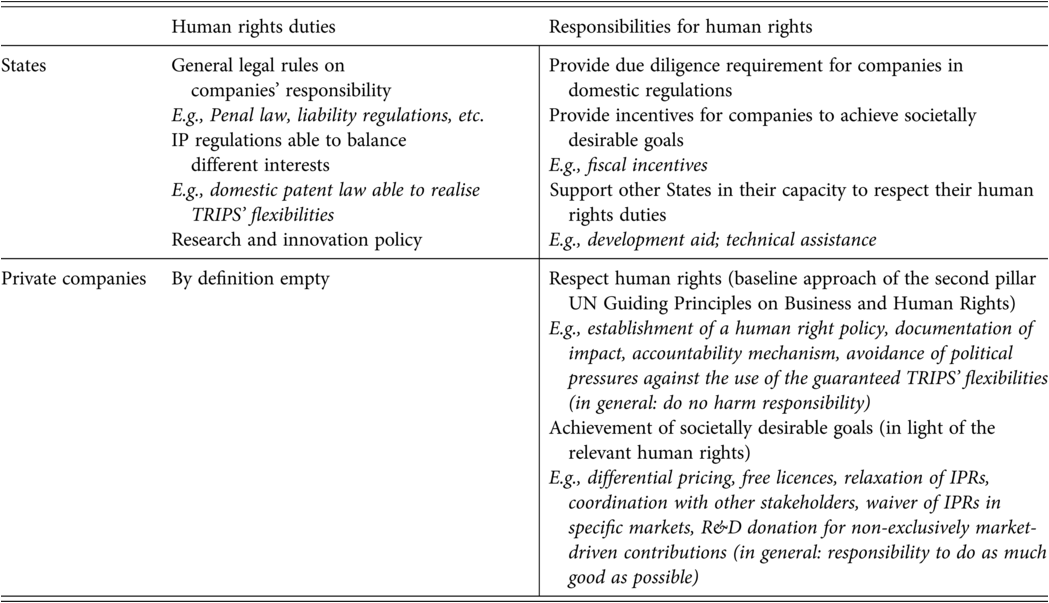
Table 4.1 Long description
The table features two primary column headers titled Human rights duties and Responsibilities for human rights. The text rows flow downward systematically based on the institutional actor categories:
States:
Human rights duties: General legal rules on companies responsibility Example, Penal law, liability regulations, etcetera. I P regulations able to balance different interests. Example, domestic patent law able to realise T R I P S flexibilities. Research and innovation policy.
Responsibilities for human rights: Provide due diligence requirement for companies in domestic regulations.
Provide incentives for companies to achieve societally desirable goals. Example, fiscal incentives.
Support other States in their capacity to respect their human rights duties. Example, development aid and technical assistance.
Private companies:
Human rights duties: By definition empty.
Responsibilities for human rights: Respect human rights open parenthesis baseline approach of the second pillar U N Guiding Principles on Business and Human Rights close parenthesis. Example, establishment of a human right policy, documentation of impact, accountability mechanism, avoidance of political pressures against the use of the guaranteed T R I P S flexibilities open parenthesis in general do no harm responsibility close parenthesis.
Achievement of societally desirable goals (in light of the relevant human rights). Example, differential pricing, free licences, relaxation of I P R s, coordination with other stakeholders, waiver of I P R s in specific markets, R and D donation for non-exclusively market-driven contributions (in general responsibility to do as much good as possible).
4.1.2.2 Caveats in Interpreting the ICESCR
This work focuses on the rights enshrined in the ICESCR and the interpretation given by the Committee on Economic Social and Cultural Rights (the Committee).Footnote 81 In Ikawa’s analysis, the interpretative work of the Committee has to deal with four main general obligations of the State parties:Footnote 82 the use of the maximum available resources, the progressive realisation and non-retrogression, the respect of minimum core obligations, and the obligation not to discriminate. These four obligations run throughout the General Comments issued by the Committee.
These general obligations and the specific content of each right have given rise to debates on the interpretative methods adopted by the Committee, including dispute over the legitimacy of the methods. The history of the emergence of the economic, social, and cultural rights (in opposition to political and civil rights), the still relatively limited richness of national and regional jurisprudence on these rights, but also the open formulation of many of the rights entailed by the ICESCR and the obligation of progressive realisation (to be applied in the context of a division of powers between the judicial and legislative or executive), all combined to make the ICESCR an especially challenging case for interpretation.Footnote 83
To take one example structurally similar to the sufficientarian position assumed here, the ‘core obligations’ approach directs attention and priority to those individuals with high vulnerability. But how to give meaning to these obligations? In her influential account, Young has identified three approaches to account for their content: the essence approach, the consensus approach, and the obligation approach.Footnote 84 Relevant to sufficientarianism is the essence approach, which focuses on basic needs of human beings and connects them with fundamental values such as life, survival, or equality. As for the general sufficientarian approach, the essence approach suffers both a theoretical challenge (how to classify values and needs) and a practical challenge (how to integrate institutional conditions bearing upon the realisation and enforcement of rights).
The disagreement might not in itself be a problem, but it does not fit easily with the functions of these ‘core’ obligations, which are thought to be bedrock obligations, clearly identifiable and solid in their protection of individuals, holding States accountable for their failure to secure them. This specific example shows that the interpretations chosen by the Committee raise legitimacy issues.Footnote 85 Moeckli identifies three phases in which different interpretative patterns were taken.Footnote 86 The first one – in General Comment 3 – is the birth of the concept of minimum core obligation, focusing on ‘minimum essential levels of each of the rights’. At that time, the Committee explicitly acknowledged the possibility for a State to justify non-compliance with minimum core obligations because of missing resources. The second phase is a phase of expansion in which the Committee expands the obligations for State parties.Footnote 87 Furthermore, it restricts the conditions for not respecting minimum core obligations. In General Comment 14, it says that ‘a State party cannot, under any circumstances whatsoever, justify its non-compliance with the core obligations set out in paragraph 43 above, which are non-derogable’.Footnote 88 The third phase is a scaled-back phase based on the reactions of State parties.Footnote 89 The Committee adapts its interpretation of the core minimum obligations back to the position it defended at the beginning. General Comment 19 uses exactly the formulation provided by General Comment 3 on the possibility of justifying non-compliance.
Overall, these changes show that interpretation needs to be openly normative, recognising the presuppositions it necessarily relies upon. This requires at least complying with the interpretation methods foreseen by public international law (the VCLT framework) but also recognising its limitations. As explained in Chapter 2, the reflective equilibrium approach is meant to address these normative presuppositions.
4.2 Relevant Human Rights for the TRIPS
This chapter draws upon ICESCR’s rights to specify how the TRIPS’ foundational norms (Articles 7 and 8) should be interpreted. These interpretative resources are conceptualised as part of the republican-sufficientarian approach adopted in this work.
The following sections are organised thusly: the first section presents the general argument by focusing on the combined contribution of the right to science and the right to self-determination while the second specifies the contours of the threshold and the third section discusses the importance of non-domination beyond the threshold on the basis of the right to science. The fourth section contextualises this reflection with the right to self-determination and the final section summarises the lessons learnt for the interpretation of the TRIPS’ foundations.
4.2.1 Overview of the Argument
The general argument is structured around a normative threshold central to the conditionalities of social and economic welfare and mutual advantage prescribed by Article 7 of TRIPS. The task is to identify the human capabilities needed for a decent life by interpreting States’ related obligations. For the time being, the structure of the argument is key: interpretation of the TRIPS should allow and empower States to secure these minimal components of welfare. All the flexibilities that the TRIPS provides should be used by a State in order to enable decent life for its population. This threshold-based argument is organised into three main parts.
The first part deals with the general determination of the threshold and the urgency of the situations of those individuals living below it. It answers the following question: in the context of defining welfare and mutual advantage in IP, what is due to human beings? This question has been the traditional locus of the scholarship on the interface between IP and human rights. This interface has mainly been considered along an access modality of human rights. The general structure of the argument is that States have the obligation to secure access to good X because of its vital importance to individuals. The right to health, for instance, in the context of the IP-AIDS crisis at the end of the 1990s, is the most renowned example of scholarship along this modality access. Similar debates resurfaced during the COVID-19 pandemic and the acute challenge of securing global access to vaccines.Footnote 90 Beyond health, General Comment 17 (which deals with Article 15(1)c ICESCR) underlines this dimension of access: ‘States parties thus have a duty to prevent unreasonably high costs for access to essential medicines, plant seeds or other means of food production, or for schoolbooks and learning materials, from undermining the rights of large segments of the population to health, food and education.’Footnote 91
This first part has two main objectives. Firstly, it briefly synthesises the outline of a healthy and educated individual as a key specification of the republican-sufficientarian threshold. Given the large body of scholarship on these different human rights (mainly health, food, and education), this synthesis should be seen as a mapping of the most important elements of the threshold. Secondly, it complements this scholarship by highlighting the relevance of the right to science. This is the opportunity to introduce this undertheorised right and to highlight its access modality (access to the benefits of science).
The second part proceeds by going beyond the modality access of human rights. The main question here is: what obligations does a State hold in a situation where urgency (i.e., living below the threshold) has mostly disappeared? The hypothesis is that, above the threshold, the main objective is to avoid domination in taking collective decisions on IP policy. Even if minimal conditions for a decent life were guaranteed (sufficientarian welfare), situations of domination could still be present. In the sense of individual and infrastructural capacities, the definition of welfare and its pursuit should be free from the risks of domination by other States and/or private companies. Thus, the right to science will be used as a key element to link both an access modality (as discussed in the first part) and a norm to empower individual and communities to do science and to engage into science-based policy decisions. This structural-procedural dimension of the right to science will be shown as a promising anti-domination measure.
The third part puts this republican-sufficientarian reading of Article 7 of TRIPS into a broader argument about self-determination. In combination with the right to science, this right will prove foundational in capturing the regulatory competence claimed by Member States to make their own policy choices along Article 8 of TRIPS. As Grosse Ruse-Khan puts it, ‘the State designs and tailors the legal framework for IP subject matter in the public interest (…)’.Footnote 92 The argument will be shown to be especially relevant for minorities such as indigenous communities and their claim to protect traditional knowledge.
Before proceeding, an important caveat is required. Freedom of expression, as protected for instance by Article 19 of ICCPR, will not be addressed in this work. In addition to pragmatic reasons pertaining to the book’s scope, this choice corresponds to the primary focus on patent and technology. Two claims accompany this caveat. Firstly, I will provide references that connect to the topics of freedom of expression with:Footnote 93 the right to self-determination (in which freedom of expression is a condition for lively and critical political debates), the right to science (linked to the ambition to empower citizens to reach consensus on public policies related to scientific research), and the importance of culture in the right to science. Secondly, the lessons learnt in this work could be used fruitfully with respect to freedom of expression. This claim functions both methodologically (the reflective equilibrium approach and the general framework on human rights) and substantively (the republican-sufficientarian interpretation of human rights).
4.2.2 Below the Threshold: Capabilities due to Every Individual
Defining the threshold is a normative question that relies upon the further determination of what should be guaranteed to every human being. States must design and interpret their IP regulation in a way that allows them to guarantee access to essential goods for the individuals within their jurisdiction. Reaching this normative threshold – defined through the capabilities required for a ‘decent life’ – is considered a priority.
Expressed as capabilities, the elements composing the TRIPS-related threshold can be interpreted along four main human rights.Footnote 94 These rights are synthesised in the form of a consistent conception built upon a certain vision of human beings in a society and what is due to them. This consistency does not mean that these elements are devoid of open normative questions. On the contrary, the argument only claims to identify and channel these open questions.
This section is organised into four subsections: a synthesis of the three most discussed human rights (health, food, and education); a contextualisation and discussion of the access modality of the right to science; a reflection on the responsibilities of private companies; and a concluding subsection.
4.2.2.1 The Healthy and Educated Individual
This first subsection draws upon existing scholarship on the interface of IP and human rights to highlight insights on how to answer the threshold-related question: what is due in priority to human beings? The subsection considers in turn the issues of health, food, and education.
The Right to Health
Firstly, each individual should have the capability to enjoy the highest attainable standard of physical and mental health as based upon Article 12 of ICESCR,Footnote 95 interpreted by the General Comment 14 and the scholarship on the interface between the right to health and the TRIPS.Footnote 96 This is linked to the first capability listed by Nussbaum: the capacity of a human being to live a life of normal length, in effect, not to die prematurely.
The right to health is not limited to a right to healthcare.Footnote 97 The wording of Article 12(2) of ICESCR makes clear that further determinants are relevant for the State obligations (such as nutritiously safe food and potable drinking water, basic sanitation, and adequate housing and living conditions).Footnote 98
Providing appropriate healthcare is interpreted around four key parameters: availability, accessibility, acceptability, and quality (AAAQ).Footnote 99 The questions of availability and economic accessibility (affordability) are especially important for the interface with patents.Footnote 100
The scholarship on the interface between the right to health and patents has attempted to empirically measure the detrimental impact of IPRs on affordability,Footnote 101 revealing that patent regulations tend to increase prices for patented drugs and make access to them more difficult.Footnote 102 However, the price premium attached to the patent seems to be different according to the country of sale (less important premiums in low-income countries).Footnote 103 Furthermore, the impact of patents is part of a debate on pricing and enforcement strategies adopted by private companies.Footnote 104 In the end, patents are not exclusively responsible for missing affordability. Contextual constraints – such as the domestic health system – also play an important role.
This debate is embedded within the aforementioned discussion on the instrumental justification of IPRs.Footnote 105 The main point of dispute might not just be the empirical findings addressed here (i.e., impact on prices), but also the justification of patent through mid-and long-term incentivisation for R&D investments. Formulated in this way, the debate seems rather about the potential consequences of cutting out this source of benefits for private companies, thus bringing the debate into a longer time frame (impact on access now versus mid- to long-term effects on R&D).
In the meantime, it allows us to more specifically identify and address two distinct challenges: (1) the patent-driven impact of prices on affordabilityFootnote 106 and (2) the incentivisation of further R&D. In the context of neglected diseases (i.e., diseases affecting mainly poor populations with very little to no purchasing power), the two challenges appear clearly distinct. It is highly questionable that patents bring positive incentives for R&D on neglected diseases.Footnote 107 Whether a utilitarian justification for IPRs holds in general is a different issue. Notwithstanding this broader debate, this specific point is interesting for clarifying that the access challenge (especially its availability and affordability) and the incentivisation challenge should be addressed differently, depending on the context.
This discussion is crucial with respect to the accessibility of essential drugs,Footnote 108 a concept used by the WHO to identify the most critical drugs needed across the globe. Providing essential drugs is a core obligation for State parties, as noted by the General Comment 14.Footnote 109 The WHO Model Lists of Essential Medicines (EML) presents a list of essential components of a basic healthcare system, listing the most efficacious, safe, and cost-effective medicines for priority conditions.Footnote 110 Priority conditions are selected based on current and estimated future public health relevance and the potential for safe and cost-effective treatment.
Especially interesting for our threshold-based reflection is the normative question as to the definition of ‘essential’. This list represents a threshold in terms of basic and urgent medicine to which everyone on the planet should have access. The definition of what is ‘essential’ relies upon normative considerations of health and what a human person should be able to do.Footnote 111 This is, for instance, reflected in the hierarchy of diseases that need to be cured in priority, a hierarchy involving a normative assumption as to which needs are most important.Footnote 112
Notwithstanding this normative priority-setting challenge, there is a question related to the inclusion of a specific drug in the list.Footnote 113 As per the WHO, the criterion of ‘cost-effectiveness’ is relevant to admitting a specific drug to the list. Insofar as patents impact the price of drugs, they are relevant for determining which drugs are included in the list. This point generally raises the question of the power struggles at play in the determination of the EML and the processes put in place to tame these struggles.Footnote 114 Overall, this normative dimension recalls that many diseases (and the corresponding drugs) are not judged to be sufficiently important and/or cost-effective to be included in the list.
However, the problem goes even deeper than availability of existing essential drugs. It also reflects the absence of incentives for drugs targeted at low-income consumers. Many drugs addressing diseases of Types II and III (i.e., diseases that impact mainly inhabitants of developing countries with low purchasing power) are not developed in the first place.Footnote 115 As will be shown further based on the right to science, a State has a duty to invest in resources to facilitate domestic scientific research about these diseases, develop medical treatments (including drugs), and manufacture them for its own population. Other States, private companies, and further actors having the capacity to help have human rights responsibilities to support weaker States. The General Comment makes numerous references to these responsibilities under the heading of ‘International Responsibilities’.Footnote 116 It writes that ‘[s]tate parties should therefore provide an environment which facilitates the discharge of these responsibilities’.Footnote 117 The Committee extends these responsibilities to non-State actors.
A special case involves drugs required to address a pandemic or endemic danger. The Committee has identified an obligation of comparable priority to the core obligations to ‘take measures to prevent, treat and control epidemic and endemic diseases’.Footnote 118 This obligation also mandates the use of drugs that are not necessarily limited to those listed on the WHO’s EML. The COVID-19 pandemic has provided a perfect example of this constellation.Footnote 119 At the start of the pandemic, populations needed access to the vaccine in order to prevent the spread of the virus, although this vaccine was not yet on the EML. In the latest version of the EML (23rd edition, 2023), the WHO ‘recommends that effective and safe therapeutics for prevention and treatment of COVID-19 should be considered as essential medicines in the context of the public health emergency’.Footnote 120 Clearly, the debates have also demonstrated that IPRs were not the only issue, but also, for instance, the capacity to manufacture vaccines in developing economies or the responsibility of developed economies to provide others with vaccines through the COVAX-scheme.Footnote 121 The Committee had urged States to accept a temporary TRIPS waiver (and to vote accordingly in the WTO).Footnote 122
Overall, the right to health is a crucial interpretative resource for the threshold-based understanding of the TRIPS’ foundations. As part of Article 7 of TRIPS, ‘welfare’ and ‘mutual advantages’ should be understood as entailing strong priority entitlements with respect to essential drugs. Beyond the current state of the EML list, each State, but also all States together, has the duty to define which medical treatments (including drugs) are essential with respect to what is due to all human beings. Non-discrimination is a crucial element of this distributive duty.
The Right to Food
Secondly, each individual should have the capability to live, understood most fundamentally as fulfilling the basic needs required to survive biologically.Footnote 123 It is mainly about the capability to get subsistence (as part of the right to food), but also the other basic elements mentioned by Article 11 of ICESCR.Footnote 124 This first dimension gathers important components of the first three capabilities as listed by Nussbaum (life, bodily health, and bodily integrity).
According to General Comment 12, two concepts are particularly important for qualifying the right to food: adequacy and sustainability. As prescribed by Article 11(1) of ICESCR, food should be ‘adequate’, a concept determined by several social, economic, cultural, climatic, and ecological conditions that help determine whether or not particular foods or diets can be considered appropriate.Footnote 125 ‘Sustainability’ is linked to the notion of food security understood as a guarantee that food remains accessible for both present and future generations. A combination of long-term availability and accessibility plays an important role here.Footnote 126 As for the right to health, accessibility has different dimensions and the General Comment specifies its economic and physical dimensions.Footnote 127 Economic accessibility implies that costs associated with food should be at a level that does not threaten the satisfaction of other basic needs. Physical accessibility implies that food must be accessible to everyone, especially for people with special needs, but also those in disaster situations. Specific mention is made of indigenous populations.
With respect to the interface of the right to food and the TRIPS, an important debate has focused on patents used to protect seeds and has been framed as a situation of war (i.e., the ‘seed wars’).Footnote 128 The interface between IPRs and plants and seeds can be problematic in at least four ways which all are, directly or indirectly, relevant to the determination of the threshold.Footnote 129
Firstly, IPRs have the effect of ‘locking in’ farmers who develop commercial dependence with patent-owners when it comes to reusing and developing their seeds to fit their specific environment.Footnote 130 On this question, States can make a choice among the possibilities offered by Article 27(3) of TRIPS. They can enact a sui generis protection system or adopt a patent regime.Footnote 131 As Correa explains, the determination of this patent regime for plant varieties needs to address several contested points.Footnote 132 First, States need to determine the scope of patentability of plants in the first place: all plants and/or their components as distinguished from plant varieties, and essentially biological processes (Article 27(3)b of TRIPS).Footnote 133 Regarding this issue, States can decide to adopt a broad scope of patentability. As per Correa and co-authors, plants are excluded from patentability in 40 per cent of the 126 countries in the Global South for which legal information was available in 2018.Footnote 134 Second, States must choose what scope to give to the exclusive rights granted, and what exceptions to foresee (such as privileges for farmers, research, and breeding exceptions). In this context, the issue of farmers’ rights is especially important. The normative core of these rights is the right to freely save, use, exchange, and sell farm-saved seeds.Footnote 135 Their work, often the result of informal and incremental exchanges, deserves protection.Footnote 136 We will come back to this issue in the context of the protection of traditional knowledge.Footnote 137
Secondly, engineered seeds (that are potentially patented) can lead to the planting of homogenised varieties which, in turn, can have two consequences. The first affects food security as homogenised planting is more likely to expose crops to pests, diseases, or changes in environmental conditions.Footnote 138 The second consequence relates to the broader issue of biodiversity. Systematic use of arguably the ‘best’ commercial seeds can occur at the cost of diversity of plant genetic resources. Ensuring food security for present and future generations requires the protection of biodiversity. This connects with previous reflection on the definition of ‘welfare’ in Article 7 of TRIPS as entailing an environmental dimension.
Thirdly, IPRs can influence R&D patterns in agriculture by reorienting research towards the more commercially attractive seed varieties.Footnote 139 By analogy to drugs needed for neglected diseases, these incentives can undermine the R&D needed to ensure food security of impoverished populations.Footnote 140
Finally, the existence of IPRs raises important questions as to the conditions of their birth. Problematic cases include those in which farmers and communities have not consented to the use and protection of their knowledge (especially in the context of traditional knowledge) and do not adequately share the benefits of these IPRs.Footnote 141 In this context, the adoption of the WIPO Treaty on Intellectual Property, Genetic Resources and Associated Traditional Knowledge (GRATK Treaty) in 2024 is hoped to facilitate a mutual reinforcement approach between IPRs as protected by the TRIPS and the Convention on Biodiversity (CBD).Footnote 142 The Treaty establishes a mandatory patent disclosure requirement (Article 3). It should be implemented in a mutually supportive manner with other relevant international agreements (Article 7). It also underlines the possibility to establish a large database listing proprietary claims on genetic resources, thereby facilitating the task of patent officers to identify any doubtful applications (Article 6).Footnote 143
Overall, these four different issues grasp elements of the food-related normative threshold we are trying to define. They all refer to what should be due to individuals. More broadly, these issues can be looked at as part of the framing of ‘seed war’ and be connected to our anti-domination reading.Footnote 144 This framing started as a conflict between two opposite views, echoing the conflict approach identified by Helfer: a common heritage approach and a private property approach. The common heritage approach was founded upon the conviction that plant genetic resources belonged to humankind as a whole and should not be subjected to any proprietary claim.Footnote 145 The private property approach started from the assumption that States should control the genetic resources they have on their territory and regulate proprietary claims made by private companies.
As Saab notes, this original struggle has shifted towards a conflict between different conceptions of IPRs, their justifications, and their limits.Footnote 146 The issue is no longer whether there should be IPRs on plant resources, but rather who controls these IPRs and which conditions and exceptions apply to them. The requirement to counterbalance companies’ IPRs with stronger farmer rights and benefit-sharing mechanisms is the new locus of this struggle.
In a republican fashion, these collective questions recall that, as already addressed by Eide’s report on the right to food in 1987, the key issue is not merely the quantity and quality of food produced but whether individuals and societies have an adequate ‘command’ over food.Footnote 147 This question is linked to the functioning of agricultural systems and their capacity to guarantee food security.Footnote 148 In this sense, the objective is not only to increase the quantity of food produced but also to support ‘modes of production that raise the incomes and the resilience of the poorest farmers and (…) not jeopardize food security in the future’.Footnote 149
The Right to Education
Thirdly, each person should enjoy the right to avail of basic education, with the focus put on Article 13 of ICESCR and how the Committee interprets it through its General Comment 13.Footnote 150 This general capability is the fourth mentioned by Nussbaum (senses, imagination, and thought). This capability arguably runs along a continuum from the basic capacity to think and reason (as cognitive actions) to the capacity of an individual to participate in a free society (Article 13(1) of ICESCR). In our framing, this capability is crucial to resisting domination and enjoying genuine freedom. For the specification of the threshold of what is due to individuals as a matter of ‘welfare’, the main issue is access to educational resources, mainly textbooks. This question mainly relates to copyright and not patents as with health and food.
The availability and affordability of textbooks are key issues for the recognition of the right to education.Footnote 151 Here, availability refers to the existence of a suitable textbook for a specific context. The issue of language adapted to a specific context – and the requirement to provide translation – is one of the difficulties faced when securing access to textbooks.Footnote 152 If the textbook exists, its price is a key parameter in determining who has access to it, with many factors determining the price of a textbook such as direct costs of production like paper and ink, royalties for the author and publisher, and distribution costs.Footnote 153
Copyright proves relevant for the availability of such educational resources in the first place because of translation issues or missing authorisation from the publisher. As Okediji explains it, ‘the reproduction and translation rights thus operate in tandem as barriers to access in developing countries’.Footnote 154 With respect to the interface between access to textbooks and the TRIPS, a bottom line in the debate seems to be the following: copyright contributes to cost and severely complicates reprography.Footnote 155 This bottom line is part of a broader debate on the socially differentiated effects of copyright.Footnote 156
This debate is centred on developing countries’ educational systems having the right to obtain bulk access, that is, access to multiple copies of a copyrighted work at affordable prices. As prescribed by Article 9 of TRIPS, Member States shall comply with Articles 1 to 21 of the Berne Convention and its Appendix, which entails provisions for compulsory licensing for educational use (Article II(5) and Article IV(4)).Footnote 157 Cumulative conditions include: a waiting period both from the date of publication before issuing a license for translation and before issuing a reproduction license, the establishment of a competent authority in the country of development to issue these licenses, and a strict limitation on teaching and scholarship and research purposes in connection with systematic instructional activities. Additionally, the granting of compulsory licences is linked to the price of the copyrighted work. If this work is available at a price ‘reasonably related to that normally charged in the country for comparable works’, the licences shall be terminated.Footnote 158
Overall, the objective of securing bulk access to educational content thanks to the Berne Appendix has been unsuccessful. As commentators have noted, the complexity of the provisions entailed by the Appendix has prevented developing countries from using them.Footnote 159 In addition to criticism on the design and content of the Appendix, the integration of the Berne Convention into the TRIPS’ set of minimal requirements has added a layer of control in the form of the three-step test of Article 13 of TRIPS.Footnote 160
This criticism has extended beyond inefficiency. Following, for instance, Shaver, the Appendix can be taken as an example of the traditional focus on production of the copyright-as-incentives approach.Footnote 161 But these production-centred incentives cannot solve distributional concerns linked to access (e.g., affordability).
Even more fundamentally, a liberal model of copyright (which links the protection of intellectual creation with broadly liberal values such as free speech for the sake of creating a more robust marketplace of ideas) might represent a threat for distinct types of social communities, particularly those in which the process of creativity and the societal reward system functions very differently, such as in certain indigenous communities.Footnote 162 As Okediji writes, ‘the “hyper-harmonization” of copyright law, at the rate observed in the TRIPS Agreement and since, facilitates an ongoing and persistent erosion of systems of organization and social governance that stand at odds with copyright’s utilitarian emphasis’.Footnote 163 Accordingly, the specific situation of indigenous communities and their right to self-determination becomes even more significant.Footnote 164
As for the other rights discussed earlier, there is still overall an important domestic margin when it comes to crafting and revising domestic IP regulations to secure access to educational resources.Footnote 165 In this context, the existence of a compromise in the form of an Appendix to the Berne Convention is better than nothing and should be used to progressively realise the right to education. In addition to renewed negotiations on this Appendix, this domestic margin is the best tool available for compensating the model of ‘thick’ minimum standards for author’s rights and ‘thin’ limitations and exceptions enshrined in the Berne Convention.Footnote 166
The Right to Science: Access to the Benefits of Science
This subsection focuses on the human right to science of Article 15(1)b of ICESCR. In addition to the three traditional loci of the IP and human rights interface (health, food, and education), the right to science is conceptualised in this work as a structuring concept. In this first part on the right to science, the focus is put on the modality access and what we could learn from the definition of the threshold. The structural-procedural dimensions of the right to science will be the focus of the next subsection.
This subsection firstly offers a contextualisation of Article 15 of ICESCR, an overview of the interpretation of the right to science, a presentation of the main points of tensions between IP and the right to science, and a discussion of the right to science from the perspective of specifying the threshold and what is due to individuals below it. This last subsection addresses the normative question of what is due to an individual in terms of access to the benefits of sciences.
Contextualising Article 15 of ICESCR
The ICESCR protects the right to science in its Article 15 of ICESCR. The ‘right to science’ is used here as a term for the right to participate in and to enjoy the benefits of scientific progress and its applications, as proposed by General Comment 25.Footnote 167 The use of the term ‘to science’, then, should not obscure the fact that an important part of Article 15(1)b of ICESCR is about participating in the production of science.
For a long time, the human right to science has largely been ignored by legal scholars. Few exceptions have acknowledged its potential, both on its own standing and for the sake of providing a promising link to IP challenges.Footnote 168 Today, the debate on the right to science has attracted more attention, especially since General Comment 25.Footnote 169 However, this human right remains largely undertheorised in contrast to other rights entailed by the ICESCR.
In addition to Article 15 of ICESCR, the right to science is to be found in the UDHR (Article 27). It has also been addressed in the Venice Statement on the Right to Enjoy the Benefits of Scientific Progress and its Applications (2009),Footnote 170 the UNESCO Universal Declaration on Bioethics and Human Rights (2005),Footnote 171 the UNESCO Recommendation on Science and Scientific Researchers (2017),Footnote 172 the reports of the Special Rapporteur in the field of cultural rights on the right to enjoy the benefits of scientific progress and its applications,Footnote 173 the Special Rapporteur in the field of cultural rights on the right to science in the COVID-19 crisis,Footnote 174 and the Special Rapporteur on toxics and human rights.Footnote 175
The following subsections focus on Articles 15(1)b, (2), (3), and (4) of ICESCR. Left aside are mainly Article 15(1)a (right to take part in cultural life) and Article 15(1)c (protection of intellectual creation).
On Article 15(1)c of ICESCR, the protection of the ‘moral and material interests resulting from any scientific, literary or artistic production of which he is the author’ has been the object of General Comment 17.Footnote 176 This General Comment qualifies the specific attributes of IPRs that can claim to enjoy a human rights protectionFootnote 177 and uses clear language to distinguish modern IP rights (especially patents) from the kind of authors’ and creators’ protection foreseen by Article 15(1)c of ICESCR (limited to natural persons, focused on the personal link between an individual and their work, protecting the material interests apt to securing an adequate standard of living, etc.).Footnote 178 The General Comment specifies that Article 15(1)c of ICESCR should be seen as intrinsically linked to the other rights of Article 15 in a relationship mutually reinforcing and limiting. This protection of the interests of authors and creators should be distinguished from the procedural human rights (or principles of law) used to improve the standards for the procedures granting patents, copyright, or other IP rights.Footnote 179
Regarding Article 15(1)a of ICESCR, there is an important debate on the distinction one should (or should not) make between cultural life and science. As Shaver argues regarding how Special Rapporteur Shaheed chose to deal with culture and/or science, there is no clear dividing line between culture and science.Footnote 180 Many scientific works and innovative technologies share both scientific and cultural dimensions. This book views this distinction pragmatically and focuses mainly on the right to science because of its paradigmatic tensions, but also its potentialities, with the international IP regime. However, IP is also relevant for cultural life and tensions with IP, mainly copyright, are also relevant.Footnote 181 Furthermore, the lessons learnt on the right to science from a republican and sufficientarian perspective could be used to address similar tensions with respect to cultural participation. I will briefly come back to the right to take part in cultural life in the concluding observations of this subsection on using human rights to interpret the TRIPS.
Interpreting the Right to Science
It is important to start by addressing key definitions. Referring to UNESCO’s Recommendation on Science and Scientific Researchers (2017), the General Comment 25 defines ‘science’ as the
enterprise whereby humankind, acting individually or in small or large groups, makes an organized attempt, by means of the objective study of observed phenomena and its validation through sharing of findings and data and through peer review, to discover and master the chain of causalities, relations, or interactions; brings together in a coordinated form subsystems of knowledge by means of systematic reflection and conceptualization; and thereby furnishes itself with the opportunity of using, to its own advantage, understanding of the processes and phenomena occurring in nature and society.Footnote 182
This definition echoes the definition that Chapman proposes.
Building upon Merton’s sociology of science, Chapman argues that science is a process composed of the following elements: problem selection, research design, subject recruitment, collection and recording data, analysis and interpretation of data, designation of authorship publication, and data sharing.Footnote 183 This approach is compatible with the Venice Statement which conceives of science as a process that actors should interpret in the present-day context.Footnote 184 The question of the determination of the purpose of science (if any) has been a controversial issue since the drafting of the ICESCR.Footnote 185 Drawing upon the UDHR, the General Comment 25 asserts that ‘the development of science in the service of peace and human rights should be prioritized by States over other uses’.Footnote 186 This purpose must not be exclusive but should be considered in priority.
In the context of IP, a relevant discussion concerns indigenous or traditional knowledge as a category of scientific practices and associated benefits. As Coomans argues, we need a dual approach, in effect, a definition of science able to account for industrialised and technological knowledge systems and non-Western, local knowledge linked to the identity, traditions, and cultural heritage of local people.Footnote 187 In order to operationalise this broad conception of science, scholars have proposed working with concepts such as ‘scientific practices’Footnote 188 or ‘knowledge systems’.Footnote 189 The idea that these concepts convey will be important for future reflections on how to comprehend indigenous knowledge from an IP perspective. Interfacing between the right to science, self-determination of peoples, and the protection of indigenous communities will prove crucial.
As General Comment 25 notes, science refers ‘both to a process following a certain methodology (“doing science”) and to the results of this process (knowledge and applications)’.Footnote 190 The applications are defined as implementation of science according to the specific concerns and needs of the population. ‘Benefits’ refer to three different outputs: the material results of the applications of scientific research (such as vaccines, fertilisers, and technical tools), the development and dissemination of scientific knowledge and information, and the role of science in forming critical and responsible citizens who can participate fully in a democratic society.Footnote 191
This definition of ‘benefits’ echoes former work in the literature. After analysing the travaux préparatoires for Article 15(1)b of ICESCR, Chapman focuses her definition of ‘benefits’ on the first dimension, that is ‘material benefits that every person should be able to enjoy in everyday life’Footnote 192 including drought-resistant plant varieties, clean energy sources, Internet access, and vaccines (as direct benefits of science), as well as indirect benefits to human development through positive economic impact.Footnote 193 Seen from the perspective of this type of end-products, Article 15(1)b of ICESCR is mainly about the distribution and access to these benefits (the access modality of the right to science).
However, as noted by the General Comment 25, it is important not to restrict benefits to these material ones but also include the improvement of knowledge and the development of the critical mind and faculties associated with doing science.Footnote 194 In other words, the value of science should not only be understood in a strictly instrumental sense. In this context, the right to science could be misunderstood in two different ways.
On the one hand, the focus could turn to benefits as end-points of scientific work and R&D processes.Footnote 195 However, this would obscure the fact that science as a process is always in-the-making and is never complete. The value of scientific activities lies also in this continual development and consolidation of knowledge, independently from concrete material benefits. Such scientific practices both require and foster valuable competencies among scientists and the broader public. To recognise science as a process and practice also opens the door to fully appreciating its participatory dimension, which requires collaboration among scientists working together to improve knowledge (e.g., professional associations, international cooperation, peer review for scientific publications, and so on), but also to consider the required dialogue with the public on numerous questions.Footnote 196 This participatory dimension of science will be considered a crucial thread in understanding the right to science discussed further.
On the other hand, the right to science could be misunderstood by treating it exclusively as a means to better realise other human rights.Footnote 197 As explained by the General Comment 25, the right to science ‘constitutes an essential tool for the realization of other economic, social and cultural rights’, especially the right to health and the right to food.Footnote 198 For instance, in the context of the right to health, this instrumental value appears clearly when the General Comment 25 calls on States to promote scientific research to create new medical applications and make them accessible and affordable to everyone, especially the most vulnerable.Footnote 199 However, this instrumental value for other human rights does not exhaust the value of the right to science. This right has a value in itself, especially in structuring the interface with IP.
Regarding the right to science, the Committee has identified twelve core obligations that I have clustered briefly here.Footnote 200 The first cluster addresses obligations to secure discrimination-free access to science while the second deals with measures ensuring education and skills necessary for science and the protection of freedom of scientific research. A specific focus is put on the training of health professionals. The third cluster directly addresses the obligations to ensure allocation of resources where there is the greatest need for scientific progress and to ensure access to those applications that are critical to the enjoyment of the right to health and other ECS rights.Footnote 201 The fourth cluster focuses on the promotion of accurate scientific information and the alignment of public policies with the best available scientific evidence. The fifth cluster deals with the development of international cooperation.
As for the other rights discussed earlier, the jurisdiction-based duties are complemented by international responsibilities. As the General Comment 25 enunciates, these responsibilities are reinforced in the case of the right to science (Article 15(4) ICESCR).Footnote 202 Firstly, scientific research is a deeply cooperative work that requires cooperation between States to enable scientists to collaborate internationally. Secondly, international cooperation should aim at minimising international disparities in science and technology. Developing economies should have the opportunity to count on the support and assistance of others to comply with their obligations under the Covenant. The General Comment specifies allocation of development aid, funding towards building and improving scientific education, research and training in developing countries, and promoting collaboration between scientific communities. Thirdly, international cooperation entails important distributive obligations. Benefits and applications of scientific progress should be distributed to the international community, particularly developing countries and especially when these benefits are closely related to further ECS rights. Fourthly, the development of technologies can help the international community in addressing global challenges such as climate change. These responsibilities will be addressed further.
Tensions between IP and Access with the Right to Science
Of specific interest to the present investigation are the links between the right to science and the TRIPS.Footnote 203 This subsection specifically focuses on the tensions between IP protection and access as reconstructed in light of the right to science.
In general, the General Comment 25 conceptualises the right to science as a ‘significant mediator’ between human rights (such as the right to health) and intellectual property rights (the protection of IPRs).Footnote 204 In its explanations, the Committee acknowledges the role that IPRs play in the development of science and technology through economic incentives for innovation.Footnote 205 Meanwhile, it highlights three different ways in which the IP system can affect the advancement of science and hinder access to its benefits.Footnote 206
Firstly, IP can create distortions in the funding of scientific research, as (especially private) funding might go to research projects promising a financial return on investment. The fact that some research results can be protected by IPRs makes them more economically profitable. The problem is that challenges where scientific progress could be life-saving often do not prove economically interesting, not least because they are often not IP protectable. Funding rules and policies exercise an important impact on the types of projects conducted by scientists.
Secondly, some IP regulations limit the possibility of sharing information related to scientific research. As explained by Durkin and co-authors, this is a relevant issue with respect to clinical trial data, engineering and manufacturing data, data related to artificial intelligence systems, or drug pricing data.Footnote 207 More generally, access to scientific results in high-ranking publications remains excessively costly and makes access de facto impossible for researchers in low-income countries.Footnote 208
Thirdly, IPRs can represent an obstacle in the access to the benefits of scientific progress. As explained, these benefits can be crucial for the enjoyment of human rights, such as the right to health.
These three tensions between IPRs and the right to science are addressed by the General Comment. Regarding the first tension, the Committee recommends providing robust funding opportunities (alone, or as part of an international research community) for research projects impacting the realisation of ESCR and to provide additional types of support in order to incentivise research on neglected issues that are especially relevant for the implementation of ESC rights. As the General Comment puts it, the objective is to provide funding schemes that ‘delink remuneration of successful research from future sales, thus fostering research by private actors in these otherwise neglected fields’.Footnote 209 This objective has been the target of interdisciplinary scholarship.Footnote 210
On the second and third tensions, the Committee conceptualises intellectual property as having an intrinsic social dimension, in effect, a ‘social product’ having ‘a social function’.Footnote 211 The conceptualisation of IPRs defended by the Committee is aligned with our previous reflections on the justification of IPRs and on the importance of a human rights-based interpretation of the TRIPS.Footnote 212
Firstly, rather than an end in and of itself, as social product with a social function IP is instead justified with respect to societal goals.Footnote 213 Secondly, this justification implies that balance is inherent in IPRs. IPRs can only be justified if they demonstrate this equilibrium between the achievement of these goals and the prerogatives they secure for right-holders. Article 7 and Article 8 of TRIPS define these societal goals. Interestingly, the Patent Report submitted by Special Rapporteur Shaheed adopts a similar argumentative strategy by mentioning Article 7 of TRIPS as the basis for the TRIPS analysis.Footnote 214 Similarly, the Economic and Social Council reports that the WTO writes that ‘the objectives of the TRIPS Agreement, set out in article 7, put emphasis on the public interest rationale of intellectual property protection. (…) This corresponds with the objectives of article 15 (1)(a) and 15 (1)(b) of the International Covenant on Economic, Social and Cultural Rights (ICESCR).’Footnote 215
Thirdly, the approach adopted by the General Comment 25 exemplifies the importance of interpretation of the TRIPS. As Shaver suggests, the dual nature of the right to science ‘thus points towards solutions in the nature of integrating and reconciling intellectual property and human rights principles, rather than asserting the primacy of one set of interests over the other’.Footnote 216 Human rights might then be used as a justification for striking a satisfactory balance within the IP system and for interpreting the TRIPS, including its exceptions and limitations to IPRs.Footnote 217
The Right to Science as Access Right
From an access perspective, some benefits made possible by science (knowledge and applications) are considered essential resources for a decent life. As for the other ECS rights, this relevance is expressed through the AAAQ scheme. Availability refers to the requirement to protect and widely disseminate scientific knowledge and its applications.Footnote 218 This includes the requirement to make scientific progress happen by investing in resources and coordinating the actions of the involved stakeholders. The dissemination effort should especially be aimed at vulnerable and marginalised groups. Accessibility has three dimensions: equal access to the application of sciences (especially when serving the fulfilment of further rights), information about the risks and benefits of science, and the opportunity to participate in scientific progress (e.g., through scientific education for all).Footnote 219 Quality refers to the best possible verifiable science according to the standards of the scientific community available at a specific time.Footnote 220 Acceptability touches upon the required efforts to explain science and its applications across different cultural and social contexts.Footnote 221 The requirement of securing non-discrimination in accessing these resources is a key duty for States.
The normative relevance of specific benefits depends upon normative qualifications regarding human life and the definition of threshold. This argument might be formulated in a republican-sufficientarian fashion, raising the question as to which part of the benefits of science should be made accessible to every human being as a condition for securing a decent life. Similarly, in interpreting the right to science, Shaver formulates a similar argument by including technologies deemed key to basic survival,Footnote 222 including, for example, electricity, telephone service, Internet access, systems for delivering clean running water to homes and for containing waste, antiretroviral therapy for HIV or oral rehydration salts, and sanitation services.Footnote 223 Drawing upon the right to science reinforces an argument that could be done based on the right to health and/or food (e.g., development of less-water-consuming seeds).
As discussed earlier when dealing with the evolving dimension of sufficientarianism, Shaver is right to insist that we must be quite broad in our interpretation of what is ‘essential’.Footnote 224 For instance, some climate-related technologies can be considered as essential if, in the short- or midterm, life or food without them will become impossible.Footnote 225 In her Patent Report, Special Rapporteur Shaheed also focuses on a ‘broad set of technologies’ considered essential to the implementation of human rights, such as an adequate standard of living and cultural and scientific participation.Footnote 226 Some of the newest innovations have become essential in a very short time period, such as the Internet and antiretroviral therapy for the HIV and COVID-19 vaccines. Science evolves and so must the list of its benefits recognised as essential.Footnote 227 It is not the case that because a benefit is new, it should not be considered essential from a human rights perspective.
The access modality is framed around the priority access to benefits that are considered essential for a decent life. However, the urgency associated with essential benefits does not mean that non-essential benefits have no normative relevance.Footnote 228 As the aforementioned Patent Report states,
the conjoined human right to science and culture should be understood as including a right to have access to, use and further develop technologies in self-determined and empowering ways. (…) Access to the benefits of scientific progress not only allows improving one’s socio-economic situation, but also gives the opportunity for meaningful participation in the life of local, national or international communities.Footnote 229
Even non-essential benefits have relevance when it comes to respecting the right to science. To argue with a hypothetical example, we could imagine a State making sure that its population has access to all essential benefits of science (assuming they can find a convincing definition of ‘essential’). That scenario would imply that one of the core obligations is fulfilled (‘Ensure access to those applications of scientific progress that are critical to the enjoyment of the right to health and other economic, social and cultural rights.’). However, the other duties remain relevant. Most importantly, non-essential benefits could prove important with respect to further research, underlining the cumulative and incremental dimension of scientific work.
The fact that non-essential benefits are also relevant will offer a good transition to the structural-procedural dimension of the right to science. Beyond allocating benefits of science (essential and not essential alike), the challenge is to address the structural capacity to create these benefits and, more generally, to engage in scientific practices. Before addressing these points in the next subsections, a quick point on the responsibilities of companies is warranted.
Responsibilities of Companies
Following our distinction between duties and responsibilities, private companies do not have human rights duties, but they do have responsibilities for human rights. Under their duty to protect, States have an obligation to legislate the requirement that private companies respect human rights and act for the sake of a progressive realisation of human rights. For instance, in the context of agriculture, an important part of the States’ duties relates to the legal requirement for private companies to obtain the consent of resource/knowledge producers and to engage with them through benefits-sharing mechanisms.Footnote 230 Furthermore, States should keep the capacity of companies to abuse their position in specific markets under control.Footnote 231 Because of the specific structural features of agricultural R&D and practices, the domination exercised by a few big companies could have detrimental effects on the capacity of smallholder farmers to make their seeds evolve considering changing environmental conditions.
The context of pharmaceutical companies exemplifies how the UN Guiding Principles on Business and Human Rights could be used to define companies’ responsibilities. Special Rapporteur Hunt has dedicated a report titled Human Rights Guidelines for Pharmaceutical Companies in relation to Access to Medicines to this responsibility, focusing on the responsibilities of pharmaceutical companies,Footnote 232 in particular private companies holding patents on drugs. However, other types of companies, such as private health providers (e.g., private hospitals), could also have specific responsibilities.Footnote 233
Following Moon, it can be argued that a two-tiered approach underlies the combination of the UN Guiding Principles on Business and Human Rights and Hunt’s Guidelines.Footnote 234 The first tier reflects the company’s responsibility to protect human rights, while the second tier calls for a contribution to socially desirable goals.
The first tier corresponds to the second pillar of the UN Guiding Principle (the baseline responsibility of companies to respect human rights).Footnote 235 According to Moon, almost half of the Hunt’s Guidelines can be reconstructed as a responsibility to protect the right to health.Footnote 236 As an important part of this first tier, Hunt’s Guidelines call on companies to respect the rights of countries to fully use provisions within the TRIPS that allow flexibilities to promote access to medicines (including compulsory licensing and parallel imports). In this sense, companies are required to respect the ‘letter and spirit’ of the Doha Declaration.Footnote 237 Preventing pressure on States regarding TRIPS flexibilities is a key issue in investor-State arbitration.Footnote 238
Furthermore, this first tier includes the procedural elements that can be understood as a means of ensuring that private companies remain accountable for their actions or lack thereof.Footnote 239 These elements typically influence the level of transparency necessary for other stakeholders – such as state actors, NGOs, or the wider public – to assess and evaluate the company’s performance and its public commitments regarding respect for the right to health. Internal monitoring and accountability mechanisms are part of this effort.
The second tier formulates expectations towards private companies that go beyond the baseline responsibility to protect human rights. Part of the determination of the contribution to socially desirable goals depends on the exact qualification of the function of companies. In a nutshell, pharmaceutical, but also agricultural, educational, or tech companies are special because of the types of products they create and the societal relevance they acquire.Footnote 240 This line of argumentation is reinforced by two further arguments. On the one hand, these companies – at least the global champions – appear to have important economic and political power. On the other hand, the R&D of these companies often indirectly depend upon publicly funded research (e.g., fundamental research or high-level training of researchers).Footnote 241 These elements contribute to the special position of these knowledge-intensive companies in terms of societal expectations.
As part of what could be expected from companies as contributions to socially desirable goals, the Guidelines formulate three measures.Footnote 242 The first is about issuing non-exclusive voluntary licenses with a view to increasing access to all medicines in low-income and middle-income countries. These licenses should also include any necessary transfer of technology. Secondly, companies should, at a minimum, consent to National Drug Regulatory Authorities using test data, in effect, the company should waive test data exclusivity in the least-developed countries and when a compulsory license is issued in a middle-income country. Thirdly, in low- and middle-income countries, the company should not apply for patents for insignificant or trivial modifications of existing medicines. In the continuation of these measures, the Guidelines encourage companies to adapt their pricing policy in order to ensure its medicines are accessible to disadvantaged individuals, communities and populations, including those living in poverty and the least well off in all markets. The arrangements could include differential pricing between and within countries, commercial voluntary licenses, not-for-profit voluntary licenses, donation programmes, or public/private partnerships.Footnote 243 Similar responsibilities apply to agricultural, educational, or tech companies.Footnote 244
Seen from a republican perspective, it is interesting to highlight that all the mechanisms and arrangements that companies should enact are decided upon by the companies themselves. On the one hand, what is part of the baseline responsibility to protect human rights (first tier) is unclear and, on the other, what is expected beyond this baseline responsibility is also unclear. The categories used make sense, but their delimitations are deeply blurred. Without measures taken by States to oversee their behaviours and require compliance with these norms, companies are in a situation where they can exercise domination upon individuals and States. For them to act or not refers to a logic of charity or reputational risk mitigation.Footnote 245 Conversely, it means that they can decide to maintain higher prices for different types of reasons (e.g., exercising pressure on governments for the sake of cross-negotiations), thereby interfering arbitrarily. Their capacity to do so is unchecked.
To counter this capacity to arbitrarily interfere, States play an important role.Footnote 246 As part of their human rights duties to craft regulations that ensure companies respect human rights and maintain accountability, they also have an obligation to provide an environment that ‘facilitates the discharge of these responsibilities [i.e., of private companies; JR]’.Footnote 247 The State shall not remain passive, expecting companies to become active on their own initiative. Following the general framing assumed here, this obligation seems to be both a duty and a responsibility. The State has a duty to make sure that companies fulfil their baseline responsibility (i.e., a standard of do no harm). At the same time, it also has a responsibility to take policy measures to incentivise companies to do more than this baseline. As Moon argues, States should act via price negotiations, price controls, generic promotion, or subsidies.Footnote 248
Access Modality: Lessons Learnt for the Threshold
This subsection provides an intermediary analysis of the lessons learnt from a republican-sufficientarian perspective. To recall, the objective is to draw upon these human rights for the sake of interpreting TRIPS’ norms, more specifically to specify the TRIPS’ related threshold.
The four human rights considered here share a common access modality. Among other dimensions, they aim at securing access to a valuable good. This modality mirrors one of the key tensions identified by Land and Nesselhauf, namely that ‘IP limits access to knowledge and knowledge-embedded good.’Footnote 249 The structure of this access modality is interesting on two counts: the ‘how’ and the ‘what’ of access. Firstly, beyond the exact delimitation of the goods to which access should be secured (the ‘what’ question), the ‘how’ question appears crucial. The duty to prevent discrimination in accessing the good in question is here of primary importance. It relies upon the importance of equality among individuals under the jurisdiction of a State, thereby underlining the egalitarian dimension of human rights.Footnote 250 It is a core duty for States parties under the ICESCR.
Secondly, the four rights are characterised by an important normative question bearing upon the ‘what’. On the one hand, to precisely grasp which good should be secured requires investigating the value of the good to be accessed. It might seem undisputed that health is valuable, but the exact definition and qualification of this good are required to address challenges pertaining to the scope of the right. As discussed earlier in the context of EML, the type of argument in favour of the inclusion of a new drug (e.g., a cancer drug) should explain why the specific ability to be restored by the drug is essential for a decent life. The argument relies upon a normative argument about what constitutes a healthy human person and, in situations of scarce resources, what aspects of this healthy person are to be privileged. The same capabilities-based approach applies to food, education, and science. In short, human rights arguments require further specification of the view of the human person they operationalise.
On the other hand, the clarification of the normative assumptions at stake in defining these capabilities is intrinsically linked to the question of who is to decide upon these definitions and the underlying vision of the human individual they convey. The challenge shifts from the content to the procedural question about the determination of the entity having the competence and/or capacity to decide upon this content. This directly connects to the required competencies and capacities of individuals to do sciences (following the other dimensions of the right to science) and, more broadly, to the issue of self-determination and the competence of the States to take advantage of the TRIPS’ flexibilities.
4.2.3 Above the Threshold: Securing Non-domination
In this second part, the main question shifts from the obligations towards individuals living below the threshold to the obligations for individuals living above. What do the concepts of welfare, mutuality, and balance of rights and obligations (Article 7 TRIPS) mean beyond access to goods/resources required for a decent life? In my hypothesis, this is where sufficientarianism needs to be complemented by a republican focus on non-domination. Above the threshold, the definition of welfare and its pursuit should be free from the risks of domination by other States and/or private companies. The right to science, then, is a key element to link both an access modality (as previously discussed) and a norm to empower individual and communities to do science and to engage in science policy decisions. In its structural-procedural dimension, the right to science calls for science-related procedures to be participatory and inclusive.
This section is organised into three subsections: the right to science as capacity and competence to do science, the interface between science and the justification of IPRs, and an account of the free and critical individual which complements previous reflections on the threshold.
4.2.3.1 The Right to Science as Capacity and Competence to Do Science
In addition to its access modality (access to the benefits and applications of science), the right to science offers structural-procedural insights from a public good and participatory reading. The first subsection focuses on processes, infrastructures, and further elements that are required in the first place to be able to do science. The second subsection focuses on the competence of a State’s population to be actively involved in determining a science framework, including, for instance, research priorities.
The Right to Science as Capacity
The right to science concerns the capability to engage in scientific practices as a public good. Members of society have a collective interest in acquiring and consolidating knowledge together but this requires specific capacities,Footnote 251 including an infrastructural dimensionFootnote 252 that can be unpacked in four clusters.
The first cluster is fundamental and directly linked to the public good dimension of science. It is thus about the cooperation and organisation required for science to exist as a public good. The second cluster entails elements related to the infrastructure necessary for scientific research, including physical assets such as universities or laboratories, but also non-physical assets ranging from basic education to the promotion of scientific curricula on a non-discriminatory basis (e.g., for under-represented communities). A potential way to increase scientific education is to reinforce ‘doing-science’ (citizen science):Footnote 253 ‘States parties should not only refrain from preventing citizen participation in scientific activities, but should actively facilitate it.’Footnote 254 The third cluster entails the materials and funding required to make scientific research possible while the fourth details a specific category of ‘material’ necessary for scientific research: knowledge, information, and data.Footnote 255
Domination might be exercised upon each of these four steps, putting into question the capacity to do science. Domination-preventing measures can be found at different levels. With respect to the first cluster, a significant domination threat comes from the privatisation of science. The institutional-legal regime put in place to guarantee science as a public good has the objective to prevent, say, private companies from arbitrarily interfering at every necessary stage of scientific work. ‘Private companies’ refers here to different types of firms involved, such as knowledge-intensive companies (e.g., pharmaceutical companies) but also academic journal/publishers or infrastructure producers (such as ICT companies).Footnote 256 Private companies can do science, but the general institutional-legal regime adopted should guarantee its fundamental orientation as a public good.
With respect to the second cluster, research exceptions foreseen in many national patent laws can be taken as an illustration of the type of justification that a right to science-based interpretation of the TRIPS could deliver. The main idea is to allow third parties to use patented inventions for the sake of further research and/or experiments.Footnote 257 With a similar justification (allowing scientific research despite protected content), Correa argues in favour of an open science policy (including securing broad access to scientific publications).Footnote 258 Kunz also provides an argument in favour of open access, inter alia as a means to facilitate the international cooperation required by Article 15(4) of ICESCR.Footnote 259
The Right to Science as Competence to Determine a Science Framework
In addition to the capacity to do science, the competence necessary in choosing which types of scientific projects to conduct is also crucial from the perspective of non-domination. The focus shifts from both the capacity to do science and the allocation of the benefits of science to the determination of priority research and, more generally, to the configuration of the institutional-legal regime of science as a public good.Footnote 260 This dimension is captured by the concept of determining a science framework.
The competence to determine this science framework has a deep participatory dimension. Members of a political community (e.g., a State) have the right to decide how they want their community to organise the public good of science and, internationally, how they want to cooperate with others.
Let us illustrate the argument with the specific point of determining research priorities as addressed by the General Comment in one of the core obligations. In line with the purpose of science as linked to the realisation of human rights, the General Comment mandates a contextual prioritisation of specific research topics in light of their relevance for the realisation of human rights, such as the right to food.Footnote 261 In creating a process of co-decision to answer this priority question, the capacity of everyone to take part and reach consensus is key to judging the processual quality.Footnote 262 As Special Rapporteur Shaheed argues in her Report on the Right to Science, marginalised populations shall also be empowered to participate in this process.Footnote 263
Two republican lessons can be drawn from this participatory dimension. Firstly, it is not satisfactory to assume that any type of research is beneficial for the enactment of human rights.Footnote 264 De Schutter is right to argue that we should interpret the ‘right to benefit from scientific progress and its applications in light of what we want to achieve’.Footnote 265 The criterion for a decent life could be drawn upon in determining the relevant policy priorities to set for future research.Footnote 266
Secondly, it would be problematic if the State or private companies were to decide for the population which priorities to set. By giving the capacity to determine scientific priorities and to decide upon the distribution of benefits to individuals, a participatory approach minimises the risk of arbitrary interferences by public or private actors.Footnote 267 The participative approach promoted by the Committee can be interpreted as an anti-domination mechanism.Footnote 268 As de Schutter claims, ‘[s]cientific progress for the poorest cannot be conceived without the poorest, whose needs are sometimes misunderstood, even by the scientists pursuing their research with the best intentions’.Footnote 269
These two elements regarding the determination of priorities can be illustrated with the Science, Technology and Innovation Strategy for Africa 2024 (STISA) elaborated by the African Union (AU).Footnote 270 As a basis for the identification of its priority areas, the AU writes that their vision is to transform Africa into a knowledge-based and innovation-led society. This vision is based on the general priorities identified for the continent in the AU Vision,Footnote 271 including the following: eradication of hunger and achieving food security, prevention and control of diseases, communication (physical and intellectual mobility), protection of space, living together/building society, and wealth creation. The first two bear upon the right to food and the right to health. The corresponding research and/or innovation areas identified are the following: agriculture/agronomy in terms of cultivation technique, seeds, soil, and climate; industrial chains in terms of conservation and/or transformation and distribution infrastructure and techniques; better understanding of endemic diseases (e.g., HIV/AIDS, malaria, etc.); maternal and child health; and traditional medicine.Footnote 272 With respect to the process chosen (both for the identification of priority research and for the implementation of the strategy), the document describes a participatory approach including different types of stakeholders.
This participatory understanding of the right to science as competence should indeed extend beyond the determination of priorities. As the General Comment puts forth in defining one of the core obligations, States shall ‘adopt and implement a participatory national strategy or action plan for the realization of this right that includes a strategy for the conservation, the development and the diffusion of science’.Footnote 273 In brief, members of the political community should be able to collectively decide on the general conditions in which science is conducted.Footnote 274 As Boggio highlights, the ‘public must be consulted and heard and, in the best case, become a co-producer of science policy’.Footnote 275 In republican terms, this involvement of the public represents an anti-domination mechanism making sure, or at least increasing the chances, that critical opinions and voices of under-represented groups are better heard.Footnote 276 It forces the public authority to take a broader view on the opinions and voices considered relevant in taking research policy decisions.
As the General Comment recalls, this call for a participative approach to science requires, in turn, a capacity-building dimension akin to the elements discussed in the previous section. In order for the population to critically assess proposals and decide together on how to organise scientific activities in a specific State, people need to be empowered in terms of competencies.
Allocation of Duties and Responsibilities
Every State has jurisdiction-based duties and responsibilities for the right to science that need to be globally coordinated through allocation mechanisms. Expressed according to the republican-sufficientarian framing of this book, the key objective is to secure a non-dominating allocation process. This means paying justice to the equality of all States as defined later based on their right to self-determination, but also to the equality of human rights bearers.Footnote 277 Such an allocation process might take inspiration from existing burden-sharing mechanism (e.g., the Tokyo Protocol’s mechanism in the context of climate change burden-sharing)Footnote 278 or multipartite organisation (e.g., the ILO and international labour law).Footnote 279 This challenge is reinforced by the relevance of private actors in the production and use of scientific knowledge.Footnote 280 States need to consider the role of private actors as part of their human rights duties while private companies themselves have responsibilities for human rights.Footnote 281
According to Besson, the capacity to deliver technological assistance or support could be used as the main meta-criterion to organise the allocation mechanism.Footnote 282 This appears aligned with the general responsibility outlined in Article 2(1) of ICESCR (‘(…) through international assistance and co-operation, especially economic and technical, to the maximum of its available resources (…)’). Affluent States and companies (defined according to their technological capacities) have stronger responsibilities to engage in the establishment of the allocation processes (process) and to deliver the most benefits for developing economies (i.e., concrete resources supporting the capacity to do science). As General Comment 25 argues, international cooperation should aim at minimising international disparities in science and technology.Footnote 283 The Venice Statement proposes that international cooperation should be directed towards countries that encounter difficulties in developing science and technology policies and science education.Footnote 284
Responsibilities of the States go beyond a better distribution of already accessible scientific benefits and also include the responsibility to address structural deficiencies in the capacity of low-income States to produce scientific benefits. This type of responsibility is especially relevant in two constellations. On the one hand, a State has a direct responsibility in the negotiation of its trade policy such as, for instance, its bilateral trade Agreements. In that case, it has the responsibility to assist and support other States in fulfilling their human rights duties.Footnote 285 On the other hand, a State must design its domestic law in a way that takes into account the responsibility of private companies.Footnote 286
But beyond bilateral aid, the responsibility of States also amounts to what Besson calls ‘multilateral coordination and institution-building’.Footnote 287 An example could be the promotion of an international collaborative model of research.Footnote 288 This example is directly connected to the issue of access to knowledge and data. Shaver underlines that this is particularly important regarding the ability of scientists, students, and researchers in general to participate in the scientific process, particularly in developing countries.Footnote 289 Echoing our previous argument on the right to education, she emphasises that open access should be extended to primary and secondary textbooks as their shortage has a critical effect on education.
In addition to the responsibilities of States, private companies also have their own set of responsibilities for human rights. Private companies producing knowledge directly relevant for the realisation of human rights such as the right to health, food, or education, arguably have the responsibility to ensure that States have the capacity to fulfil their human rights duties. This includes making relevant IP-protected inventions available at low or no cost (pricing policy), funding of research activities and capacity-building programmes in developing economies, participating in public-private partnerships, or transferring technologies.Footnote 290 In a republican-sufficientarian perspective, all these elements should be guided by two main desiderata: (1) helping States raise every individual to the threshold defined as the capability to lead a decent life and (2) addressing structural deficiencies in accessing and producing scientific knowledge relevant to the realisation of human rights.
4.2.3.2 Access as Default
As previously discussed, the participatory approach of the right to science affects priority-setting, the allocation of benefits and, more broadly, the general conditions of doing science. Importantly, it has an impact where the right to science touches upon a further policy field.Footnote 291 In the context of this work, this is the case of the interface between the right to science and the determination of the domestic IP regime. The participative dimension functions as an anti-domination mechanism by allowing a transparent and inclusive debate on how to design and interpret the domestic IP regime. As Helfer and Austin note, reflection on the required positive impact of IPRs on social and economic welfare must take a broad and diverse population as reference group, and not only already wealthy individuals and companies.Footnote 292 Similarly, in her Patent Report, Special Rapporteur Shaheed stresses that ‘national patent laws and policies should be adopted and reviewed in forums that promote broad engagement, with input from innovators and the public at large’.Footnote 293
This subsection investigates the impact of this participative approach based on the right to science on the justification of IPRs and on considering IPRs as human rights.
IPRs’ Need for Justification
Interpreting the TRIPS’ foundations based on the right to science allows highlighting from a different perspective the philosophical reflections on the justification of IPRs.Footnote 294 Recall our previous conclusion: the protection of specific creations of the mind (e.g., patents as temporary monopolies granted to an inventor) must be justified, while the absence of IPRs need not be justified. IP protection is justified only if it contributes to the societal goals prescribed, for instance, by Article 7 of TRIPS. It means that where IP is not justified, access to benefits and applications should, per default, be guaranteed.Footnote 295
This previous conclusion is reinforced and put into the broader framework of the right to science. Individuals shall have access to the benefits of science (the access modality), but they shall also have the capacity and competence to engage in doing science and co-deciding on policy strategies. From the perspective of the State, the crafting and interpretation of a domestic IP regime (and the corresponding interpretation of the TRIPS) shall be compatible with these duties. The State hence has a duty to design and interpret its IP regime in a way that, per default, secures access to benefits and applications of science and, more broadly, empowers individuals to participate in scientific practices. Exceptions to this default access – in effect, the granting of IP rights – should be carefully delimited and justified according to societal objectives.
As Porsdam Mann, Donders, and Porsdam put it, ‘the default is that everyone should be able to benefit from scientific advances, and only if certain, well described conditions are met, may this presumption in favor of individual access rights be limited’.Footnote 296 The right to science not only identifies a tension between access (e.g., to benefits of science) and protection (IPRs), but also reinforces a default position in favour of access and preconditions to exercise one’s participative right to science.
It is important to take stock to clarify the implications of this framework. It might seem more revolutionary than it really is. On the one hand, as explained, it is another way to look at the justification of IP. The main lesson was that IP is by no means natural or ‘already there’ without any justification, rather, it needs to be justified. In terms of framing, the change is fundamental: IP is the exception while access is the default. The right to science reinforces that line of argumentation by recalling two elements. Firstly, there is no justification for IP without the specification of societal goals that function as guiding parameters. Secondly, these societal goals of IP (the conditionalities of Article 7 of TRIPS) must be interpreted based on human rights duties.Footnote 297 The crafting and interpretation of these parameters are the locus of a harmonious approach in which human rights inform the interpretation of the IP regime.
On the other hand, this default is not an absolute but is an assumption. IPRs can be justified if they realise the societal goals set by the legal regime. As explained earlier, the human right to science calls for a participatory approach to address the interface between IP and human rights. It means concretely that participation must be secured for the sake of defining the societal parameters of the IP regime (domestically and, by extension, those of Articles 7 and 8 of TRIPS) and interpreting them.
IPRs as Human Rights
One might challenge this default position by referring to the idea that IPRs are themselves human rights. One could point to the human rights duty of States to protect the moral and material interests of authors (as prescribed by Article 15(1)c of ICESR).Footnote 298 States would hence face a tension between Article 15(1)b and c of ICESCR. Letter b protects the enjoyment of the benefits of scientific progress and its applications, while letter c protects the right to benefit from the protection of the moral and material interests of intellectual production.Footnote 299 It is important to distinguish between two distinct constellations: a human rights-relevant part of a copyright regime and a general, per default position for the overall IP regime.Footnote 300
The first constellation focuses on the human right duty to ensure protection of the intellectual creation of an author.Footnote 301 According to General Comment 17, the kind of author and creator protection foreseen by Article 15(1)c of ICESCR is limited to natural persons, focused on the personal link between an individual and their work. It furthermore protects only the material interests required for securing an adequate standard of living, etc.Footnote 302
This first constellation implies, from the perspective of the State, an obligation to fulfil two distinct human rights duties (Article 15(1)b and c of ICESCR).Footnote 303 In facing this situation, the General Comment 17 calls on States to ‘strike an adequate balance’ between all the rights of the ICESCR, especially the different parts of Article 15(1) of ICESCR.Footnote 304 Shaheed writes that the two dimensions of Article 15(1) of ICESCR are ‘human rights principles designed to work in tandem, and striking an appropriate balance between the two goals is essential’.Footnote 305 As prescribed by the participatory reading of the right to science, this balance should be achieved by means of broad consultation and as a product of a satisfactory legislative process (e.g., with sufficient opportunity to publicly engage with its content).
More important for the present argument is the second constellation which captures the majority of IP norms. For all these norms, the normative structure of the argument is the default assumption argumentation proposed: IPRs need to be justified. The structure is not about striking a balance among human rights but rather justifying a temporary monopoly on the basis of prescribed societal parameters (such as those entailed by Articles 7 and 8 of TRIPS).
4.2.3.3 A Relational Account of the Free Individual
The participative dimension of the right to science echoes the reflection on republican freedom by calling us to go beyond an individualistic focus and consider human beings as members of a political community. The competencies and capacities of individuals to critically engage with collective choices prove essential. In the context of interpreting the TRIPS, two relational arguments reinforce the State’s duty to support individuals in reaching the sufficientarian threshold and in securing their capacity to take collective decisions. A brief exploration of these two arguments will make clear why previous mention of culture warrants reference here and how the participative dimension of the right to science will be folded into a republican reading of the right to self-determination.
The Importance of Competencies
The right to science is not only about having access to scientific benefits, but also about doing science and making decisions about science, thereby requiring specific competencies (like critical thinking). These competencies require basic education and further forms of literacy and to nurture them further in return.
The relational account of freedom defended in this work helps in explaining why school-level education is indeed crucial (allowing people to learn basic skills such as reading, writing, counting, and the like), but not sufficient. For instance, Shaver deals with the requirement to provide informational literacy. She compares this literacy to the capacity to read and write in the information age and defines it as the ‘ability to be a sophisticated consumer and producer of knowledge’.Footnote 306 If this literacy appears necessary for the capacity of a person to be free, it should henceforth be considered part of the threshold.Footnote 307
Secondly, the relational account focuses on the concrete capacity of individuals to take advantage of available information. An important narrative in IP presents individuals as being able to draw upon commonly accessible knowledge and develop their own intellectual creations. This view is linked to the general IP justification discussed previously: patents represent temporary monopoly rights granted in exchange with information for the broader public. As mentioned by Sunder, this narrative should not obscure the required competencies to take advantage of commonly accessible knowledge. There is a risk of romanticising the commons.Footnote 308 It is not because a body of information/knowledge is accessible (in the sense of being availableFootnote 309) that individuals have the competence, the technical means and/or the opportunity to make something out of it.Footnote 310 A range of parameters should be secured in order to transform this availability into something that everyone can use. Education and literacy are parts of these parameters. The requirement to prevent structural discrimination and strive towards equality of opportunities is another parameter that is common in ESC rights.
Science and Culture in Dialogue
These two relational arguments bring the debate back to the ambition to secure freedom for citizens as part of a political community. This ambition offers a rejoinder to the previous distinction assumed between science and culture. It indeed also connects to freedom of speech and, more broadly, to informational freedoms. To recall, these freedoms were considered out of the scope of this work. It is nevertheless important to note that this would be the place where they could be integrated into the argument.
The hypothesis is that there is double relation between culture and the threshold. Culture is a precondition for the possibility of relational freedom and, at the same time, culture is also the product of (free) choices made by individuals and political communities.Footnote 311
Firstly, the capacity to be free requires cultural resources. According to Kymlicka’s influential account, culture as a set of shared practices and discourses represents a precondition for individuals to be able to lead an autonomous life.Footnote 312 If freedom implies the capacity to make choices among various options, then societal culture is important not only because it provides its members with a range of options, but also because it transforms this bare material into meaningful options. It also depicts a whole range of life options for us, options which are considered more or less desirable.Footnote 313 In that very large sense, for an individual to grow, it is crucial for them to be able to take part in cultural activities.Footnote 314 This is part of the threshold of what is required for a decent life.
This dimension is especially important in the context of collective self-determination for communities that are structurally at risk of suffering from domination. As will be addressed later, indigenous communities, for instance, have a strong claim to protect their cultural resources (i.e., artefacts, traditions, and practices) as specific ways to look at and apprehend the world. What should be protected is not only the output of cultural practices as defined by externally imposed categories, but the very cultural fabric of a community.
Culture not only makes freedom possible in the first place but also serves as a set of resources that could be used for the sake of further creation. Individuals should hence be able to use and create new cultural resources both as a way to pursue and reinvent their own cultural practices, and as a means of entering into relationships with other individuals and communities.
In that context, individuals should be empowered to protect their own creation. Not least, this is an important precondition to make revenues possible from these cultural creations. As Sunder puts it, cultural production is ‘both an end and a means of development’.Footnote 315 Revenues made possible through marketing cultural creations also contribute to reinforcing the capacity to be free. As she writes, ‘[i]n the Knowledge Age, wealth lies not simply in access to other people’s knowledge (although this is certainly important), but also in the ability to produce new knowledge and to benefit from this creation, culturally, and economically’.Footnote 316
This point recalls the importance of thinking beyond the sufficientarian threshold and focusing on the capacities and competencies of individuals claiming to be free. Essential benefits are crucial (as part of the threshold), but non-essential benefits are also crucial as part of the set of resources that individuals can use to construct themselves as autonomous subjects, but also as material which they can use to experiment and create. Linked to culture (as indeed Article 15(1) of ICESCR does), the right to science can be used to reinforce the link between free individuals and meaningful access to publicly available knowledge.Footnote 317 As Shaver argues, a system of rights, privileges, and immunities in cultural works ‘should respect and promote the ability of ordinary people to access, enjoy, perform, reinvent, and share cultural works—despite disadvantages such as poverty, language, or lack of the human and social capital needed to navigate complex legal rules’.Footnote 318
In the end, concepts of welfare, mutuality, and balance understood in a republican sense call for true capacities and competencies to take advantage of the benefits and applications, but more generally of common knowledge. As Oke proposes, this needs to be mirrored by a different conception of innovation as being more systemic (taking into account the context of innovation and actors in a holistic way).Footnote 319 More generally, it also connects this framing of the TRIPS with competition/antitrust policy which also aims to create real competition opportunities (as opposed to mainly theoretical opportunities). The TRIPS should hence be understood as an international IP Agreement with strong ambitions to empower. This must resonate with the trade-related dimension of the TRIPS. The WTO is about global trade competition and its rules and, if understood in a republican manner, is also about securing conditions of competition in which the States can compete on fair terms.
4.2.4 The Right to Self-Determination
The third section takes this republican-sufficientarian reading of Article 7 of TRIPS and the right to science into a broader argument about self-determination. This right will prove foundational in capturing the regulatory competence claimed by Member States to make their own policy choices along Article 8 of TRIPS.
Self-determination represents the fundamental normative principle at work when it comes to justifying why Member States should be able to implement their TRIPS obligations as they choose.Footnote 320 As Austin argues, ‘domestic self-determination’ refers to the ability of nations to craft intellectual property laws to suit their own circumstances, circumstances that include both their domestic situations and their relationships with other States.Footnote 321 Our previous analysis of Article 7 and Article 8 of TRIPS recalled that every Member State should enjoy the right to choose and implement domestic policy, including enforcement mechanisms of IP protection. The same principle was recalled through the Doha Declaration and was argued to be part of the international acquis (national autonomy principle).Footnote 322
Investigating the right to self-determination is hence important in two ways. Firstly, it brings light to an underlying principle of international law that deploys a structural effect on the TRIPS (as on any international Agreement). Secondly, considered as a human right, self-determination is crucial to interpreting the TRIPS’ foundations. This importance will be illustrated with the perspective of indigenous peoples.Footnote 323 As Taubman argues, the challenges raised by the situation of indigenous communities have nourished a crucial process of re-foundation for the IP community.Footnote 324 Self-determination will be shown to be a key norm with which to account for the claims of these communities when it comes to IP laws.
This section is organised into two subsections. The first explores the effects that self-determination understood as a human right can have on interpreting TRIPS obligations and the second connects these findings on self-determined indigenous communities and the TRIPS.
4.2.4.1 Self-Determination and the TRIPS
In the context of the TRIPS, and more broadly trade policy, the right of a political community to take collective decisions on its own is addressed by several commentators as the ‘right to regulate’.Footnote 325 As Gross Ruse-Khan defines it,
[t]he basic idea is that States generally retain the right to protect public interests in a nondiscriminatory, bona fide way. As a basic expression of State sovereignty, this principle does not need to be “imported” into IP treaties – it predates their existence and merely requires proper recognition in the increasingly dense system of treaty obligations to protect and enforce IP rights in a particular way.Footnote 326
This subsection briefly recalls the main features of the right to self-determination and specifies its relevance for the TRIPS’ foundations.
Self-Determination as a Principle and as a Human Right
Self-determination, recognised as a human right and principle of international law, informs States’ authority to design IP regimes suited to their specific circumstances and political choices. As both a human right and one of the key principles of the UN Charter,Footnote 327 the principle of self-determination is found in Article 1(2) of the UN Charter as well as recognised in the common Article 1 of the two UN Covenants.Footnote 328 In its latest Chagos Opinion, the ICJ confirmed that the right to self-determination is a ‘fundamental human right’Footnote 329 and that ‘respect for the principle of equal rights and self-determination of peoples is one of the purposes of the United Nations’.Footnote 330
In Western Sahara, the ICJ formulated the ‘principle’ of self-determination as the ‘need to pay regard to the free and genuine expression of the will of the people concerned’.Footnote 331 This essence of self-determination is the requirement to adhere to a procedure that sets a standard for decisions affecting the destiny of a people.Footnote 332 This finding represents a common theme across ICJ-developed case law. In the Chagos Opinion, the Court writes that self-determination might be achieved through different options, but that it ‘must be the expression of the free and genuine will of the people concerned’.Footnote 333 This procedural quality is claimed to be the normative core of the principle of self-determination.Footnote 334 In addition to this principle, the ICJ has recognised the specificity of certain circumstances and their implications for self-determination,Footnote 335 thereby identifying specific rights to self-determination in the form of customary rules.
In brief, interpreting self-determination always constitutes an attempt to reconcile different normative demands. On the one hand, the ICJ perceives of self-determination as a general principle of the international legal order to be a foundational structuring norm.Footnote 336 It offers a normative rationale for the existence of States and their claims to sovereignty.Footnote 337 On the other hand, the ICJ has used self-determination as a norm with strong aspirational components. This was highlighted in the decolonisation cases, but also in the effects that the norm exercises on the development of specific parts of international law such as in reference to indigenous people.Footnote 338 The more aspirational function can be framed by reference to the conceptual body of human rights law. Analytically, this function shifts the focus from the State-level to the claims held by a group of individuals to protect their capacity to decide autonomously upon specific issues like their economic, social, and cultural developments.Footnote 339 In the context of intra-State mechanisms of autonomy, Burri and Thürer speak of a ‘new constitutional dimension’ of self-determination.Footnote 340
Republican Self-Determination for the IP Interface
Crafting an IP regime inevitably requires arbitrage between competing demands. The right to self-determination should here work in tandem with the right to science. The right to science includes the ability to participate in doing science, but also to decide upon science (to collectively determine a scientific framework). Both concur in justifying the rights of individuals to decide upon the interface between IP and the right to science. As Gross Ruse-Khan puts it, ‘[h]ere, the State essentially mediates between different constituencies and groups in a society – rather than acting in a vertical (top- down) relation to its citizens’.Footnote 341
Of course, there are limits to this claim, such as the international obligations accepted by this same State (also as emanations of its right to self-determination) and general procedural obligations, such as non-discrimination or good faith. In the formulation of the Max Planck Declaration on Patent Protection (with the title ‘Regulatory Sovereignty under TRIPS’), ‘sovereign states should retain the discretion to adopt a patent system that best suits their technological capabilities as well as their social, cultural and economic needs and priorities, with the proviso that the exercise of such discretion must remain within the boundaries of international law’.Footnote 342 Expressed in republican terms, the State should retain its competence to make policy choices as a reflection of its population’s choices.
A republican understanding of the underlying principle of self-determination is especially significant in that it allows us to highlight a specific category of risks for States. States might be threatened in their capacity to choose for themselves because of the arbitrary interferences of other actors such as States, international organisations, or private companies. This danger is especially important for weak States that may not be able to resist attempts of arbitrary interference. This issue is indeed crucial for the TRIPS-plus bilateral trade policy (trying to limit States’ self-determination by limiting TRIPS’ flexibilities), but also in the context of an investor-State arbitration on IP questions.Footnote 343 In that context, self-determination represents a normative goal to be achieved in the future. In making IP-related decisions, the State has the goal to ensure its capacity to remain self-determined in the future.
To conclude this preliminary argument on the link between the TRIPS’ interpretation and self-determination, let us provide two illustrations. Chapter 5 examines concrete proposals. Firstly, Austin has argued that the Panel in US – 110(5) Copyright has adopted an approach that is quite deferential to the US competence to make national choices.Footnote 344 As part of the three-step test in the context of copyright (Article 13 of TRIPS), the Panel interprets ‘certain’ to mean ‘clearly defined’.Footnote 345 This choice is interpreted as being deferential to States that have developed a rich approach to exceptions to copyright (such as the ‘fair use’ doctrine in US law). In a similar way, the Panel interpreted the ‘special case’ condition without exercising detailed normative scrutiny.Footnote 346 It considered the nation’s ‘own history and national priorities’ to assess the special character, without going into an examination of the domestic policy justifications.Footnote 347
Secondly, in the China-Intellectual Property Rights dispute, the Panel took a deferential approach to China’s policy choices.Footnote 348 In its finding, the Panel confirmed the right of China to exercise censorship (as foreseen by Article 17 of Berne Convention). Moreover, it confirmed the discretion enjoyed by China in choosing and implementing measures meant to prevent copyright privacy. The Panel recalled the importance of Article 1(1) of TRIPS and Article 41(5) of TRIPS as autonomy-protecting provisions.Footnote 349 In contrast to the US case dealing with an advanced economy, China’s specific political and economic situation has played a role in the Panel’s qualification.Footnote 350 In Austin’s summary, ‘[i]t is the inevitability of differences in the circumstances of different nations – social, economic, political, even climatic differences – that suggests that deference to domestic law choices as to how to shape intellectual property laws should itself be regarded as a key value that ought to inform the construction of international intellectual property jurisprudence’.Footnote 351
4.2.4.2 Self-Determination, Indigenous Communities, and the TRIPS
This general approach to self-determination is used here to shed light on the specific challenges of indigenous communities in relation to TRIPS’ obligations. The Doha Declaration already mentioned the importance of indigenous communities by focusing on the protection of traditional knowledge and folklore.Footnote 352 Several FTAs address the issue of the IP protection granted to knowledge produced by and in the context of indigenous communities.Footnote 353
For our present argument, the importance of self-determination for indigenous communities can be found at several levels. Firstly, exercising the right to indigenous self-determination can create tensions with the IP protection regime, particularly with respect to the best methods to protect creations and knowledge. Secondly, going further, it can also create tensions with the IP categories created by or anchored in the TRIPS (such as ‘authorship’ or even ‘rights’). These categories can have a detrimental impact on the cultural fabric of communities. In that sense, IP law – if not respectful of the claim held by indigenous communities – can destroy the ‘the values, techniques, and beliefs that formed distinctive cultures and that, in turn, sustained the norms that nourished innovation in these societies’.Footnote 354
In order to investigate these two points, let us provide a brief overview of self-determination for indigenous communities before addressing IP-relevant issues. The last subsection offers a critical view on human rights and IPRs in the context of indigenous communities.
Self-Determination for Indigenous Communities
Indigenous communities encounter distinct challenges in broader legal and social contexts. Although their right to self-determination might not amount to a right to secede, it can justify important intra-State mechanisms of autonomy or prerogatives of co-decision.Footnote 355 This interpretation can be supported by decisions made by the UN-GA, most importantly the Declaration on the Rights of Indigenous Peoples (UNDRIP).Footnote 356 This Declaration may be seen as a landmark in the discussion on self-determination, not least because of the relevance of the GA Declarations in the crystallisation of interpretation patterns and the emergence of new customary rules.Footnote 357
Indeed, the definition of ‘indigenous community’ has proven difficult to formulate.Footnote 358 Anaya considers the following set of negative experiences to be relevant: experience of subjugation, marginalisation, dispossession, exclusion, and/or discrimination.Footnote 359 In 2016, Special Rapporteur Victoria Tauli-Corpuz formulated a more comprehensive definition by focusing on generally accepted characteristics which include: self-identification as an indigenous people; the existence of and desire to maintain a special relationship with ancestral territories; distinct social, economic, or political systems from mainstream society, which may be reflected in language, culture, beliefs, and customary law; and a historically non-dominant position within society.Footnote 360
The characteristics mentioned here and in similar definitions explain why we should distinguish between a minority’s protection regime (in general) and a specific regime for indigenous communities. These communities are often minorities, but their need for protection does not primarily spring from this element but rather on the other constituting features of being an indigenous community (e.g., a special relationship with ancestral territories).Footnote 361
This explains why self-determination could be so important for indigenous communities rather than potential secession. The focus is instead on mechanisms meant to secure autonomy with respect to economic, social, and cultural development; control over resources and land; and non-discrimination mechanisms for all issues in relation to the State(s) they are part of. This includes prerogatives for dealing with one’s natural resources, an issue of extreme importance for indigenous people.Footnote 362
Before addressing the different IP-relevant elements mentioned in Article 31 of UNDRIP, it is worth underlining that other international conventions also protect the general claim to indigenous self-determination. Article 27 of ICCPR describes in the negative (‘shall not be denied the right’) many prerogatives that indigenous communities claim. The CCPR General Comment 23 further explains that this right is meant to recognise that ‘culture manifests itself in many forms, including a particular way of life associated with the use of land resources, especially in the case of indigenous peoples’.Footnote 363 Furthermore, the International Convention on the Elimination of All Forms of Racial Discrimination can also be used as a basis to protect indigenous communities. The Committee on the Elimination of Racial Discrimination has dedicated General Recommendation 23 to the issue of indigenous people and has especially called upon State parties to ‘recognize and protect the rights of indigenous peoples to own, develop, control and use their communal lands, territories and resources (…)’.Footnote 364
Article 31 of UNDRIP is especially important for IP issues in the context of indigenous communities. The article reads as follows:
Indigenous peoples have the right to maintain, control, protect and develop their cultural heritage, traditional knowledge and traditional cultural expressions, as well as the manifestations of their sciences, technologies and cultures, including human and genetic resources, seeds, medicines, knowledge of the properties of fauna and flora, oral traditions, literatures, designs, sports and traditional games and visual and performing arts. They also have the right to maintain, control, protect and develop their intellectual property over such cultural heritage, traditional knowledge, and traditional cultural expressions.
As Frankel writes in analysing this article, ‘self-determination is a motivating and normative underpinning for the protection of traditional knowledge’.Footnote 365 In this context, it is especially important that the Preamble of the newly adopted GRATK Treaty explicitly mentions the UNDRIP. I draw upon Puig’s account in analysing the three different objects of protection that indigenous communities can claim:Footnote 366 traditional knowledge (TK), genetic resources (GR), and intangible cultural heritage/folklore. TK and GR are often addressed together.
Protection of Traditional Knowledge (TK) and Genetic Resources (GR)
The WIPO defines TK as ‘knowledge, know-how, skills and practices that are developed, sustained and passed on from generation to generation within a community, often forming part of its cultural or spiritual identity’.Footnote 367
The chosen wording is important and has given rise to controversies.Footnote 368 To start with, ‘traditional’ is defined in reference to the processes of creation, preservation, and dissemination that are found in the cultural practices of specific communities.Footnote 369 As per a WIPO report, it ‘is a vital, dynamic part of the contemporary lives of many communities today’.Footnote 370 Panizzon and Cottier argue that it differs from formalised, scientific, and industrialised R&D processes.Footnote 371 The word ‘traditional’ has nevertheless been criticised for its association with colonial-era imagery. Some scholars prefer to use the term ‘indigenous knowledge’, thereby excluding TK, which is not indigenous.Footnote 372 As explained earlier, this discussion should be linked with the right to science and a broad definition of the concept of ‘science’. The notion of scientific practices should be broad enough to capture non-fully formalised knowledge systems, such as knowledge creation and preservation systems practised by indigenous communities.Footnote 373
The IP protection of TK has proven difficult to achieve because it has been considered part of the public domain.Footnote 374 As it appears, TK does not fit the modern conditions prescribed to warrant IP protection. The challenge is particularly strong for patents, for instance, on medicinal knowledge incrementally developed within a community over a long period of time. This virtual absence of protection has given rise to two general approaches.Footnote 375 The first is said to be ‘defensive’ in trying to prevent third parties from using TK without fulfilling conditions to which TK holders have agreed (such as consent and benefit-sharing mechanisms, as mentioned earlier in the context of the right to food). The second approach is a ‘positive’ protection that aims to give control over the economic use (and potential value) of TK to the TK holders. For both strategies, the challenge is to identify the best type of IPR for the protection in question. Sui generis regimes of protection have been discussed by WIPO and the literature.Footnote 376 In addition to these two approaches, scholars have also noted that this discussion should be further developed regarding the revision of Western concepts of IP protection (like the arguably not so clear demarcation line between the public domain and IP-protected inventions).Footnote 377
In facing this challenging situation, Okediji has proposed adopting a tiered approach able to do justice to various degrees of publicness (‘secret traditional knowledge’, ‘sacred traditional knowledge’, ‘closely held traditional knowledge’, and ‘widely diffused traditional knowledge’).Footnote 378 To illustrate the shift away from a single solution for all TK, take the first category, ‘sacred traditional knowledge’. This category needs to be protected robustly, drawing upon mechanisms linked with trade secret protection.Footnote 379 In contrast, ‘closely held traditional knowledge’ needs to draw upon protection akin to moral author rights and economic protection rights. ‘Widely diffused traditional knowledge’ could be addressed using attribution rights. For the present argument, the point is to underline the wide spectrum of protection mechanisms for valuable assets created by a community that wants to defend and promote its cultural and spiritual identity. The reflection needs to start from the community and its claim to self-determination, and not from existing legal categories which have been developed for a completely different reality.
Similar challenges appear for the protection of GR, which refers broadly to any genetic material which can be of value and is mainly relevant with respect to plant, animal, or microbial material.Footnote 380 GR can be of important value in the context of agricultural resources (e.g., seeds, as discussed earlier), but also for medicinal uses. This specific domain has seen commercial actors take control of products developed based on GR by indigenous communities. Some of these products have been protected by modern IPRs (fulfilling the conditions prescribed for a patent) which, in turn, have been used against the communities at the source of the creation.Footnote 381 As for TK, the challenge is to develop an effective and just protection regime.
Overall, as Taubman argues, the issue should be approached as a rebalancing of the protection regime between the gatekeepers, the custodians of TK and GR, and all those who want to use these materials.Footnote 382 In 2024, efforts towards this rebalancing have led to the adoption of the WIPO GRATK Treaty. This Treaty calls States to require a mandatory disclosure by the applicant. The rationale is that this disclosure shall prevent granting patent protection to inventions based on TK associated with GR which are not novel (Article 3(2)). As Alves writes, this Treaty has ‘the potential to steer the development of the intellectual property framework in ways more considerate of the interests and needs of Indigenous peoples and local communities, and more respectful of their rights, promoting transparency, ethical progress, and some level of inclusiveness’.Footnote 383
The third object of protection includes intangible cultural heritage and folklore. According to WIPO, folklore includes music, dance, art, designs, names, signs and symbols, performances, ceremonies, architectural forms, handicrafts and narratives, and many other artistic or cultural expressions.Footnote 384 The cultural expressions of indigenous communities are currently not adequately protected by IPRs. As Bracha and Syed put it, the objective is to ‘ensure that individuals have meaningful agency vis-à-vis the dense fog of symbolic material suffusing their environment to enable effective participation in the semiotic shaping of one’s own subjectivity’.Footnote 385 This echoes the importance of cultural resources for freedom, both for individual and for self-determined political communities.
In this context, the UNESCO Convention on the Protection and Promotion of the Diversity of Cultural Expressions (2005) is relevant.Footnote 386 Its Preamble recognises ‘the importance of traditional knowledge as a source of intangible and material wealth, and in particular the knowledge systems of indigenous peoples, and its positive contribution to sustainable development, as well as the need for its adequate protection and promotion’. The Convention mandates State parties to enact a set of policies to protect indigenous cultural heritage. However, the Convention specifies that nothing under its terms shall be interpreted as ‘modifying rights and obligations of the Parties under any other treaties to which they are parties’ (Article 20(2)).
IPRs as Solutions?
A critical note is in order. As Okediji argues, this discussion on how best to protect TK, and more broadly the creations of indigenous communities, is in tension with a strong human rights approach.Footnote 387 In other words, this highlights the putative inconsistency of applying a human rights approach in criticising IPRs held by pharmaceutical companies while defending them for indigenous communities. Indeed, the default access position argued for in the precedent subsection must here also be respected.
There are two ways to mitigate the inconsistency claim. Firstly, as explained, the default access position does not imply the impossibility of a justified IPR. The tiered approach outlined earlier exactly fits this perspective: a specific category of IPRs (or rights with similar effects) is justified only to the extent that it serves the protection of a specific interest of the indigenous community (i.e., societal parameters). Secondly, a human rights approach should not exclusively focus on the access modality (i.e., access to a good X). It must also integrate a procedural dimension, such as with the right to science and the right to self-determination. A political community has the right to decide how a normative trade-off concerning IP must be addressed. These communities also have the right to choose protection mechanisms for their intellectual creations and to decide upon the interface between these protection mechanisms and their specific conditions of life.
Overall, these three objects of IP protection (TK, GR, and intangible cultural heritage/folklore) illustrate the difficulties of applying modern IPR to the context of indigenous communities. The incremental innovation processes, the long-term protection required, the combination of economic, cultural, and sacred values, but also fundamentally different conceptions of property and ownership, all are features of the complex relations that indigenous communities and IP specialists must learn to foster.Footnote 388 Expressed positively, as for instance by Taubman, the claims formulated by indigenous communities represent a learning opportunity for the IP community: ‘Difficult and contentious as it has been at times, the traditional knowledge debate may ultimately be seen as a tonic for the policy domain of IP, helping to open up a more informed, more inclusive, more broadly based discourse on the role, the principles, and the legitimacy of the IP system.’Footnote 389
This call for inclusion can, indeed, be interpreted in a republican fashion. The objective is to make sure that international IP law-making and, most importantly, domestic law-making are designed in a way that tracks the relevant interests of indigenous communities and integrates them into the IP regime. In a moral-political sense, they should also be used to combine existing sui generis protection mechanisms (or newly conceived ones) which aim at guaranteeing specific competencies related to control, attributability, and economic revenues, instantiated through mechanisms such as prior information, consent, and benefit-sharing mechanisms.Footnote 390
4.2.5 Enriching the Interpretation of the TRIPS’ Foundations
As the methodological approach of the reflective equilibrium has foreseen, this concluding section offers a brief overview of the lessons learnt with respect to the interpretation of the TRIPS’ foundations. To recall, these interpretative resources reflect international human rights law as it stands today. The focus is not on an ideal theory of individual entitlements, but on the interpretation of existing legal duties and responsibilities for States and private companies. The objective is a gradual enrichment of the sufficientarian-republican reframing of the TRIPS which, in Chapter 5, will be used to interpret further TRIPS’ norms (the ‘guiding light’ function).
The first subsection deals with the interpretation of Article 8 of TRIPS while the second addresses Article 7 of TRIPS. The third focuses on the critical perspective offered by human rights.
4.2.5.1 Article 8: Self-Determination and National Autonomy
Firstly, our analysis has underlined the importance of the right to self-determination, which informs the general principle of national autonomy discussed in the context of Article 8 of TRIPS and as a principle of the ‘acquis’ of international IP law. Self-determination offers a conceptual and normative underpinning for the claim raised by States to implement their TRIPS’ obligations in a way that fits their national specificities. According to Kennedy, this crucial part of the object and purpose of the TRIPS excludes a conception of TRIPS as the creation of a global system for the protection of private rights.Footnote 391 The TRIPS provides the framework in which sovereign States (i.e., self-determined States) are empowered to design their domestic IP policy and to handle individual IP rights at the national level.
A republican understanding of this principle of self-determination focuses on the right (de jure) and capacity (de facto) of a State to determine its own conception of domestic and global justice (what is due to its people and populations of other countries) and to design and interpret its domestic IP laws correspondingly. Considering the republican interpretation of the right to self-determination, the analysis does not limit itself to de jure considerations (with a right existing in theory, but not in fact implementable) but further includes how a specific right can be used given all constraints exercised upon a State. This is an important perspective to consider the imbalances of powers and the significant risks of domination that powerful States could exercise upon weaker States.Footnote 392 In this context, coalition of States such as the BRICS have taken important action in order to defend and extend the policy space available for sovereign States.Footnote 393
Similar reflections are crucial for the specific situations of indigenous communities, who were shown to have a right to self-determination in collectively choosing how to organise themselves. This competence includes a right to defensively or proactively protect their intellectual creations including, for instance, TK, GR, or folklore and traditions. It is a duty for States that deal with indigenous communities within their jurisdiction to take their situation into account when designing IP law.
4.2.5.2 Article 7: Intellectual Property and Its Justification
Article 7 of TRIPS recalls that the justification of IPRs requires fulfilling societal parameters. For instance, as the Max Planck Declaration on Patent Protection states, ‘patent rights ought to be defined, justified and continually reconsidered by reference to their socio-economic benefits and costs’.Footnote 394 These ‘socio-economic benefits and costs’ directly refer to the determination of societal parameters which will be used as benchmarks to assess definition, justification, and continual reconsideration of the patent system.
The interpretation of the key provisions of Article 7 of TRIPS should draw upon the human rights obligations of States. As explained, the main argument is not that a human right (e.g., the right to health) is an external constraint upon IPRs. This possibility exists in case of a genuine conflict, though this does not appear the most plausible case. The focus of this chapter has been on taking human rights obligations as interpretative resources for composing the foundational norms of the TRIPS.
Three conditionalities prescribed by Article 7 of TRIPS were shown to be particularly relevant: social and economic welfare, mutual advantage of producers and users of technology, and a balance of rights and obligations.
Firstly, understood in a sufficientarian manner, social and economic welfare is conceived of in broadly two different parts and demarcated by a threshold. Below the threshold is the domain of individual lives which do not reach the condition of decency and which call for a profound change. The main goal here is to have enough for a decent life defined by human capabilities. States should arguably use the flexibilities provided by TRIPS to ensure these basic elements of welfare.
Above the threshold, the main objective is to avoid domination. Even if minimal conditions for a decent life were guaranteed (sufficientarian welfare), situations of domination could remain present. In the sense of the structural capacity and competence mentioned earlier (the right to science and the general right to self-determination), the definition and pursuit of welfare should be free from the risks of domination by other States and/or private companies.
Secondly, this interpretation is supported by examining the perspective of mutual benefit for both technology producers and users, as well as the balance between rights and obligations. As explained, the idea of mutuality grasps a normative relationship between producers and users of technology. As for welfare, the idea of mutuality has two components. The first is sufficientarian: mutuality consists of a threshold of having enough capabilities. The second is republican: mutuality requires that both producers’ and users’ interests must be considered. This understanding of mutuality leads to procedural reflections on how to secure justifiability to all involved stakeholders. In that sense, it fundamentally connects to the idea of balance as a mechanism to align IP law with the societal interests it must fulfil.
The human rights-based interpretation of mutuality and balance clearly indicates that the TRIPS cannot be exclusively about the protection of the interests of IPRs’ owners. Well-crafted IPRs are justifiable, but they need to fulfil the demanding societal objectives set by Article 7 of TRIPS. For all other situations, alongside a human right to science framework, the default situation was shown to be absence of protection, that is, access and availability, only limited in specific constellations by the other element entailed by Article 15 of ICESCR (mainly the right to the protection of moral and material interests resulting from intellectual productions).
The interests of IPR owners are important, but only instrumentally: they are protected for the sake of social and economic welfare under conditions of mutuality and balanced relations. The interests of the other stakeholders considered in globo are the proper objectives of the TRIPS. This is true for users (as expressly mentioned by Article 7 of TRIPS), and by extension for the broader public (as made clear in the right to science framework). Among this broader public, specific stakeholders should enjoy special consideration as necessary elements to achieve welfare. This mainly includes competitors, intermediaries, or follow-up innovators.Footnote 395
Thirdly, as mentioned by Article 7 of TRIPS, this interpretation is especially important when it comes to technological innovation. To recall, Article 7 of TRIPS includes two objectives: ‘the promotion of technological innovation’ and ‘the transfer and dissemination of technology’. This focus on technological innovation was shown to be relevant from the perspective of the right to science (access to the benefits of science). Beyond this individual sufficientarian impetus, technological innovation of an important magnitude can also mean risks of structural domination for States. If individuals and/or their States are structurally dominated because of a technological capacity they do not possess, they cannot be said to have the capacity to act freely. To compete on an equal footing by having access to these technologies qualifies as a condition to remain free.
As the distinction between human rights duties and responsibilities for human rights made clear, States and other relevant actors have important responsibilities to support and assist other States with fewer resources in order to enable them to fulfil their duties. As explained, the determination and allocation of who the bearer of these duties and responsibilities is requires international institutional coordination mechanisms. Affluent States (i.e., States with the corresponding capacity) have the responsibility to contribute to a technological improvement of this structural dimension. The TRIPS should not only be about obtaining access to existing goods (i.e., mainly a distribution challenge), but it should also contribute to diminishing risks of structural domination by increasing the capacity of States to produce relevant scientific research in the first place.
This reframing makes clear that the TRIPS as a general set of norms of the international IP regime should be interpreted as contributing to the capacity of States to fulfil their human rights duties and obligations. This is true in a sufficientarian sense (reaching a threshold in terms of goods/resources to secure a decent life), but also in a republican sense (preventing domination from happening and securing the capacity of States to decide for themselves).
4.2.5.3 A Critical Human Rights Approach
Human rights-based perspectives on IP have sometimes been criticised for failing to be critical enough, especially in a coexistence approach (using human rights primarily as interpretative resources).Footnote 396 We can briefly pause and assess whether this criticism holds.
Firstly, the brief discussion of the situation of indigenous communities has shown that the right to self-determination in combination with the right to science could be used to critically address IP-related challenges. These challenges bear upon the interpretation of TRIPS’ categories for indigenous communities but also, going further, the development of better suited sui generis protection mechanisms. The main normative goal is to enable these communities to define as they see fit the societal parameters of IP (e.g., defining welfare in a specific way) and to craft corresponding protection mechanisms.
This example can be incorporated into the larger ambition of decolonising IP law and discourse.Footnote 397 As, for instance, Special Rapporteur Mofokeng on the right to health claims, her entire mandate is focused on proposing a decolonised frame of interpretation of the right to health.Footnote 398 This critical approach is not the focus of this work. However, my claim is that the general reframing proposed here is compatible with this critical approach. The right to science and the right to self-determination represent promising normative resources for this approach.Footnote 399 As will be seen with respect to the obligations to support LDC (Article 66(2) of TRIPS), the modality of support can be paternalistic or, drawing upon the reframing proposed here, can be respectful of the capacity of individuals to choose their social organisation.
Secondly, the reframing of the TRIPS deploys critical force through its capacity to address new threats. This is one of the strengths of a capability approach: its ability to evolve by accounting for the concrete situation of individuals and their capacity to act and exist as they want.Footnote 400 The reframing is particularly interesting because of its aptitude to draw upon concrete procedural mechanisms and robust theory in the background.
From a concrete procedural perspective, a right to science and a right to self-determination framework opens the way for individuals organised in political communities to actively identify the kind of capabilities they think should enjoy priority. These prioritised capabilities shall then transform into policy-making choice and IP-relevant choices.
The list of capabilities (and hence components of the threshold) is always open to revision. It should mirror the threats and dangers experienced by individuals in their daily life. For instance, the capability approach can easily integrate new threats based on environmental changes. Basic capabilities (as in Nussbaum’s list) must not necessarily be changed (though they could be), but their concrete implications in terms of institutional-legal mechanisms would change. In the theoretical dispute between Sen’s account (more readily open to revision) and Nussbaum’s account (list of ten capabilities valid across different settings), our participative approach tends to go more in the direction of Sen’s public deliberation approach. The practical differences between the two accounts – along a more or less demanding ideal of the individual in a group – should not be exaggerated, however.
This capacity to evolve and consider specific situations echoes the perspective ‘from below’ suggested by IP scholars.Footnote 401 As Chon explains, with the example of copyright and education, the starting point should not be to look at the TRIPS or the Berne Convention to interpret the relevant limitations/exceptions, but rather to start looking at the concrete needs and capabilities of populations in terms of educational material.Footnote 402 As Chon argues, this approach focuses on the social justice dimension of an Agreement like the TRIPS.Footnote 403 In addressing these questions, the method ‘from below’ would, according to Chon, ‘highlight rather than footnote the perspectives of developing countries and, importantly, the non-elite users and consumers of knowledge goods within both developed and developing countries’.Footnote 404 A participative capabilities-based approach has the advantage of enabling differentiation among a specific population. It thus enables a focus on vulnerable individuals.Footnote 405
Overall, the sufficientarian-republican reframing avoids the trap of exclusively considering what was labelled the access modality of human rights (access to a valuable good, such as a drug, textbook, seed, or benefits of science). The reframing highlights the structural-procedural dimension of the combination of the right to science and the right to self-determination. This structural facet highlights the importance not only of considering the State’s duty to distribute existing goods in a specific way (using the threshold to determine priority). The State also has the duty to proactively create the conditions to prevent domination from happening and to invest resources to create the relevant resources and goods in the first place. At stake is the capacity of the State to conduct scientific research which corresponds best to its own challenges and interests.Footnote 406
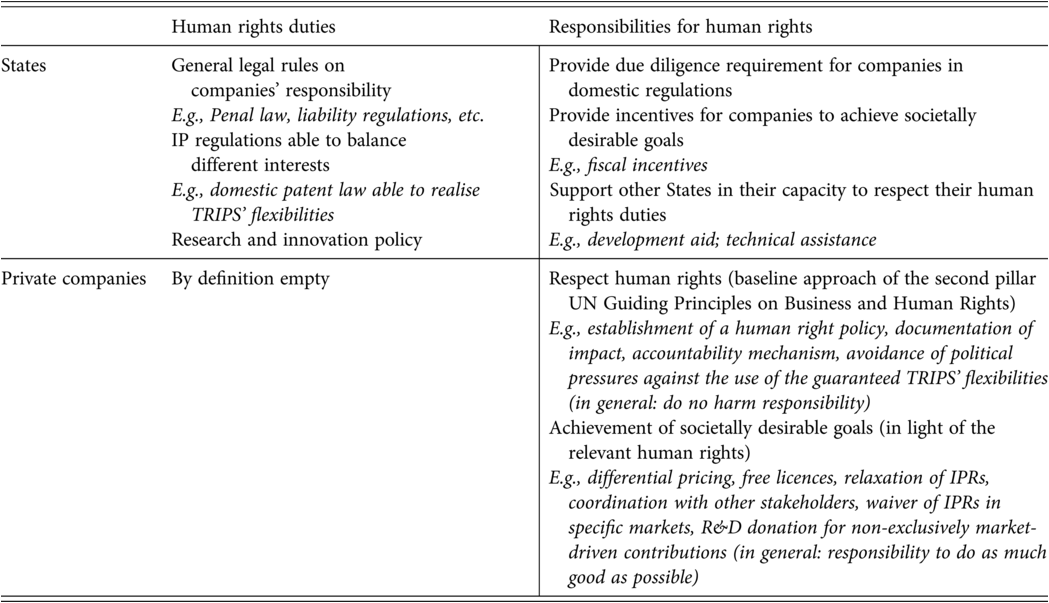

 Open access