Book contents
11 - Conclusion
Published online by Cambridge University Press: 23 December 2009

Summary
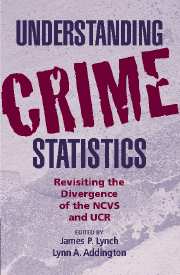
One goal of Understanding Crime Statistics is to encourage and facilitate the appropriate use of crime statistics through a discussion of the divergence of the Uniform Crime Reports (UCR) and the National Crime Victimization Survey (NCVS). We also seek to build on the idea of complementarity, which originated from the work of Biderman and Lynch (1991). Specifically, Biderman and Lynch's work makes two important points concerning crime statistics. One is that all statistical systems will distort to some degree the data produced and the important lesson for researchers is to understand how this occurs so that appropriate adjustments can be made. The second point is that it is virtually impossible to get statistical systems that are organized as differently as the NCVS and the UCR to tell the same story across the board. Given these two points, Biderman and Lynch concluded that energy and resources were better invested in discovering ways to use these data systems in complementary rather than competing ways.
Although the principle of complementarity seems to be widely accepted today, this acceptance may be fickle. Complementarity has not received a real test because of the coincidence that the two series have tracked reasonably well for more than a decade. When the two series diverge, and history tells us that they will, ready explanations for this divergence must be available as well as examples of very specific ways in which the two systems (even in a divergent state) can be used jointly to shed new light on the crime problem.
Information
- Type
- Chapter
- Information
- Understanding Crime StatisticsRevisiting the Divergence of the NCVS and the UCR, pp. 297 - 334Publisher: Cambridge University PressPrint publication year: 2006
References
(2005). “Disentangling the effects of bounding and mobility on reports of criminal victimization.” Journal of Quantitative Criminology 21:321–343.CrossRefGoogle Scholar
, , & (2003). “Changes in police notification for rape.” Criminology 41:841–872.CrossRefGoogle Scholar
Biderman, A. D., & Cantor, D. (1984, August). “A longitudinal analysis of bounding, respondent conditioning and mobility as a source of panel bias in the National Crime Survey.” Presented at the American Statistical Association, Social Statistics Section, Philadelphia.
, , & (1982). “A quasi-experimental analysis of personal victimization in the National Crime Survey.” Proceedings of the American Statistical Association, Section on Survey Methods (pp. 516–521). Washington, DC: American Statistical Association.Google Scholar
, & (1991). Understanding crime incidence statistics: Why the UCR diverges from the NCS. New York: Springer-Verlag.CrossRefGoogle Scholar
, & (2005). “Exploring the effects of changes in design on the analytical uses of the NCVS data.” Journal of Quantitative Criminology 21:293–319.CrossRefGoogle Scholar
. (2005). American Red Cross: Customer segmentation pumps new life into blood donation efforts. San Diego, CA: Author.Google Scholar
, & (2004, May). Using a dual frame sampling design increase the efficiency of reaching population subgroups in a telephone survey. Paper presented at the Annual Meetings of the American Association of Public Opinion Researchers, Phoenix, AZ.Google Scholar
Edison Media Research and Mitofsky International. (2004). Evaluation of Edison-Mitofsky Election System 2004. Washington, DC.
(2005, October 8). “Storms took toll on jobs in September: Unemployment rate up to 5.1%.” Washington Post, p. D01.Google Scholar
, & (1988). “Preliminary results from the NCVS CATI experiment.” American Statistical Association Proceedings of the Survey Research Section. Washington, DC: American Statistical Association.Google Scholar
, & (1982, March). “Broken windows: The police and public safety.” Atlantic Monthly, pp. 1–10.Google Scholar
, , & (1997). The effects of the redesign on victimization estimates: Data brief. Washington, DC: Bureau of Justice Statistics.Google Scholar
(1996). “The measurement of rape victimization in crime surveys.” Criminal Justice and Behavior 23:55–69.CrossRefGoogle Scholar
, & (2004, December). The remarkable drop in crime in New York. Paper presented at the meeting of Italy's National Institute of Statistics.Google Scholar
(2001). “The social ecology of violent victimization: Individual and contextual effects.” Journal of Quantitative Criminology 17:3–32.CrossRefGoogle Scholar
, & (2005). Crime and victimization in the three largest metropolitan areas, 1980–1998.Washington, DC: Bureau of Justice Statistics.Google Scholar
(2002). Trends in juvenile offending: An analysis of victim survey data. Washington, DC: Office of Juvenile Justice Delinquency Prevention.Google Scholar
, & (2003, November). Exploring the sources of non-response in the Uniform Crime Reports. Paper presented at the Annual Meetings of the American Society of Criminology, Denver, CO.Google Scholar
Lynch, J., & Jarvis, J. P. (2005). Towards an error profile of the Uniform Crime Reports: Assessing the magnitude of missing data and the effects of imputation. Unpublished manuscript, John Jay College, New York.
(1999). Bridging the gaps: Estimating crime rates from police data.Washington, DC: Bureau of Justice Statistics.Google Scholar
, & (2004). Dynamic scoring: A back of the envelope guide (Working Paper 11000). Cambridge, MA: National Bureau of Economic Research.CrossRefGoogle Scholar
, , & (1982). Uniform Crime Reports as organizational outcomes: Three time series experiments. Social Problems 29:361–372.CrossRefGoogle Scholar
(2003). Politics and science in census taking. Washington, DC: Population Research Bureau.Google Scholar
(1997). Time for life: The surprising way that Americans use their time. College Park: Pennsylvania State University Press.Google Scholar
(2001). Breaking away from broken windows: Baltimore neighborhoods and the nationwide fight against crime, grime, fear, and decline. Boulder, CO: Westview Press.Google Scholar
, & (1998). Prevalence, incidence and consequences of violence against women: Findings from the National Survey of Violence Against Women. Washington, DC: National Institute of Justice.Google Scholar
, , & (August, 2000). Comparing metropolitan area estimates of crime from the NCVS and UCR. Paper presented at the Joint Statistical Meetings, American Statistical Association, Indianapolis, Indiana.Google Scholar
Accessibility standard: Unknown
Why this information is here
This section outlines the accessibility features of this content - including support for screen readers, full keyboard navigation and high-contrast display options. This may not be relevant for you.Accessibility Information
Accessibility compliance for the PDF of this chapter is currently unknown and may be updated in the future.