Book contents
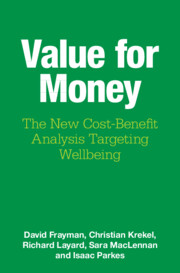
- Value for Money
- Value for Money
- Copyright page
- Contents
- Foreword
- 1Introduction and Summary
- Part IMethodology
- Part IIMental Health and Employment
- Part IIIOther Areas of Policy
- 7Education and Skills
- 8Police
- 9Green Space and the Built Environment
- 10Research and Development
- 11Roads and Railways
- 12Welfare Payments and the State Pension Age
- 13Concluding Thoughts
- Our Thanks
- Appendices
- References
- Index
9 - Green Space and the Built Environment
from Part III - Other Areas of Policy
Published online by Cambridge University Press: 21 October 2026

Book contents
- Value for Money
- Value for Money
- Copyright page
- Contents
- Foreword
- 1Introduction and Summary
- Part IMethodology
- Part IIMental Health and Employment
- Part IIIOther Areas of Policy
- 7Education and Skills
- 8Police
- 9Green Space and the Built Environment
- 10Research and Development
- 11Roads and Railways
- 12Welfare Payments and the State Pension Age
- 13Concluding Thoughts
- Our Thanks
- Appendices
- References
- Index
Summary
In this chapter, we mainly review the effect of (i) improved contact with nature and (ii) new house building near the green belt. As one example of (i) we review the case for more ‘pocket parks’ in urban areas. From a German survey of house-movers, we estimate that, when a person has one more hectare of green space within one kilometre of their house, their life satisfaction rises by 0.0066 points (out of 10). (This contradicts the theory of spatial equilibrium and traditional methods used to value nature via differences in house prices.) Given this (and the Treasury valuation of a WELLBY), a pocket park would be worth establishing, provided it cost less than £61 million per hectare.
We next consider house building when house prices have become prohibitively expensive for many people due to the shortage of land with planning permission. We review the effect of giving planning permission on land near commuter stations outside cities. We conclude that this would deliver huge benefits, and we discuss how this could be organised.
Information
- Type
- Chapter
- Information
- Value for MoneyThe New Cost-Benefit Analysis Targeting Wellbeing, pp. 85 - 96Publisher: Cambridge University PressPrint publication year: 2026
Accessibility standard: WCAG 2.0 A
Why this information is here
This section outlines the accessibility features of this content - including support for screen readers, full keyboard navigation and high-contrast display options. This may not be relevant for you.Accessibility Information
The HTML of this chapter conforms to version 2.0 of the
Web Content Accessibility Guidelines
(WCAG), ensuring core accessibility principles are addressed and meets the basic
(A)
level of WCAG compliance, addressing essential accessibility barriers.
Content Navigation
Table of contents navigation
Allows you to navigate directly to chapters, sections, or non‐text items through a linked table of contents, reducing the need for extensive scrolling.
Allows you to navigate directly to chapters, sections, or non‐text items through a linked table of contents, reducing the need for extensive scrolling.
Index navigation
Provides an interactive index, letting you go straight to where a term or subject appears in the text without manual searching.
Provides an interactive index, letting you go straight to where a term or subject appears in the text without manual searching.
Reading Order & Textual Equivalents
Single logical reading order
You will encounter all content (including footnotes, captions, etc.) in a clear, sequential flow, making it easier to follow with assistive tools like screen readers.
You will encounter all content (including footnotes, captions, etc.) in a clear, sequential flow, making it easier to follow with assistive tools like screen readers.
Short alternative textual descriptions
You get concise descriptions (for images, charts, or media clips), ensuring you do not miss crucial information when visual or audio elements are not accessible.
You get concise descriptions (for images, charts, or media clips), ensuring you do not miss crucial information when visual or audio elements are not accessible.
Full alternative textual descriptions
You get more than just short alt text: you have comprehensive text equivalents, transcripts, captions, or audio descriptions for substantial non‐text content, which is especially helpful for complex visuals or multimedia.
You get more than just short alt text: you have comprehensive text equivalents, transcripts, captions, or audio descriptions for substantial non‐text content, which is especially helpful for complex visuals or multimedia.
Structural and Technical Features
ARIA roles provided
You gain clarity from ARIA (Accessible Rich Internet Applications) roles and attributes, as they help assistive technologies interpret how each part of the content functions.
You gain clarity from ARIA (Accessible Rich Internet Applications) roles and attributes, as they help assistive technologies interpret how each part of the content functions.