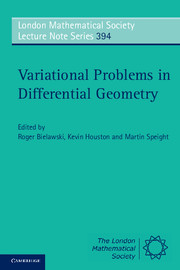
Book contents
- Frontmatter
- Contents
- List of contributors
- Preface
- 1The supremum of first eigenvalues of conformally covariant operators in a conformal class
- 2K-Destabilizing test configurations with smooth central fiber
- 3Explicit constructions of Ricci solitons
- 4Open Iwasawa cells and applications to surface theory
- 5Multiplier ideal sheaves and geometric problems
- 6Multisymplectic formalism and the covariant phase space
- 7Nonnegative curvature on disk bundles
- 8Morse theory and stable pairs
- 9Manifolds with k-positive Ricci curvature
- References
6 - Multisymplectic formalism and the covariant phase space
Published online by Cambridge University Press: 05 November 2011

Book contents
- Frontmatter
- Contents
- List of contributors
- Preface
- 1The supremum of first eigenvalues of conformally covariant operators in a conformal class
- 2K-Destabilizing test configurations with smooth central fiber
- 3Explicit constructions of Ricci solitons
- 4Open Iwasawa cells and applications to surface theory
- 5Multiplier ideal sheaves and geometric problems
- 6Multisymplectic formalism and the covariant phase space
- 7Nonnegative curvature on disk bundles
- 8Morse theory and stable pairs
- 9Manifolds with k-positive Ricci curvature
- References
Summary
In most attempts to build the mathematical foundations of Quantum Field Theory (QFT), two classical ways have been explored. The first one is often referred to as the Feynman integral or functional integral method. It is a generalization to fields of the path integral method of quantum mechanics and is heuristically based on computing integrals over the infinite dimensional set of all possible fields Φ by using a kind of ‘measure’ – which should behave like the Lebesgue measure on the set of all possible fields Φ – times eiℒ(Φ)/ℏ, where ℒ is a Lagrangian functional (but attempts to define this ‘measure’ failed in most cases). The second one is referred to as the canonical quantization method and is based on the Hamiltonian formulation of the dynamics of classical fields, by following general axioms which were first proposed by Dirac and later refined. The Feynman approach has the advantage of being manifestly relativistic, i.e. it does not require the choice of a particular system of space-time coordinate, since the main ingredient is ℒ(Φ), which is an integral over all space-time. By contrast, the canonical approach, at least its classical formulation, seems to be based on the choice of a particular time coordinate which is needed to define the Hamiltonian function through an infinite dimensional Legendre transform.
However there are alternative formulations of the Hamiltonian structure of the dynamics of classical fields, which could be used as a starting point of a covariant canonical quantization.
Information
- Type
- Chapter
- Information
- Variational Problems in Differential Geometry , pp. 94 - 126Publisher: Cambridge University PressPrint publication year: 2011
References
[1] , , Categorified Symplectic Geometry and the String Lie 2-algebra, Homology, Homotopy Appl. 12 (2010), no. 1, 221–236. arXiv:0901. 4721.Google Scholar
[2] , Variationsrechnung und partielle Differentialgleichungen erster Ordnung, Teubner, Leipzig (reprinted by Chelsea, New York, 1982); Acta litt. ac scient. univer, Szeged, Sect. Math., 4 (1929), p. 193.Google Scholar
[4] , Ueber die zweite Variation vielfache Integralen, J. reine angew. Math. 56 (1859), 122–148.Google Scholar
[5] , , Covariant description of canonical formalism in geometrical theories, in Three hundred years of gravitation ( and , eds.), Cambridge University Press, Cambridge, 1987, 676–684; E. Witten, Interacting field theory of open supertrings, Nucl. Phys. B 276 (1986), 291–324.Google Scholar
[6] , Calcul des variations, formes différentielles et champs géodésiques, in Géométrie différentielle, Colloq. Intern. du CNRS LII, Strasbourg 1953, Publ. du CNRS, Paris, 1953, p. 17–34; On the generalization of symplectic geometry to multiple integrals in the calculus of variations, in Differential Geometrical Methods in Mathematical Physics, eds. K. Bleuler and A. Reetz, Lect. Notes Maths. vol. 570, Springer-Verlag, Berlin, 1977, p. 395–456.Google Scholar
[7] , Introduction à lathéorie des invariants intégraux, Bull. Acad. Roy.Belgique (1913), 1043–1073.Google Scholar
[9] , , A co-variant approach to Ashtekar's canonical gravity, Class. Quant. Gravity, Vol. 14, N. 2, (1997), 477–488 (12).Google Scholar
[10] , , Covariant Poisson bracket in geometric field theory, Commun. Math. Phys. 256 (2005), 375–410.Google Scholar
[11] , , Multisymplectic and polysymplectic structures on fiber bundles, preprint arXiv:0708.1586.
[13] , , Symplectic approach to the theory of quantized fields, I, Commun. Math. Phys. 13 (1969), 24–44 and —, II, Arch. Rational Mech. Anal. 43 (1971), 101–124.Google Scholar
[14] , , (with the collaboraton of , , ), Momentum maps and classical relativistic fields, Part I/covariant field theory, preprint arXiv/physics/9801019
[15] , On the generalization of the canonical formalism in the classical field theory, Rep. Math. Phys. No 4, Vol. 3 (1972), 307–326.Google Scholar
[16] , , The Hamilton–Cartan formalism in the calculus of variations, Ann. Inst. Fourier Grenoble 23, 1 (1973), 203–267.Google Scholar
[17] , Hamiltonian formalisms for multidimensional calculus of variations and perturbation theory, in Noncompact problems at the intersection of geometry, analysis, and topology, Contemp. Math., 350 (2004), 127–147.Google Scholar
[18] , The use of the covariant phase space on non nonlinear fields, in preparation.
[19] , , Covariant Hamiltonian formalism for the calculus of variations with several variables: Lepage–Dedecker versus De Donder–Weyl, Adv. Theor. Math. Phys. 8 (2004), 565–601.Google Scholar
[20] , , The notion of observable in the covariant Hamiltonian formalism for the calculus of variations with several variables, Adv. Theor. Math. Phys. 8 (2004), 735–777.Google Scholar
[21] , Ueber die Reduction der Integration des partiellen Differentialgleichungen erster Ornung zwischen irgend einer Zahl Variabeln auf die Integration eines einzigen Systemes gewàhnlicher Differentialgleichungen, J. reine angew. Math. 17 (1837), 68–82.Google Scholar
[22] , Zur Theorie des Variations-Rechnung und des Differential-Gleichungen, J. reine angew. Math. 17 (1837), 97–162.Google Scholar
[23] , A finite dimensional canonical formalism in the classical field theory, Commun. Math. Phys. 30 (1973), 99–128.Google Scholar
[24] , Multiphase spaces and gauge in the calculus of variations, Bull. de l'Acad. Polon. des Sci., Série sci. Math., Astr. et Phys. XXII (1974), 1219–1225.Google Scholar
[25] , , A canonical structure for classical field theories, Commun. Math Phys. 46 (1976), 183–206.Google Scholar
[26] , Geometric quantization,in Dynamical systems IV, , , eds., Springer-Verlag, 1990.Google Scholar
[27] , Die Prinzipien der Mechanik für mehrere Variable, Sitzungsberichte Akad. Wiss. Berlin, Bd. XLVI, 14 nov. 1901, 1108; Die Prinzipien der Mechanik für mehrere unavhäangige Variable, J. Reine Angw. Math., Bd. 124 (1902), 202–277.Google Scholar
[28] , Les théorèmes de Noether – Invariance et lois de conservation au XXe siècle, Les éditions de l'Ecole Polytechnique, 2004.
[29] , Sur les champs géodésiques du calcul des variations, Bull. Acad. Roy. Belg., Cl. Sci. 27 (1936), 716–729, 1036–1046.Google Scholar
[30] , Invariante Variationsprobleme, Nachrichten von der Königlichen Gesellschaft des Wissenschaften su Göttingen, Mathematisch-physikalische Kalsse, 1918, p. 235–257.
[31] , The commutation laws of relativistic field theory, Proc. Roy. Soc. London, Ser. A, Vol. 214, No. 1117 (1952), 143–157.Google Scholar
[32] , Die Hamilton–Jacobische Theorie für Doppelintegrale, Diss. Göttingen, 1915.
[33] , Les méthodes nouvelles de la mécanique céleste, t. III, Paris, –Gauthier–Villars, 1899.Google Scholar
[34] , On covariant phase space and the variational bicomplex, Int. J. Theor. Phys., Vol. 43, No. 5 (2004), 1267–1286.Google Scholar
[35] , A note on the foundation of relativistic mechanics – II: Covariant Hamiltonian general relativity, in Topics in Mathematical Physics, General Relativity and Cosmology, , , , editors, pg 397, (World Scientific, Singapore 2006). arXiv:grqc/0202079Google Scholar
[36] , The Hamilton–Jacobi theory in the calculus of variations, its role in mathematics and physics, Krieger Pub. 1973.Google Scholar
[37] , Quantization of nonlinear systems, J. Math. Phys. vol. 1, N. 6 (1960), 468–488.Google Scholar
[38] , Geometric quantization and quantum Mechanics, Appl. Math. Sci. 30, Springer-Verlag 1980.Google Scholar
[40] , A global formulation of the inverse problem of the calculus of variations, J. Diff. Geom. 14 (1979), 543–562.Google Scholar
[41] , The C-spectral sequence, Lagrangian formalism, and conservations laws, I and II, J. Math. Anal. Appl. 100 (1984), 1–40 and 41–129.Google Scholar
[42] , Secondary calculus and the covariant phase space, J. Geom. Phys. 59 (2009), no. 4, 426–447.Google Scholar
[43] , The Lagrangian–Hamiltonian Formalism for Higher Order Field Theories, J. Geom. Phys. 60 (2010), no. 6-8, 857–873. arXiv:0905.4580.Google Scholar
[44] , Partial Differential Hamiltonian Systems, preprint arXiv:0903.4528
[45] , Sulle equazioni differenziali che provengono da questiono di calcolo delle variazioni, Rend. Cont. Acad. Lincei, ser. IV, vol. VI, 1890, 42–54.Google Scholar
[46] , Sopra una estensione della teoria Jacobi–Hamilton del calcolo delle varizioni, Rend. Cont. Acad. Lincei, ser. IV, vol. VI, 1890, 127–138.Google Scholar
[47] , Geodesic fields in the calculus of variation for multiple integrals, Ann. Math. (3) 36 (1935), 607–629.Google Scholar
[48] , Action functional and global geometry, in Mathematical aspects of string theory, , eds., Advanced Series in Mathematical Physics, vol 1, World Scientific, 1987, 259–284.Google Scholar
Accessibility standard: Unknown
Why this information is here
This section outlines the accessibility features of this content - including support for screen readers, full keyboard navigation and high-contrast display options. This may not be relevant for you.Accessibility Information
Accessibility compliance for the PDF of this chapter is currently unknown and may be updated in the future.
- 15
- Cited by