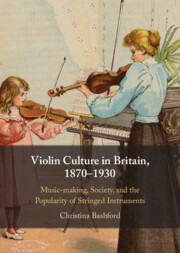
 Violin Culture in Britain, 1870–1930
Music-making, Society, and the Popularity of Stringed Instruments
Book contents
- Violin Culture in Britain, 1870–1930
- Violin Culture in Britain, 1870–1930
- Copyright page
- Contents
- Figures
- Tables
- Acknowledgments
- Notes on the Text
- Abbreviations
- Introduction
- 1 Growth of a Culture
- Part I People and Practicalities
- Part II The Conceptual Presence of Strings
- Conclusion
- Select Bibliography
- Index
Conclusion
Published online by Cambridge University Press: 13 September 2025

Book contents
- Violin Culture in Britain, 1870–1930
- Violin Culture in Britain, 1870–1930
- Copyright page
- Contents
- Figures
- Tables
- Acknowledgments
- Notes on the Text
- Abbreviations
- Introduction
- 1 Growth of a Culture
- Part I People and Practicalities
- Part II The Conceptual Presence of Strings
- Conclusion
- Select Bibliography
- Index
Summary
The remarkable take-up of the violin and the coalescence of a culture of learning and playing stringed instruments in the classical tradition, 1870–1930, had structural and democratizing effects on how British musical life developed. Expanding numbers of competent players increased the size and depth of the music profession and contributed to the growth of opportunities for audiences to hear live music, often well beyond the concert hall. The interrelated expansion of teacher numbers generated new generations of learners who would treat music as a leisure pursuit and whose critical mass prompted the foundation of many amateur symphony orchestras and often sustained amateur choral performances nationwide. Alongside came a significant revolution in string playing’s social demography. Whereas in 1870 string playing was the occupation or pastime of men, by the early twentieth century women had broken firmly into these arenas and were obtaining work in many (though not all) areas of the music profession. Cross-class, multigenerational learning contributed to the sea change, especially in the wave of working-class adults and children who found affordable group string instruction at local educational institutes or in elementary schools.
Information
- Type
- Chapter
- Information
- Violin Culture in Britain, 1870–1930Music-making, Society, and the Popularity of Stringed Instruments, pp. 304 - 312Publisher: Cambridge University PressPrint publication year: 2025
Accessibility standard: WCAG 2.0 A
Why this information is here
This section outlines the accessibility features of this content - including support for screen readers, full keyboard navigation and high-contrast display options. This may not be relevant for you.Accessibility Information
The HTML of this chapter
conforms to version 2.0 of the
Web Content Accessibility Guidelines
(WCAG), ensuring core accessibility principles are addressed and meets the basic
(A)
level of WCAG compliance, addressing essential accessibility barriers.
Content Navigation
Table of contents navigation
Allows you to navigate directly to chapters, sections, or non‐text items through a linked table of contents, reducing the need for extensive scrolling.
Allows you to navigate directly to chapters, sections, or non‐text items through a linked table of contents, reducing the need for extensive scrolling.
Index navigation
Provides an interactive index, letting you go straight to where a term or subject appears in the text without manual searching.
Provides an interactive index, letting you go straight to where a term or subject appears in the text without manual searching.
Reading Order & Textual Equivalents
Single logical reading order
You will encounter all content (including footnotes, captions, etc.) in a clear, sequential flow, making it easier to follow with assistive tools like screen readers.
You will encounter all content (including footnotes, captions, etc.) in a clear, sequential flow, making it easier to follow with assistive tools like screen readers.
Short alternative textual descriptions
You get concise descriptions (for images, charts, or media clips), ensuring you do not miss crucial information when visual or audio elements are not accessible.
You get concise descriptions (for images, charts, or media clips), ensuring you do not miss crucial information when visual or audio elements are not accessible.
Visual Accessibility
Use of colour is not sole means of conveying information
You will still understand key ideas or prompts without relying solely on colour, which is especially helpful if you have colour vision deficiencies.
You will still understand key ideas or prompts without relying solely on colour, which is especially helpful if you have colour vision deficiencies.
Structural and Technical Features
ARIA roles provided
You gain clarity from ARIA (Accessible Rich Internet Applications) roles and attributes, as they help assistive technologies interpret how each part of the content functions.
You gain clarity from ARIA (Accessible Rich Internet Applications) roles and attributes, as they help assistive technologies interpret how each part of the content functions.