Book contents
- Frontmatter
- Contents
- List of Contributors
- Series Foreword
- Introduction: Sociocultural Theory and Education: Students, Teachers, and Knowledge
- PART ICONCEPTS AND PARADIGMS
- PART IIDEVELOPMENT AND LEARNING
- 6Periods in Child Development
- 7Development Through the Lifespan
- 8Learning and Development of Preschool Children from the Vygotskian Perspective
- 9The Learning Activity in the First Years of Schooling
- 10Remediation Through Educationw
- PART IIISOCIOCULTURAL THEORY APPLICATION IN THE CLASSROOM
- PART IVDIVERSE LEARNERS AND CONTEXTS OF EDUCATION
- Author Index
- Subject Index
- Titles in the series
- References
10 - Remediation Through Educationw
The Developmental Path Toward Reflection
Published online by Cambridge University Press: 05 June 2012

Book contents
- Frontmatter
- Contents
- List of Contributors
- Series Foreword
- Introduction: Sociocultural Theory and Education: Students, Teachers, and Knowledge
- PART ICONCEPTS AND PARADIGMS
- PART IIDEVELOPMENT AND LEARNING
- 6Periods in Child Development
- 7Development Through the Lifespan
- 8Learning and Development of Preschool Children from the Vygotskian Perspective
- 9The Learning Activity in the First Years of Schooling
- 10Remediation Through Educationw
- PART IIISOCIOCULTURAL THEORY APPLICATION IN THE CLASSROOM
- PART IVDIVERSE LEARNERS AND CONTEXTS OF EDUCATION
- Author Index
- Subject Index
- Titles in the series
- References
Summary
In spite of the fact that the field of remedial (special) education and school psychology was the source and testing ground for many of Vygotsky's innovative ideas, this domain itself has remained in the shadow of his scientific heritage in the West. The publication of the second volume of Vygotsky's collected works, The Fundamentals of Defectology (Vygotsky, 1993), has created a knowledge base for the theoretical elaboration and practical implications of Vygotsky's ideas within the North American system of special education. In order for this volume to be of the utmost help, the following should be considered:
Defectology is the term that reflects the area of Vygotsky's research and practice that is relevant to contemporary special education and school psychology. The term itself sounds rather degrading. As once noted by McCagg (1989, p. 40), this term would not survive a scientific discussion in the Western world today because it carries too many negative connotations regarding individuals with a disability. Ironically, the negative undertone of the term itself is in no way present in the inspiring and positive attitude of Vygotsky writings. The word defectologia (or defectology in the English transliteration) literally means the study of defect. In Russia, for more than a century this term has referred to the study of children with disabilities and the methods used for their evaluation, education, and upbringing.
[…]
Information
- Type
- Chapter
- Information
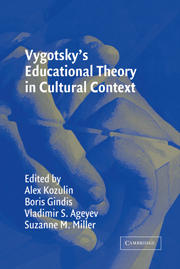
- Vygotsky's Educational Theory in Cultural Context , pp. 200 - 222Publisher: Cambridge University PressPrint publication year: 2003
References
AAMR (1992). Mental retardation: Definition, classification, and systems of supports (9th ed.). Washington, DC: American Association on Mental Retardation
(1997). The remediation of executive functions in children with cognitive disorders: The Vygotsky-Luria neuropsychological approach. Journal of Intellectual Disability Research, 41(pt. 2), 144–151CrossRefGoogle ScholarPubMed
ALMANAH (2000–2002). Moscow: Institute of Corrective Pedagogy. Available at: www.ise.iip.net/almanah
Bakhurst, D., & Padden, C. (1991). The Meshcheryakov experiment: Soviet work on the education of blind/deaf children. Learning and Instruction, 1, 201–215CrossRef
Bein, E. S., Vlasova, T. A., Levina, R. E., Morozova, N. G., & Shif, Z. I. (1993). Afterword. In The collected works of L. S. Vygotsky. Vol. 2. The fundamentals of defectology (abnormal psychology and learning disabilities), pp. 302–314. (Jane E. Knox and Carol B. Stevens, Trans.) (R. W. Rieber and A. S. Carton, Eds.). New York: Plenum PressCrossRef
Belopolskaya, N. L., & Grebennikova, N. V. (1997). Neuropsychology and psychological diagnosis of abnormal development. In E. L. Grigorenko, P. M. Ruzgis, & R. J. Sternberg (Eds.), Russian psychology: Past, present, and future (pp. 155–179). Commack, NY: Nova Academic Press
, & (1992). Differentsial'no-psikhologicheskaia diagnostika deteei s intellektual'noi nedastatochnost'iu [Differential psychological diagnostics of children with cognitive deficiency]. Psikhologichesky Zhurnal, 4, 98–97Google Scholar
Berk, L. & Winsler, A. (1995). Scaffolding children's learning: Vygotsky and early childhood education. Washington, DC: National Association for the Young Children
Bruner, J. (1987). Prologue to the English edition. In R. W. Rieber and A. S. Carton, (Eds.), The collected works of L. S. Vygotsky. Vol. 1. Problems of general psychology, pp. 1–16 (Norris Minick, Trans.). Editors of the English translation: New York: Plenum Press
Chulkov, V. N., Lubovsky, V. I., & Martsinovskaia, E. N. (Eds.) (1990). Differentsirovannyi podkhod pri obuchennii i vospitan slepoglukhikry detei [Differentiative approaches to the teaching and upbringing of deaf-blind children]. Moscow: Academia Pedagogicheskikh Nauk
Clay, M. M., & Cazden, C. B. (1990). A Vygotskian interpretation of reading recovery. In L. Moll (Ed.), Vygotsky and education: Instructional implications and application of social-historical psychology (pp. 206–222). London: Cambridge University PressCrossRef
Cole, G. (1987). The learning mystique: A critical look at “learning disabilities.” New York: Fawcett Columbine
Daniels, H., & Lunt, I. (1993). Vygotskian theory and special education practice in Russia. Educational Studies, 19(1), 79–89CrossRef
, & (1997). PASS Reading Enhancement Program: A short manual for teachers. Journal of Cognitive Education, 5(3), 193–208Google Scholar
Das, J. P., Naglieri, J. A., & Kirby, J. R. (1994). Assessment of cognitive processes: The PASS theory of intelligence. Boston: Allyn & Bacon
Echevarria, J., & McDonough, R. (1993). Instructional conversations in special education setting: Issues and accommodations. Educational Practice Report: 7. National Center for Research on Cultural Diversity and Second Language Learning. Washington, DC. Available at: http://www.ncbe.gwu.edu
Feuerstein, R., & Gross, S. (1997). The learning potential assessment device. In D. Flanagan, Genshaft, J., & Harrison, P. (Eds.), Contemporary intellectual assessment: Theories, tests, and issues. New York: Guilford Press
Feuerstein, R., Rand, Y., Hoffman, N., & Miller, R. (1980). Instrumental enrichment: An intervention program for cognitive modifiability. Baltimore: University Park Press
, & (1994). Inclusive school movement and the radicalization of special education reform. Exceptional Children, 60, 294–309CrossRefGoogle Scholar
Gindis, B. (1986). Special education in the Soviet Union: Problems and perspectives. The Journal of Special Education, 20(3), 375–383CrossRef
(1994). Vygotsky's defectology. American Journal on Mental Retardation, 100(2), 214–216Google Scholar
(1996). Assessment of cognitive processes: The PASS theory of intelligence. School Psychology International, 17(3), 305–308CrossRefGoogle Scholar
Gindis, B. (1998). Navigating uncharted waters: School psychologists working with internationally adopted post-institutionalized children. Communiqué (National Association of School Psychologists) September (Part l) 27(1), 6–9 and October (Part ll) 27(2), pp. 20–23
(1989). Multidimensional treatment of mental retardation (Edgar A. Doll Award Address). Psychology in Mental Retardation and Developmental Disabilities, 15(1), 1–10Google Scholar
Haywood, H. C. (1993). A mediational teaching style. International Journal of Cognitive Education and Mediated Learning, 3(1), 27–38
Haywood, H. C., Brooks, P. H., & Burns, S. (1992). Bright start: Cognitive curriculum for young children. Watertown, MA: Charles Bridge
Haywood, H. C., Brown, A., & Wingenfeld, S. (1990). Dynamic approaches to psychoeducational assessment. School Psychology Review, 19(4), 411–422
Haywood, H. C., & Tzuriel, D. (1992). Interactive assessment. New York: Springer-Verlag
Ivanova, A. Y. (1976). Obuchaemost kak printsip otsenki ymstvennogo pazvitia u detei [Learning Aptitude as a Diagnostic Method in Cognitive Development of Children]. Moscow: Pedagogika
Jamieson, J. R. (1994). Teaching as transaction: Vygotskian perspective on deafness and mother-child interaction. Exceptional Children, 60, 434–449CrossRef
Kauffman, J. M., & Hallahan, D. P. (1995). The illusion of full inclusion. Austin, TX: Pro-Ed
Knox, J., & Kozulin, A. (1989). The Vygotskian tradition in Soviet psychological study of deaf children. In W. O. McCagg & L. Siegelbaum (Eds.), The disabled in the soviet union, pp. 88–99. Pittsburgh: University of Pittsburgh Press
Knox, J., & Stevens, C. (1993). Vygotsky and Soviet Russian defectology: An introduction. In R. W. Rieber & A. S. Carton (Eds.), The collected works of L. S. Vygotsky. Vol. 2: The Fundamentals of Defectology (abnormal psychology and learning disabilities), pp. 1–28. New York: Plenum PressCrossRef
Kozulin, A. (1990). Vygotsky's psychology: A biography of ideas. Cambridge, MA: Harvard University Press
Kozulin, A. (1986). Vygotsky in context. In L. S. Vygotsky, Thought and language (rev. ed.). Cambridge, MA: MIT Press
Kozulin, A. (1998). Psychological tools: A sociocultural approach to education. Cambridge, MA: Harvard University Press
, & (1995). Mediated learning experience and psychological tools: Vygotsky's and Feuerstein's perspectives in a study of student learning. Educational Psychologist, 30(2), 67–75CrossRefGoogle Scholar
Lebedinsky, V. V. (1985). Narushchenia v psikhicheskom razvitii u detei [Disorders in children's psychological development]. Moscow: MGU Press
(1995). Dynamic assessment and the legacy of L. S. Vygotsky. School psychology international, 16(2), 143–153CrossRefGoogle Scholar
Lidz, C., & Elliott, J. (Eds.) (2000). Dynamic assessment: Prevailing models and applications. Oxford: Elsevier Science
Lipsky, D., & Gartner, A. (1996). Inclusion, school restructuring, and the remaking of american society. Harvard Educational Review, 66, 762–796CrossRef
Lubovsky, V. I. (1989). Psikhologicheskie problemy diagnostiki anormalnogo razvitia detei [Psychological issues in diagnostic of children with abnormal development]. Moscow: Pedagogika Press
Lubovsky, V. I. (1990). Psikhologicheskii Experiment v Differentcialnoi Diagnistike Umstvennoi Otstalosti [Psychological experiment in differential diagnosis of mental retardation in children]. Defectology, 6, 3–16
Lubovsky, V. I. (1996). L. S. Vygotsky i Spetcialnaya Psikhologia. [L. S. Vygotsky and special psychology]. Voprosy Psikhologii, 6, 118–125
Luria, A. R. (1979). The making of mind: A personal account of Soviet psychology. Cambridge, MA: Harvard University Press
Lurie, L., & Kozulin, A. (1998). The instrumental enrichment cognitive intervention program with deaf Ethiopian immigrant children in Israel. In A. Weisel (Ed.), Issues unresolved: New perspectives on language and deaf education (pp. 161–170). Washington, DC: Gallaudet University Press
McCagg, W. O. (1989). The Origins of Defectology. In W. O. McCagg & L. Siegelbaum (Eds.), The disabled in the Soviet Union, pp. 1–18. Pittsburgh: University of Pittsburgh Press
Malofeev, N. N. (2001). Specialnoe Obuchenie v Rossii I Zagranistei [Special Education in Russia and Abroad]. Moscow: Institute of Corrective Pedagogy, Pechatnyi Dvor. Available at: www.ise.iip.net/almanah
Meshcheryakov, A. (1979). Awakening to life: Forming behavior and mind in deaf-blind children (K. Judelson, Trans.). Moscow: Progress
Minick, N. (1987). Implication of Vygotsky's theories for dynamic assessment. In C. Lidz (Ed.), Dynamic assessment: An interactional approach to evaluating learning potential, pp. 116–140. New York: Guilford
Newman, F., & Holzman, L. (1993). Lev Vygotsky: Revolutionary scientist. London, New York: Routledge
Petrovsky, A., & Yaroshevsky, M. (1998). Kratki Psickologicheskii Slovar [Brief psychological encyclopedia]. Rostov-na-Dony, Russia: Fenix
Presseisen, B., & Kozulin A. (1994). Mediated learning: The contribution of Vygotsky and Feuerstein in theory and practice. In M. Ben-Hur (Ed.), On Feuerstein's instrumental enrichment, pp. 51–82. Palatine, IL: IRI/Skylight
Rubinshtein, S. Y. (1979). Psikhologia umstvenno otstalogo shkolnika [Psychology of a mentally retarded student]. Moscow: Prosvecshenie Press
Rueda, R., Goldenberg, C., & Gallimore, R. (1992). Rating instructional conversations: A guide. Educational Practice Report: 4. National Center for Research on Cultural Diversity and Second Language Learning. Washington, DC. Available at: http://www.ncbe.gwu.edu
Schulte, A., Osborn, S., & Erchul, W. (1998). Effective special education: A United States dilemma. School Psychology Review, 27(1), 66–77
Smith-Davis, J. (2000). People with disabilities in Russia: Progress and prospects. In Keith, K., & Schalock, R. (Eds.), Cross-cultural perspectives on quality of life, pp. 126–134. Washington, DC: AAMR
Stainback, S., Stainback, W., & Forest, M. (1989). Educating all students in the mainstream of regular education. Baltimore: Brookes
Strebeleva, E. A. (2000). Rannyia diagnostika umstvennoi otstalosti [Procedures for early diagnostic of mental retardation] (Vol. 2, pp. 2–11). Moscow: Institute of Corrective Pedagogy, Almanah, Available at: www.ise.iip.net/almanah/2/st09.htm
Suddaby, A. (1998). Children with learning difficulties. In J. Riordan (Ed.), Soviet education: The gifted and the handicapped. London: Routledge
Sutton, A. (1988). Special education for handicapped pupils. In J. Riordan (Ed.), Soviet education: The gifted and the handicapped. London: Routledge
Tzuriel, D. (2001). Dynamic assessment of young children. New York: Kluwer Academic/Plenum Publishers
, , , & (1999). The effectiveness of Bright Start Program in kindergarten on transfer abilities and academic achievements. Early Childhood Research Quarterly, 14, 111–141CrossRefGoogle Scholar
van der Veer, R., & Valsiner, J. (1991). Understanding Vygotsky: A quest for synthesis. Oxford: Basil Blackwell
Venger, A. L. (1994). Structura Psychologicheskogo Syndroma [Structure of psychological syndrome]. Voprosy Psichologii, 4, 82–92
Vlasova, T. A. (1984). Otbor detei v vspomogatelny shkolu [Screening children for special schools]. Moscow: Pedagogika
Vlasova, T. A., Lubovsky, V. I., & Tsypina, N. A. (Eds.) (1984). Deti s zaderzkoi psikhicheskogo razvitia [Children with delayed mental development]. Moscow: APN RSFSR
Vygotsky, L. S. (1983). Sobraniye Sochinenii [Collected works] (Vol. 5). Moscow: Pedagogika
Vygotsky, L. S. (1987). The collected works of L. S. Vygotsky. Vol. 1. Problems of general psychology (Norris Minick, Trans.) (R. W. Rieber & A. S. Carton. Eds.). New York: Plenum Press
Vygotsky, L. S. (1993). The collected works of L. S. Vygotsky. Vol. 2: The fundamentals of defectology (abnormal psychology and learning disabilities) (Jane E. Knox and Carol B. Stevens, Trans.) (R. W. Rieber & A. S. Carton, Eds.). New York: Plenum Press
Vygotsky, L. S. (1995). Problemy Defectologii [Problems of defectology] Moscow: Prosvecshenie Press
Yaroshevsky, M. G. (1993). L. S. Vygotsky: V Poiskach Novoi Psichologii. [Vygotsky: In search for the new psychology]. St. Petersburg, Russia: Publishing House of International Foundation for History of Science
, , & (1999). Vygotsky, sign language, and the education of deaf pupils. The Journal of Deaf Studies and Deaf Education, 4(1), 9–15CrossRefGoogle ScholarPubMed
Accessibility standard: Unknown
Why this information is here
This section outlines the accessibility features of this content - including support for screen readers, full keyboard navigation and high-contrast display options. This may not be relevant for you.Accessibility Information
Accessibility compliance for the PDF of this chapter is currently unknown and may be updated in the future.
- 16
- Cited by