
Skip to main content Accessibility help
×
  • Cited by 3
    • Show more authors
    • Open Access
      You have digital access to this book
    • Select format
    • Publisher:
      Cambridge University Press
      Publication date:
      23 November 2023
      09 November 2023
      ISBN:
      9781009263757
      9781009263788
      9781009263795
      Creative Commons:
      Creative Common License - CC Creative Common License - BY Creative Common License - NC
      This content is Open Access and distributed under the terms of the Creative Commons Attribution licence CC-BY-NC 4.0.
      https://creativecommons.org/creativelicenses
      Dimensions:
      (229 x 152 mm)
      Weight & Pages:
      0.76kg, 414 Pages
      Dimensions:
      (229 x 152 mm)
      Weight & Pages:
      0.668kg, 412 Pages
    Open Access
    You have digital access to this book
    Selected: Digital
    View content
    Add to cart View cart Buy from Cambridge.org

    Book description

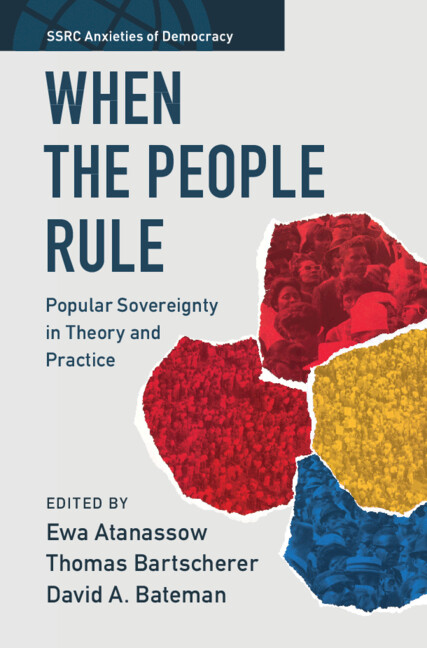
    In recent decades, popular sovereignty has come under increasing pressure. The rise of populism, often illiberal or authoritarian, has undermined minority rights, individual autonomy, and rule of law. The expansion of international institutions and greater reliance on market and non-governmental organizations have gradually insulated large areas of policymaking from public control. In turn, these developments cast doubt on the viability and desirability of liberal democracy itself. When the People Rule argues that comprehending and responding to the political crises of our time requires a radical refocusing on popular sovereignty. Each chapter offers a fresh perspective and opens new avenues of inquiry into popular sovereignty, advancing debate over the very heart of this principle - what it means for the people to rule. Thorough and timely, this volume is also available as Open Access on Cambridge Core.

    Reviews

    ‘‘We, the People…’ are the beginning words of the American Constitution, perhaps ‘the’ founding document of popular sovereignty. Yet who are the People, and who decides who they are, and how? Such questions imply contested notions of identity, belonging, representation and agency. The excellent contributions to this timely volume do not shy away from controversy when pointing to the many challenges autocratic tendencies and nationalisms pose to the liberal order. The book is a ‘must-read’ for students of democracy and the future of liberalism.’

    Helmut K. Anheier - Hertie School

    ‘This wide-ranging and timely volume argues persuasively that popular sovereignty is an essential concept for understanding political life. Drawing on an impressive variety of scholarly perspectives, the contributors show how popular sovereignty is an indispensable framework not only for analyzing the origins and evolution of modern democracies and their troubled present, but also for imagining their futures.’

    Ran Halévi - Gallimard

    ‘When the People Rule is a refreshingly wide ranging, historically rich and conceptually sophisticated set of essays that illuminate the theory and practice of popular sovereignty. Its star cast of theorists and historians rescues the idea of self-rule from the condescension of those who regard it as an empty place holder or a purely formal concept. Instead, it focuses on how political sovereignty is made to work in different contexts through constant innovation and the actual labor of politics. Its essays shed light on many old puzzles in political theory. At the same time, it powerfully illuminates contemporary political debates over democracy and populism.’

    Pratap Bhanu Mehta - Princeton University and Center for Policy Research Delhi

    ‘Who are The People? Should they rule? Can they? Do they? How? These are among the oldest and deepest questions in political theory. The answers offered by the erudite and provocative essays in this stellar collection set the terms for debating the most pressing issues facing democracy today.’

    Josiah Ober - Stanford University

    Refine List

    Actions for selected content:

    Select all | Deselect all
    • View selected items
    • Export citations
    • Download PDF (zip)
    • Save to Kindle
    • Save to Dropbox
    • Save to Google Drive

    Save Search

    You can save your searches here and later view and run them again in "My saved searches".

    Please provide a title, maximum of 40 characters.
    ×

    Contents

    Full book PDF

    Page 2 of 2


    • 17 - The Voices of the People
      pp 304-319
    • Epilogue
      pp 320-334
    • The Precipice of Hope: A Conversation with Hahrie Han
    • Select Bibliography
      pp 335-370
    • Speeches
      pp 370-372
    • Index
      pp 373-392

    Page 2 of 2


    Metrics

    Altmetric attention score

    Full text views

    Total number of HTML views: 0
    Total number of PDF views: 0 *
    Loading metrics...

    Book summary page views

    Total views: 0 *
    Loading metrics...

    * Views captured on Cambridge Core between #date#. This data will be updated every 24 hours.

    Usage data cannot currently be displayed.

    Accessibility standard: WCAG 2.2 AAA

    Why this information is here

    This section outlines the accessibility features of this content - including support for screen readers, full keyboard navigation and high-contrast display options. This may not be relevant for you.

    Accessibility Information

    The HTML of this book complies with version 2.2 of the Web Content Accessibility Guidelines (WCAG), offering more comprehensive accessibility measures for a broad range of users and attains the highest (AAA) level of WCAG compliance, optimising the user experience by meeting the most extensive accessibility guidelines.

    Content Navigation
    Table of contents navigation

    Allows you to navigate directly to chapters, sections, or non‐text items through a linked table of contents, reducing the need for extensive scrolling.

    Index navigation

    Provides an interactive index, letting you go straight to where a term or subject appears in the text without manual searching.

    Reading Order and Textual Equivalents
    Single logical reading order

    You will encounter all content (including footnotes, captions, etc.) in a clear, sequential flow, making it easier to follow with assistive tools like screen readers.

    Full alternative textual descriptions

    You get more than just short alt text: you have comprehensive text equivalents, transcripts, captions, or audio descriptions for substantial non‐text content, which is especially helpful for complex visuals or multimedia.

    Visualised data also available as non‐graphical data

    You can access graphs or charts in a text or tabular format, so you are not excluded if you cannot process visual displays.

    Visual Accessibility
    Use of high contrast between text and background colour

    You benefit from high‐contrast text, which improves legibility if you have low vision or if you are reading in less‐than‐ideal lighting conditions.
