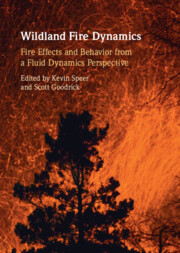
Book contents
- Wildland Fire Dynamics
- Wildland Fire Dynamics
- Copyright page
- Contents
- Contributors
- 1 Wildland Fire Combustion Dynamics
- 2 The Structure of Line Fires at Flame Scale
- 3 Energy Transport and Measurements in Wildland and Prescribed Fires
- 4 Fire Line Geometry and Pyroconvective Dynamics
- 5 Firebrands
- 6 Re-envisioning Fire and Vegetation Feedbacks
- 7 Wind and Canopies
- 8 Coupled Fire–Atmosphere Model Evaluation and Challenges
- Index
- References
1 - Wildland Fire Combustion Dynamics
The Intersection of Combustion Chemistry and Fluid Dynamics
Published online by Cambridge University Press: 16 June 2022

Book contents
- Wildland Fire Dynamics
- Wildland Fire Dynamics
- Copyright page
- Contents
- Contributors
- 1 Wildland Fire Combustion Dynamics
- 2 The Structure of Line Fires at Flame Scale
- 3 Energy Transport and Measurements in Wildland and Prescribed Fires
- 4 Fire Line Geometry and Pyroconvective Dynamics
- 5 Firebrands
- 6 Re-envisioning Fire and Vegetation Feedbacks
- 7 Wind and Canopies
- 8 Coupled Fire–Atmosphere Model Evaluation and Challenges
- Index
- References
Summary
To “spread like wildfire” is a phrase used to describe something that propagates unexpectedly, rapidly, and incessantly. Much of the unpredictable behavior of a wildfire stems from processes including the heat released from the combustion zone (flames), the structure and condition of fuels, the wind field and turbulence driving the fire, and terrain. However, the chemical make-up of the biomass fuel that powers a wildfire also provides a source for the capricious nature of combustion and the behavior of wildfires. This chapter provides a brief overview of the chemistry of biomass fuels and the chemical processes by which such fuels combust and release the energy that enables the fire to become self-sustaining. It then looks in some detail at the mechanisms through which the combustion chemistry driving the heat release from the fuels is influenced by the environment surrounding the combustion zone. In the worst instances these mechanisms can result in fire behavior that causes widespread death and destruction often over a very short period of time. In the best instances they enable fire to be used as a reliable tool for reducing the hazard present in the wild landscapes of our countryside and surrounding our homes.
Keywords
Information
- Type
- Chapter
- Information
- Wildland Fire DynamicsFire Effects and Behavior from a Fluid Dynamics Perspective, pp. 1 - 34Publisher: Cambridge University PressPrint publication year: 2022
References
Anderson, HE, Rothermel, RC (1965) Influence of moisture and wind upon the characteristics of free-burning fires. Symposium (International) on Combustion 10(1), 1009–1019.CrossRefGoogle Scholar
Andreae, MO (2019) Emission of trace gases and aerosols from biomass burning: An updated assessment. Atmospheric Chemistry and Physics 19(13), 8523–8546.CrossRefGoogle Scholar
Andreae, MO, Merlet, P (2001) Emission of trace gases and aerosols from biomass burning. Global Biogeochemical Cycles 15(4), 955–966.CrossRefGoogle Scholar
Antal, MJ, Várhegyi, G (1995) Cellulose pyrolysis kinetics: The current state of knowledge. Industrial & Engineering Chemistry Research 34(3), 703–717.CrossRefGoogle Scholar
Antal, MJ, Várhegyi, G, Jakab, E (1998) Cellulose pyrolysis kinetics: Revisited. Industrial & Engineering Chemistry Research 37(4), 1267–1275.Google Scholar
Atreya, A (1998) Ignition of fires. Philosophical Transactions of the Royal Society A: Mathematical, Physical and Engineering Sciences, 356(1748), 2787–2813.Google Scholar
Bachelard, G (1938) The Psychoanalysis of Fire. London: Quartet Books. (orig. La Psychanalyse du Feu, trans. Alan C.M. Ross, 1964).Google Scholar
Ball, R, McIntosh, AC, Brindley, J (1999a) The role of char-forming processes in the thermal decomposition of cellulose. Physical Chemistry Chemical Physics 1(21), 5035–5043.Google Scholar
Ball, R, McIntosh, AC, Brindley, J (1999b) Thermokinetic models for simultaneous reactions: A comparative study. Combustion Theory and Modelling 3(3), 447–468.Google Scholar
Ball, R, McIntosh, AC, Brindley, J (2004) Feedback processes in cellulose thermal decomposition: Implications for fire-retarding strategies and treatments. Combustion Theory and Modelling 8(2), 281–291.CrossRefGoogle Scholar
Beall, FC, Eickner, HW (1970) Thermal Degradation of Wood Components: A Review of the Literature. Research Paper FPL 130. USDA Forest Service, Madison, Wisconsin.Google Scholar
Bilger, RW (1989) Turbulent diffusion flames. Annual Review of Fluid Mechanics 21(1), 101–135.CrossRefGoogle Scholar
Boonmee, N, Quintiere, JG (2005) Glowing ignition of wood: The onset of surface combustion. Proceedings of the Combustion Institute 30(2), 2303–2310.CrossRefGoogle Scholar
Bowman, CT (1975) Non-equilibrium radical concentrations in shock-initiated methane oxidation. Symposium (International) on Combustion 15(1), 869–882.CrossRefGoogle Scholar
Branca, C, di Blasi, C (2004) Parallel- and series-reaction mechanisms of wood and char combustion. Thermal Science 8(2), 51–63.Google Scholar
Broido, A (1976) Kinetics of solid-phase cellulose pyrolysis. In: Shafizadeh, F, Sarkanen, KV, Tillman, DA, eds. Thermal Uses and Properties of Carbohydrates and Lignins. New York: Academic Publishing, pp. 19–36.Google Scholar
Broido, A, Javierson, AC, Ouano, AC, BarrallII, EM (1973) Molecular weight decrease in the early pyrolysis of crystalline and amorphous cellulose. Journal of Applied Polymer Science 17(12), 3627–3635.Google Scholar
Broido, A, Weinstein, M (1970) Thermogravimetric analysis of ammonia-swelled cellulose. Combustion Science and Technology 1(4), 279–285.Google Scholar
Cheney, NP (2008) Can forestry manage bushfires in the future? Australian Forestry 71(1), 1–2.Google Scholar
Cheney, P, Sullivan, A (2008) Grassfires: Fuel, Weather and Fire Behaviour, 2nd ed. Collingwood, Australia: CSIRO Publishing.Google Scholar
Coblentz, WW (1905) Infra-red absorption spectra, II: Liquids and solids. The Physical Review 20(6), 337–363.Google Scholar
Cruz, MG, Gould, JS, Kidnie, S, Bessell, R, Nichols, D, Slijepcevic, A (2015) Effects of curing on grassfires: II. Effect of grass senescence on the rate of fire spread. International Journal of Wildland Fire 24(6), 838–848.Google Scholar
Cruz, MG, Hurley, RJ, Bessell, R, Sullivan, AL (2020) Fire behaviour in wheat crops: Effect of fuel structure on rate of fire spread. International Journal of Wildland Fire 29(3), 258–271.CrossRefGoogle Scholar
Deguchi, S, Tsujii, K, Horikoshi, K (2006) Cooking cellulose in hot and compressed water. Chemical Communications 11(31), 3293–3295.Google Scholar
Demirbaş, A (2004) Combustion characteristics of different biomass fuels. Progress in Energy and Combustion Science 30(2), 219–230.Google Scholar
Di Blasi, C (1993) Modeling and simulation of combustion processes of charring and non-charring solid fuels. Progress in Energy and Combustion Science 19(1), 71–104.CrossRefGoogle Scholar
Di Blasi, C (1998) Comparison of semi-global mechanisms for primary pyrolysis of lignocellulosic fuels. Journal of Analytical and Applied Pyrolysis 47(1), 43–64.Google Scholar
Diebold, JP (1994) A unified, global model for the pyrolysis of cellulose. Biomass and Bioenergy 7(1–6), 75–85.CrossRefGoogle Scholar
Eghlimi, A, Lu, L, Sahajwalla, V, Harris, D (1999) Computational modelling of char combustion particles based on the structure of char particles. In: Second International Conference of CFD in the Minerals and Process Industries; December 6–8, 1999. CSIRO, Melbourne, Australia.Google Scholar
Gaydon, AG, Wolfhard, HG (1960) Flames: Their Structure, Radiation and Temperature, 2nd ed. London: Chapman and Hall Ltd.Google Scholar
Gordobil, O, Moriana, R, Zhang, L, Labidi, J, Sevastyanova, O (2016) Assessment of technical lignins for uses in biofuels and biomaterials: Structure-related properties, proximate analysis and chemical modification. Industrial Crops and Products 83(May), 155–165.Google Scholar
Gould, JS, McCaw, WL, Cheney, NP (2011) Quantifying fine fuel dynamics and structure in dry eucalypt forest (Eucalyptus marginata) in Western Australia for fire management. Forest Ecology and Management 262(3), 531–546.Google Scholar
Greenberg, JP, Friedli, H, Guenther, AB, Hanson, D, Harley, P, Karl, T (2006) Volatile organic emissions from the distillation and pyrolysis of vegetation. Atmospheric Chemistry and Physics 6(1), 81–91.Google Scholar
Grootemaat, S, Wright, IJ, van Bodegom, PM, Cornelissen, JHC (2019) Scaling up flammability from individual leaves to fuel beds. Oikos 126(10), 1428–1438.Google Scholar
Gullett, BK, Touati, A (2003) PCDD/F emissions from forest fire simulations. Atmospheric Environment 37(6), 803–813.Google Scholar
Howard, D, Macsween, K, Edwards, GC, Desservettaz, M, Guérette, E-A, Paton-Walsh, C, Surawski, NC, Sullivan, AL, Weston, C, Volkova, L, Powell, J, Keywood, MD, Reisen, F, (Mick) Meyer, CP (2019) Investigation of mercury emissions from burning of Australian eucalypt forest surface fuels using a combustion wind tunnel and field observations. Atmospheric Environment 202(Apr.), 17–27.Google Scholar
Hurst, DF, Griffith, DWT, Cook, GD (1994) Trace gas emissions from biomass burning in tropical Australian savannas. Journal of Geophysical Research 99(D8), 16441–16456.Google Scholar
Lemieux, PM, Lutes, CC, Santoianni, DA (2004) Emissions of organic air toxics from open burning: A comprehensive review. Progress in Energy and Combustion Science 30(1), 1–32.Google Scholar
Luke, RH, McArthur, AG (1978) Bushfires in Australia. Canberra: Australian Government Publishing Service.Google Scholar
McArthur, AG (1967) Fire Behaviour in Eucalypt Forests. Forestry and Timber Bureau Leaflet 107. Canberra: Commonwealth Department of National Development.Google Scholar
Milosavljevic, I, Oja, V, Suuberg, EM (1996) Thermal effects in cellulose pyrolysis: Relationship to char formation process. Industrial & Engineering Chemistry Research 35(3), 653–662.Google Scholar
Mok, WSL, Antal, MJ (1983) Effects of pressure on biomass pyrolysis. II. Heats of reaction of cellulose pyrolysis. Thermochimica Acta 68(2–3), 165–186.Google Scholar
Morrison, RT, Boyd, RN (1983) Organic Chemistry, 4th ed. Boston, MA: Allyn and Bacon, Inc.Google Scholar
Mulvaney, JJ, Sullivan, AL, Cary, GJ, Bishop, GR (2016) Repeatability of free-burning fire experiments using heterogeneous forest fuel beds in a combustion wind tunnel. International Journal of Wildland Fire 25(4), 445–455.CrossRefGoogle Scholar
Ohlemiller, TJ (1985) Modeling of smoldering combustion propagation. Progress in Energy and Combustion Science 11(4), 277–310.CrossRefGoogle Scholar
O’Sullivan, AC (1997) Cellulose: The structure slowly unravels. Cellulose 4(3), 173–207.Google Scholar
Parker, WJ, LeVan, SL (1989) Kinetic properties of the components of douglas-fir and the heat of combustion of their volatile pyrolysis products. Wood and Fiber Science 21(3), 289–305.Google Scholar
Philibert, J (2006) Some thoughts and/or questions about activation energy and pre-exponential factor. Defect and Diffusion Forum 249, 61–72.Google Scholar
Pyne, SJ, Andrews, PL, Laven, RD (1996) Introduction to Wildland Fire, 2nd ed. New York: John Wiley and Sons.Google Scholar
Rein, G (2013) Smouldering fires and natural fuels. In: Belcher, CM, ed. Fire Phenomena and the Earth System. New York: John Wiley & Sons, pp. 15–33.Google Scholar
Rein, G (2016) Smoldering Combustion. In: Hurley, MJ, Gottuk, DT, Hall, JR Jr., Harada, K, Kuligowski, ED, Puchovsky, M, Torero, JL, Watts, JM Jr., Wieczorek, CJ, eds. SFPE Handbook of Fire Protection Engineering. New York: Springer, pp. 581–603.Google Scholar
Reisen, F, Brown, S, Cheng, M (2006) Air toxics in bushfire smoke: Firefighters exposure during prescribed burns. Forest Ecology and Management 234(Supp 1), S144–S144.CrossRefGoogle Scholar
Rothermel, RC (1972) A Mathematical Model for Predicting Fire Spread in Wildland Fuels. Research Paper INT-115. USDA Forest Service, Intermountain Forest and Range Experimental Station, Odgen UT.Google Scholar
Shafizadeh, F (1982) Introduction to pyrolysis of biomass. Journal of Analytical and Applied Pyrolysis 3(4), 283–305.Google Scholar
Sullivan, AL (2017a) Inside the inferno: Fundamental processes of wildland fire behaviour. Part 1: Combustion chemistry and energy release. Current Forestry Reports 3, 132–149.Google Scholar
Sullivan, AL (2017b) Inside the inferno: Fundamental processes of wildland fire behaviour. Part 2: Heat transfer and interactions. Current Forestry Reports 3, 150–171.Google Scholar
Sullivan, AL, Ball, R (2012) Thermal decomposition and combustion chemistry of cellulosic biomass. Atmospheric Environment, 47(Feb.), 133–141.Google Scholar
Sullivan, AL, Matthews, S (2013) Determining landscape fine fuel moisture content of the Kilmore East “Black Saturday” wildfire using spatially-extended point-based models. Environmental Modelling and Software 40, 98–108.Google Scholar
Surawski, NC, Macdonald, LM, Baldock, JA, Sullivan, AL, Roxburgh, SH, Polglase, PJ (2020) Exploring how fire spread mode shapes the composition of pyrogenic carbon from burning forest litter fuels in a combustion wind tunnel. Science of the Total Environment, 698(Jan.), 134306.CrossRefGoogle Scholar
Surawski, NC, Sullivan, AL, Meyer, CP, Roxburgh, SH, Polglase, PJ (2015) Greenhouse gas emissions from laboratory-scale fires in wildland fuels depend on fire spread mode and phase of combustion. Atmospheric Chemistry and Physics 15(9), 5259–5273.Google Scholar
Surawski, NC, Sullivan, AL, Roxburgh, SH, Polglase, PJ (2016) Estimates of greenhouse gas and black carbon emissions from a major Australian wildfire with high spatiotemporal resolution. Journal of Geophysical Research: Atmospheres 121(16), 9892–9907.Google Scholar
Varner, JM, Kane, JM, Kreye, JK, Engber, E (2015) The flammability of forest and woodland litter: A synthesis. Current Forestry Reports 1(2), 91–99.Google Scholar
Vervisch, L, Poinsot, T (1998) Direct numerical simulation of non-premixed turbulent flames. Annual Review of Fluid Mechanics, 30, 655–691.Google Scholar
Vines, RG (1981) Physics and chemistry of rural fires. In: Gill, AM, Groves, RH, Noble, IR, eds. Fire and the Australian Biota. Canberra: Australian Academy of Science, pp. 129–150.Google Scholar
Weinstein, M, Broido, A (1970) Pyrolysis–crystallinity relationships in cellulose. Combustion Science and Technology 1(4), 287–292.Google Scholar
Williams, FA (1977) Mechanisms of fire spread. Symposium (International) on Combustion 16(1), 1281–1294.Google Scholar
Williams, FA (1982) Urban and wildland fire phenomenology. Progress in Energy Combustion Science 8(4), 317–354.Google Scholar
Wodley, FA (1971) Pyrolysis products of untreated and flame retardant-treated a-cellulose and levoglucosan. Journal of Applied Polymer Science 15(4), 835–851.Google Scholar
Yaman, S (2004) Pyrolysis of biomass to produce fuels and chemical feedstocks. Energy Conversion and Management 45(5), 651–671.Google Scholar
Accessibility standard: Unknown
Why this information is here
This section outlines the accessibility features of this content - including support for screen readers, full keyboard navigation and high-contrast display options. This may not be relevant for you.Accessibility Information
Accessibility compliance for the HTML of this chapter is currently unknown
and may be updated in the future.
- 3
- Cited by