To save content items to your account,
please confirm that you agree to abide by our usage policies.
If this is the first time you use this feature, you will be asked to authorise Cambridge Core to connect with your account.
Find out more about saving content to .
To save content items to your Kindle, first ensure no-reply@cambridge.org
is added to your Approved Personal Document E-mail List under your Personal Document Settings
on the Manage Your Content and Devices page of your Amazon account. Then enter the ‘name’ part
of your Kindle email address below.
Find out more about saving to your Kindle.
Note you can select to save to either the @free.kindle.com or @kindle.com variations.
‘@free.kindle.com’ emails are free but can only be saved to your device when it is connected to wi-fi.
‘@kindle.com’ emails can be delivered even when you are not connected to wi-fi, but note that service fees apply.
Human rights offer to ground global health law in equity and justice. Human rights norms, advocacy, and strategies have proven successes in challenging private and public inequities and in realizing more equitable domestic and global health governance. However, mobilizing human rights within global health law faces enormous political, economic, technological, and epidemiological challenges, including from the corrosive health impacts of power, politics, and commerce. This article focuses on what human rights could bring to three major global health law challenges — health systems strengthening and universal health coverage, the commercial and economic determinants of health, and pandemic disease threats. We argue that human rights offer potentially powerful norms and strategies for achieving equity and justice in these and other key global health domains. The challenge for those working in human rights and global health law is to work nimbly, creatively, and courageously to strengthen the contribution of these instruments to health justice.
This article examines the role of international humanitarian law (IHL) in safeguarding artisanal fishing communities residing along the banks of the Magdalena River in Colombia after the recognition of the river as a rights-bearing entity1 and a victim of the armed conflict. The article also explores the potential of targeted peacebuilding interventions for achieving sustainable well-being, ecological restoration and enduring peace. Against the backdrop of historical conflict, the Magdalena River and its adjoining communities have suffered significant harm, requiring widespread reparations that go beyond immediate crisis management. The study proposes a comprehensive approach for achieving sustainable well-being, ecological restoration and enduring peace, acknowledging the complex connections between legal frameworks, environmental considerations and the cultural heritage of the riverine community.
This chapter covers the common ethical and legal issues that arise in psychiatry. It begins with an overview of the four ethical principles guiding medical practice: autonomy, beneficence, nonmaleficence, and justice. A brief discussion of parens patriae and police power follow, highlighting their particular applications in psychiatry. The chapter then goes on to illustrate how the balancing of these principles guides everyday ethical and legal issues. Confidentiality and its exceptions in the interests of safety and prevention of abuse/neglect are covered in detail. Next, informed consent and decision-making are explored. The requirements for informed consent are reviewed, leading into a discussion of those instances when an individual lacks capacity for informed consent (surrogate decision-making, involuntary admission and treatment, and exceptions). Finally, the chapter closes with an examination of the prohibitions against dual relationships, including sexual relationships, with patients.
This chapter discusses the Islamic perspectives on public health which emphasize the promotion of physical, mental, and spiritual well-being. Islamic teachings encourage preventive measures such as personal hygiene, nutritious food, and spiritual rituals. Islamic leaders stress the importance of providing accessible health care to all individuals, caring for vulnerable populations, and incorporating Islamic teachings and ethical values into modern medical knowledge. Contemporary Islamic perspectives prioritize preventive measures, accessible health care, addressing social determinants of health, community responsibility, and ethical medical practice.
Epilepsy is one of the most common neurological conditions affecting women and men of all ages. This chapter explores population-level data collected in women with epilepsy (WWE). It begins with an overview of the epidemiology of epilepsy and differences between males and females, then examines common epilepsy comorbidities (depression and anxiety). Finally, this chapter looks at special issues females with epilepsy may encounter through the lifespan starting with childhood and adolescence, running through the reproductive years and into the menopausal transition. The data first introduced in this chapter will be expanded upon in subsequent subject-specific chapters (these are highlighted in each section below).
The Supreme Court of India's judgment in Vedanta Ltd v. State of Tamil Nadu and Others, affirming the closure of Vedanta's copper smelting plant in Tuticorin in southern India, concludes a long and contentious chain of litigation. The plant's troubled history and the ensuing litigation reflect contestations between economic development, environmental and social devastation, human well-being, and corporate responsibility, which are often characteristic of environmental litigation in the global south. This article analyzes the significance of the Indian Supreme Court's reliance on established constitutional rights principles as well as settled environmental jurisprudence, and highlights the relevance of this judicial pronouncement for climate litigation in the global south.
The COVID-19 pandemic has clearly demonstrated that international cooperation to combat pandemics is insufficient. The World Health Organization has, therefore, recently reformed the International Health Regulations based on the experience of the COVID 19-pandemic. The World Health Assembly also plans to adopt a new Pandemic Agreement to further strengthen international cooperation. However, negotiations have not yet been successful, and this year’s World Health Assembly agreed to extend the negotiations for the Pandemic Agreement by one year. Reason enough to analyse and critically evaluate the reform efforts in detail, and to give an outlook on the future of international pandemic law.
Today, considerations of disability are a vital part of health law scholarship and teaching, but that was not always the case. This Essay traces how disability’s role in health law has grown over the past three decades, alongside the author’s own evolution as a health and disability law scholar. The recent official designation of disabled people as a health disparities population is encouraging, but much work remains to achieve health equity for disabled persons.
Moving to Edinburgh from Glasgow to study medicine at the age of 17. A brief description of teaching methods as they were then. My experience of psychiatry as a medical student, and a discussion of self-harm. Met my future husband, who was to spend a lot of his life as an agricultural economist, working in Mexico.
An introduction and overview of intellectual disability. The American Psychiatric Association (APA) diagnostic criteria for intellectual disability (DSM-5 criteria) are covered: Deficits in general mental abilities; Impairment in adaptive functioning for individual’s age and sociocultural background which may include communication, social skills, person independence, and school or work functioning; All symptoms must have an onset during the developmental period; The condition may be subcategorised according to severity based on adaptive functioning as mild, moderate, or severe. The chapter also covers the role and evidence base for medication and key issues when prescribing for people with intellectual disability.
This study extends debates on implications of informal welfare for population health and well-being. It examines whether cultural and ideational precepts such as social capital, affect enrolment in National Health Insurance Scheme (NHIS) among people living with chronic disease(s) in Ghana. It also explores how NHIS enrolment explains the association between social capital and health-related quality of life (HRQoL) using empirical data from five regions in Ghana. Results indicate that bonding social capital was associated with HRQoL. Bridging and linking social capital were positively and negatively associated with enrolment in NHIS, respectively. Enrolment in the NHIS explained the relationships of trust in neighbours, bridging and linking social capital with HRQoL. Thus, while social capital can improve HRQoL of people living with chronic disease(s), it does so by, among others, influencing their participation in formal health protective services. Culturally driven informal welfare resources are critical to making formal programmes meaningful to people.
May 11, 2023, marked the end of the federal COVID-19 Public Health Emergency (PHE). During the PHE, regulatory flexibilities allowed telehealth to more effectively connect physicians providing care and patients seeking it. This paper discusses the implications of the end of the PHE on telehealth coverage, payment, reimbursement, and licensure, and exposes inconsistencies and inequities in extant state regulations.
The global impacts of COVID-19 have been calamitous, unleashing widespread human suffering and exacerbating health crises, all while worsening pre-existing inequalities and transgressing fundamental human rights. Despite earnest pleas from the United Nations and developing nations for an equitable distribution of COVID-19 vaccines, these appeals were largely unheeded. Instead, major pharmaceutical manufacturers and high-income countries (HICs) had maintained a stranglehold on vaccine technology through the safeguarding of intellectual property rights (IPRs), leading to exorbitant pricing and preferential distribution to affluent regions. This vaccine hoarding has left low- and middle-income countries (LMICs) with delayed and insufficient supplies, endangering the lives of the most vulnerable. The stringent enforcement of IPRs mechanisms, rather than aligning with international human rights obligations, has further marginalised the right to life, health, and access to vaccines and medicines, particularly in LMICs. This study ardently advocates for a policy shift that promotes the decolonisation of human rights in the context of IPRs and global health law.
Extant studies of special education teacher wellbeing often focus on negative aspects, such as stress, burnout and the consequent attrition from teaching, the latter occurring with increasing frequency in the field of special education. In this article, the authors use the OECD teacher wellbeing framework to conceptualise special education teacher wellbeing as a positive multidimensional construct, making the case for uncoupling special education teacher wellbeing from mainstream teacher wellbeing given the almost paradigmatic difference in roles, responsibilities, and educational context within Australian schools. The (limited) literature reveals numerous possibilities for supporting and promoting special education teacher wellbeing with salient wellbeing-promoting factors, such as teacher self-efficacy, connectedness, professional development, and class structure. Further empirical studies harnessing these factors will help improve working conditions and the wellbeing of special education teachers.
Socio-economic, environmental and ecological factors, as well as several natural hazards, have repeatedly been shown to drive emerging infectious-disease risk. However, these drivers are largely excluded from surveillance, warning and response systems. This paper identifies, analyses and categorises 64 warning and response systems for infectious diseases. It finds that 80% of them are “reactive” – they wait for disease outbreaks before issuing an alert and implementing mitigating strategies. Only 6% of the warning and response systems were “prevention-centred.” These both monitored and were linked to strategies that addressed drivers of disease emergence and re-emergence. This paper argues that warning systems’ failure to conceptualise emerging infectious diseases as part of an integrated human, animal and environmental system stems from inadequate multi-sectoral collaboration and governance, compounded by barriers to data sharing and integration. This paper reviews existing approaches and frameworks that could help to build and expand prevention-centred warning and response systems. It also makes recommendations to foster multi-sectoral collaboration in governance and warning systems for infectious diseases. This includes proposing solutions to address compartmentalisation in international agreements, developing One Health national focal points and expanding bottom-up initiatives.
Medicine, including fields in healthcare and life sciences, has seen a flurry of quantum-related activities and experiments in the last few years (although biology and quantum theory have arguably been entangled ever since Schrödinger's cat). The initial focus was on biochemical and computational biology problems; recently, however, clinical and medical quantum solutions have drawn increasing interest. The rapid emergence of quantum computing in health and medicine necessitates a mapping of the landscape. In this review, clinical and medical proof-of-concept quantum computing applications are outlined and put into perspective. These consist of over 40 experimental and theoretical studies. The use case areas span genomics, clinical research and discovery, diagnostics, and treatments and interventions. Quantum machine learning (QML) in particular has rapidly evolved and shown to be competitive with classical benchmarks in recent medical research. Near-term QML algorithms have been trained with diverse clinical and real-world data sets. This includes studies in generating new molecular entities as drug candidates, diagnosing based on medical image classification, predicting patient persistence, forecasting treatment effectiveness, and tailoring radiotherapy. The use cases and algorithms are summarized and an outlook on medicine in the quantum era, including technical and ethical challenges, is provided.
For reasons of human health and sustainability, there is a growing interest in the potential of integrated nature-based interventions in healthcare. However, it is not clear which quality criteria underlie these interventions. Here, we develop a study protocol for a scoping review to explore potential quality criteria relating to the design, implementation and evaluation of nature-based interventions in healthcare institutions. The literature search will be conducted in PubMed, MEDLINE, Web of Science and Scopus, focusing on studies published in English between January 2005 and April 2023. The Joanna Briggs Institute Scoping Review methodology and Preferred Reporting Items for Systematic Reviews with extension for scoping reviews will be used. Search terms were developed stepwise and in consultation with the interdisciplinary research team and the project steering group. Two researchers will perform the screening of the papers independently. Using descriptive content analysis, identified quality criteria will be classified according to the applied theoretical frameworks, outcomes, levels (institutional, professional and patient) and the domains of biodiversity, human health or intervention processes. Ultimately, this descriptive work will result in a set of quality indicators and a prototype nature-based intervention quality assessment framework, which will be presented to the project steering group and multi-stakeholder assembly for further refinement.
In today’s globalized and flat world, a patient can access and seek multiple health and disease management options. A digitally enabled participatory framework that allows an evidence-based informed choice is likely to assume an immense importance in the future. In India, traditional knowledge systems, like Ayurveda, coexist with modern medicine. However, due to limited crosstalk between the clinicians of both disciplines, a patient attempts integrative medicine by seeking both options independently with limited understanding and evidence. There is a need for an integrative medicine platform with a formalized approach, which allows practitioners from the two diverse systems to crosstalk, coexist, and coevolve for an informed cross-referral that benefits the patients. To be successful, this needs frameworks that enable the bridging of disciplines through a common interface with shared ontologies. Ayurgenomics is an emerging discipline that explores the principles and practices of Ayurveda combined with genomics approaches for mainstream integration. The present review highlights how in conjunction with different disciplines and technologies this has provided frameworks for (1) the discovery of molecular correlates to build ontological links between the two systems, (2) the discovery of biomarkers and targets for early actionable interventions, (3) understanding molecular mechanisms of drug action from its usage perspective in Ayurveda with applications in repurposing, (4) understanding the network and P4 medicine perspective of Ayurveda through a common organizing principle, (5) non-invasive stratification of healthy and diseased individuals using a compendium of system-level phenotypes, and (6) developing evidence-based solutions for practice in integrative medicine settings. The concordance between the two contrasting streams has been built through extensive explorations and iterations of the concepts of Ayurveda and genomic observations using state-of-the-art technologies, computational approaches, and model system studies. These highlight the enormous potential of a trans-disciplinary approach in evolving solutions for personalized interventions in integrative medicine settings.
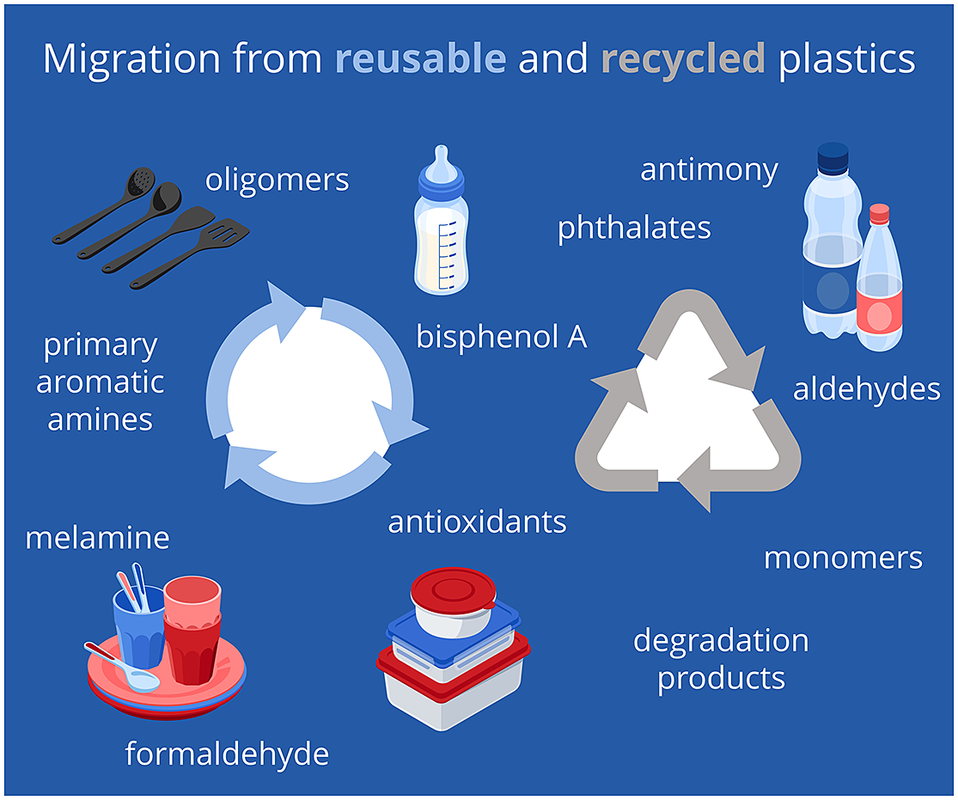
In the battle against plastic pollution, many efforts are being undertaken to reduce, reuse and recycle plastics. If tackled in the right way, these efforts have the potential to contribute to reducing plastic waste and plastic’s spread in the environment. However, reusing and recycling plastics can also lead to unintended negative impacts because hazardous chemicals, like endocrine disrupters and carcinogens, can be released during reuse and accumulate during recycling. In this way, plastic reuse and recycling become vectors for spreading chemicals of concern. This is especially concerning when plastics are reused for food packaging, or when food packaging is made with recycled plastics. Therefore, it is of utmost importance that care is taken to avoid hazardous chemicals in plastic food contact materials (FCMs) and to ensure that plastic packaging that is reused or made with recycled content is safe for human health and the environment. The data presented in this review are obtained from the Database on Migrating and Extractable Food Contact Chemicals (FCCmigex), which is based on over 800 scientific publications on plastic FCMs. We provide systematic evidence for migrating and extractable food contact chemicals (FCCs) in plastic polymers that are typically reused, such as polyamide (PA), melamine resin, polycarbonate and polypropylene, or that contain recycled content, such as polyethylene terephthalate (PET). A total of 1332 entries in the FCCmigex database refer to the detection of 509 FCCs in repeat-use FCMs made of plastic, and 853 FCCs are found in recycled PET, of which 57.6% have been detected only once. Here, we compile information on the origin, function and hazards of FCCs that have been frequently detected, such as melamine, 2,4-di-tert-butylphenol, 2,6-di-tert-butylbenzoquinone, caprolactam and PA oligomers and highlight key knowledge gaps that are relevant for the assessment of chemical safety.
Several scientific communities and international health organizations promoting an interdependent human-nature health perspective are calling upon healthcare professionals (HCP) to integrate this vision into their practice and become role models. However, rising cases of stress, burnout, and depression, among this group jeopardize this potential and their self-care. Therefore, we conducted an exploratory qualitative study focusing on how HCP relate to their self-care, their relationship with nature and its implementation into their professional practice. Semi-structured interviews with 16 HCP were executed, transcribed and imported into NVivo. Using the six-step framework, we conducted a thematic analysis, followed by two-step member-checking. Three main findings arose. First, participants employ various self-care strategies outside of work whenever possible. Second, their nature experiences can be drawn along a continuum ranging in level of intensity, attitude and reciprocity, which does not seem to be disclosed during consultation. Third, the reflexive interviews may have led to increased awareness and agency on the former topics, which we have termed ‘nature-connected care awareness’. A preliminary framework to stimulate nature-connected care awareness could support HCP in becoming a role model.