We partner with a secure submission system to handle manuscript submissions.
Please note:
You will need an account for the submission system, which is separate to your Cambridge Core account. For login and submission support, please visit the
submission and support pages.
Please review this journal's author instructions, particularly the
preparing your materials
page, before submitting your manuscript.
Click Proceed to submission system to continue to our partner's website.
To save this undefined to your undefined account, please select one or more formats and confirm that you agree to abide by our usage policies. If this is the first time you used this feature, you will be asked to authorise Cambridge Core to connect with your undefined account.
Find out more about saving content to .
To send this article to your Kindle, first ensure no-reply@cambridge.org is added to your Approved Personal Document E-mail List under your Personal Document Settings on the Manage Your Content and Devices page of your Amazon account. Then enter the ‘name’ part of your Kindle email address below. Find out more about sending to your Kindle.
Find out more about saving to your Kindle.
Note you can select to save to either the @free.kindle.com or @kindle.com variations. ‘@free.kindle.com’ emails are free but can only be saved to your device when it is connected to wi-fi. ‘@kindle.com’ emails can be delivered even when you are not connected to wi-fi, but note that service fees apply.
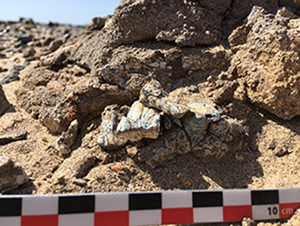
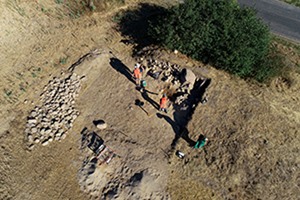
The Early to Middle Pleistocene Transition (EMPT) is characterised by major environmental changes and evolutionary innovations within the genus Homo but the scarcity of the African EMPT fossil and archaeological records obscures its palaeoecological context. Here, we present archaeological and faunal evidence from a newly excavated West-Turkana EMPT site—Kanyimangin.
Detailed photogrammetry and 3D laser scanning of rock art, geophysics research and sondage excavations conducted at the Painted Hand Petroglyph Panel, a large rock art site in south-western Colorado, USA, has revealed new information about the cultural situation in the pre-Columbian and historic North American Southwest.
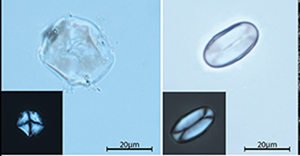
Plant domestication represents a major turning point in human history, resulting in the shift from a hunting/gathering/fishing-based economy to food production. Combining the analysis of ground stone tools and dental calculus, the PATH project aims to investigate dynamics of plant consumption, and the knowledge and toolkits involved in their processing.
Excavation at Mogou, a Bronze Age cemetery containing over 1700 burials and 6000 individuals, has revealed a diverse range of multiple burials. Building on this dataset, the Mogou Multidisciplinary Investigation Project aims to explore connections between kinship, burial space and social organisation in Bronze Age north-west China.
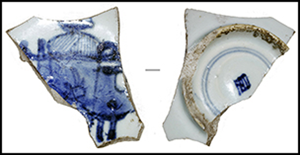
A Mongolian-German project is investigating abandoned early modern military and monastic sites in central Mongolia, including how the ruins of these urban nodes continue to shape cultural memory within nomadic society. Initial excavations have revealed a previously unknown site type, interpreted as garrisons from the period of Manchu rule (AD 1636–1911).
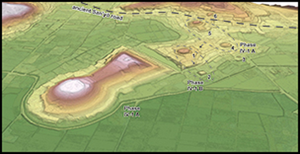
The authors present the results of a drone-based airborne LiDAR survey of the fifth century AD Tsukuriyama mounded tomb group in Okayama Prefecture, Japan, revealing the relationship between tomb building and the surrounding landscape during Japan's period of ancient state formation.
Bronze and Early Iron Age hoards in Poland are the focus of a multi-faceted study combining archival research with laboratory analyses and landscape studies. The diverse dataset is expected to reveal new insights into the phenomenon of metal deposition.
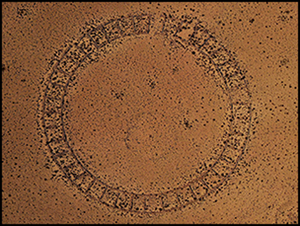
Research carried out in the Carangas region of highland Bolivia has identified a surprising concentration of pre-Hispanic religious sites, which are linked both to ancient Andean cults of wak'a (sacred mountains, tutelary hills and mummified ancestors) and to the Incan settlement of the region. Of these sites, one ceremonial centre stands out for its unprecedented characteristics for the Andes.
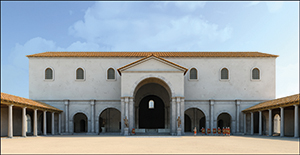
A 3D reconstruction of the principia at Novae (Bulgaria) allows modelling of the inscribed statues, altars and building stones as they used to look. By restoring the inscribed monuments to their original contexts, the model means that Roman military religiosity and its messages can be analysed in the legionary headquarters.
Confirming ephemeral human occupation is a crucial issue in cave archaeology. The project ‘Tracing human presence in caves of Polish Jura’ focuses on the application of molecular methods to decode the history of past human activities in cave sediments in the Kraków-Częstochowa Upland. The results will be compared with archaeological and palaeoecological proxies.