We partner with a secure submission system to handle manuscript submissions.
Please note:
You will need an account for the submission system, which is separate to your Cambridge Core account. For login and submission support, please visit the
submission and support pages.
Please review this journal's author instructions, particularly the
preparing your materials
page, before submitting your manuscript.
Click Proceed to submission system to continue to our partner's website.
To save this undefined to your undefined account, please select one or more formats and confirm that you agree to abide by our usage policies. If this is the first time you used this feature, you will be asked to authorise Cambridge Core to connect with your undefined account.
Find out more about saving content to .
To send this article to your Kindle, first ensure no-reply@cambridge.org is added to your Approved Personal Document E-mail List under your Personal Document Settings on the Manage Your Content and Devices page of your Amazon account. Then enter the ‘name’ part of your Kindle email address below. Find out more about sending to your Kindle.
Find out more about saving to your Kindle.
Note you can select to save to either the @free.kindle.com or @kindle.com variations. ‘@free.kindle.com’ emails are free but can only be saved to your device when it is connected to wi-fi. ‘@kindle.com’ emails can be delivered even when you are not connected to wi-fi, but note that service fees apply.
We apply superadditivity and monotonicity properties associated with the Jensen discrete inequality to derive relationships between the entropy function of a probability vector and a renormalized arbitrary sub-vector. The results are extended to cover other entropy measures such as joint entropy, conditional entropy and mutual information.
This paper gives an approximate solution to the Wiener-Hopf integral equation for filtering fractional Riesz-Bessel motion. This is obtained by showing that the corresponding covariance operator of the integral equation is a continuous isomorphism between appropriate fractional Sobolev spaces. The proof relies on properties of the Riesz and Bessel potentials and the theory of fractional Sobolev spaces.
Recently Dragomir and Goh have produced some interesting new bounds relating to entropy measures in information theory. We establish several refinements of their results.
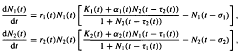
Lotka-Volterra systems have been used extensively in modelling population dynamics. In this paper, it is shown that chaotic behaviour in the sense of Smale can exist in timeperiodically perturbed systems of Lotka-Volterra equations. First, a slowly varying threedimensional perturbed Lotka-Volterra system is considered and the corresponding unperturbed system is shown to possess a heteroclinic cycle. By using Melnikov's method, sufficient conditions are obtained for the perturbed system to have a transverse heteroclinic cycle and hence to possess chaotic behaviour in the sense of Smale. Then a special case involving a reduction to a two-dimensional Lotka-Volterra system is examined, leading finally to an application with a model for the self-organisation of macromolecules.
Closed-form analytical expressions are derived for the reflection and transmission coefficients for the problem of scattering of surface water waves by a sharp discontinuity in the surface-boundary-conditions, for the case of deep water. The method involves the use of the Havelock-type expansion of the velocity potential along with an analysis to solve a Carleman-type singular integral equation over a semi-infinite range. This method of solution is an alternative to the Wiener-Hopf technique used previously.
We study an optimal control problem for a quasilinear parabolic equation which has delays in the highest order spatial derivative terms. The cost functional is Lagrange type and some terminal state constraints are presented. A Pontryagin-type maximum principle is derived.
The first part of this paper starts with a brief discussion of some methods for solution of nonlinear equations which have interested the first author over the last twenty years or so. In the second part we discuss a recent research involvement, the success of which relies heavily on the numerical solution of nonlinear equation systems. We briefly describe path-following methods and then present an application to a simple steady-state reaction-diffusion equation arising in combustion theory. Results for some regular geometric shapes are shown and compared with those from an approximate method.
Connections between a linear partial difference equation with constant coefficients and a nonlinear partial difference equation are established by means of a comparison theorem and a continuous dependence of parameters theorem. A linearized oscillation theorem is also established as an application.
In this survey we consider a regularized Newton method for the approximate solution of the inverse problem to determine the shape of an obstacle from a knowledge of the far field pattern for the scattering of time-harmonic acoustic or electromagnetic plane waves. Our analysis is in two dimensions and the numerical scheme is based on the solution of boundary integral equations by a Nyström method. We include an example of the reconstruction of a planar domain with a corner both to illustrate the feasibility of the use of radial basis functions for the reconstruction of boundary curves with local features and to connect the presentation to some of the research work of Professor David Elliott.
We consider a mesh grading quadrature method for real constant-coefficient Cauchy singular integral equations of index 0. The quadrature method is based on the trapezoidal rule. A complete stability and convergence analysis is given by the use of the noncompact perturbation analysis as in Jeon [10] and Elschner and Stephan [7]. The order of convergence can be arbitrarily high if the order of mesh grading is high enough. We also provide an efficient way of evaluating asymptotics of the solution at the end points. Experimentally, we observe that the method also works well for Cauchy singular integral equations with variable coefficients.
In this paper we prove the existence of asymptotic expansions of the error of the spline collocation method applied to Fredholm integral equations of the first kind with logarithmic kernels. These expansions justify the use of Richardson extrapolation for the acceleration of convergence of the method. The results are stated and proven for a single equation, corresponding to the parameterization of a boundary integral equation on a smooth closed curve. As a byproduct we obtain the nodal superconvergence of the scheme. These results are then extended to smooth open arcs and to systems of integral equations. Finally we prove that such expansions also exist for the Sloan iteration of the numerical solution.
We consider an ordinary differential equation arising in the study of the Ricci flow on R2. The existence and uniqueness of solutions of this equation are derived. We then study the asymptotic behaviour of these solutions at ±∞.
This paper is concerned with a generalization of the Bernstein polynomials in which the approximated function is evaluated at points spaced in geometric progression instead of the equal spacing of the original polynomials.
This paper considers a nonautonomous cooperative system, in which all the parameters are time-dependent and asymptotically approach periodic functions. We prove that under some appropriate conditions any positive solutions of the system asymptotically approach the unique positive periodic solution of the corresponding periodic system.
In 1984, Elliott and Stenger wrote a joint paper on the approximation of Hilbert transforms over analytic arcs. In the present paper we sharpen the previously obtained results of Elliott and Stenger, and we also obtain formulas for approximating Cauchy integrals over analytic arcs.
The paper presents some additional solutions of the diffusion equation
for the case s = 2, m = −1, a case that was left open in a previous discussion. These solutions behave in a manner that is physically acceptable as the time, t, increases and as the radial coordinate, r, tends to infinity.