We partner with a secure submission system to handle manuscript submissions.
Please note:
You will need an account for the submission system, which is separate to your Cambridge Core account. For login and submission support, please visit the
submission and support pages.
Please review this journal's author instructions, particularly the
preparing your materials
page, before submitting your manuscript.
Click Proceed to submission system to continue to our partner's website.
To save this undefined to your undefined account, please select one or more formats and confirm that you agree to abide by our usage policies. If this is the first time you used this feature, you will be asked to authorise Cambridge Core to connect with your undefined account.
Find out more about saving content to .
To send this article to your Kindle, first ensure no-reply@cambridge.org is added to your Approved Personal Document E-mail List under your Personal Document Settings on the Manage Your Content and Devices page of your Amazon account. Then enter the ‘name’ part of your Kindle email address below. Find out more about sending to your Kindle.
Find out more about saving to your Kindle.
Note you can select to save to either the @free.kindle.com or @kindle.com variations. ‘@free.kindle.com’ emails are free but can only be saved to your device when it is connected to wi-fi. ‘@kindle.com’ emails can be delivered even when you are not connected to wi-fi, but note that service fees apply.
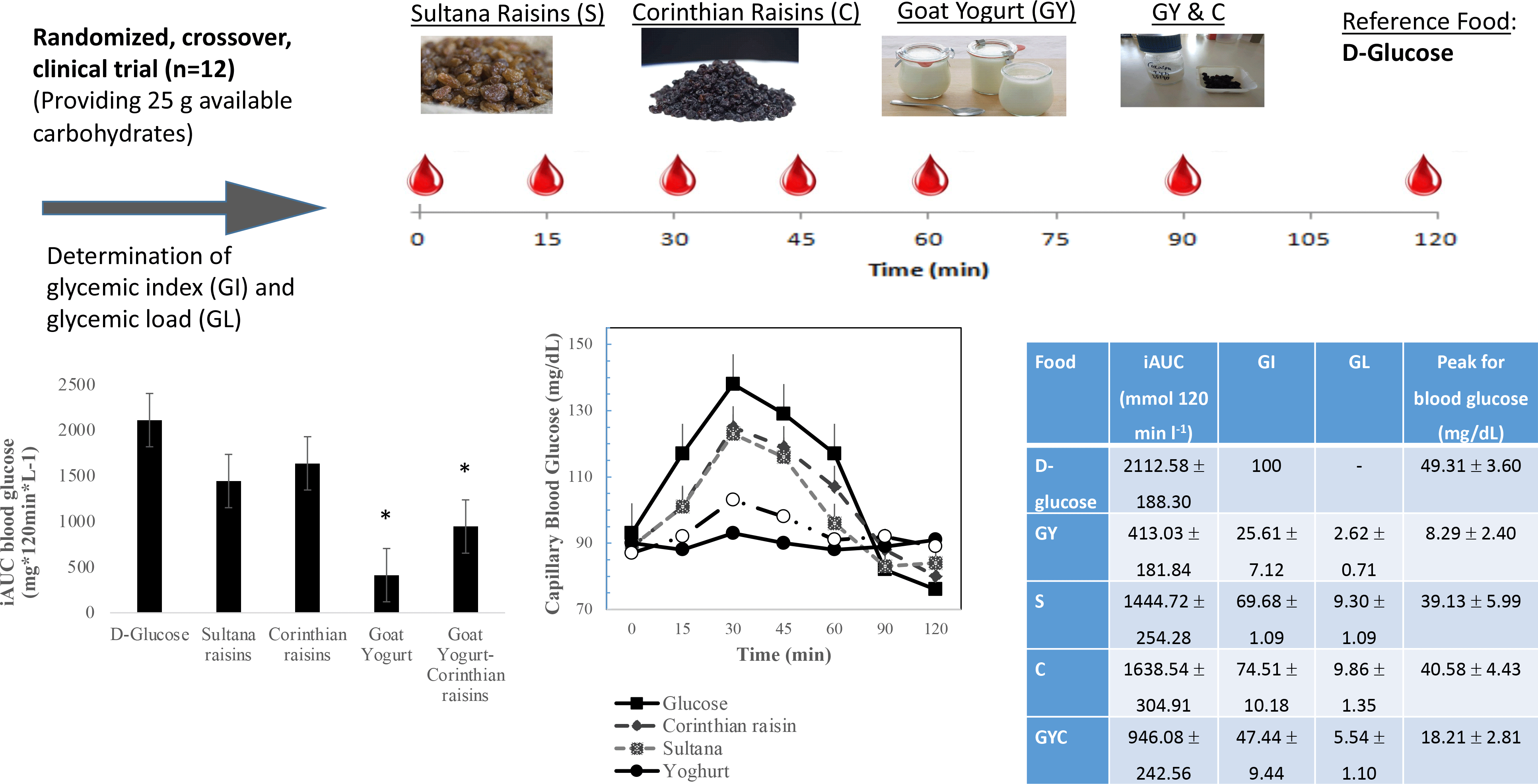
Goat milk yogurt (GMY) and raisins are popular foods with a favourable nutrient profile. Our aim was to determine the glycaemic index (GI) and postprandial responses to GMY-containing angiotensin-converting enzyme inhibitory (ACE-I) peptides carrying the RPKHPINHQ isracidin fragment and two Greek raisin varieties in an acute feeding setting. A total of twelve healthy participants (four male and eight female) consumed breakfast study foods containing 25 g available carbohydrate on seven occasions over a 3- to 9-week period: food 1: D-glucose (25 g) served as the control and was consumed on three separate occasions; food 2: GMY (617·28 g); food 3: Corinthian raisins (37·76 g); food 4: Sultana raisins (37·48 g) and food 5: GMY & C (308·64 g GMY and 18·88 g C). Postprandial glucose was measured over a 2 h period for the determination of GI and glycaemic load (GL). Subjective appetite ratings (hunger, fullness and desire to eat) were assessed by visual analogue scales (100 mm) at 0–120 min. Blood pressure (systolic and diastolic; BP) was measured at baseline and 120 min. GMY provided low GI (26), C and S provided high GI/low GL (75/10 and 70/9, respectively) and GMYC provided low GI (47) values on glucose scale compared with D-glucose. Peak blood glucose rise was significantly lower only for GMY and GMYC compared with reference food (D-Glucose), as well as C and S (Pfor all < 0·05). No differences were observed between test foods for fasting glucose, BP and subjective appetite. In conclusion, GMY and GMYC attenuated postprandial glycaemic responses, which may offer advantages to glycaemic control.