


 ’
 ’,


 .


 . The other relevant lexical entries are Souda s. v. ‘Ερμαῖ (a condensed version of Harpokration's entry), and Hesykhios s.v.
 .
 cf. Plato, Gorgias 487e.
 . Note also Aristotle's use of the phrase
 in the Metaphysics 1002a22,1017b 17. Note how the body that declares itself to be ‘just’ a block of stone is in fact entirely the product of the sculptor's artifice, reduced from a larger natural block so as to display the erect phallus. I owe this point to John Henderson.
 , Diogenes Laertios 8.1.31.
 , Photios s.v.
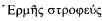 , Aristophanes, Wealth 1153.
 , Et. Magn., Harpokration and Souda s.v.
 . Hermes Tetrakephalos: Eustath. on Iliad 24.334, Hesykhios s.v.
 , Photios s.v.
 . Hermes Epitermios: Hesykhios s.v.
 .
 Hermes Agoraios: Pollux 7.15, Pausanias 1.15.1, 7.22.2,
 . See also
 .


 is an example of a non-Hipparkhan herm publicly set up at a halfway point.
 is an indication of how integrated a monument the Hipparkhan herms were.

 .




 seem to be first used in extant texts with reference to the mutilation of the hermai. But the figurative use of
 at Aristophanes, Knights 372 suggests that the words were originally used of trimming the edges or surplus off an object. In some late papyri the words are specifically used of the trimming done by a mason/sculptor.

Crossref Citations

This article has been cited by the following publications. This list is generated based on data provided by Crossref.
Winkler, John J.
1990.
Phallos Politikos: Representing the Body Politic in Athens.
differences,
Vol. 2,
Issue. 1,
p.
29.
Halperin, David M.
1990.
The Democratic Body: Prostitution and Citizenship in Classical Athens.
differences,
Vol. 2,
Issue. 1,
p.
1.
Shapiro, H.A.
1992.
Theseus in Kimonian Athens: The iconography of Empire.
Mediterranean Historical Review,
Vol. 7,
Issue. 1,
p.
29.
Millett, Paul
2005.
The Trial of Socrates Revisited.
European Review of History: Revue européenne d'histoire,
Vol. 12,
Issue. 1,
p.
23.
2007.
A Companion to Greek Religion.
p.
439.
Elsner, J.
2010.
Picturesque and Sublime: Impacts of Pausanias in Late-Eighteenth- and Early-Nineteenth-Century Britain.
Classical Receptions Journal,
Vol. 2,
Issue. 2,
p.
219.
Zografou, Athanassia
2010.
Chemins d'Hécate.
p.
307.
Taylor, Martha C.
2012.
The Encyclopedia of Ancient History.
Bremmer, Jan N.
2013.
The agency of Greek and Roman statues.
Opuscula. Annual of the Swedish Institutes at Athens and Rome,
Vol. 6,
Issue. ,
p.
7.
Funke, Peter
2013.
Geschichte der Antike.
p.
59.
2016.
Raveenthiran, V.
2017.
Congenital Anomalies of the Penis.
p.
15.
2018.
Hipparchos.
p.
157.
2019.
2021.
Wilding, Alexandra
2021.
Reinventing the Amphiareion at Oropos.
p.
256.
Wilding, Alexandra
2021.
Reinventing the Amphiareion at Oropos.
p.
i.
Chatterjee, Paroma
2021.
Between the Pagan Past and Christian Present in Byzantine Visual Culture.
Wilding, Alexandra
2021.
Reinventing the Amphiareion at Oropos.
p.
1.
Wilding, Alexandra
2021.
Reinventing the Amphiareion at Oropos.
p.
121.