

 , as well as
 , see
 , see e.g.
 echoes Hesiod Theo. 26
 .
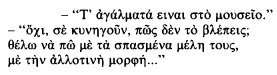
 (Mythistorema 3). See also these marvellous lines from
 (Thrush):
 .
 , see
 is used, as Gow says, of ‘wanton or lascivious laughter’. It does not follow that ‘the giggling of the girls should be understood as genuine enticement: it is sexual laughter not mockery.’ (DuQuesnay 213). It is Polyphemus himself who describes the laughter; and his interpretation of the girls' giggling as sexual and directed as genuine enticement towards him is not necessarily to be trusted; this uncertainty is not merely ‘the doubts of the modern reader’ (DuQuesnay 213, contra Coleman); the disjunction between a character's statement and the (sophisticated, Hellenistic) reader's interpretation of the truth/sincerity/applicability of that statement is a common source of Theocritean humour. It may indeed be interesting – even essential – to discover how contemporaries may have read a poem, but perhaps DuQuesnay is incautious in his complete certainty that he knows that ancient readers would have been ‘in no doubt that the Cyclops was indeed cured.’ (213). (In support of his argument, DuQuesnay quotes Callimachus Epig. 46 Pfeiffer (A.P. 12. 150), on which see the Appendix, but does not discuss the comment of the scholion:
 . See
 and
 is too rigid, since
 sometimes encroaches on the sense assigned to
 (i.e. ‘listen’ as opposed to ‘obey’), and he translates here as ‘give ear to them’. It may seem, however, more vivid to take
 here in its common stronger sense of ‘obey’ – Polyphemus does attempt to take up the girls' invitation to sport with them; but they giggle when he does.
 (which itself puns on the
 of
 Odysseus). His claim to be a somebody looks forward to his humiliation at the hands (words) of the stranger. Indeed, at 61 the Cyclops hopes that
 will come. It will be a
 called
 , however.
 II.
 in this sense in Old and New Comedy:
 : ‘The wit largely involves the opacity of “shepherded” (epoimainen), which suspends divergent interpretations by saying, in effect, “saw it through by behaving like the herdsman that he was.”’
 with
 .
 since the gift of a lock of hair (as we would normally read such a remark) seems not to be part of the norms of a lover's discourse in the Greek world. (Perhaps it refers to a lover's excessive care of his own personal appearance?) The Cyclops does discuss his own hirsuteness at length. So, too, he offers gifts of other flowers (if not roses), and talks of food and lover's presents (although not ‘apples’), and he calls Galatea
 . The Cyclops does not straightforwardly reject lovers' tokens, but rather has his own version of them.
 in fifth-century discourse, see e.g.
 ; is taken here with
 . Segal (128) suggests it may also qualify ‘the good Cydonian man’ who is later called ‘dear to the Muses’ (95).
 in epiphanies, see
 , and Segal 170-1, who compares Aesch. P. V. 1030-3.
 , which seems, however, a quite different expression, even if it draws on the same tradition of poetic claims of truth. The phrase
 occurs at
 . But
 occurs also at

 ), where Rogers translates ‘in very truth’ and Gow suggests that, unlike the Theocritus or Aeschylus passage, it may have the weakened sense ‘really and truly’; Holzinger, however, takes it closely with
 and translates it ‘in the true sense of the term’ (‘in wahren Sinne des Wortes sollst du bersten’). Meineke, followed by Green, glosses ‘ea lege, ut vera sint quae tu loqueris’, i.e. he supplies
 , ‘on condition of the truth of your words’. The most extended discussion is in
 ’ 39). So, he concludes, ‘the truth’ here is to be taken as Simichidas’ self-awareness and willingness to be true to himself: ‘ἐπ
 significa dunque; obbedire alia propria natura, essere conformi a se stessi; ed e detto di chi sa esprimere se stesso pur rimanendo entro i limiti determinati dalla natura.’ 47. Against this, however, Segal sees this answer of Lycidas as an ironically literal misprision of Simichidas’ self-deprecation. Moreover,
 seems a less certain expression than Serrao assumes. If, as Frijs Johansen and Whittle suggest, ἐπί here ‘indicates the goal towards which the action is intended’, that is, as Gow puts it, ἐπί with a dative of ‘attendant aim’, then Theocritus' expression suggests a movement towards truth (and the poetic status associated with it) which has not necessarily been completed yet e.g. ‘formed for truth’, ‘with truth as an aim’. In other words, the phrase may suggest the poetic claim of truth but pulls back from a direct assertion of the truth of the poet's voice.
 of the right to speak and the authority of kings and judges emphasizes the constant involvement of the act of speaking out with the institutions of power and authority; see e.g.
 is a suggestion of Heinsius accepted by most editors. The MSS. reading has recently been defended by
 51). See Berger 16-20; Segal 229; Rosenmeyer 270.

Crossref Citations

This article has been cited by the following publications. This list is generated based on data provided by Crossref.
1988.
The Well-Read Muse.
p.
147.
2008.
Caneva, Stefano Giovanni
2010.
Raccontare Zeus. Poesia e cultura di corte ad Alessandria, a partire dall’Inno I di Callimaco.
Pallas,
Vol. 83,
Issue. ,
p.
295.
2011.
2012.