


 . The postponement of agreement on the sending of help does not indicate reluctance on either side, but was a necessary consequence of the military situation: a Macedonian force could not be sent to Italy until each side had secured an Adriatic port and a Carthaginian fleet could ensure its safety.

 .

 (
 (Plb.9.41.10).

 . The sentence purports to explain the decision of the people of Echinus to surrender. As it stands, it makes poor sense: if the allies failed to stop supplies reaching Philip by sea, it was not because they could not do so (as the sentence implies), but because the Roman fleet did not act (as Holleaux supposed, following Niese 484). Stylistic considerations show that the fragment 9.41.1-4, which comes from the Anon. de obsid. tol., is no more than a paraphrase of Polybius (see Büttner-Wobst's apparatus and
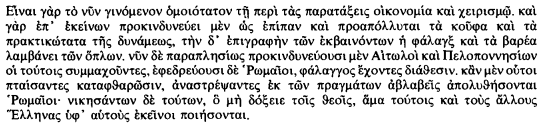
 .
 (Ducrey 330 n. 1). That
 reflects the confusion of Greek thinking on the subject.
 (Plb. 18.3.3-7; Volkmann (n. 108) 76-7). Doson made an exception of Mantinea in reprisal for the killing of an Achaean garrison (Plb.2.58.4-15). There is no reason to think that there had been a significant change in attitudes (as supposed by
 7
 ), and it was natural for those who held that Greeks should not behave in this way to each other to draw the corollary that such behaviour was to be expected of barbarians. On the view that the Romans were
 , asserted in these speeches, but never by Polybius in his own person, see
 see
 . If this is reckoned from his entry into office, the battle took place in June 207 (see De Sanctis 444;
 for 207/6: see Klaffenbach, (n. 58) 6; Deininger (n. 52) 35 n. 6.
 evidently includes the Romans, as at 42.1). The mediators' presence: Livy 28.7.14 adfuerant enim legati nuper Heracleae concilio Romanorum Aetolorumque.
 (on the meaning of
 here see Walbank's note). Livy's language is misleading (particularly 28.5.13 concilium Aetolis Heracleam indicium): cf.
 (attested by
 in 211/0, Dorimachus may have held one of his tenures in 212/1.

Crossref Citations

This article has been cited by the following publications. This list is generated based on data provided by Crossref.
Eckstein, Arthur
and
Čašule, Nikola
2012.
The Encyclopedia of Ancient History.
2015.
Prieto, Juan P.
2022.
Publius at Naupaktos: The First Macedonian War and Phlegon of Tralles’ anti-Roman Prophecies inDe Mirabilia3.
Klio,
Vol. 104,
Issue. 2,
p.
587.
2022.
2023.