




No CrossRef data available.
Article contents
Euripides, Medea 108–1101
Published online by Cambridge University Press: 09 November 2018
Extract
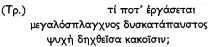
Herwerden altered μεγαλό- to μελανόσπλαγχνος. Dr Diggle (P.C.Ph.S. n.s. XV (1969), 38–9) commends this alteration, alleging that Medea suffers from melancholy and adducing a number of passages of Greek verse which refer to blackness of viscera or soul.
These passages are a mixed lot. The Homeric φρένες ἀμφὶ μέλαιναι2 is formulaic and seems to be used in descriptions of almost every imaginable emotional state. At Aeschylus, Choeph. 413–14 σπλάγχνα δέ μοι (Schütz: μου Μ) κελαινοῦται πρὸς ἔπος κλυούσᾳ Pers. 115–16 ταῦτά μοι μελαγχίτων φρὴν ἀμύσσεται φόβῳ, Suppl. 785 κελαινόχρως δὲ πάλλεται μου καρδία, the emotion is fear.
Information
- Type
- Research Article
- Information
- Copyright
- Copyright © The Author(s). Published online by Cambridge University Press 1970
Footnotes
1
I am grateful to Dr Diggle for helpful correspondence.
References
page 42 note 2 Il. I. 103 Google Scholar, 17. 83, 17. 499, 17. 573, Od. 4. 661 Google Scholar.
page 42 note 3 Cf. Aristotle, , Resp. 26 Google Scholar (479 b 22), Probl. 27. 8 (948 b 13), fr. 243 (Rose), Lucretius 3. 152 ff., Pliny, , Nat. II. 224 Google Scholar.
page 42 note 4 Cf. Ovid, , Met. 8. 465 Google Scholar saepe metu sceleris pallebant ora futuri, Horace, , Ep. I.1.61Google Scholar nil conscire sibi, nulla pallescere culpa (after the commission of a crime), Lucan 7. 466–8 omnia torpor pectora constrinxit, gelidusque in uiscera sanguis… coit (in blood-relatives about to kill each other).
page 43 note 1 For the physiology see Plato, , Tim. 70 b–cGoogle Scholar, Aristotle, , Probl. 27. 3Google Scholar (947 b 23), Lucretius 3. 288 ff.