

 (first printed in 1958), e.g. W. Kraus (Vienna, 1960), E. W. Handley (London, 1965 [instructed by E. Fraenkel]), and F. H. Sandbach (Oxford, 1973), with no tradition of previous exegesis to get in the way, have applied the doctrine of Heraeus and Housman to v. 892. For other discussion since 1931 see App. IV.

 .
 the coarse adjective
 (cf. an Athenian graffito of the second quarter of the fifth century.
 , Schol.
 written above
 ). Menander's slave is drunk (see vv. 469-71) and has just made an indecent joke about his addressee's sexual life (see below, n. 29).

 , 398
 , 424
 , 488
 (conj.), 514–15

 , 624
 , 640
 , 901
 , 934

 .
 . On the other hand he rejects an allegation of ignorance of Homer (v. 26) and has heard of the
 of Philitas (v. 43).
 see
 ( Vit. 1).
 ; for the force of the γε cf.
 , Dysc. 892
 , and Ach. 79
 .
 of the three females involved. This term in 425 was probably thought to relate to the taking of money for sexual services (see n. 122). Applied to females who provided other services besides the narrowly sexual and who received gifts rather than agreed sums of money, e.g. those who called themselves
 , it was somewhat abusive (cf. Plut. Sol. 15.2 [on the Athenian love of euphemism]

 ). Applied to ordinary street-walkers and brothel-inhabitants it carried little emotional charge. At the height of his moral indignation the farmer calls the females over whom the great war is being fought
 . The author of the gloss on v. 537 in cod. Ravenna, Bibl. Class. 429
 , Andreas Divus (Florence, 1538), N. Frischlin (Frankfurt, 1586) and others miss completely the affective heightening. Those who perceive it (e.g. R. F. P. Brunck [Strasbourg, 1781], who translated ‘Simaetham meretricem … suas meretrices … tribus scortis … propter scorta’) do not try to explain the source of the affectivity.
 which the slave then throws at her must suggest she is capable of worse. Translations like
 Inv. 14470, IB 16-19, IV cent, from Attica; published by
 (the fascicle containing this article was issued in January 1961).
 .
 R), Pollux 5.93, Hesych. II p. 592
 ,
 ‘penis’, see Hesych. II p. 592,
 ,
 see
 Eupolis. Com. fr. 344. It is a reasonable guess that Hesychius' sources got the rest from comedy.
 see
 et sim. in the writing of grammarians p. 23.
 , was first restored by

 (Ach. 1131, Equ. 433, Thesm. 211-12); for the second

 .
 ).
 (extraits byzantins) (

 et sim. obviously come from a less abbreviated version of the treatise carried by the Paris codex. See
 referred to
 in general. Machon's anecdote, vv. 402-10, shows that in Alexandrian Greek by the middle of the third century it had a restricted set of associations (cf.

 , schol.
 .
 (schol. R

 , schol. V ad eundem locum …

 , Hesych. II p. 586
 ,
 ,
 :

 ) or from
 (schol. V

 Aelius Dionysius λ 6 Erbse (=

 , Hesych. II p. 586

 ,

 , Paroemiogr. anon. IV 73,
 ). Lucian and Galen (see above, n. 65), doubtless dependent on Atticist lexicography, distinguish the Lesbian and the Phoenician vices. There is no trace in ancient writing of the notion associating tribadism with Lesbos (see
 , rather than Didymus ap.
 looks to be the first half of a very similar explanation.
 alleged here in the mouth of a slave and confidently deny it at
 (related to some passage of comedy in which a fellatrix was called a
 ).
 through the ninety-five books of Pamphilus'
 . See
 (
 .
 in the sense of scortari from Attic Greek but argued that Corinthian usage may have been different.
 .
 was omitted either by design or by accident.
 ), Hesych. IV p. 42 s.v.

 ,
 .
 [usually misinterpreted as ‘fellator’]),
 . The astrologer
 , from the
 . Nothing is to be deduced from
 is exploited in order to make a joke about fellation. The account of the post-coital behaviour of male goats at schol.
 of Didymus see
 is used of other types of oral vice at schol. Eccl. 643, 841; at Hesych. I p. 420, s.v.
 , the verb seems to be used of masturbation (the sense is obscure at I p. 252, s.v.
 ,
 .)
 and Didymus'
 see above, n. 74. In both cases Didymus would have drawn on one of the older Alexandrian authorities.
 , is sometimes admitted (v. 487), sometimes replaced with
 (vv. 310, 487).
 in those on vv. 643, 841; of
 in those on vv. 10, 607, 612; of
 in those on vv. 12, 13, 97.
 , 54, s.v.
 , 93, s.v.
 , 96, s.v.
 , et al.; for

 ,
 , et al.; for

 ,
 , et al.; for

 , et al.; for
 p. 314, s.v.
 , 384, s.v.
 , et al.; for

 ; for

 , et al.; for
 et sim.
 et sim.
 , p. 420, s.v.
 for
 .
 on the other hand is in the list.

 see [
 (II p. 565) the words

 .
 by Solon caused the entry I p. 322
 . Cf. II p. 432
 .
 made the doctrine public in 1499.
 .
 , Nub. 529, Vesp. 84, 687, Lys. 137
 , Thesm. 200.
 ; Nub. 909
 ,
 ; Lys. 777

 .
 , p. 734, s.v.
 .
 (on which see p. 22).

 (Thesm. 53-7) may however be a Byzantine combination.
 see Eupolis, fr. 92.26 CGF Austin,

 ,
 .
 was in origin a euphemistic term. Perhaps so. I suspect however that Christian attitudes to sex have perverted Benveniste's view. See below, nn. 198, 281, on the bad odour of commercialism.
 (Plut. 149),
 (Eccl. 1098),
 (Pax 812), and
 (Av. 1258) could be related as specifics. For


 , IV p. 783.1
 Suetonius' Π.
 . offered many such etymologies; cf. in addition to
 .
 of Aristophanes see
 and
 .
 see Antiph. com. fr. 159.4.
 , 657
 , 680
 , Equ. 61
 , 270
 , 71
 , 1126
 , Hesych. I p. 118 s.v.
 , p. 200, s.vv.
 , p. 213, s.v.
 , p. 220, s.v.
 , et al.

 , schol.
 , Av. 165, Equ. 261.
 . For the use of
 see also

 , Nub. 1436,
 (also transmitted in cod. Florence, Bibl. Laur. S. Marc. 303) see
 ,
 , p. 512, s.v.
 ,
 , p. 383, s.v.
 .
 and has the entry
 (col. 1292 Tittman).
 is not evidenced elsewhere. For μαστροπύειν ‘act as a
 , see
 .
 113.214
 , 2.38, p. 121.35-6
 ,
 , 166
 ,
 , 196.5
 … 196.11
 ,
 (i.e. cunnilingos),
 (i.e.
 , fellatores).
 7.187 …

 ,

 ,
 ,
 .
 with the sense of
 . The epigram seems to have been first printed by
 .
 occurs only at
 at A.P. 11.242.1, 415.3;
 at 11.395.1;
 at 11.241.1 (cf.
 at 11.7.4 (
 itself seems to be quite absent from epigram);
 at 9.330.8 (cf.
 , interpreted by Jacobus Micyllus (Frankfurt, 1538) as ‘gulosus’, by T. Hemsterhys and J. M. Gesner (Amsterdam, 1743) as ‘patinarius’. I. Bekker was the first to print
 (Leipzig, 1853).
 is an emendation, made simultaneously by
 only at As. 56 (citing a proverb). The euphemistic
 serves for both the male and female organs.
 (4) and
 (10) are also
 . The type of formation was common in old epic poetry and in Ionian technical prose but practically absent from the Athenian vernacular; see
 in general see
 , D. W. Triller's
 , and F. L. Abresch's
 .
 .

 . Sexual intercourse is always referred to euphemistically in the epistles (see 1.3, 6, 10, 11, 12, 16, 21; 2.3, 4, 5, 7, 8, 15).
 . Überlieferung, Quellen und Text der Kanones 1–84 (Diss.
 , Diog. Laert. 6. 61, schol.
 (non adulterabis non fornicaberis Vet. Lat. ne adulteres Jerome),
 clearly of the male part in the sexual act. The participle
 renders the Hebrew qadeš at Deut. 23. 17 (fornicans Vet. Lat. scortaior Jerome).
 [impudici Vet. Lat. fornicarii Jerome] distinguished from
 and
 , Heb. 13. 4 (
 ). The masculine noun is absent from the Septuagint apart from the obscure Si. 23. 16–18 (no Hebrew extant; fornicarius Vet. Lat.). To judge by 1 Kings 14.24, 15.12, 22.47, 2 Kings 23. 7, Hos. 4. 14 it was not thought suitable to translate the Hebrew qadeš (
 Aquila: effeminatus Jerome). The feminine noun on the other hand not only regularly translated zonah but also qdešah at Gen. 38. 21–2 (fornicaria … fornicaria Vet. Lat. mulier … scortum Jerome) and Deut. 23. 17 (fornicaria Vet. Lat. meretrix Jerome). I am grateful to P. S. Alexander for guidance in biblical matters.

 .
 of male fornication see
 , ‘fornicator’ but the contexts are very general ones and the nature of Justin's addressees must be kept in mind. More certain are
 , p. 479, s.v.
 , p. 563, s.v.
 , III p. 362, s.v.
 . If these are all interpolations from the glossary of Cyrillos my point is all the stronger. I p. 426, s.v.
 ,
 , p. 554, s.v. κυσονίπται, p. 616, s.v.
 would stem from Diogenian, Hesychius' principal source. For
 of libidinous activity see Hesych. II p. 88, s.v.
 , p. 121, s.v.
 , p. 635, s.v.
 (at p. 213 however
 glosses
 ). Pagan society did not entirely approve of the kind of male the Church called a
 nine survive:
 ,
 (I 14–22).

 . At Equ. 877, 879, Vesp. 687 he uses
 of the behaviour of anal pathics.
 , id est irrumationem (perhaps
 bene uale et dimittet sine praemio.’ In the margin of the presentation copy made for Lorenzo de' Medici and autographed on 1 September 1473, cod. Florence, Bibl. Laur. 53. 33, he added ‘unde hoc uerbo usus est Lucianus pro genere libidinis quo mulieres inter se utuntur.’ Similar notes have been added at 7.67 (hoc genus libidinis mulieres Lesbiae primae inuenerunt unde id agere
 (cf. Demosth. 19. 248) was meant to fill the second blank space (ρω αι ἔρ ἔρρωσο in iater editions). Every modern apparatus criticus saddles Calderini with the responsibility for
 .
 . On Vulcanius and his sources see
 referring across to those on κάζω and
 the former follows Étienne's explanation of the verb; the latter gives the correct explanation of
 . The eleventh edition of
 and
 as ‘se prostituer’
 as ‘prostitué’.
 at Theocr. 21.32, translating ‘surely you won't act stupidly’ and arguing that by the time of Theocritus the verb ‘had lost its literal force’.
 clearer than does the book cited above, n. 228. German-speakers conscious of their social impregnability or momentary superiority use such language freely (often shortening to ‘du kannst mich’). A Greek of the pagan era would not have done so; it would have suggested that he was himself a particularly low sort of pathic. At Catull. 97.12, 98.4,
 in cod. Paris, Bibl. Nat. suppl. gr. 1164 (see above, p. 18) lists
 and
 . Extant literature and the lexica contain many more: e.g.

 .
 , p. 568, s.v.
 , p. 569, s.v.
 ; for the Cretans
 ,
 .
 at schol.

 Nub. 1470
 , Ran. 28

 , a vase graffito reported by
 (see also
 , Demosth. 10. 62

 , 19. 186
 . 21. 112 οὐ μέτεστιν, οὒ 25. 50
 Aristaen. 1. 24. 15–16
 . This type should be kept distinct from the one at

 ,
 was set against 1305

 . The commentator presumably had in mind the scene of Euripides' tragedy in which the heroine shook a rattle at the child on her arm as she sang (see
 , P. Oxy. 6. 852, fr. 1, col. ii, 8,
 (
 N.G. Wilson (private communication) suggests

 .
 ,

 ,
 . Presumably they were thought unable to satisfy the appetites of their womenfolk. For Ionian women,
 , see Aeschines Socr. ap. Athen. 5. 220 b. For the women of Ionian Miletus and the dildo (not necessarily referred to earlier in this play) see schol.
 .
 γε (Reiske: γε codd.) τὸ δεῖνα.
 (C33 Lang; see p. 15).
 .
 at Nub. 910–14 and the young scape-grace at Nub. 1328–68 take insults as compliments and the leno at

 .
 is an odd word for a grammarian himself to use. For
 however see schol.
 , p. 312, s.v.
 .
 and
 (‘make water’, ‘ease oneself’, ‘coeo’) suggests that with ‘relieve oneself’ he had masturbation in mind.
 ),
 see Petron. 21. 2, Martial 11. 30. 1, 12. 85.
 see
 = ‘rafa perineale’).

 . In general see
 of an ithyphallic Pan) and in general
 of a person lacking in sexual self-control see Crates Theb. ap.
 and
 are absent from oratory, from Plato's dialogues and even from tragedy. For the epic usage exploited by the cook see

 Od. 24. 282
 ,
 , Erg. 134
 .
 .
 before sexual intercourse), Hesych. II p. 554, s.v.
 .
 ) is not its object, but a self-contained incredulous repetition of a word from the previous line.’
 (see
 ,
 ), Aristophon.fr. 9.9–10, Alexis, fr. 145,
 (a corpse speaking).
 see above, n. 14. It had much the same tone and force as εὐρύπρωκτος (
 (Ach. 106). It would have been stronger than καταπύγων (see above, p. 23), suggesting long habituation.
 , Av. 177
 (
 . For ᾰρα with the future of verbs of the general sense of
 (i.e. aliquid pati) see
 future (cf.
 (Kuster:

 .
 , ‘paedicabor si baccarin;
 , scil.
 quasi dicat “peream si baccharin tibi emo”’ (
 is wrong but the general purport of the slave's reaction comes out.
 replies to a threat of sexual assault.
 with
 . Brunck replaced
 with
 (after F. Morel) and found ‘uis et lepos quidam’ in the repetition of the pair of particles.
 , 75
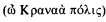 . The same attitude to pathics is evinced by the chorus (vv. 664, 716).


 … makes the matter clear, if not
 . In general see
 aut aliud obscoenum uerbum ex Aristophanis Concionatricibus intelligunt.’

Crossref Citations

This article has been cited by the following publications. This list is generated based on data provided by Crossref.
Cassio, Albio Cesare
1983.
Post-Classical Λέσβιαι.
The Classical Quarterly,
Vol. 33,
Issue. 1,
p.
296.
Halperin, David M.
1990.
The Democratic Body: Prostitution and Citizenship in Classical Athens.
differences,
Vol. 2,
Issue. 1,
p.
1.
Bing, Peter
2003.
The Unruly Tongue: Philitas of Cos as Scholar and Poet.
Classical Philology,
Vol. 98,
Issue. 4,
p.
330.
Baechle, Nicholas
2015.
A Companion to Greek Literature.
p.
461.
2016.
Worman, Nancy
2016.
A Companion to Euripides.
p.
515.
Coker, Amy
2019.
How filthy was Cleopatra?.
Journal of Historical Pragmatics,
Vol. 20,
Issue. 2,
p.
186.
2019.
The Encyclopedia of Greek Comedy.
p.
404.
2020.
2022.
2022.