
Hostname: page-component-7b7567c8c-tnzcf Total loading time: 0 Render date: 2026-11-14T21:41:50.002Z Has data issue: false hasContentIssue false

Works and nights: Marcus Argentarius (AP 9.161)

Published online by Cambridge University Press:  23 January 2012

Renaud Gagné
Affiliation:
Pembroke College, Cambridge
Regina Höschele
Affiliation:
University of Toronto
Rights & Permissions [Opens in a new window]

Extract

Core share and HTML view are not available for this content. However, as you have access to this content, a full PDF is available via the 'Save PDF' action button.

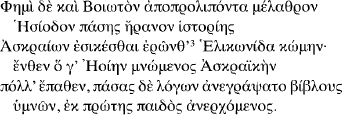
In a long and colourful passage from Book 3 of his elegiac poem Leontion, a veritable manifesto of Hellenistic erotics, Hermesianax of Colophon (early third century BC) presents us with an amusing list of poets and their loves (fr. 7 Powell = Athen. XIII 597B). This catalogue features, inter alia, an enamoured Hesiod inspired by a woman. The notion of surly old Hesiod in love with a girl may come as a bit of a surprise to most students of classical philology. After all, one might suppose that the harsh, archaic misogyny of the didactic poet does not bode well for amorous relationships with members of the opposite sex. That makes the statement of Hermesianax (7.21–26) all the more remarkable:

I claim that even Boeotian Hesiod, keeper of all legends, left his home and came out of love to the Heliconian village of the Ascraians. There, wooing Ascraian Ehoie, he suffered many a thing and wrote down in books all his Catalogues, as he hymned her, starting up again and again from the first girl.

Information

Type
Research Article
Copyright
Copyright © The Author(s). Published online by Cambridge University Press 2009