




Hostname: page-component-7b7567c8c-wxvwp Total loading time: 0 Render date: 2026-11-17T02:44:55.540Z Has data issue: false hasContentIssue false

On directional Whitney inequality

Published online by Cambridge University Press:  26 February 2021

Feng Dai*
Affiliation:
Department of Mathematical and Statistical Sciences, University of Alberta, Edmonton, AB T6G 2G1, Canada
Andriy Prymak
Affiliation:
Department of Mathematics, University of Manitoba, Winnipeg, MB R3T 2N2, Canada e-mail: prymak@gmail.com
*
Rights & Permissions [Opens in a new window]

Abstract

Core share and HTML view are not available for this content. However, as you have access to this content, a full PDF is available via the 'Save PDF' action button.

This paper studies a new Whitney type inequality on a compact domain $\Omega \subset {\mathbb R}^d$ that takes the form

$$ \begin{align*} \inf_{Q\in \Pi_{r-1}^d(\mathcal{E})} \|f-Q\|_p \leq C(p,r,\Omega) \omega_{\mathcal{E}}^r(f,\mathrm{diam}(\Omega))_p,\ \ r\in {\mathbb N},\ \ 0<p\leq \infty, \end{align*} $$
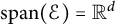
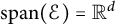
where $\omega _{\mathcal {E}}^r(f, t)_p$ denotes the rth order directional modulus of smoothness of $f\in L^p(\Omega )$ along a finite set of directions $\mathcal {E}\subset \mathbb {S}^{d-1}$ such that $\mathrm {span}(\mathcal {E})={\mathbb R}^d$, $\Pi _{r-1}^d(\mathcal {E}):=\{g\in C(\Omega ):\ \omega ^r_{\mathcal {E}} (g, \mathrm {diam} (\Omega ))_p=0\}$. We prove that there does not exist a universal finite set of directions $\mathcal {E}$ for which this inequality holds on every convex body $\Omega \subset {\mathbb R}^d$, but for every connected $C^2$-domain $\Omega \subset {\mathbb R}^d$, one can choose $\mathcal {E}$ to be an arbitrary set of d independent directions. We also study the smallest number $\mathcal {N}_d(\Omega )\in {\mathbb N}$ for which there exists a set of $\mathcal {N}_d(\Omega )$ directions $\mathcal {E}$ such that $\mathrm {span}(\mathcal {E})={\mathbb R}^d$ and the directional Whitney inequality holds on $\Omega $ for all $r\in {\mathbb N}$ and $p>0$. It is proved that $\mathcal {N}_d(\Omega )=d$ for every connected $C^2$-domain $\Omega \subset {\mathbb R}^d$, for $d=2$ and every planar convex body $\Omega \subset {\mathbb R}^2$, and for $d\ge 3$ and every almost smooth convex body $\Omega \subset {\mathbb R}^d$. For $d\ge 3$ and a more general convex body $\Omega \subset {\mathbb R}^d$, we connect $\mathcal {N}_d(\Omega )$ with a problem in convex geometry on the X-ray number of $\Omega $, proving that if $\Omega $ is X-rayed by a finite set of directions $\mathcal {E}\subset \mathbb {S}^{d-1}$, then $\mathcal {E}$ admits the directional Whitney inequality on $\Omega $ for all $r\in {\mathbb N}$ and $0<p\leq \infty $. Such a connection allows us to deduce certain quantitative estimate of $\mathcal {N}_d(\Omega )$ for $d\ge 3$.

A slight modification of the proof of the usual Whitney inequality in literature also yields a directional Whitney inequality on each convex body $\Omega \subset {\mathbb R}^d$, but with the set $\mathcal {E}$ containing more than $(c d)^{d-1}$ directions. In this paper, we develop a new and simpler method to prove the directional Whitney inequality on more general, possibly nonconvex domains requiring significantly fewer directions in the directional moduli.

Information

Type
Article
Copyright
© Canadian Mathematical Society 2021