



1 Introduction
So far, non-commutative Iwasawa theory has only been developed for p-adic Lie extensions of a number field F containing the cyclotomic
$\mathbb {Z}_p$
 -extension
$F^{cyc}$
 with Galois group
$\Gamma =\mathrm {Gal}(F^{cyc}/F) \cong \mathbb {Z}_p$
 . In particular, the definition of the category
${\mathfrak M}_H(G)$
 (see [Reference Coates, Fukaya, Kato, Sujatha and VenjakobCFK+05]) and the construction of characteristic elements via the K-theory localization sequence in (loc.cit) make crucial use of the cyclotomic
$\mathbb {Z}_p$
 -extension and the structure theory of finitely generated
$\Lambda (\Gamma )$
 -modules, and it is not known what to expect for p-adic Lie extensions not containing
$F^{cyc}$
 .
In this article, we study the Selmer group of an elliptic curve over a so-called
$\mathrm {PGL}_2$
 -extension, defined as follows. Let F be a number field, E and
$E'$
 elliptic curves defined over F and p a prime
$\geqslant 5$
 . Assume that both E and
$E'$
 do not have complex multiplication. Let
$F_\infty =F(E^{\prime }_{p^\infty })$
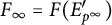 , so as shown in [Reference SerreSer72]
$\Sigma =\mathrm {Gal}(F_\infty /F)$
 is an open subgroup of
$\mathrm {GL}_2(\mathbb {Z}_p)$
 . It follows that if C denotes the center of
$\Sigma $
 , then C is isomorphic to an open subgroup of
$\mathbb {Z}_p^*$
 . Let
$K_\infty =F_\infty ^C$
 , so
$G=\mathrm {Gal}(K_\infty /F)$
 is a three-dimensional p-adic Lie group with no element of order p, isomorphic to an open subgroup of
$\mathrm {PGL}_2(\mathbb {Z}_p)$
 . It is an easy consequence of the Weil pairing that
$K_\infty $
 does not contain the cyclotomic
$\mathbb {Z}_p$
 -extension of F.
1.1 Result in Section 2
Let S be a finite set of primes of F containing all the primes above p and all the primes where either E or
$E'$
 has bad reduction. Let
$\mathrm {Sel}(E/K_\infty )$
 be the Selmer group of E over
$K_\infty $
 as in Section 2.2. The first main result of this article gives an explicit formula for the G-Euler characteristic of
$\mathrm {Sel}(E/K_\infty )$
 in terms of the arithmetic invariants of E.
Theorem 1.1 Let E and
$E'$
 be non-isogenous elliptic curves defined over a finite extension F of
$\mathbb Q$
 , and assume that both E and
$E'$
 do not have complex multiplication. Let p be a prime
$\geqslant 5$
 , and let
$F_\infty =F(E^{\prime }_{p^\infty })$
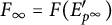 , and
$\Sigma =\mathrm {Gal}(F_\infty /F)$
 . Let C be the center of
$\mathrm {Gal}(F_\infty /F)$
 , and let
$K_\infty =F_\infty ^C$
 and
$G=\mathrm {Gal}(K_\infty /F)\cong \Sigma /C$
 . Assume that
-
(i) both E and $E'$
 have good ordinary reduction at all primes of F dividing p;
-
(ii) $\mathrm {Sel}(E/F)$
is finite; -
(iii) $\mathcal {C}(E/K_\infty ) = \mathrm {Sel}(E/K_\infty )^\vee $
is
$\Lambda (G)$
-torsion; -
(iv) hypothesis $(\mathrm {S}_{\Sigma })$
in Section 2.2 is satisfied.





Then
$\mathrm {Sel}(E/K_\infty )$
 has finite G-Euler characteristic, and

Here,
$c_v(E)$
 is the Tamagawa factor of E at v, which is defined as
$c_v=[E(F_v):E_0(F_v)]$
 , where
$E_0(F_v)$
 is the subgroup of
$E(F_v)$
 consisting of the points of non-singular reduction modulo v. The Euler factor at v of the complex L-function of E over F is
$L_v(E,s)$
 and
$\mid \cdot \mid _p$
 is the p-adic valuation of
$\mathbb Q$
 , normalized such that
$\mid p\mid _p=p^{-1}$
 . The set
$\mathfrak {M}$
 is the set of primes of F not dividing p where
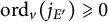
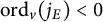
$\mathrm {ord}_v(j_{E'})<0$
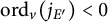 , and
$\mathfrak {R}$
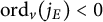
 is the set of primes of F not dividing p such that
$\mathrm {ord}_v(j_{E'})\geqslant 0$
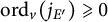 ,
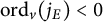
$\mathrm {ord}_v(j_E)<0$
 and for which there exists a finite extension
$F_{v'}$
 of
$F_v$
 contained in
$F_{\infty ,w}$
 such that
$| a_{v'}(E') |=2\sqrt {q}$
 , where q is the cardinality of the residue field of
$F_{v'}$
 .
Remark 1.2 Comparing the expression for
$\chi (G,\mathrm {Sel}(E/K_\infty ))$
 with the Euler characteristic formula for
$\mathrm {Sel}(E/F_\infty )$
 given in [Reference CoatesCoa99, Conjecture 1.13 and Theorem 1.14] shows that some of the Tamagawa factors disappear when one passes from
$F_\infty $
 to
$K_\infty $
 , which indicates that the Iwasawa theory of p-adic Lie extensions not containing
$F^{cyc}$
 might be very different from the Iwasawa theory of strongly admissible p-adic Lie extensions.
1.2 Result in Section 3
The definition of a pseudonull module over a non-commutative algebra was introduced by Venjakob in [Reference VenjakobVen02]. These modules occur naturally in the theory of modules over Iwasawa algebras of p-adic Lie groups of dimension
$> 1$
 , generalizing the role played by finite modules in the one-dimensional case. In particular, if one defines a pseudo-isomorphism of
$\Lambda (G)$
 -modules to be a morphism whose kernel and cokernel are pseudonull, then the main result of [Reference Coates, Schneider and SujathaCSS03b] classifies finitely generated modules over non-commutative Iwasawa algebras up to pseudo-isomorphism, generalizing the well-known structure theorem for finitely-generated
$\Lambda (\Gamma )$
 -modules.
The second main result of this article shows that some general results about the algebraic structure of the Selmer group remain true when one passes from the
$\mathrm {GL}_2$
 - to the
$\mathrm {PGL}_2$
 -extension. The main result of [Reference Ochi and VenjakobOV02] shows that
$\mathcal {C} (E/F_\infty )$
 has no nontrivial pseudonull submodule. The following theorem shows that the same is true over
$K_\infty $
 .
Theorem 1.3 Assume that both E and
$E'$
 have good ordinary reduction at any prime of F dividing p. Further assume that for all
$v \in S$
 ,
$v \nmid p$
 ,
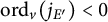
$\mathrm {ord}_v(j_{E'})<0$
 . If
$\mathcal {C}(E/K_\infty )$
 is
$\Lambda (G)$
 -torsion, then it has no nontrivial pseudonull submodule.
1.3 Result in Section 4
The final main result of this article is a formula regarding the change in the Iwasawa
$\mu $
 -invariants (as
$\Lambda (G)$
 -modules) of Selmer groups (over the
$\mathrm {PGL}_2$
 -extension) of elliptic curves with an isogeny between them. There are some extra terms appearing in the formula for the
$\mathrm {PGL}_2$
 -case compared to the
$\mathrm {GL}_2$
 -case by [Reference HowsonHow02, Theorem 3.1]. We also note that similar formulas in the commutative cases were treated by Schneider (see [Reference SchneiderSch87]) and Perrin-Riou (see [Reference Perrin-RiouPR87, Appendix] and [Reference Perrin-RiouPR89]).
Let
$E_1$
 and
$E_2$
 be elliptic curves without complex multiplication defined over a number field F with good ordinary reduction at all places of F above p, and they are isogenous via
${\varphi }: E_1 \rightarrow E_2$
 . We assume that
$F_\infty =F(E_{1,p^{\infty }})=F(E_{2,p^\infty })$
 is a pro-p extension of F. Let A be the p-part of the kernel of
${\varphi }$
 and let
$\tilde {A}_v$
 be the image of A under the reduction map
$v: E_1 \rightarrow \tilde {E}_1$
 . Let S be a finite set of primes of F including all the primes which divide p and places, where
$E_1$
 (hence,
$E_2)$
 has bad reduction.
Theorem 1.4 Let
$p\ge 5$
 . Let
$ {\varphi }: E_1 \rightarrow E_2$
 be an isogeny between two elliptic curves without complex multiplication. Assume that the dual Selmer groups
$\mathcal {C}(E_i/K_\infty )$
 are
$\Lambda (G)$
 -torsion for
$i=\{1,2\}$
 . Then

2 Euler characteristic formula for the
$\mathrm {PGL}_2$
-extension

2.1 Strategy
Recall that E and
$E'$
 are elliptic curves without complex multiplication defined over a number field F and p a prime
$\geqslant 5$
 . We assume throughout that both E and
$E'$
 have good ordinary reduction at all primes of F dividing p. Let
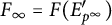
$F_\infty =F(E^{\prime }_{p^\infty })$
 , so as shown in [Reference SerreSer72],
$\Sigma =\mathrm {Gal}(F_\infty /F)$
 is an open subgroup of
$\mathrm {GL}_2(\mathbb {Z}_p)$
 . Let C denote the center of
$\Sigma $
 , so C consists of scalar multiples of the identity and is isomorphic to an open subgroup of
$\mathbb {Z}_p^\times $
 . Let
$K_\infty =F_\infty ^C$
 and
$G=\mathrm {Gal}(K_\infty /F)\cong \Sigma /C$
 . It follows from the previous remarks that
$K_\infty $
 is a p-adic Lie extension of F of dimension
$3$
 , and
$E_{p^\infty }(K_\infty )$
 is finite as
$E_{p^\infty }(F_\infty )$
 is finite by [Reference ZerbesZer04, Proposition 10] (see also [Reference Lim and MurtyLM14, Lemma 6.2]).
In Section 2.2, we construct a commutative diagram relating
$\mathrm {Sel}(E/K_\infty )$
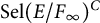
 to
$\mathrm {Sel}(E/F_\infty )^C$
 , analogous to the “fundamental diagram” relating
$\mathrm {Sel}(E/F_\infty )$
 to
$\mathrm {Sel}(E/F^{cyc})$
 appearing in [Reference Coates, Schneider and SujathaCSS03a]. We then analyze the local extensions corresponding to the extension
$K_\infty $
 of F in Section 2.3, and we use these results in Sections 2.4 and 2.5 to determine the kernels and cokernels of the local restriction maps of the fundamental diagram. Finally, in Section 2.6, we calculate the G-Euler characteristic of
$\mathrm {Sel}(E/K_\infty )$
 , thereby completing the proof of Theorem 1.1.
2.2 The fundamental diagram
In order to calculate the G-Euler characteristic of
$\mathrm {Sel}(E/K_\infty )$
 , we compare
$\mathrm {Sel}(E/K_\infty )$
 with the C-invariants of
$\mathrm {Sel}(E/F_\infty )$
 . Let S be a finite set of primes of F containing all the primes above p and all the primes where either E or
$E'$
 has bad reduction. For any extension
$M / F$
 , we write
$G_S(M)$
 for the Galois group of the maximal algebraic extension of M unramified outside the primes above S. Then we may define
$\mathrm {Sel}(E/K_\infty )$
 as the kernel of the natural map
$\lambda _S(K_\infty ): H^1(G_S(K_\infty ),E_{p^\infty })\to \bigoplus _{v\in S}J_v(K_\infty )$
 , where
$J_v(K_\infty )$
 is the usual local cohomology term as defined in [Reference ZerbesZer09, Section 2.1].
By definition of Selmer group, we have a short exact sequence

Taking C-invariants of the exact sequence

and comparing it with (2), we obtain the following fundamental diagram:

We will make the hypotheses as and when needed.
$(\mathrm {{WLC}}_G)$
 :
$H^2(G_S(K_\infty ),E_{p^\infty })=0$
 .
$\mathrm {(S}_{\Sigma })$
 : The map
$\lambda _S(F_\infty )$
 in (3) is surjective.
$\mathrm {(S}_{G})$
 : The map
$\lambda _S(K_\infty )$
 is surjective.
Remark 2.1 Let
$R=\mathrm {Gal}(F_\infty /F(A[p]))$
 . If
$\mathrm {Sel}(E/F_\infty )$
 is
$\Lambda (R)$
 -cotorsion, then by [Reference ZerbesZer04, Corollary 1, p. 603], hypothesis
$\mathrm {(S}_{\Sigma })$
 is satisfied. We also note that since
$\mathrm {Gal}(F(A[p])/F)$
 is a finite group,
$\mathrm {Sel}(E/F_\infty )$
 is
$\Lambda (R)$
 -cotorsion, if and only if
$\mathrm {Sel}(E/F_\infty )$
 is
$\Lambda (\Sigma )$
 -cotorsion (see [Reference Ochi and VenjakobOV02, after Definition 3.2]).
Similarly, if
$\mathrm {Sel}(E/K_\infty )$
 is
$\Lambda (G)$
 -cotorsion, (or equivalently
$\mathrm {Sel}(E/K_\infty )$
 is
$\Lambda (\tilde {G})$
 -cotorsion, after replacing G by a finite index pro-p subgroup
$\tilde {G}$
 ) then by [Reference Hachimori and VenjakobHV03, Theorem 7.2], hypotheses
$(\mathrm {{WLC}}_G)$
 and
$\mathrm {(S}_{G})$
 are satisfied.
2.3 Decomposition groups
We now describe the decomposition groups in
$K_\infty $
 of primes of F. For a prime v of F, let w denote a fixed prime of
$K_\infty $
 above v. The decomposition group
$G_v$
 of w in G can be canonically identified with the local Galois group
$\mathrm {Gal}(K_{\infty ,w}/F_v)$
 . Note that
$G_v\cong \Sigma _w/C_w$
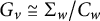 , where
$C_w=C\cap \Sigma _w$
 . The following two propositions describe the structure of these local Galois groups.
Proposition 2.2 Let v be a finite prime of F which does not divide p. If
$\mathrm {ord}_v(j_{E'})<0$
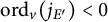 , then
$K_{\infty ,w}=F_v(E^{\prime }_{p^\infty })$
 and
$\dim (G_v)=2$
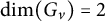 . If
$\mathrm {ord}_v(j_{E'})\geqslant 0$
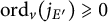 , then
$G_v$
 is finite of order prime to p if and only if there exists a finite extension
$F_{v'}$
 of
$F_v$
 contained in
$F_{\infty ,w}$
 such that
$|a_{v'}(E')|=2\sqrt {q}$
 . Otherwise,
$G_v$
 is an open subgroup of
$\mathbb {Z}_p^*$
 .
Proof Suppose that
$\mathrm {ord}_v(j_{E'})<0$
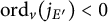 . Then

where
$q^{(v)}_{E'}$
 is the Tate period of
$E'$
 over
$F_v$
 , and we have an exact sequence of
$\mathrm {Gal}(F_v(E^{\prime }_{p^\infty })/F_v)$
 -modules

It follows that every element that acts on
$E^{\prime }_{p^\infty }$
 by scalar multiplication must be the identity, so
$C_w = 1$
 and hence,

This is isomorphic to an open subgroup of
$ \mathbb {Z}_p^{\times } \rtimes \mathbb {Z}_p(1)$
 and hence has p-cohomological dimension
$2$
 . Assume now that
$\mathrm {ord}_v(j_{E'})\geqslant 0$
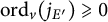 . Now
$F_v(E^{\prime }_{p^\infty })$
 is a finite extension of order prime to p of the unramified
$\mathbb {Z}_p$
 -extension of
$F_v$
 , so it follows that
$\mathrm {Gal}(K_{\infty ,w}/F_v)$
 is either finite or an open subgroup of
$\mathbb {Z}_p^*$
 . Let
$F_{v'}$
 be an extension of
$F_v$
 contained in
$F_{\infty ,w}$
 such that
$\mathrm {Gal}(F_{\infty ,w}/F_{v'})$
 is pro-p. Let
${\varphi }$
 be a topological generator of
$\mathrm {Gal}(F_{\infty ,w}/F_{v'})$
 , and let
$\Phi $
 be the matrix representing
${\varphi }$
 with respect to some fixed
$\mathbb {Z}_p$
 -basis of
$E^{\prime }_{p^\infty }$
 . Then
$\Phi $
 satisfies the polynomial

where q is the cardinality of the residue field of
$F_{v'}$
 . It follows that
$\Phi $
 is scalar if and only if
$F_{v'}(T)$
 has a double root, which happens precisely when
$| a_{v'}(E') |=2\sqrt {q}$
 .
Corollary 2.3 If v is a prime of F not dividing p where
$\mathrm {ord}_v(j_{E'})<0$
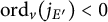 , then
$H^1(K_{\infty ,w},E_{p^\infty })=0$
 .
Proof This follows since the profinite degree of
$\mathrm {Gal}(\overline {F}_v / K_{\infty ,w})$
 is prime to p, as in [Reference ZerbesZer11, Lemma 4.2].
For the primes of F above p, the situation is more subtle.
Proposition 2.4 Let v be a prime of F dividing p. Then
$\dim G_v=2$
 , and up to a finite extension, the extension
$K_{\infty ,w}$
 of
$F_v$
 is totally ramified.
Proof We need to show that
$C\cap \Sigma _w\cong \mathbb {Z}_p$
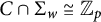 . Now as shown in [Reference CoatesCoa99],
$\Sigma _w$
 is a p-adic Lie group of dimension
$3$
 , and by choosing a suitable
$\mathbb {Z}_p$
 -basis of
$E^{\prime }_{p^\infty }$
 , it can be represented by upper triangular matrices. Suppose now that
$C\cap \Sigma _w=1$
 . Then
$C\times \Sigma _w$
 is a subgroup of
$\Sigma $
 of dimension
$4$
 , so it must be of finite index in
$\Sigma $
 . However, with respect to the chosen basis every matrix in
$C\times \Sigma _w$
 is upper triangular, which gives a contradiction. Hence,
$C_w\cong \mathbb {Z}_p$
 . Let
$k_v$
 be the residue field of
$F_v$
 . Now, upto a finite extension, the maximal unramified pro-p extension of
$k_v$
 contained in
$k_v(E^{\prime }_{p^\infty })$
 is the unique unramified
$\mathbb {Z}_p$
 -extension, which is the field of definition of
$\tilde {E'}_{v,p^\infty }$
 . It is well-known that we have an exact sequence of
$\Sigma _w$
 -modules

where
$\mathfrak {M}_\infty $
 is the maximal ideal of the ring of integers of
$F_v(E^{\prime }_{p^\infty })$
 and
$\hat {E'}_v$
 is the formal group of the elliptic curve over the ring of integers of
$F_v(E^{\prime }_{p^\infty })$
 . So if an element of
$\Sigma _w$
 acts on
$E^{\prime }_{p^\infty }$
 by scalar multiplication, then it must also act by scalar multiplication on
$\tilde {E'}_{v,p^\infty }$
 . It follows that if
$k_{K_\infty ,w}$
 denotes the residue field of
$K_{\infty ,w}$
 , then
$\tilde {E'}_{v,p^\infty }(k_{K_\infty ,w})$
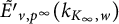 is finite, or equivalently, the extension
$K_{\infty ,w}$
 of
$F_v$
 is totally ramified upto a finite extension.
2.4 Local cohomology
Lemma 2.5 Let
$v\in S$
 , w be a prime of
$K_\infty $
 lying above v, and let
$k_{\infty ,w}$
 be the residue field of
$F_{\infty , w}$
 . Let

If
$v \nmid p$
 , then
$X_w^{G_v}\neq 0$
 if and only if (i)
$\mathrm {ord}_v(j_{E'})\geqslant 0$
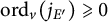 , (ii) there exists a finite extension
$F_{v'}$
 of
$F_v$
 contained in
$F_{\infty ,w}$
 such that
$| a_{v'}(E')|=2\sqrt {q}$
 , and (iii)
$\mathrm {ord}_v(j_E)<0$
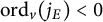 . If this is the case, then

If
$v \mid p$
 , then
$\chi (G_v, X_w)=1.$

Proof Suppose
$v \mid p$
 . Let
$M=\tilde {E}_{v,p^\infty }(k_{\infty ,w})$
 . We have the Hochschild–Serre spectral sequence

From this, we obtain that
$\chi (\Sigma _w,M)=\prod \chi (G_v,H^i(C_w,M))^{(-1)^i}.$
 Since,
$C_w$
 has p-cohomological dimension at most one, one obtains

But by [Reference ZerbesZer04, Proposition 4],
$\chi (\Sigma _w,M)=1$
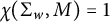 . Hence,
$\chi (G_v,X_w)=\chi (G_v,M^{C_w})$
 . But by Proposition 2.4, the residue field of
$K_{\infty ,w}$
 is a finite extension of the residue field of
$F_v$
 and hence
$M^{C_w}=\tilde {E}_{v,p^\infty }(k_{K_{\infty ,w}})$
 is finite and so
$\chi (G_v,M^{C_w})=1$
 .
Now, let
$v \in S$
 and
$v \nmid p$
 . If
$\mathrm {ord}_v(j_{E'})<0$
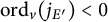 , then by the proof of Proposition 2.2,
$C_w=1$
 and hence
$X_w=0$
 . Hence,
$\mathrm {ord}_v(j_{E'})\geqslant 0$
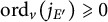 and under this hypothesis there are two possible cases. Either
$G_v$
 is finite of order prime to p which holds if and only if
$(ii)$
 holds or
$G_v$
 is an open subgroup of
$\mathbb {Z}_p^*$
 . If
$G_v$
 is finite of order prime to p, by inflation restriction exact sequence
$X_w^{G_v}\cong H^1(\Sigma _w,E_{p^\infty }(F_{\infty ,w}))$
 with cardinality equal to
$| c_v(E)|_p^{-1}$
 for
$\mathrm {ord}_v(j_E)<0$
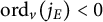 and
$H^1(\Sigma _w,E_{p^\infty }(F_{\infty ,w}))$
 is zero otherwise by [Reference ZerbesZer04, Proposition 2]. Suppose now that
$G_v$
 is an open subgroup of
$\mathbb {Z}_p^*$
 , then as shown in the proof of [Reference ZerbesZer04, Proposition 2],
$\dim \Sigma _w=1$
 , and
$\Sigma _w$
 has no element of order p (see the line after eq. (2.5) of [Reference ZerbesZer04]). Hence, p-cohomological dimension of
$\Sigma _w$
 is
$1$
 . This implies that p-cohomological dimension of
$C_w$
 is zero and since the module
$E_{p^\infty }(F_{\infty ,w})$
 is p-primary, we have
$X_w=H^1(C_w, E_{p^\infty }(F_{\infty ,w}))=0.$

2.5 Analysis of the local restriction maps
Recall that we have defined the local restriction maps

Here,

where w runs over all primes of
$K_\infty $
 above v.
Lemma 2.6 Let
$v\in S$
 . Then,
$\mathrm {coker}(\eta _v)=0$
 .
Proof By Kummer theory and applying inflation-restriction sequence, we have

But
$\operatorname {\mathrm {cd}}_p(C_w)\leqslant 1$
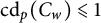 for all w, so
$\mathrm {coker}(\eta _v)=0$
 for all
$v\in S$
 .
2.6 Calculation of the Euler characteristic
To simplify notation, define the following conditions:
-
• (Tors $\!\! _G$
) The Pontryagin dual
$\mathcal {C} (E/K_\infty )$
is
$\Lambda (G)$
-torsion. -
• (Tors $\!\! _{\Sigma }$
) The Pontryagin dual
$\mathcal {C} (E/F_\infty )$
is
$\Lambda (\Sigma )$
-torsion.


Also, we need the following definition.
Definition 2.7 Let
$\mathfrak {R}$
 be the set of primes of F such that
-
(i) $v \nmid p$
, -
(ii) $\mathrm {ord}_v(j_{E'})\geqslant 0$
, -
(iii) there exists a finite extension $F_{v'}$
of
$F_v$
contained in
$F_{\infty ,w}$
such that
$| a_{v'}(E')|=2\sqrt {q}$
, and -
(iv) $\mathrm {ord}_v(j_E)<0$
.




Proposition 2.8 Suppose that
$(\mathrm {S_G})$
 is satisfied. Then
$\mathrm {Sel}(E/K_\infty )$
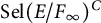
 has finite G-Euler characteristic if and only if so does
$\mathrm {Sel}(E/F_\infty )^C$
 , and if this is the case, then

Proof Note that we are assuming that E and
$E'$
 does not have complex multiplication and hence by the proof of [Reference ZerbesZer04, Proposition 10]
$E_{p^\infty }(F_\infty )$
 is finite; therefore,
$\ker (\beta )$
 and
$\mathrm {coker}(\beta )$
 are both finite. (In fact, we have
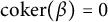
$\mathrm {coker}(\beta )=0$
 since
$\mathrm {coker}(\beta )\cong H^2(C,E_{p^\infty }(F_\infty ))$
 and C has p-cohomological dimension
$1$
 .) It is shown in [Reference SerreSer98] that
$\chi (G,M)=1$
 for every finite p-primary G-module M. Applying the snake lemma to the fundamental diagram 4, we therefore deduce that
$\mathrm {coker}(\alpha )$
 has finite G-Euler characteristic if and only if so does
$\ker (\eta )$
 , and if this is the case, then

Here, the second equality is a direct consequence from Lemma 2.5 and the fact that

where w runs over all primes of
$K_\infty $
 above v. It follows from Shapiro’s lemma that

where w is some fixed prime of
$K_\infty $
 above v. But as shown in Proposition 2.2, for any prime
$v\in \mathfrak {R}$
 , the local cohomology group
$G_v$
 is finite of order prime to p, so by Lemma 2.5, we have

and hence,

Now,
$\ker (\alpha )$
 is finite since it is contained in
$\ker (\beta )$
 , so

The proposition therefore follows from (5) and the exact sequence

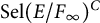
It now remains to relate the G-Euler characteristic of
$\mathrm {Sel}(E/F_\infty )^C$
 to the
$\Sigma $
 -Euler characteristic of
$\mathrm {Sel}(E/F_\infty )$
 . We first need the following lemma.
Lemma 2.9 If
$\mathrm {(S}_{G})$
 holds, then we have a short exact sequence

Proof The proof follows from Lemma 2.6.
Proposition 2.10 If hypotheses
$\mathrm {(S}_{G})$
 ,
$\mathrm {(S}_{\Sigma })$
 , and
$(\mathrm {{WLC}}_G)$
 are satisfied, then

for all
$i\geqslant 1$
 .
Proof We have
$\operatorname {\mathrm {cd}}_p(C)=1$
 , so
$H^i(C,\mathrm {Sel}(E/F_\infty ))=0$
 for all
$i\geqslant 2$
 . We first show that
$H^1(C,H^1(G_S(F_\infty ),E_{p^\infty }))=0$
 . The Hochschild–Serre spectral sequence gives an exact sequence

where the term on the right is zero since
$\operatorname {\mathrm {cd}}_p(C)=1$
 . The triviality of
$H^1(C,H^1(G_S(F_\infty ),E_{p^\infty }))$
 now follows from hypothesis
$(\mathrm {{WLC}}_G)$
 .
By assumption, we have a short exact sequence

Taking C-cohomology and using that
$H^1(C,H^1(G_S(F_\infty ),E_{p^\infty }))=0$
 , we obtain

As shown in Lemma 2.9, the map

is surjective, which finishes the proof.
Corollary 2.11 We have canonical isomorphisms

for all
$i\geqslant 0$
 .
Proof The result is an immediate consequence of Proposition 2.10 and the Hochschild–Serre spectral sequence.
Combining Corollary 2.11 with Proposition 2.8, we get the following result.
Proposition 2.12 Assume hypotheses
$\mathrm {(S}_{\Sigma })$
 and (Tors
$_G$
 ) are satisfied. Then,
$\mathrm {Sel}(E/K_\infty )$
 has finite G-Euler characteristic if and only if
$\mathrm {Sel}(E/F_\infty )$
 has finite
$\Sigma $
 -Euler characteristic, and if this is the case, then

Combining Proposition 2.12 with the formula for
$\chi (\Sigma ,\mathrm {Sel}(E/F_\infty ))$
 given by [Reference ZerbesZer04, Theorem 1] gives Theorem 1.1.
Remark 2.13 It follows from the equation in Proposition 2.12 that in theory
$\chi (G,\mathrm {Sel}(E/K_\infty ))$
 could be non-integral (which cannot happen over strongly admissible p-adic Lie extensions!), but unfortunately we do not have the numerical data to construct an example.
3 Results on non-existence of pseudonull submodules
Throughout this section, let G be a compact p-adic Lie group without p-torsion and
$\Lambda (G)$
 its Iwasawa algebra. Let
$d=\dim G$
 . It is shown in [Reference Goodearl and WarfieldGW04] that
$\Lambda (G)$
 is a Noetherian ring. In the following sections, we collect some results from the theory of
$\Lambda (G)$
 -modules that will be needed in the proof of Theorem 1.3. Since we restrict our discussions to the absolute minimum, we give references where a detailed treatment of the topics can be found.
3.1 Pseudonull modules
In the following, we recall the definition of pseudonull modules as given in [Reference VenjakobVen02] and state one of its basic properties. In the presentation, we follow Section 2 in [Reference Ochi and VenjakobOV02], but we restrict the discussion to the Iwasawa algebras of p-adic Lie groups. A general treatment can be found in [Reference VenjakobVen03].
Convention 3.1 For a finitely generated
$\Lambda (G)$
 -module M, write

for any
$i\geqslant 0$
 .
Recall the following definition.
Definition 3.2
-
(i) If $M\neq 0$
is a
$\Lambda (G)$
-module, then $$ \begin{align*}j(M)=\min \{ i\mid E^i(M)\neq 0\}\end{align*} $$
is called the grade of M.
-
(ii) The Noetherian ring $\Lambda (G)$
is an Auslander regular ring if it has finite global homological dimension and if the following condition holds: For any
$\Lambda (G)$
-module M, any
$m\geqslant 0$
and any submodule N of
$E^m(M)$
, we have
$j(N)\geqslant m$
.


In [Reference VenjakobVen02], Theorem 3.26, it is shown that for any p-adic Lie group G without p-torsion, its Iwasawa algebra
$\Lambda (G)$
 is Auslander regular. In particular, this implies that any finitely generated
$\Lambda (G)$
 -module M has a canonical filtration

which allows us to make the following definition.
Definition 3.3 A finitely generated
$\Lambda (G)$
 -module M is pseudonull if
$M=T_{d-2}$
 .
The following lemma, which characterizes pseudonull
$\Lambda (G)$
 -modules in terms of their
$\operatorname {\mathrm {Ext}}$
 -groups, is very useful in practice.
Lemma 3.4 A finitely generated
$\Lambda (G)$
 -module is pseudonull if and only if

Proof See the proof of Proposition 2.4 in [Reference Ochi and VenjakobOV02].
3.2 Duality groups
One of the fundamental results of Lazard is that every p-adic Lie group with no element of order p is a Poincar
$\acute {\text {e}}$
 duality group (cf. [Reference Symonds and WeigelSW00]), so in particular, it is a duality group in the sense of [Reference Neukirch, Schmidt and WingbergNSW13, Chapter III, Section 4].
For us, this fact is particularly useful because of the following result.
Proposition 3.5 Let G be a duality group at p of dimension n, and let M be a
$\Lambda (G)$
 -module which has a resolution by finitely generated projectives.
-
(i) If M is a free finitely generated $\mathbb {Z}_p$
-module, then $$ \begin{align*} E^kM=0 \text{ if } k\neq n. \end{align*} $$
-
(ii) If M is a finite p-primary G-module, then
$$ \begin{align*} E^kM=0 \text{ if } k\neq n+1. \end{align*} $$


3.3 Two useful exact sequences
In this section, we recall the definition of two exact sequences of
$\Lambda (G)$
 -modules, which were first defined in Venjakob’s generalization of Jannsen’s homotopy theory (cf. [Reference JannsenJan89]) in [Reference Ochi and VenjakobOV02, Section 3], and which will be crucial in the proof of Theorem 1.3. We follow the presentation given in [Reference Ochi and VenjakobOV02].
Let
$\mathcal {G}$
 be a profinite group which is topologically of finite type of rank d. As shown in [Reference Neukirch, Schmidt and WingbergNSW13, Chapter V.6], there is a surjective homomorphism from a free profinite group
$\mathcal {F}$
 of rank d to
$\mathcal {G}$
 , which gives an exact sequence

The module
$\mathcal {N}^{ab}(p)$
 fits into the following exact sequence, which is called the Fox–Lyndon resolution associated with the above free presentation of
$\mathcal {F}$
 :

(see [Reference Neukirch, Schmidt and WingbergNSW13, Theorem 5.6.6]). We extract from it the short exact sequence

and one can show that the augmentation ideal
$\mathcal {I}=\ker (\Lambda (\mathcal {G})\rightarrow \mathbb {Z}_p)$
 is a free
$\Lambda (\mathcal {F})$
 -module of rank d.
To simplify notation, we make the following definition.
Definition 3.6 Let A be a p-divisible p-primary abelian group of finite
$\mathbb {Z}_p$
 -corank r with a continuous action of
$\mathcal {G}$
 . For a finitely generated
$\Lambda (\mathcal {G})$
 -module M, define

where
$A^\vee $
 denotes the Pontryagin dual of A. Here,
$M[A]$
 is equipped with the usual diagonal action of
$\mathcal {G}$
 .
Note that
$\otimes _{\mathbb {Z}_p}A^\vee $
 is an exact functor on the category of finitely generated
$\Lambda (\mathcal {G})$
 -modules.
Lemma 3.7 The module
$\Lambda (\mathcal {G})[A]$
 is a free
$\Lambda (\mathcal {G})$
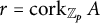
 -module of rank
$r=\operatorname {\mathrm {cork}}_{\mathbb {Z}_p}A$
 .
Proof See the proof of Lemma 4.2 in [Reference Ochi and VenjakobOV02].
We now specialize to the case when
$\mathcal {G}$
 is the absolute Galois group of some finite extension K of
$\mathbb Q$
 or
$\mathbb Q_p$
 ; that is, let
$\bar {K}$
 be an algebraic closure of K, and let
$\mathcal {G}=\mathrm {Gal}(\bar {K}/K)$
 . Note that
$\mathcal {G}$
 is profinite by definition. Let
$K_\infty $
 be a p-adic Lie extension of K contained in
$\bar {K}$
 , and let
$\mathcal {H}=\mathrm {Gal}(\bar {K}/K_\infty )$
 and
$G=\mathrm {Gal}(K_\infty /K)$
 . Again, let A be a p-divisible p-primary abelian group of finite
$\mathbb {Z}_p$
 -corank r with a continuous action of
$\mathcal {G}$
 . Tensoring (7) by
$A^\vee $
 gives an exact sequence

where
$\Lambda (\mathcal {G})[A]$
 is a projective
$\Lambda (\mathcal {G})$
 -module by Lemma 3.7. Taking
$\mathcal {H}$
 -homology of (8) therefore gives an exact sequence

from which we extract the short exact sequence

where


and I is defined by the exactness of the exact sequence

Equations (10) and (13) are the fundamental exact sequences.
3.4 Strategy of proof
Let us return to the setup and notations in Theorem 1.3. Let us assume
$(\mathrm {S}_G)$
 and
$(\mathrm {WLC_G})$
 . We also note that if we assume
$(Tors_G)$
 , then it implies
$(\mathrm {S}_G)$
 and
$(\mathrm {WLC_G})$
 by Remark 2.1.
Note that neither
$\Sigma $
 nor G have elements of order p since
$p\geqslant 5$
 . Recall that the Selmer group of E over
$K_\infty $
 is given by the exact sequence

where S is a finite set of primes of F containing those above p and the ones where at least one of E or
$E'$
 has bad reduction. For the proof of Theorem 1.3, it will be more convenient to rewrite the local term as follows. Let
$v\in S$
 , and denote by
$G_w$
 the decomposition group of a fixed prime of
$K_\infty $
 above v. Then

so that (14) can be rewritten as

By assumption
$\mathrm {(S}_{G})$
 , the map
$\lambda _S(K_\infty )$
 is surjective, so dualizing (15) gives the short exact sequence

where


Here, we quote the following result from [Reference Ochi and VenjakobOV02].
Proposition 3.8 Assume
$(\mathrm {{WLC}}_G)$
 . Then,
$X_S$
 has no nontrivial pseudonull submodule. Equivalently, we have

By Lemma 3.4, proving that
$\mathcal {C} (E/K_\infty )$
 has no nontrivial pseudonull submodule is equivalent to showing that

We split the proof of this result in two steps: In Section 3.5, we prove a couple of results about the vanishing of the
$\operatorname {\mathrm {Ext}}$
 -groups of the local terms
$U_v$
 . We then finish the proof of Theorem 1.3 in Section 3.6 by imitating the arguments in [Reference Ochi and VenjakobOV02, Section 5].
3.5 Local results
To analyze the
$\operatorname {\mathrm {Ext}}$
 -groups of the local terms
$U_v$
 for
$v\in S$
 , we use the following lemma, which we quote from [Reference Ochi and VenjakobOV02].
Lemma 3.9 Let
$v\in S$
 , and denote by
$G_v$
 the decomposition group in G of some finite prime of
$K_\infty $
 above v. Then for any finitely generated
$\Lambda (G_v)$
 -module M, we have canonical isomorphisms

for all
$i\geqslant 0$
 .
The structure of the local extensions
$K_{\infty ,w}$
 over
$F_v$
 is given by Propositions 2.2 and 2.4. For a prime v of F, let w denote a fixed prime of
$K_\infty $
 above v. Recall that the decomposition group
$G_v$
 of w in G can be canonically identified with the local Galois group
$\mathrm {Gal}(K_{\infty ,w}/F_v)$
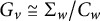
 . Also recall that
$G_v\cong \Sigma _w/C_w$
 , where
$C_w=C\cap \Sigma _w$
 .
In the following, for
$v \in S$
 , we denote
$\mathcal {H}_v=\mathrm {Gal}(\overline {F}_v/K_{\infty , w}), G_v=\mathrm {Gal}(K_{\infty ,w} /F_v), \mathcal {G}_v=\mathrm {Gal}(\overline {F}_v/F_v).$

The next result is the heart of the proof of Theorem 1.3.
Proposition 3.10 For all
$v\in S$
 , we have

for all
$i\geqslant 2$
 .
Proof Let
$v\in S$
 . Let
$X_v=H^1(K_{\infty ,w},E)(p)^\vee .$
 By Lemma 3.9, it is sufficient to show that

for all
$i\geqslant 2$
 and for all
$v\in S$
 . We have to consider different cases.
Assume first that
$v\nmid p$
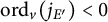
 . If
$\mathrm {ord}_v(j_{E'})<0$
 , then is shown in [Reference CoatesCoa99] we have
$X_v=0$
 , so (21) is clear. Similarly, if
$\mathrm {ord}_v(j_{E'})\geqslant 0$
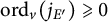 and
$G_v$
 is trivial, then

which is finite by [Reference ZerbesZer04, Lemma 1], so
$E_{\Lambda (G_v)}^iX_v=0$
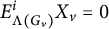 for all
$i\geqslant 2$
 by Proposition 3.5. The same argument also works if
$G_v$
 is finite of order prime to p. Assume now that
$\mathrm {ord}_v(j_{E'})\geqslant 0$
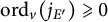 and
$G_v\cong \mathbb {Z}_p$
 . The fundamental exact sequences (10) and (13), applied to
$A=E_{p^\infty }$
 , give


where
$n_v\geqslant 1$
 ,
$\operatorname {\mathrm {pd}} Y_v\leqslant 1$
 (cf. [Reference Ochi and VenjakobOV02, Lemma 4.5]), and
$W_v=E_{p^\infty }(K_{\infty ,w})^\vee .$
 Here,
$Y_v=(\mathcal {I}[E_{p^\infty }])_{\mathcal {H}_v}, X_v=H_1(\mathcal {H}_v, E_{p^\infty }^\vee )$
 , and
$I_v$
 is defined using (13) with
$\mathcal {G}$
 ,
$\mathcal {H}$
 , and A replaced by
$\mathcal {G}_v, \mathcal {H}_v$
 , and
$E_{p^\infty }$
 , respectively. We have to distinguish between two different cases:
-
(1) $\mathrm {ord}_v(j_E)\geqslant 0$
: It follows from [Reference ZerbesZer04, Lemma 1] that if
$E_{p^\infty }$
is not rational over
$K_{\infty ,w}$
, then it will become rational over some finite extension of
$K_{\infty ,w}$
of order prime to p. We can therefore without loss of generality assume that
$E_{p^\infty }$
is rational over
$K_{\infty ,w}$
. It follows from (22) and (23) that for all
$i\geqslant 2$
we have canonical isomorphisms $$ \begin{align*} E_{\Lambda(G_v)}^iX_v\cong E_{\Lambda(G_v)}^{i+1}I_v\cong E_{\Lambda(G_v)}^{i+2}W_v. \end{align*} $$
But $E_{\Lambda (G_v)}^{i+2}W_v$
is zero by Proposition 3.5 which leads to the conclusion. -
(2) $\mathrm {ord}_v(j_E)<0$
: From the Tate parameterization, we get a short exact sequence of
$G_v$
-modules (24) $$ \begin{align} 0\rightarrow\mu_{p^\infty}\rightarrow E_{p^\infty}(K_{\infty,w})\rightarrow T\rightarrow 0, \end{align} $$
where T is a finite p-group on which $G_v$
acts trivially. Dualizing (24) and using Proposition 3.5 shows that $$ \begin{align*} E_{\Lambda(G_v)}^iW_v=0 \end{align*} $$
for all $i\geqslant 3$
. Arguing as above shows that we have canonical isomorphisms
$E_{\Lambda (G_v)}^iX_v\cong E_{\Lambda (G_v)}^{i+2}W_v$
for all
$i\geqslant 2$
, which finishes the prove in this case.
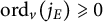






Assume now that
$v\mid p$
 . In complete analogy to the above situation, we have short exact sequences


where
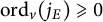
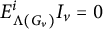
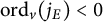
$n_v\geqslant 1$
 ,
$\operatorname {\mathrm {pd}} Y_v\leqslant 1$
 , and

Here, we recall that
$\tilde {E}_{v}$
 denotes the reduction of E mod v and
$k_{K_{\infty ,w}}$
 is the residue field of
$K_{\infty ,w}$
 . Now
$\dim G_v=2$
 and
$\tilde {E}_{v,p^\infty }(k_{K_{\infty ,w}})$
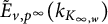 is finite, so we can argue as above.
The following result will also be crucial in the proof.
Proposition 3.11 For all
$v\in S$
 , we have

Proof From the fundamental exact sequences (10) and (13), for all
$v\in S$
 , we have short exact sequences


where
$n_v\geqslant 1$
 ,
$\operatorname {\mathrm {pd}} Y_v\leqslant 1$
 , and

Suppose that
$v\mid p$
 . Using (28) and (29), we deduce that we have the short exact sequence

Now, by Auslander regularity in Definition 3.2(ii),
$E_{\Lambda (G_v)}^2E_{\Lambda (G_v)}^3W_v=0$
 , so we have an injection

But since
$\operatorname {\mathrm {pd}} Y_v\leqslant 1$
 , it follows that
$E_{\Lambda (G_v)}^1Y_v\cong DY_v$
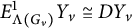 (see [Reference Ochi and VenjakobOV02, discussion before Lemma 3.1]), where by Lemma 4.9 in [Reference Ochi and VenjakobOV02]
$DY_v$
 is given by

But this is finite since
$K_{\infty ,w}$
 is totally ramified up to a finite extension, so we deduce from Lemma 3.5 that
$E_{\Lambda (G_v)}^2DY_v=0$
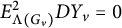 , which proves (27) when
$v\mid p$
 .
Suppose now that
$v\nmid p$
 . If
$\dim G_v=2$
 (or equivalently if
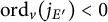
$\mathrm {ord}_v(j_{E'})<0$
 ), then we see from Lemma 5.4 in [Reference Ochi and VenjakobOV02] that
$X_v=0$
 , so we can assume that
$\dim G_v\leqslant 1$
 . If
$\dim G_v=0$
 , then clearly the result is trivial. Assume, therefore, that
$\dim G_v=1$
 , that is,
$K_{\infty ,w}=F_v^{cyc}$
 . We have to distinguish between two different cases:
-
(1) $\mathrm {ord}_v(j_E)\geqslant 0$
: In this case,
$E_{p^\infty }$
is rational over
$K_{\infty ,w}$
(or maybe over a finite extension of
$K_{\infty ,w}$
of order prime to p, which does not really make any difference), so
$W_v\cong \mathbb {Z}_p^2$
as an abelian group. Using (28) and Proposition 3.5, we deduce that
$E_{\Lambda (G_v)}^iI_v=0$
for all
$i\geqslant 1$
, so it follows from (29) that we have a canonical isomorphism $$ \begin{align*} E_{\Lambda(G_v)}^1X_v\cong E_{\Lambda(G_v)}^1Y_v. \end{align*} $$
Now $\operatorname {\mathrm {pd}} Y_v\leqslant 1$
, so arguing as above, we have $$ \begin{align*} E_{\Lambda(G_v)}^1Y_v\cong \varinjlim\mathrm{Hom}(E_{p^i},\mu_{p^\infty})^\vee, \end{align*} $$
which is congruent to $\mathbb {Z}_p^2$
as an abelian group. Proposition 3.5, therefore, implies that
$E_{\Lambda (G_v)}^2E_{\Lambda (G_v)}^1X_v=0$
, as required. -
(2) $\mathrm {ord}_v(j_E)<0$
: From the Tate parameterization, it is clear that we have an isomorphism of abelian groups $$ \begin{align*} E_{p^\infty}(K_{\infty,w})\cong \mathbb{Z}_p\times\Delta, \end{align*} $$
where $\Delta $
is a finite p-group. Let
$F_{\infty ,w}=F_v(E_{p^\infty })$
, so if we define
$\Omega _w=\mathrm {Gal}(F_{\infty ,w}/K_{\infty ,w})$
, then
$\Omega _w\cong \mathbb {Z}_p$
. By Hochschild–Serre, we have an exact sequence $$ \begin{align*} 0\rightarrow H^1(\Omega_w,E_{p^\infty})\rightarrow H^1(K_{\infty,w},E_{p^\infty})\rightarrow H^1(F_{\infty,w},E_{p^\infty})^{\Omega_w}. \end{align*} $$
As shown in [Reference CoatesCoa99, Lemma 3.3], we have $H^1(F_{\infty ,w},E_{p^\infty })=0$
, so we can canonically identify
$X_v$
with
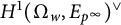
$H^1(\Omega _w,E_{p^\infty })^\vee $
. Now,
$E_{p^\infty }$
fits into a short exact sequence of Galois modules (30) $$ \begin{align} 0\rightarrow \mu_{p^\infty}\rightarrow E_{p^\infty}\rightarrow\mathbb Q_p/\mathbb{Z}_p\rightarrow 0. \end{align} $$
Taking $\Omega _w$
-cohomology of (30) and observing that
$\Omega _w$
acts trivially on
$\mu _{p^\infty }$
gives $$ \begin{align*} 0 \rightarrow \mu_{p^\infty} \rightarrow E_{p^\infty}(K_{\infty,w}) \rightarrow \mathbb Q_p/\mathbb{Z}_p\xrightarrow{\delta} \mathrm{Hom}(\Omega_w,\mu_{p^\infty})\\ \rightarrow H^1(\Omega_w,E_{p^\infty}) \rightarrow \mathbb Q_p/\mathbb{Z}_p \rightarrow 0. \end{align*} $$
By explicit calculation, it is easy to see that $\delta $
is surjective, so $$ \begin{align*} H^1(\Omega_w,E_{p^\infty})\cong\mathbb Q_p/\mathbb{Z}_p, \end{align*} $$
and hence, $X_v\cong \mathbb {Z}_p$
. By Proposition 3.5, we have $$ \begin{align*} (E_{\Lambda(G_v)}^1\mathbb{Z}_p)^\vee =\varinjlim_i\varinjlim_{U\leqslant G_v}H^1(U,\mathbb{Z}/p^i\mathbb{Z})^*, \end{align*} $$
where U runs over the open normal subgroups of $G_v$
, the inner direct limit is taken with respect to the corestriction maps and
$^*$
means
$\mathrm {Hom}(\thicksim ,\mathbb Q/\mathbb {Z})$
.Claim. $E_{\Lambda (G_v)}^1\mathbb {Z}_p\cong \mathbb {Z}_p$
.Proof of claim. The claim easily follows from [Reference Neukirch, Schmidt and WingbergNSW13, Corollary 5.5.7] but we also add another proof.
Clearly, every open normal subgroup of $G_v$
is isomorphic to
$\mathbb {Z}_p$
, and there is a unique one of index
$p^n$
for all
$n\geqslant 1$
; denote this subgroup by
$U_n$
, and set
$U_0=G_v$
. For
$n\geqslant 0$
and
$a\geqslant 1$
, and denote by (31) $$ \begin{align} \operatorname{\mathrm{cor}}_{n,a}&:H^1(U_{n+a},\mathbb{Z}/p^i\mathbb{Z})\rightarrow H^1(U_n,\mathbb{Z}/p^i\mathbb{Z}), \end{align} $$
(32) $$ \begin{align} \operatorname{\mathrm{res}}_{n,a}&:H^1(U_n,\mathbb{Z}/p^i\mathbb{Z})\rightarrow H^1(U_{n+a},\mathbb{Z}/p^i\mathbb{Z}) \end{align} $$
the respective (co)restriction maps. Let
$$ \begin{align*} f_{n+a}\in H^1(U_{n+a},\mathbb{Z}/p^i\mathbb{Z})\cong\mathrm{Hom}(U_{n+a},\mathbb{Z}/p^i\mathbb{Z}), \end{align*} $$
and choose some lift
$$ \begin{align*} \tilde{f}_n\in\mathrm{Hom}(U_n,\mathbb{Z}/p^{i+a}\mathbb{Z}) \end{align*} $$
of $f_{n+a}$
. Note that this lift is certainly not unique! We then have $$ \begin{align*}\begin{aligned} \operatorname{\mathrm{cor}}_{n,a}(f_{n+a})&=\operatorname{\mathrm{cor}}_{n,a}\circ\operatorname{\mathrm{res}}_{n,a}(\tilde{f}_n)\\ &=p^a\tilde{f}_n, \end{aligned}\end{align*} $$
which is independent of the chosen lift. It follows immediately from this equation that $\operatorname {\mathrm {cor}}_{n,a}$
gives an isomorphism $$ \begin{align*} \operatorname{\mathrm{cor}}_{n,a}:H^1(U_n,\mathbb{Z}/p^i\mathbb{Z})\xrightarrow{\cong} H^1(U_{n+a},\mathbb{Z}/p^i\mathbb{Z}), \end{align*} $$
and so
$$ \begin{align*} \varinjlim_n H^1(U_n,\mathbb{Z}/p^i\mathbb{Z})\cong\mathbb{Z}/p^i\mathbb{Z}, \end{align*} $$
which proves the claim.
Since $\dim G_v=1$
, it therefore follows from Lemma 3.5 that $$ \begin{align*} E_{\Lambda(G_v)}^2E_{\Lambda(G_v)}^1X_v=0, \end{align*} $$
which finishes the proof.
















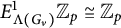


3.6 Algebraic structure of the dual Selmer group
As a consequence of Propositions 3.10 and 3.11, we get the following partial proof of (20).
Proposition 3.12
$E^iE^i \mathcal {C} (E/K_\infty )=0$
 for all
$i\geqslant 3$
 .
Proof Let
$U=\bigoplus _{v\in S}U_v$
 . From (16), for all
$i\geqslant 2$
 , we obtain exact sequences

so by Proposition 3.10, for all
$i\geqslant 3$
 , we have canonical isomorphisms

The proposition is now an immediate consequence of Proposition 3.8.
Proof of Theorem 1.3. It remains to show that
$E^2E^2 \mathcal {C} (E/K_\infty )=0$
 . From the long Ext-sequence of (16), we get the exact sequence

which we can split up into the short exact sequences


In complete analogy to the GL
$_2$
 -situation analyzed in [Reference Ochi and VenjakobOV02, Proof of Lemma 5.6], we have a canonical isomorphism
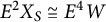
$E^2X_S\cong E^4W$
 , where
$W=E_{p^\infty }(K_\infty )^\vee $
 . We therefore have
$E^3E^2X_S=0$
 , and so from the first sequence we get an isomorphism

From the second sequence (34), we get an exact sequence

Combining Lemma 3.9 with Proposition 3.11, we have
$E^2E^1U=0$
 . Proposition 2.4 with [Reference Ochi and VenjakobOV02, Lemma 5.4(i)] shows that for all
$v \in S$
 ,
$v\mid p$
 ,
$X_v$
 is torsionfree. Note that we are assuming that for all
$v \in S$
 ,
$v \nmid p$
 ,
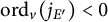
$\mathrm {ord}_v(j_{E'})<0$
 ; this implies, by [Reference Ochi and VenjakobOV02, Lemma 5.4(ii)], that
$X_v=0$
 . Since
$\operatorname {\mathrm {pd}} X_v\leqslant 1$
 , we have
$E_{\Lambda (G_v)}^1E_{\Lambda (G_v)}^1X_v\cong E_{\Lambda (G_v)}^1(DX_v)= {\mathrm {tor}}_{\Lambda (G_v)}X_v=0 $
 (cf. [Reference Neukirch, Schmidt and WingbergNSW13, Proposition 5.5.3(i) and Definition 5.4.10]), and so
$E^1E^1U=0$
 . Hence, we have
$E^1C\cong E^2B$
 . Now, D is a quotient of
$E^1 \mathcal {C} (E/K_\infty )$
 , so clearly

From the third sequence, we therefore get an injection

Claim
$E^1E^1X_S={\mathrm {tor}}_{\Lambda (G)}X_S$
 .
Proof of Claim
In the notation of [Reference Ochi and VenjakobOV02], we have a short exact sequence

Using Proposition 3.5 and the fact that
$\dim (G)=3$
 , we deduce that


From the short exact sequence (which is a special case of (10)),

we therefore get an isomorphism
$E^1X_S\cong E^1Y$
 . But
$\operatorname {\mathrm {pd}} Y\leqslant 1$
 , so
$DY\cong E^1Y$
 , and hence,

which proves the claim (the second equality follows from [Reference Neukirch, Schmidt and WingbergNSW13, Proposition 5.5.3(i) and Definition 5.4.10]).
So
$E^2B$
 is a pseudonull submodule of
$X_S$
 , which implies that
$E^2B=0$
 , and hence
$E^2E^2 \mathcal {C} (E/K_\infty )=0$
 .
4 Variation of Iwasawa
$\mu $
-invariants under isogeny

Let
$p\ge 5$
 be a fixed prime as before and
$E_1$
 and
$E_2$
 be elliptic curves without complex multiplication defined over a number field F with good ordinary reduction at all places of F above p, and they are isogenous via
${\varphi }: E_1 \rightarrow E_2$
 . We assume that
$F_\infty =F(E_{1,p^{\infty }})=F(E_{2,p^\infty })$
 is a pro-p extension of F. Let A be the p-part of the kernel of
${\varphi }$
 . Throughout this section, S is a finite set of primes of F including all the primes which divide p and places where
$E_1$
 (hence
$E_2)$
 has bad reduction. Let
$F^S$
 be the maximal extension of F unramified outside S. Similar to an assumption on the surjectivity of the global to local maps over the
$GL(2)$
 -extension
$F_\infty $
 (see [Reference HowsonHow02, Assumption L, Equation (72)]), we assume the corresponding condition over the
$\mathrm {PGL}_2$
 -extension
$K_\infty $
 .
Assumption K The localization maps

are surjective for both
$i=1,2$
 .
Remark 4.1 Assume the weak Leopoldt’s conjecture over
$K_\infty $
 , that is,
$H^2(F_S/K_\infty ,E_{i,p^\infty })=0$
 . Then Assumption K is satisfied if and only if the Selmer group
$\mathcal {C}(E_i/K_\infty )$
 is
$\Lambda (G)-$
 torsion (see [Reference Ray and SujathaRS22, Theorem 3.4]).
Remark 4.2 We also note that if we assume that
$\mathcal {C}(E_i/K_\infty )$
 is
$\Lambda (G)-$
 torsion then [Reference Hachimori and VenjakobHV03, Theorem 7.2] shows that
$H^2(F_S/K_\infty ,E_{i,p^\infty })=0$
 and Assumption K is satisfied.
The isogeny
${\varphi }$
 induces homomorphisms on the cohomology groups and Selmer groups, and hence, we have the following diagram:

As in the proof of [Reference HowsonHow02, Theorem 3.1], for a discrete, cofinitely generated
$\Lambda (G)$
 -module D, we let
$\chi (G,D) = \prod _{i \ge 0} \# (H^i(G,D))^{(-1)^i}$
 . If M is a finitely generated
$\Lambda (G)$
 -module then we have the
$\mu $
 -invariant
$\mu (M)=ord_p(\chi (G, {M(p)^\vee }))$
 , where
$M(p)$
 is the submodule of M consisting of all the elements of M which are annihilated by some power of p. Our main theorem below is an analog of [Reference HowsonHow02, Theorem 3.1] but for the non-admissible
$\mathrm {PGL}_2$
 -extension
$K_\infty $
 .
Theorem 4.3 Let
$p\ge 5$
 . Let
$ {\varphi }: E_1 \rightarrow E_2$
 be an isogeny between two elliptic curves without complex multiplication. Assume that
$\mathcal {C}(E_i/K_\infty )$
 is
$\Lambda (G)-$
 torsion for both
$i =\{1,2\}$
 Then as
$\Lambda (G)$
 -modules

Proof From the exact sequence,

obtained using snake Lemma, since the Euler characteristic
$\chi (G,-)$
 is multiplicative, we obtain

Note that all the Euler characteristics above are defined because of [Reference HowsonHow02, Corollary 1.7] and [Reference Ray and SujathaRS22, Lemma 2.1]. Since
$\mathrm {coker}({\varphi }_1)$
 and
$\mathrm {ker}({\varphi }_1)$
 are both annihilated by a finite power of p, the number we require is

4.1 Global calculations
We start with the exact sequence

Since the p-cohomological dimension
$\mathrm {cd}_p(\mathrm {Gal}(F^S/K_\infty )) \le \mathrm {cd}_p(\mathrm {Gal}(F^S/F))=2$
 (by [Reference Neukirch, Schmidt and WingbergNSW13, Proposition 10.9.3]), we have
$H^j(F^S/K_\infty ,E_{i,p^\infty })$
 and
$H^j(F^S/K_\infty ,A)=0$
 for all
$j\ge 3$
 .
Taking
$\mathrm {Gal}( F_S/K_\infty )$
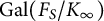 -invariants of the terms in the sequence (40) and using the assumption that
$H^2(F^S/K_\infty ,E_{1,p^\infty })=0$
 one obtains the exact sequence

Hence, it is easy to see that

As C is a pro-p group, procyclic group of dimension one. We choose a generator
$\sigma $
 of C. By [Reference Neukirch, Schmidt and WingbergNSW13, Proposition 1.7.7],
$ H^1( C ,E_{ i,p^\infty })=\frac {E_{i,p^\infty }}{p^{n_i} E_{i,p^\infty }}=0$
 by p-divisibility of
$E_{i,p^\infty }$
 . Here,
$\sigma $
 acts as multiplication by
$1+p^{n_i}$
 on
$E_{i,p^\infty }$
 . Taking C-invariants of (40), one obtains the following exact sequence:

Thus, one obtains an exact sequence

and this gives that

Since
$H^j(F^S/K_\infty ,A)=0$
 for all
$j\ge 3$
 , the Hochschild–Serre spectral sequence

yields the following Euler characteristic formula:

We have
$H^0(F^S/K_\infty ,A)=A^{C}$
 which is finite and hence the Euler characteristic
$\chi (G,A^{C})=1$
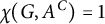 . From (43), we have

By multiplicativity of the Euler characteristics along the exact sequence (42), one obtains

As C is procyclic, pro-p with p-cohomological dimension one,
$ H^1(C ,A)= A_C$
 and hence
$H^1(C,A)$
 is finite. Thus,
$\chi (G, H^1(C,A))=1$
 and hence,

Combining (41), (44), and (45), we get

This completes the computation of Euler characteristics of the kernel and cokernel of the global map
${\varphi }_2$
 .
4.2 Local computations
Next, let us do the local calculations. As before, let us fix a prime v of F in S and w a prime of
$K_\infty $
 above v. Let
$\tilde {A}_v$
 be the image of A under the reduction map
$v: E_1 \rightarrow \tilde {E}_1$
 . We define

As the inertia subgroup of
$K_\infty $
 over F at the prime w over v is infinite for v a prime of F above p, we have that
$K_{\infty ,w}$
 is a deeply ramified extension of
$F_v$
 (cf. [Reference Ray and SujathaRS22, p. 929]). Hence, by [Reference Coates and GreenbergCG96, Proposition 4.8 and Theorem 2.13], one gets

Let X be
$ A$
 if
$v \nmid p$
 and
$\tilde {A}_v$
 if
$v \mid p$
 . Let
$Y_i$
 be
$E_{i,p^\infty }$
 if
$v \nmid p$
 and
$ \tilde {E}_{i,p^\infty }$
 if
$ v \mid p$
 .
Now, let v be any prime of F in S, not necessarily above p. Then, from the proof of [Reference Coates and HowsonCH01, Lemma 5.2], for each finite extension L of
$F_v$
 , we have that
$H^2(L,E_{i,p^\infty }) =0.$
 The reduction map
$E_{i,p^\infty } \rightarrow \tilde {E}_{i,p^\infty }$
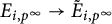 is surjective and hence the map induced on the cohomologies
$H^2(L,E_{i,p^\infty })\rightarrow H^2(L,\tilde {E}_{i,p^\infty })$
 is also surjective as
$cd_p(G_L)=2$
 (see [Reference SerreSer02, Corollary in Section 4.3]). Therefore,
$H^2(L,\tilde {E}_{i,p^\infty })=0.$
 Passing to direct limit over all the finite extensions of
$F_v$
 contained in
$K_{\infty ,w}$
 we have that
$H^2(K_{\infty ,w},Y_i)=0$
 and thus we have
$ \prod _{w \mid v} H^2(K_{\infty ,w},Y_i)=0.$

Next, we have the exact sequence

from which it is easy to deduce that

From the above sequence, we obtain the exact sequences

Taking product over all primes w lying above a fixed prime v, one gets that the sequence

is exact. The multiplicativity of Euler characteristics in exact sequences yields

We remark again that finiteness of these Euler characteristics follow from [Reference HowsonHow02, Corollary 1.7]. Applying Shapiro’s lemma, one obtains

for
$M=H^1(K_{\infty , w},X),Y_i(K_{\infty ,w}), \text { or }X(K_{\infty ,w})$
 . From this, one gets

Since X is finite, so is
$ X(K_{\infty ,w})$
 which gives that
$\chi ( G_v,X(K_{\infty ,w}))=1$
 .
Let
$ C_w=\mathrm {Gal}(F_{\infty ,w}/ K_{\infty ,w}) $
 be the decomposition subgroup of C (by a slight abuse of notation, we are still denoting by w a prime of
$F_\infty $
 over the prime w of
$K_\infty $
 ). So,

Now, let us analyze each of the cases: (i)
$ v \mid p$
 , (ii)
$v \nmid p$
 and
$ord_v(j_E) <0$
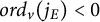 , and (iii)
$ v \nmid p$
 and
$ord_v(j_E) \ge 0$
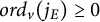 separately.
Case (I)
$ v \mid p$
 .
When
$ v \mid p$
 , we have
$Y_i= \tilde {E}_{i,p^\infty }$
 . By [Reference Coates and HowsonCH01, Lemma 5.1],
$\Sigma _w$
 has p-cohomological dimension at most
$3$
 and as
$C_w=C \cap \Sigma _w$
 , by using [Reference Neukirch, Schmidt and WingbergNSW13, Chapter 3, Section 3, Exercise 4], we obtain that
$G_v$
 has p-cohomological dimension at most
$2$
 . Since
$H^i(C_w,\tilde {E}_{i,p^\infty })=0 $
 for all
$i \ge 2$
 , an application of Hochschild–Serre spectral sequence yields the exact sequence

As
$ {E}_{i,p^\infty }$
 is p-divisible, we have
$H^1(C_w,{E}_{i,p^\infty })=0$
 and as
$C_w$
 is of p-cohomological dimension
$1$
 and there is a surjection
$E_{i,p^\infty } \rightarrow \tilde {E}_{i,p^\infty }$
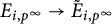 , so
$H^1(C_w,\tilde {E}_{i,p^\infty })$
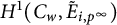 is also trivial. Hence, we get that

We obviously have
$H^0(G_v,\tilde {E}_{i,p^\infty }^ {C_w}) =H^0(\Sigma _w, \tilde {E}_{i,p^\infty })$
 . By assumption, since E has good ordinary reduction at v, by [Reference Coates and HowsonCH01, Corollary 5.26], we have
$H^3(\Sigma _w, \tilde {E}_{i,p^\infty })=0$
 . Therefore, finally we deduce that
$ \chi (G_v,\tilde {E}_{i,p^\infty }^ {C_w})=\chi (\Sigma _w, \tilde {E}_{i,p^\infty })$
 but this Euler characteristic is
$1$
 , again by (loc.cit).
Case (II)
$ v \nmid p$
 and
$ord_v(j_E)<0$
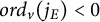 .
When
$ v \nmid p$
 and
$ ord_v (j_E) <0$
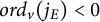 , we have
$J_v(F_\infty )=0$
 by [Reference Coates and HowsonCH01, Corollary 5.12]. Since by the proof of Theorem
$3.1$
 of [Reference Ray and SujathaRS22],
$J_v(K_\infty )= J_v(F_\infty )^{C}$
 , we get that
$J_v(K_\infty )$
 is trivial.
Case (III)
$ v \nmid p$
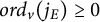
 and
$ord_v(j_E)\ge 0$
 .
When
$ v \nmid p$
 and
$ ord_v (j_E) \ge 0$
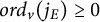 , since
$p \geqslant 5$
 , we have
$H^j(\Sigma _w,E_{p^\infty })=0$
 for
$j\ge 1$
 from [Reference Coates and HowsonCH01, Proposition 5.12]. By an analogous Hochschild–Serre spectral sequence (see (50)) and [Reference Coates and HowsonCH01, Lemma 5.1(ii)], we have
$H^j(G_v,E_{i,p^\infty }^{C_w})=0$
 for
$j \ge 1$
 . So the Euler characteristics is
$\chi (G_v,E_{i,p^\infty }^{C_w})= \# H^0(G_v,E_{i,p^\infty }^{C_w})= \# E_{i,p^\infty }(F_v)$
 .
Combining these cases, from (48), we obtain

By (47) and applying Shapiro’s lemma,

By considering the Hochschild–Serre spectral sequence,

we get

Since A is a p-group, from [Reference MilneMil06, Lemma I.2.9], we have that
$\underset {v \in S , v \nmid p}{\prod } \chi (\mathrm {Gal}( \overline {F}_v/F_v),A)=1$
 . Using (39) and recalling (46), one gets

We have from [Reference MilneMil06, Theorem I.5.1]

If v is a non-archimedean prime of F, then from [Reference MilneMil06, Theorem I.2.8],

Substituting these above we get the formula stated in Theorem 4.3.
Let
$\mathcal {C}(E_i/K_\infty )$
 be the Pontryagin dual of the Selmer group
$\mathrm {Sel}(E_i/K_\infty )$
 .
Corollary 4.4 Let
$p\ge 5$
 . Let
$ {\varphi }: E_1 \rightarrow E_2$
 be an isogeny between two elliptic curves without complex multiplication. Assume that the dual Selmer groups
$\mathcal {C}(E_i/K_\infty )$
 are
$\Lambda (G)$
 -cotorsion for both
$i=\{1,2\}$
 . Then

Remark 4.5 Since
$\ker ({\varphi }_1)$
 and
$\mathrm {coker}({\varphi }_1)$
 are killed by some finite power of p (cf. statement before Section 4.1),
$ \mathcal {C}(E_1/K_\infty ) \otimes \mathbb {Q}_p\cong \mathcal {C}(E_2/K_\infty ) \otimes \mathbb {Q}_p$
 and hence
$\mathcal {C}(E_1/K_\infty )$
 and
$\mathcal {C}(E_2/K_\infty )$
 have the same
$\Lambda (G)$
 -ranks.
Acknowledgments
Sections 2 and 3 are revised versions of parts of unpublished works from the Ph.D. thesis of the third author. Section 4 will be a part of the Ph.D. thesis of the second author. The first author thanks Anwesh Ray for his encouragement to study the difference of Iwasawa
$\mu $
 -invariants of Selmer groups over the
$\mathrm {PGL}_2$
 -extension of elliptic curves with an isogeny between them. We thank the reviewer for the detailed review and careful comments.



