


 one sequence for each positive integer k ≦ 2 by
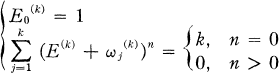
 are the k-th roots of unity and (E



Crossref Citations

This article has been cited by the following publications. This list is generated based on data provided by Crossref.
Sagan, Bruce E.
1985.
Congruences via abelian groups.
Journal of Number Theory,
Vol. 20,
Issue. 2,
p.
210.
Ehrenborg, Richard
2002.
The Asymptotics of Almost Alternating Permutations.
Advances in Applied Mathematics,
Vol. 28,
Issue. 3-4,
p.
421.
Guo, Victor J.W.
and
Zeng, Jiang
2006.
Some arithmetic properties of the q-Euler numbers and q-Salié numbers.
European Journal of Combinatorics,
Vol. 27,
Issue. 6,
p.
884.
Mendes, Anthony
Remmel, Jeffrey B.
and
Riehl, Amanda
2010.
Permutation Patterns.
p.
259.
Fuller, Evan
and
Remmel, Jeffrey
2011.
Quasi-symmetric functions and up–down compositions.
Discrete Mathematics,
Vol. 311,
Issue. 16,
p.
1754.
Luck, J.M.
2014.
On the frequencies of patterns of rises and falls.
Physica A: Statistical Mechanics and its Applications,
Vol. 407,
Issue. ,
p.
252.
Sagan, Bruce E.
2026.
Generalized Euler numbers and ordered set partitions.
Discrete Mathematics,
Vol. 349,
Issue. 2,
p.
114715.