Contents
Research Article
On the Fractional Parts of a Polynomial
-
- Published online by Cambridge University Press:
- 20 November 2018, pp. 168-173
-
- Article
-
- You have access
- Export citation
-
Heilbronn [6] proved that for any ϵ > 0 there exists C(ϵ) such that for any real θ and N ≧ 1 there is an integer x satisfying

where ||α|| denotes the difference between α and the nearest integer, taken positively. Danicic [2] obtained an analogous result for the fractional parts of θxk and in 1967 Davenport [4] generalized Heilbronn's result to polynomials of degree
 with no constant term. The last condition is essential, for if there is a constant term then no analogous result can hold (see Koksma [7, Kap. 6 SatzlO]).
 with no constant term. The last condition is essential, for if there is a constant term then no analogous result can hold (see Koksma [7, Kap. 6 SatzlO]).
On Derivations of Lie Algebras
-
- Published online by Cambridge University Press:
- 20 November 2018, pp. 174-180
-
- Article
-
- You have access
- Export citation
-
A well known result in the theory of Lie algebras, due to H. Zassenhaus, states that if
 is a finite dimensional Lie algebra over the field K such that the killing form of
 is non-degenerate, then the derivations of
 are all inner, [3, p. 74]. In particular, this applies to the finite dimensional split simple Lie algebras over fields of characteristic zero. In this paper we extend this result to a class of Lie algebras which generalize the split simple Lie algebras, and which are defined by Cartan matrices (for a definition see § 1). Because of the fact that the algebras we consider are usually infinite dimensional, the method we employ in our investigation is quite different from the standard one used in the finite dimensional case, and makes no reference to any associative bilinear form on the algebras.
 is a finite dimensional Lie algebra over the field K such that the killing form of
 is non-degenerate, then the derivations of
 are all inner, [
Subinvariance in Solvable Lie Algebras
-
- Published online by Cambridge University Press:
- 20 November 2018, pp. 181-185
-
- Article
-
- You have access
- Export citation
Compatible Tight Riesz Orders
-
- Published online by Cambridge University Press:
- 20 November 2018, pp. 186-200
-
- Article
-
- You have access
- Export citation
On a Theorem of Goldschmidt Applied to Groups with a Coprime Automorphism
-
- Published online by Cambridge University Press:
- 20 November 2018, pp. 201-206
-
- Article
-
- You have access
- Export citation
Sequential Compactness of X Implies a Completeness Property for C(X)
-
- Published online by Cambridge University Press:
- 20 November 2018, pp. 207-210
-
- Article
-
- You have access
- Export citation
Divisibility of Direct Sums in Torsion Theories
-
- Published online by Cambridge University Press:
- 20 November 2018, pp. 211-214
-
- Article
-
- You have access
- Export citation
-
Given a hereditary torsion theory
 on the category Mod R of right R-modules we obtain in this paper necessary and sufficient conditions for the direct sum
 of a given family
 of R-modules to be divisible for the torsion theory
 . Using this criterion we show that if
 is a family of R-modules having the property that
 is divisible for every countable subset K ol J then
 is itself divisible.
Orthogonal Designs with Zero Diagonal
-
- Published online by Cambridge University Press:
- 20 November 2018, pp. 215-224
-
- Article
-
- You have access
- Export citation
-
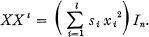
Definition 1. An orthogonal design of order n and type (si, … , si) (st positive integers) on the commuting variables x1 , … , xl is an n X n matrix X with entries chosen from ﹛0, ±x 1, … , ±xl﹜ such that