Contents
Research Article
On Some Diophantine Inequalities Involving the Exponential Function
-
- Published online by Cambridge University Press:
- 20 November 2018, pp. 616-626
-
- Article
-
- You have access
- Export citation
-
It is well known that for any real number θ there are infinitely many positive integers n such that

Here ||a|| denotes the distance of a from the nearest integer, taken positively. Indeed, since ||a|| < 1, this implies more generally that if θ 1, θ 2, . . . , θk are any real numbers, then there are infinitely many positive integers n such that


Some Relationships Between Bers and Beltrami Systems and Linear Elliptic Systems of Partial Differential Equations
-
- Published online by Cambridge University Press:
- 20 November 2018, pp. 627-642
-
- Article
-
- You have access
- Export citation
Invariant Subspaces of Continuous Functions
-
- Published online by Cambridge University Press:
- 20 November 2018, pp. 643-651
-
- Article
-
- You have access
- Export citation
On Tchebycheff Quadrature
-
- Published online by Cambridge University Press:
- 20 November 2018, pp. 652-658
-
- Article
-
- You have access
- Export citation
-
Tchebycheff proposed the problem of finding n + 1 constants A, x 1, x 2, . . , xn ( — 1 ≤ x 1 < x 2 < . . . < xn ≤ +1) such that the formula
(1)
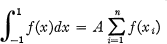
is exact for all algebraic polynomials of degree ≤n. In this case it is clear that A = 2/n. Later S. Bernstein (1) proved that for n ≥ 10 not all the xi 's can be real. For a history of the problem and for more references see Natanson (4).
Colouring of Trivalent Polyhedra
-
- Published online by Cambridge University Press:
- 20 November 2018, pp. 659-664
-
- Article
-
- You have access
- Export citation
The Construction of Fields with Infinite Cyclic Automorphism Group
-
- Published online by Cambridge University Press:
- 20 November 2018, pp. 665-668
-
- Article
-
- You have access
- Export citation
The k-Normal Completion of Function Lattices
-
- Published online by Cambridge University Press:
- 20 November 2018, pp. 669-675
-
- Article
-
- You have access
- Export citation
On the Location of Singularities of a Class of Elliptic Partial Differential Equations in Four Variables
-
- Published online by Cambridge University Press:
- 20 November 2018, pp. 676-686
-
- Article
-
- You have access
- Export citation
-
In this paper we shall investigate the singular behaviour of the solutions to the elliptic equation
(1.1)

where A (r 2), C(r 2) are entire functions of the complex variable

On the line Graph of a Finite Affine Plane
-
- Published online by Cambridge University Press:
- 20 November 2018, pp. 687-694
-
- Article
-
- You have access
- Export citation
Commutators of Operators on Hilbert Space
-
- Published online by Cambridge University Press:
- 20 November 2018, pp. 695-708
-
- Article
-
- You have access
- Export citation
Regular Rank Rings
-
- Published online by Cambridge University Press:
- 20 November 2018, pp. 709-719
-
- Article
-
- You have access
- Export citation
-
1.1. Throughout this note,
 will denote an associative ring but we shall not require to possess a unit.
If A and B are subsets of
, then A + B will denote the set {x + y| x ∊ A, y ∊ B}. A τ will denote the set {u ∊ | au = 0 for all a ∊ A} .Elements a and b will be said to be orthogonal if ab = ba = 0.
 will denote an associative ring but we shall not require
A Theorem on k-Saturated Graphs
-
- Published online by Cambridge University Press:
- 20 November 2018, pp. 720-724
-
- Article
-
- You have access
- Export citation
-
In this paper we consider finite graphs without loops and multiple edges. A graph
 is considered to be an ordered pair 〈G, *〉 where G is a finite set the elements of which are called the vertices of while * is a subset of [G]2 (where [G]2 is the set of all subsets of two elements of G). The elements of * are called the edges of . If {P, Q} ∊ *, we say that Q is adjacent to P. The degree of a vertex is the number of vertices adjacent to it. Let k be an integer. We say that is the complete k-graph if G has k elements and * = [G]2.
 is considered to be an ordered pair 〈G,
Sur L'Indice de Certains Réseaux de R4 Permis Pour un Octaèdre
-
- Published online by Cambridge University Press:
- 20 November 2018, pp. 725-730
-
- Article
-
- You have access
- Export citation
-
Si un réseau G de Rn contient Zn et est permis pour l'«octaèdre généralisé» Ωn d'équation

l'indice de Zn dans G est borné supérieurement par n! d'après les théorèmes généraux de Minkowski.

Trees and Tree-Equivalent Graphs
-
- Published online by Cambridge University Press:
- 20 November 2018, pp. 731-733
-
- Article
-
- You have access
- Export citation
A Filter Description of the Homomorphisms of H ∞
-
- Published online by Cambridge University Press:
- 20 November 2018, pp. 734-757
-
- Article
-
- You have access
- Export citation
Formal Categories
-
- Published online by Cambridge University Press:
- 20 November 2018, pp. 758-801
-
- Article
-
- You have access
- Export citation
-
A category
 is made up of its class of objects
 , of a function M (or
 ) which assigns to each (A,B) ∊ × the class M(A, B) of all morphisms from A to B, of an operation μ which is a class of maps

A, B, C ∊
, and of a family of maps
 is made up of its class of objects
 , of a function M (or
 ) which assigns to each (A,B) ∊
Convexity Properties for Weak Solutions of Some Differential Equations in Hilbert Spaces
-
- Published online by Cambridge University Press:
- 20 November 2018, pp. 802-807
-
- Article
-
- You have access
- Export citation
A Note on Well-Distributed Sequences
-
- Published online by Cambridge University Press:
- 20 November 2018, pp. 808-810
-
- Article
-
- You have access
- Export citation
-
A sequence
 is said to be well distributed (mod 1) (3, 4, 5) if the limit
(1.1)
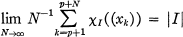
exists, uniformly in p ≥ 0, for all intervals I in [0, 1], with length |I|, characteristic function
 where (x) is the fractional part of x. If (1.1) is true for p = 0 and all I in [0, 1] we say that is uniformly distributed (mod 1).
 is said to be well distributed (mod 1) (3, 4, 5) if the limit
 where (x) is the fractional part of x. If (1.1) is true for p = 0 and all I in [0, 1] we say that
Some Refinements of Lyapunov's Second Method
-
- Published online by Cambridge University Press:
- 20 November 2018, pp. 811-819
-
- Article
-
- You have access
- Export citation
Characterizations of Developable Topological Spaces
-
- Published online by Cambridge University Press:
- 20 November 2018, pp. 820-830
-
- Article
-
- You have access
- Export citation