Contents
Research Article
Injectivity in the Topos of Complete Heyting Algebra Valued Sets
-
- Published online by Cambridge University Press:
- 20 November 2018, pp. 550-568
-
- Article
-
- You have access
- Export citation
-
Let
 be a complete Heyting algebra (CHA). An -valued set is a pair (X, δ) where X is a set and δ is a function from X × X to such that

for all x, y z in X.
-valued sets form a category  as follows: a morphism from (X, δ) to (Y, δ) is a function f from X × Y to such that
-
(i) f(x) ∧ δ(x, x′) ≦ f(x′, y), f(x, y) ∧ δ(y, y′) ≧ f(x, y′),
-
(ii) f(x, y) ∧ f(x, y′) ≦ δ(y, y′), and
-
(iii)
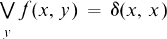
-
 be a complete Heyting algebra (CHA). An
 as follows: a morphism from (X, δ) to (Y, δ) is a function f from X × Y to
Basic Commutators and Minimal Massey Products
-
- Published online by Cambridge University Press:
- 20 November 2018, pp. 1119-1146
-
- Article
-
- You have access
- Export citation
Projective Approximations
-
- Published online by Cambridge University Press:
- 20 November 2018, pp. 178-192
-
- Article
-
- You have access
- Export citation
Discrete Convex Functions and Proof of the Six Circle Conjecture of Fejes Tóth
-
- Published online by Cambridge University Press:
- 20 November 2018, pp. 569-576
-
- Article
-
- You have access
- Export citation
-
A system
 of openly disjoint discs in the planeis said to form a 6-neighboured circle packing if every
 is tangent to at least 6 other elements of (It is evident that such a system consists of infinitely many discs.) The simplest example is the regular circle packing all of whose circles are of the same size and have exactly 6 neighbours. L. Fejes Tóth conjectured that the regular circle packing has the interesting extremal property that, if we slightly “perturb” it, then there will necessarily occur either arbitrarily small or arbitrarily large circles. More precisely, he asked whether or not the following “zero or one law” (cf. [3], [6]) is valid: If is a 6-neighboured circle packing, then

where r(C) denotes the radius of circle C, inf and sup are taken over all C ∊
 of openly disjoint discs in the planeis said to form a 6-neighboured circle packing if every
 is tangent to at least 6 other elements of
