Contents
Research Article
The Current Theory of Analytic Sets
-
- Published online by Cambridge University Press:
- 20 November 2018, pp. 207-230
-
- Article
-
- You have access
- Export citation
Almost-Bounded Holomorphic Functions with Prescribed Ambiguous Points
-
- Published online by Cambridge University Press:
- 20 November 2018, pp. 231-240
-
- Article
-
- You have access
- Export citation
-
Let f be a function mapping the open unit disk D into the extended complex plane. A point ζ on the unit circle C is called an ambiguous point of f if there exist two Jordan arcs J 1 and J 2, each having an endpoint at ζ and lying, except for ζ, in D, such that


Bernstein Power Series
-
- Published online by Cambridge University Press:
- 20 November 2018, pp. 241-252
-
- Article
-
- You have access
- Export citation
-
In Bernstein's proof of the Weierstrass Approximation Theorem, the polynomials

are constructed in correspondence with a function f ∊ C [0, 1] and are shown to converge uniformly to f. These Bernstein polynomials have been the starting point of many investigations, and a number of generalizations of them have appeared. It is our purpose here to consider several generalizations in the form of infinite series and to establish some of their properties.

The k-Extremally Disconnected Spaces as Projectives
-
- Published online by Cambridge University Press:
- 20 November 2018, pp. 253-260
-
- Article
-
- You have access
- Export citation
Extension Of Finite Projective Planes I. Uniform Hjelmslev Planes
-
- Published online by Cambridge University Press:
- 20 November 2018, pp. 261-266
-
- Article
-
- You have access
- Export citation
Complete Reductibility of Infinite Groups
-
- Published online by Cambridge University Press:
- 20 November 2018, pp. 267-274
-
- Article
-
- You have access
- Export citation
Convolutions as Bilinear and Linear Operators
-
- Published online by Cambridge University Press:
- 20 November 2018, pp. 275-285
-
- Article
-
- You have access
- Export citation
Randomly Packed and Solidly Packed Spheres
-
- Published online by Cambridge University Press:
- 20 November 2018, pp. 286-298
-
- Article
-
- You have access
- Export citation
Groups with Representations of Bounded Degree
-
- Published online by Cambridge University Press:
- 20 November 2018, pp. 299-309
-
- Article
-
- You have access
- Export citation
Pairs of Consecutive Power Residues or Non-Residues
-
- Published online by Cambridge University Press:
- 20 November 2018, pp. 310-314
-
- Article
-
- You have access
- Export citation
Linear Relations Between Higher Matrix Commutators
-
- Published online by Cambridge University Press:
- 20 November 2018, pp. 315-320
-
- Article
-
- You have access
- Export citation
-
Let Mn denote the space of all n-square matrices over an algebraically closed field F. For A, B ∊ Mn , let

define the iterated commutators of A and B. Recently several research papers (1, 2, 4, and 5) have appeared on these commutators. In (1), Kato and Taussky have proved that for n = 2 the iterated commutators of A and B satisfy the linear relation

Arcs of Parabolic Order Four
-
- Published online by Cambridge University Press:
- 20 November 2018, pp. 321-338
-
- Article
-
- You have access
- Export citation
On Two Problems Concerning the Generalized Lototsky Transforms
-
- Published online by Cambridge University Press:
- 20 November 2018, pp. 339-342
-
- Article
-
- You have access
- Export citation
-
The generalized Lototsky transform (or the [F, dn ] transform) of a sequence {sn } into a sequence {tn ) was defined in (2) in the following way: Let {dn ) (dn ≠ —1) be a fixed complex sequence and let

then the sequence {tn } is defined by

In a recent paper by V. F. Cowling and C. L. Miracle (1) on these transformations, the following two problems were left open.


Criteria for Solvability of Certain Congruences
-
- Published online by Cambridge University Press:
- 20 November 2018, pp. 343-352
-
- Article
-
- You have access
- Export citation
-
Lower case italics will denote rational integers, while lower case Greek letters will denote algebraic integers. The Law of Quadratic Reciprocity can be formulated as follows:
If p and a are distinct odd primes, then a is a quadratic residue (mod p) if and only if ( — 1)(p-1)/2p is a quadratic residue (mod q).
Let Xp denote the non-principal quadratic character (mod p) and let ζp be a primitive pth. root of unity. Then


One-Dimensional Cell Complexes with Homeotopy Group Equal to Zero
-
- Published online by Cambridge University Press:
- 20 November 2018, pp. 353-357
-
- Article
-
- You have access
- Export citation
-
Let K denote a connected finite 1-dimensional cell complex (1, p. 95), G(K) its group of homeomorphisms, and D(K) the group of homeomorphisms of K which are isotopic to the identity. The group
 (K) = G(K)/D(K) is a topological invariant of K and is called the homeotopy group ofK (4). K may be thought of as a linear graph (connected finite 1- dimensional simplicial complex) extended to admit loops and multiple edges and (K) as the topological analogue of the automorphism group A(L), (the permutations of vertices which preserve edge incidence relations) of a linear graph L.
 (K) = G(K)/D(K) is a topological invariant of K and is called the homeotopy group ofK (4). K may be thought of as a linear graph (connected finite 1- dimensional simplicial complex) extended to admit loops and multiple edges and
A Generalization of the Hardy Spaces
-
- Published online by Cambridge University Press:
- 20 November 2018, pp. 358-369
-
- Article
-
- You have access
- Export citation
-
The Hardy spaces for right half-planes,
 , σ real, 1 ≤ p ≤ ∞, are defined to consist of all those functions f(s), holomorphic for Re s > σ, for which μp (f, x) exists and is bounded for x > σ, where
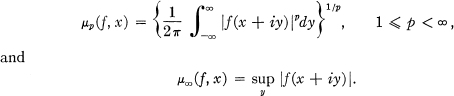
These spaces have been studied extensively (see, for example, 3, Chapter 8, and 2, §19.1).
 , σ real, 1 ≤ p ≤ ∞, are defined to consist of all those functions f(s), holomorphic for Re s > σ, for which μ
On Anti-Commutative Algebras with an Invariant Form
-
- Published online by Cambridge University Press:
- 20 November 2018, pp. 370-378
-
- Article
-
- You have access
- Export citation
-
In this paper we consider anti-commutative algebras with an invariant form, that is, an algebra A over a field F such that

and A possesses a symmetric bilinear form f(x, y) such that

Lie and Malcev algebras (2, 3) are examples of such algebras and we shall consider generalizations of these algebras obtained by introducing commutation, x o y = xy — yx, as a new multiplicative operation in the non-commutative Jordan algebras of (1).


On Subplanes of Free Planes
-
- Published online by Cambridge University Press:
- 20 November 2018, pp. 379-385
-
- Article
-
- You have access
- Export citation
The Multiplier Theorem for Difference Sets
-
- Published online by Cambridge University Press:
- 20 November 2018, pp. 386-388
-
- Article
-
- You have access
- Export citation
Lattice Tetrahedra
-
- Published online by Cambridge University Press:
- 20 November 2018, pp. 389-396
-
- Article
-
- You have access
- Export citation