Contents
Research Article
Combinatorial Relations and Chromatic Graphs
-
- Published online by Cambridge University Press:
- 20 November 2018, pp. 1-7
-
- Article
-
- You have access
- Export citation
Remarks On Finite Groups Defined By Generating Relations
-
- Published online by Cambridge University Press:
- 20 November 2018, pp. 8-17
-
- Article
-
- You have access
- Export citation
-
1. Introduction. After establishing a duplication principle (§2) which enables us to derive a group of order 2h with k + 1 involutory generators from any group of order h with k generators, we shall prove the following combination principle :
Let
 and
 be two groups, each having k generators, such that the rth generators of and have relatively prime periods for each r from 1 to k.
 and
 be two groups, each having k generators, such that the rth generators of
On Laves' Graph Of Girth Ten
-
- Published online by Cambridge University Press:
- 20 November 2018, pp. 18-23
-
- Article
-
- You have access
- Export citation
A Class Of Permutation Groups Of Prime Degree
-
- Published online by Cambridge University Press:
- 20 November 2018, pp. 24-34
-
- Article
-
- You have access
- Export citation
-
In (1), using the theory of group representations, Brauer studied groups
 of finite order g containing elements A of prime period p which commute only with their own powers Ai . If
 is a p-Sylow subgroup of , the normalizer
 can be generated by A and another element B such that
1.1
 ,
where ϒ is a primitive root (mod p), and t and q are positive integers suchthat
1.2 tq = p − 1.
 of finite order g containing elements A of prime period p which commute only with their own powers A
 is a p-Sylow subgroup of
Set-Transitive Permutation Groups
-
- Published online by Cambridge University Press:
- 20 November 2018, pp. 35-42
-
- Article
-
- You have access
- Export citation
On The Homology Theory Of Abelian Groups
-
- Published online by Cambridge University Press:
- 20 November 2018, pp. 43-53
-
- Article
-
- You have access
- Export citation
A Canonical Set For Matrices Over a Principal Ideal Ring Modulo m
-
- Published online by Cambridge University Press:
- 20 November 2018, pp. 54-59
-
- Article
-
- You have access
- Export citation
The Wedderburn Theorem
-
- Published online by Cambridge University Press:
- 20 November 2018, pp. 60-62
-
- Article
-
- You have access
- Export citation
The Existence of a Distribution Function for an Error Term Related to the Euler Function
-
- Published online by Cambridge University Press:
- 20 November 2018, pp. 63-75
-
- Article
-
- You have access
- Export citation
-
The average order of the Euler function ϕ(n), the number of integers less than n which are relatively prime to n, raises many difficult and still unanswered questions. Thus, for
1.1
 ,
and
1.2
 ,
it is known that R(x) = O(x log x) and H(x) = O(log x). However, though these results are quite old, they were not improved until recently.


On Explicit Bounds In Schottky's Theorem
-
- Published online by Cambridge University Press:
- 20 November 2018, pp. 76-82
-
- Article
-
- You have access
- Export citation
On Regions Omitted By Univalent Functions II
-
- Published online by Cambridge University Press:
- 20 November 2018, pp. 83-88
-
- Article
-
- You have access
- Export citation
-
1. Introduction. Let S denote the family of functions f(z) regular and univalent in ∣z∣ < 1, with the expansion f(z) = z + a 2 z 2 + … about z = 0, and let Af denote the area of the intersection of the open circle ∣ω∣ < 1 with Df , the image of ∣z∣ < 1 under f(z). A few years ago one of the authors (1) proved that if
1

then
2
 .

Convolution Transforms Related To Non-Harmonic Fourier Series
-
- Published online by Cambridge University Press:
- 20 November 2018, pp. 89-100
-
- Article
-
- You have access
- Export citation
-
1. Introduction. Widder has pointed out (2, p. 219) in connection with Wiener's fundamental work on the operational calculus (1, pp. 557-584), that the convolution transform
(1.1)

will be inverted by the operator DE (D), where D = d/dx, and
 ,
where a suitable interpretation must be found for E(D).


On An Inversion Formula For The Laplace Transformation
-
- Published online by Cambridge University Press:
- 20 November 2018, pp. 101-115
-
- Article
-
- You have access
- Export citation
Asymptotic Behaviour Of The Inverse Of a Laplace Transform
-
- Published online by Cambridge University Press:
- 20 November 2018, pp. 116-125
-
- Article
-
- You have access
- Export citation
-
1. Introduction. There are many problems, particularly in circuit theory, where the inverse of a Laplace transform is required but only for large values of the independent variable. For example (2, p. 66) the Laplace transform
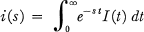
of the current function for a semi-infinite cable under certain conditions turnsout to be
 .

On The Potential Theory Of Coclosed Harmonic Forms
-
- Published online by Cambridge University Press:
- 20 November 2018, pp. 126-137
-
- Article
-
- You have access
- Export citation
On Selberg's Lemma For Algebraic Fields
-
- Published online by Cambridge University Press:
- 20 November 2018, pp. 138-143
-
- Article
-
- You have access
- Export citation
Correction
Correction To “On a Generalization Of The First Curvature Of a Curve In A Hypersurface Of a Riemannian Space”
-
- Published online by Cambridge University Press:
- 20 November 2018, p. 144
-
- Article
-
- You have access
- Export citation
Research Article
Two Remarks On Extreme Forms
-
- Published online by Cambridge University Press:
- 20 November 2018, pp. 145-149
-
- Article
-
- You have access
- Export citation
Note On Extreme Forms
-
- Published online by Cambridge University Press:
- 20 November 2018, pp. 150-154
-
- Article
-
- You have access
- Export citation
On Integers n Relatively Prime To ƒ(n)
-
- Published online by Cambridge University Press:
- 20 November 2018, pp. 155-158
-
- Article
-
- You have access
- Export citation