




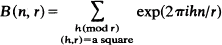

 is considered in terms of the Cauchy-composition of even functions (mod r). It is found to be multiplicative in r. The evaluation of the above sum gives an identity involving Pillai's arithmetic function



Crossref Citations

This article has been cited by the following publications. This list is generated based on data provided by Crossref.
Eugeni, Franco
and
Rizzi, Bruno
1988.
A New Generalization of Three Identities of Ramanujan and Suryanarayana.
Journal of Information and Optimization Sciences,
Vol. 9,
Issue. 2,
p.
241.
Sándor, J.
and
Crstici, B.
2004.
Handbook of Number Theory II.
p.
179.
Li, Yan
and
Kim, Daeyeoul
2017.
Menon-type identities derived from actions of subgroups of general linear groups.
Journal of Number Theory,
Vol. 179,
Issue. ,
p.
97.
Li, Yan
and
Kim, Daeyeoul
2017.
A Menon-type identity with many tuples of group of units in residually finite Dedekind domains.
Journal of Number Theory,
Vol. 175,
Issue. ,
p.
42.
Tóth, László
2023.
Proofs, generalizations and analogs of Menon’s identity: a survey.
Acta Universitatis Sapientiae, Mathematica,
Vol. 15,
Issue. 1,
p.
142.